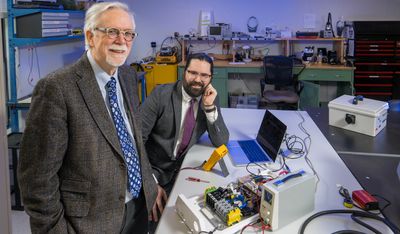
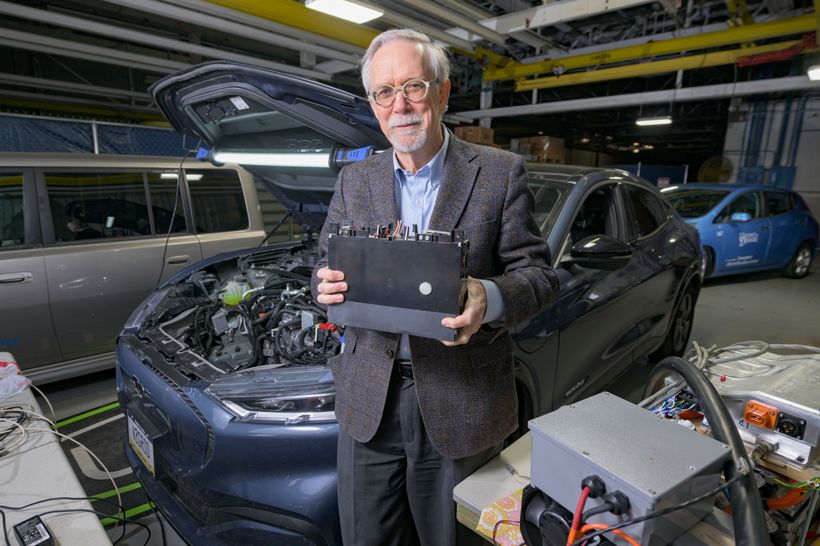
University of Delaware researchers Willett Kempton and Rodney McGee are advancing technologies and standards that allow electric vehicles to send electricity back to homes and the power grid. Known as vehicle-to-grid (V2G) technology, this approach could help consumers manage electricity costs, provide backup power and improve grid reliability.
Kempton pioneered vehicle-to-grid research at the University of Delaware nearly three decades ago, helping establish the foundation for using electric vehicles as mobile energy storage systems. McGee chaired the development of SAE J3068, an automotive communications standard that supports more affordable bidirectional charging.
As automakers, including Ford, move toward bringing bidirectional power technology to more affordable electric vehicles, Kempton and McGee can explain how it works, what it means for consumers and utilities, and how it could shape the future of transportation and energy.
Areas of Expertise Electric vehicles
Vehicle-to-grid (V2G) technology
Bidirectional charging
Energy storage
Electric power grids
Automotive engineering
Renewable energy
EV charging standards
To connect with Kempton directly and arrange an interview, visit his ExpertFile profile and click on the "contact" button. Interested journalists can also email MediaRelations@udel.edu to email Kempton or McGee.
·
5 min
The University of Delaware, Exelon Corporation/Delmarva Power and collaborators have released a new report showing that electric vehicles equipped with vehicle-to-grid (V2G) technology can be profitable for private owners and businesses alike, with data from real electricity markets to back up the claims.
The report is the outcome of a pilot program announced in 2024 by UD, and completed at the offices of Delmarva Power, which is part of Exelon Corporation, to confirm the value of V2G services to the grid.
Among the key findings: the collaborators report that a V2G-enabled passenger electric vehicle (EV) could earn as much as $3,359 per year, based on 2021-2025 market prices, for storing and supplying energy to the electric grid during times of need, otherwise known as providing grid services. Heavier vehicles, such as fleet vehicles, delivery trucks or school buses, could earn over $9,000 per year, per vehicle.
That’s a powerful income generator, given that privately owned vehicles are parked 96% of the time, on average, in the United States. Company fleet vehicles — even those operating 40 hours per week — remain stationary 75% of the average work week.
The pilot, which included collaborators Ford Motor Company, the region’s electric grid operator PJM Interconnection, and aggregator Nuvve Corp., was tested using a small fleet of Delmarva Power EVs retrofitted with the bidirectional charging technology and a new advanced communications standard.
The term “bidirectional charging” means that the V2G technology enables electric vehicle batteries to store extra energy from the electric grid when there is a surplus and to discharge that energy back to the grid when it is needed. In this way, V2G-enabled EVs can help the grid stay balanced, strengthening grid resilience and reliability, especially during peak demand and extreme weather events. New PJM rules allow properly certified EVs to provide this balancing and be paid for it — and the pilot proved they can meet these requirements and be paid for the service.
For UD Professor Willett Kempton, who invented the V2G technology with colleagues at the University nearly 30 years ago, it’s a pivotal moment.
“Whether it could scale cost-effectively was an open question, and we’ve proven that it can — with the right combination of policies, standards and technology,” said Kempton, professor of marine science and policy.
For businesses such as Exelon, the report makes clear that V2G technology can help offset the cost of fleet electric vehicles while supporting the electric grid. This is because when the batteries in the parked fleet vehicles are aggregated together, they can function as a virtual power plant. The result is energy storage and supply that is available to the electric grid significantly faster than other conventional power resources, with virtually no wait times needed to power up or down.
Unlocking a parked vehicle’s earning power Since Kempton and colleagues pioneered the innovative V2G technology, UD researchers have kept the charge going, accelerating progress on everything from V2G technology development to new automotive communication standards (called LIN-CP) for electric cars. They have advanced policy innovations at the state and federal level to overcome barriers in widespread adoption by enabling V2G technology to compete in electric markets, too.
The recent pilot with Exelon/Delmarva Power and others also revealed that the EV batteries used for V2G remained fully functional after a full year of market operation — with no measured reduction in battery health — all while providing pollution-free power.
“Something that might not be obvious to everyone is that these payments are not a subsidy; these EVs are earning money by competing with legacy generators, which is novel in a lot of ways,” said Kempton. “And when you’re participating in the market instead of a fuel-burning generator, you’re also reducing pollution.”
This makes the technology both economically smart and functionally sound in a world where the electric grid is expected to include more renewables in the coming years.
Kempton explained that most U.S. planned future electricity generation is scheduled to come from wind and solar. This will create greater fluctuation in the electric grid, which means more storage for energy surpluses will be needed. That’s where V2G can help, Kempton said.
According to Brian Derr, senior analyst, Exelon Technology and R&D, insights from the pilot will inform future deployments and support the company’s broader strategy to enable the clean energy transition while maintaining reliable service for the communities it serves.
“By leveraging existing assets in new ways, Exelon is positioning itself to build a more flexible, resilient and customer-focused energy system,” said Derr.
Accelerating progress toward a V2G industry Next steps to expand the V2G industry to support the grid will require mass manufacturing to scale up the number of individual cars or fleets that are participating and earning money, Kempton said.
Until now, changes to V2G-enabled vehicles have been done by retrofitting existing EVs to accommodate the V2G technology. Now with lower-cost standards and realistic market revenue values that can be expected, Kempton is looking at how this becomes adopted in many cars and many charging stations.
“We’ll need at least a few car companies and charging station companies to mass produce this V2G equipment, and to deploy the technology into vehicles in the factory,” Kempton said. “If it is designed in, and mass produced, it’s incredibly cheap, especially when you compare it to the potential yearly revenue.”
At UD, faculty and students continue to play a large role in the work aimed at bringing a fully functioning V2G industry to fruition. Kempton, Rodney McGee and recent graduates John Metz and Catherine Gilman, for example, are focused on policy changes and standards to allow V2G-enabled electric vehicles to provide grid services in more states. Such policies currently exist in Delaware and Maryland. Kempton would like to see this number grow.
Meanwhile, UD postdoctoral researcher Garrett Ejzak and alumnus Go Charan Kilaru are focused on other aspects of the work. Ejzak is developing and testing these new EV technologies, and Kilaru is designing cryptography measures to ensure security protocols for V2G communications. Concurrently, UD students Colden Rother, Jude Borden, Lucia Paye-Layleh and Emmie Rossi are examining ways UD could electrify some of its campus fleets, under the advisement of UD’s Kimberly Oremus, associate professor of marine science and policy, economics, and public policy and administration.
To arrange an interview with Kempton, visit his profile page below and click on the "contact" button. For interviews with officials from Exelon/Delmarva Power, contact Matt Ford, in
Delmarva Power Communications, at 302-429-3060.
·
4 min
In 2025, the University of Delaware had many exceptional media mentions. Here are some of the most notable.
Science coverage dominated Where will the next big hurricane hit? Ask the sharks. (The Washington Post) – Aaron Carlisle, a marine ecologist, was featured for his revolutionary work using sharks to predict major weather events. Scientists could soon lose a key tool for studying Antarctica's melting ice sheets as climate risks grow (NBC News) – Carlos Moffat, an associate professor and oceanographer, spoke about the national budget and how it's impacting climate research. These Katrina Survivors Feel Overlooked. Now, They’re Using TikTok to Tell Their Stories (Rolling Stone) – Jennifer Trivedi, a disaster researcher, spoke about why Hurricane Katrina was such a major story. Malala Yousafzai, Migration and Sustainability (Forbes) – Saleem Ali, a professor of energy and environment, contributed regularly to Forbes on environmental topics. Scientists went hunting for freshwater deep beneath the Atlantic Ocean. What they found could have global implications (CNN) – Holly Michael, a professor of Earth sciences and civil and environmental engineering, spoke about the history of freshwater. Engineering Professor Answers Electric Car Questions (WIRED) – Willett Kempton, a professor of engineering, joined WIRED to answer the internet's most interesting questions about electric cars. Plastic shopping bag policies are actually working, a new study suggests (CNN) – Kimberly Oremus, associate professor of marine science and policy, was featured in several major outlets on the effectiveness of plastic bag bans. Insects are dying: here are 25 easy and effective ways you can help protect them (The Guardian) – Douglas Tallamy, an entomologist, was featured in dozens of outlets for his expertise. Political news coverage was front and center U.S. Chamber of Commerce sues Trump administration over $100,000 H-1B visa fees (NPR) – Daniel Kinderman, a political science professor, was interviewed for his expertise on a lawsuit involving changes in work visas. The government shutdown is over, but expect more fights and higher insurance prices to come (Delaware Public Media) – David Redlawsk, a political psychologist, discussed the recent government shutdown and what an end to it signals. Wrestling Over Charlie Kirk’s Legacy and the Divide in America (The New York Times) – Dannagal Young, a communications professor, commented on how media reacted to the death of Charlie Kirk. Consequences for colleges whose students carry mountains of debt? Republicans say yes (NPR) – Dominique Baker, associate professor of education, was quoted in multiple national outlets for her education expertise. General expertise came in clutch Why the U.S. struggles with passenger service despite having the most rail lines (NPR) – Allan Zarembski, a professor of railroad engineering, was featured in dozens of national publications for his expertise. From folklore to your front porch: The history of the jack-o'-lantern (NPR) – Cindy Ott, an associate professor of history, detailed the history of this autumn staple in multiple outlets. Nexstar Media Group buying Tegna in deal worth $6.2 billion (AP) – Danilo Yanich, professor of public policy, noted the ways the media giant duplicates work across networks. Warren Buffett hired Todd Combs to take over Berkshire's portfolio one day. Here's what close watchers say about his surprise exit. (Business Insider) – Lawrence Cunningham, director of UD's Weinberg Center, was featured throughout the year for his business and economic expertise. Enlighten Me: How to make your holidays truly happy (Delaware Public Media) – Amit Kumar, a professor of marketing, discussed strategies for finding happiness during the holidays throughout the winter season. Students and their stories shined throughout the year Networking: Is it what you know or who you know? (The Chronicle of Higher Education) – UD's career-development office, which assists students on their job journeys, was featured. U of Delaware Creates Yearlong Co-Ops for Business Students (Inside Higher Ed) – A new partnership with the state of Delaware connects business students to local employers, with the goal of reducing brain drain in the region was featured. Wilmington’s 'STEM Queen' earns national Obama–Chesky honor (The News Journal/Delaware Online) – Jacqueline Means, a management information systems major, was featured for earning a national recognition. Vita Nova Restaurant Gives Culinary Students Hands-on Training (Delaware Today) – The student-staffed restaurant, Vita Nova, was featured. Delaware professor transforms writing class by teaching students to use AI as the technology reshapes the workforce (WHYY) – Matt Kinservik, a professor of English, was featured for teaching students to use AI responsibly, exploring its capabilities and fact-checking tools. Pop culture experts weighed in 'Stranger Things' expert at UD chats about Netflix show's appeal (The News Journal/Delaware Online) – Siobhan Carroll, an associate English professor, sat down with a reporter to discuss the latest season and how the horror genre is often a mirror of our real world. “Horrendous And Insulting”: Backlash Erupts Over “Misrepresentation” In 2026 Wuthering Heights (Bored Panda) – Thomas Leitch, an English professor, said that “literal adaptations of classic novels are exceedingly rare, maybe impossible.” Major changes at UD highlighted University of Delaware appoints interim president to the permanent post (The Philadelphia Inquirer) – News of UD's new president, Laura A. Carlson, was covered throughout the region. Retiree learning center gets boost with $1M gift for downstate OLLI classes (Spotlight Delaware) – a large donation to the southern Delaware chapter of the Osher Lifelong Learning Institute, was featured. To speak with any of these experts in 2026 on these stories or others, please reach out to MediaRelations@udel.edu. Happy holidays and cheers for a bright and healthy new year!
Media
Social
Biography
Willett Kempton is Professor in the College of Earth, Ocean, and Environment, and the Department of Electrical & Computer Engineering, at the University of Delaware. Dr. Kempton directs ~15 researchers and students in research on clean energy technologies, is active in public testimony, and lectures widely on offshore wind power and on electric vehicles. He has published scientific and technical articles on offshore wind power, electric transportation, energy analysis, and the beliefs and values that citizens and policymakers apply to environmental issues.
Industry Expertise
Research
Education/Learning
Areas of Expertise
Vehicle-to-Grid Power
Offshore Wind Policy
Media Appearances
Ford’s new EV pickup will come with more affordable home-power backup
Canary Media online
2026-10-27
To ensure that the AC power flowing from Ford's EV is safe for homes, the auto maker's system uses communications technology from a tech standard certified by the automotive standards organization SAE International called SAE J3068. University of Delaware professor Willett Kempton led the development of the AC bidirectional charging capabilities for the J3068 standard along with Rodney McGee, the university’s EV standards expert.
A new utility program could pay thousands to EV owners who sell power back to the grid
Boston Globe print
2026-07-23
Connecting cars to the electric grid is already a thing in Europe, said Willett Kempton, a professor of electrical and computer engineering at the University of Delaware, and a co-inventor of the underlying technology.
EVs are one step closer to becoming roaming grid batteries
Canary Media online
2024-02-20
The big challenge is providing utilities with all of the data points they need in order to feel comfortable receiving power from EVs, said Willett Kempton, professor and associate director of UD's Center for Research in Wind (CReW).
Meet the UD researchers who are shaping the future of electric vehicles
The News Journal/Delaware Online online
2024-01-22
Local paper spotlights the work of Willett Kempton, professor of marine science an policy, and Rodney McGee, director of UD's Center for Transportation Electrification. Their research team has been fine-tuning publishing standards that could change the electric vehicle industry in a matter of years.
Get Over Your Range Anxiety: Study Shows Small EV Batteries Meet Most Drivers’ Needs
Carscoops online
2023-03-03
The study, led by Willett Kempton at the University of Delaware, and published in the journal Energies, looked at 333 drivers with internal combustion vehicles around Atlanta, Georgia. The team looked at their driving habits since 2004, and then compared annual mileage needs against a selection of hypothetical EVs with varying ranges.
Willett Kempton, a University of Delaware professor, and his team looked at driving data for 333 gasoline vehicles over one year in the Atlanta area and then created a model to see the extent to which various EV options would have been able to meet the needs of those drivers.
Prof. Willett Kempton said ‘What we did was figure out how much people drive a year, distinguishing every single trip and stop, and then overlaid that with all the possible EVs you could buy. If you know how far you need to drive, our data on range and charging speed will tell you what EVs will work for you.’
Meet the Little-Known Inventor of Vehicle-to-Grid Tech. It is Not a Mere Fad
The Mobilist online
2021-05-18
Yet it turns out that V2G is no faddish notion, but a term going back to a paper about a quarter century ago. Its inventor, a little-known University of Delaware professor named Willett Kempton, is armed with a fistful of patents for his idea. And Nuvve, a company he co-founded that went public in a Spac in March, saw its share price soar as much as 56% yesterday before ending the day up 30.9%.
Offshore wind report says Delaware could procure power at less than half current cost
Delaware Public Media online
2022-04-07
Willett Kempton, a University of Delaware professor who is a technical advisor to the offshore wind group, said the cost of offshore wind has plunged to about half of what it was in 2018 when a state task force decided the time wasn’t right for Delaware to commit to buying power generated offshore.
Influence of Battery Energy, Charging Power, and Charging Locations upon EVs’ Ability to Meet Trip Needs
Energies
2023
One year of high-resolution driving data from a sample of 333 instrumented gasoline passenger vehicles are used to create a trip inventory of U.S. vehicle travel requirements. A set of electric vehicles (EVs) is modeled, differing in battery size (kWh), recharging power (kW), and locations for charging when parked. Each modeled EV’s remaining energy is tracked while traversing the entire sample’s trip inventory in order to estimate how well each EV meets all U.S. driving requirements.
Marshaling ports required to meet US policy targets for offshore wind power
Energy Policy
2022
We analyze infrastructure needed for offshore wind power targets set by U.S. state and federal policies—specifically, manufacturing, vessels, and offshore wind ports. By examining cost-competitive turbine and project sizes and infrastructure challenges, we identify marshaling ports as a key bottleneck.
Metering Requirements and Design for an Electric Vehicle Charging System Providing Grid Services
SAE International Journal of Sustainable Transportation, Energy, Environment, & Policy
2020
Vehicle-to-Grid (V2G) technology is capable of providing grid services from electric vehicles (EVs). To do so, it imposes more demanding engineering design requirements on electric vehicle supply equipment (EVSE). To provide grid services, bidirectional power flow and accumulated energy between grid and EVs must be metered and uploaded to a remote server participating in electricity markets.
Electric power from offshore wind via synoptic-scale interconnection
Proceedings of the National Academy of Sciences
2010
World wind power resources are abundant, but their utilization could be limited because wind fluctuates rather than providing steady power. We hypothesize that wind power output could be stabilized if wind generators were located in a meteorologically designed configuration and electrically connected. Based on 5 yr of wind data from 11 meteorological stations, distributed over a 2,500 km extent along the U.S. East Coast, power output for each hour at each site is calculated.
Large CO2 reductions via offshore wind power matched to inherent storage in energy end-uses
Geophysical Research Letters
2007
We develop methods for assessing offshore wind resources, using a model of the vertical structure of the planetary boundary layer (PBL) over water and a wind-electric technology analysis linking turbine and tower limitations to bathymetry and continental shelf geology. These methods are tested by matching the winds of the Middle-Atlantic Bight (MAB) to energy demand in the adjacent states (Massachusetts through North Carolina, U.S.A.).
Vehicle-to-grid power fundamentals: Calculating capacity and net revenue
Journal of Power Sources
2005
As the light vehicle fleet moves to electric drive (hybrid, battery, and fuel cell vehicles), an opportunity opens for “vehicle-to-grid” (V2G) power. This article defines the three vehicle types that can produce V2G power, and the power markets they can sell into. V2G only makes sense if the vehicle and power market are matched. For example, V2G appears to be unsuitable for baseload power—the constant round-the-clock electricity supply—because baseload power can be provided more cheaply by large generators, as it is today.