
Experts Matter. Find Yours.
Connect for media, speaking, professional opportunities & more.

Vitamin D2 and D3: what’s the difference and which should you take?
Vitamin D is important for maintaining health, as it has many roles in the human body. But there is more than one form of vitamin D, and recent research suggests that these forms may have different effects. So what are the different types of vitamin D, and is one really more beneficial than the other? Although medical conditions later associated with vitamin D deficiency, such as the bone disease rickets, have been known about since the 17th century, vitamin D itself wasn’t identified until the early 20th century. This discovery led to Adolf Windaus winning the Nobel prize for chemistry in 1928. The vitamin D family actually includes five molecules, with the two most important being vitamin D2 and D3. These molecules are also known as ergocalciferol and cholecalciferol, respectively. While both of these types of vitamin D contribute to our health, they differ in how we get them. Dietary vitamin D2 generally comes from plants, particularly mushrooms and yeast, whereas we get vitamin D3 from animal sources, such as oily fish, liver and eggs. Both forms of vitamin D are also available in dietary supplements. What most people probably don’t know is that most of our vitamin D comes from exposing our skin to sunlight. When our skin is exposed to the sun, ultraviolet rays convert a precursor molecule called 7-dehydrocholesterol into vitamin D3. This important effect of exposure to the sun explains why people living at more extreme latitudes, or people who have darker skin, are more prone to vitamin D deficiency. Melanin, a pigment in the skin, blocks ultraviolet rays from activating 7-dehydrocholesterol, thus limiting D3 production. Wearing clothing or sunscreen has a similar effect. Both vitamins D2 and D3 are essentially inactive until they go through two processes in the body. First, the liver changes their chemical structure to form a molecule known as calcidiol. This is the form in which vitamin D is stored in the body. Calcidiol is then further altered in the kidneys to form calcitriol, the active form of the hormone. It is calcitriol that is responsible for the biological actions of vitamin D, including helping bones to form, metabolising calcium and supporting how our immune system works. Technically, vitamin D isn’t a vitamin at all, but a pro-hormone. This means the body converts it into an active hormone. All hormones have receptors (on bone cells, muscle cells, white blood cells) that they bind to and activate, like a key unlocking a lock. Vitamin D2 has the same affinity for the vitamin D receptor as vitamin D3, meaning neither form is better at binding to its receptor. Different effects on the immune system A recent study found that vitamin D2 and D3 supplementation had different effects on genes important for immune function. These findings are significant, as most previous research has failed to find much difference in the effect of supplementation with either vitamin D2 or D3. Most of the research published to date has suggested that the main difference between vitamin D2 and D3 supplementation is the effect on circulating vitamin D levels in the bloodstream. Studies have repeatedly shown that vitamin D3 is superior at raising levels of vitamin D in the body. These findings were supported by a recent review of the evidence which found that vitamin D3 supplementation increased vitamin D levels in the body better than vitamin D2. But not all studies agree. Very few studies support vitamin D2 supplementation being superior to vitamin D3. One trial showed that vitamin D2 was better at treating immune issues in patients who were on steroid therapy. However, other than increasing vitamin D levels in the body, there is not much evidence that vitamin D3 supplements are better than vitamin D2 supplements. One study found that vitamin D3 improved calcium levels more than vitamin D2. But we need more research to provide definitive answers. So which should I take? Vitamin D deficiency is now more prevalent than ever, with around a billion people worldwide being vitamin D deficient. It is important that people at risk of vitamin D deficiency – older adults, people living in less sunny climates and people with darker skin – take vitamin D supplements. Health professionals recommend that most people take 10 micrograms of vitamin D a day, especially in winter. It would appear that vitamin D3 supplements are the superior option for maintaining vitamin D levels, but short exposure of the skin to the sun, even on a cloudy day, will also help you keep healthy vitamin D levels.


Function – not fashion. What masks are the best to get behind when facing the risk of Omicron?
Omicron is here and it is spreading like wildfire across America and most of the globe. It’s highly transmissible and easily caught. For more than a year, most Americans have been taking on the simple approach of ‘masking up’ to contain any possible spread. People were using anything from surgical masks, N95s, cloth masks and even gators. Whatever could be used to provide a barrier around one’s nose and mouth. Cloth masks caught on, some even became fashion pieces – but as this most recent wave of COVID has shown, the type of mask is now just as important as the idea of simply covering up and looking good. “Cloth masks and things like that are very comfortable and they have good coverage on the face,” says Rodger D. MacArthur from the Medical College of Georgia. “But they don’t fit so tight and so air and any virus that’s in the air and come through the sides.” MacArthur who brings 20 years experience in the Division of Infectious Diseases at Augusta University says medical surgical masks are best for getting the most protection. "It’s not simply being so close to somebody that you sneeze on them, you splatter them with droplets. It’s in the air we’re breathing.” He just keeps a disposable one folded up in his pocket, but encourages the highest forms of protection you can find. Masks have been a popular and contentious topic during this pandemic and there’s a lot to know about this important topic – and if you are a reporter looking to cover this story – then let our experts help. Dr. Rodger MacArthur is a widely recognized expert in COVID-19, HIV antiretroviral therapy, resistance to antiretroviral drugs, and sepsis. He is available to speak with media – simply click on his icon now to arrange an interview today.


Trailblazing treatment by ChristianaCare physical therapists catches attention of NFL
ChristianaCare physical therapists have developed a trailblazing treatment to prevent muscle strains that has caught the attention of numerous sports teams, including the Los Angeles Rams and Baltimore Ravens. The treatment involves using a screening tool called the “core sling screen” to test the strength of trunk muscles, also known as core muscles, and is combined with a specialized exercise program to strengthen those muscles. Weakness in those muscles can lead to common athletic injuries such as strains in the abdomen, groin, quadriceps and lower back. A study on the treatment’s success was published this spring in the Journal of Sport Rehabilitation. Following that, ChristianaCare physical therapists, Brian Catania, MPT, SCS, ATC, and Travis Ross, PT, DPT, who co-authored the study and spearheaded the treatment, presented it to the NFL’s Professional Football Athletic Trainer Symposium. Athletic trainers with the Los Angeles Rams and the Baltimore Ravens met directly with Catania and Ross to learn how to use it to prevent their players from sustaining muscle injuries. “The research by ChristianaCare Rehabilitation Services regarding core slings is an extremely effective approach that is based off of sound reasoning and practical application,” said Jon Hernandez, PT, DPT, SCS, ATC, CSCS, physical therapist and assistant athletic trainer for the Rams. “The principles of the sling activation series are incorporated into our daily, clinical practice. Whether it be our injury prevention programs, corrective exercises, or rehabilitation practices, the sling activation series is applicable to a myriad of conditions we see in an NFL athletic training room.” Catania and Ross care for patients at ChristianaCare Rehabilitation Services at Glasgow, in Newark, Del. They began working on ways to increase resilience in core muscles nearly nine years ago. Through their research, they developed a screening tool, that they call the “core sling screen,” which detects weakness in those muscles. Strains are among the most common sports injuries, according to the U.S. National Institute of Arthritis and Musculoskeletal and Skin Diseases. “We reasoned that if we could identify ways to improve the strength of the core muscles, common lower extremity injuries would be less likely to occur,” said Catania, who also is the program manager at ChristianaCare’s Rehabilitation Services location in Glasgow. “But it had to be a two-part approach. We needed to develop a reliable screening tool to examine the core muscles and then also come up with a targeted exercise program to strengthen those muscles.” The study was conducted by ChristianaCare’s departments of Rehabilitation Services and Sports Medicine. “At ChristianaCare, we are relentlessly curious and we continuously look for ways to innovate,” said Bradley Sandella, D.O., director of Sports Medicine at ChristianaCare, who also co-authored the study. “We don’t want to just treat injuries – we want to prevent them from ever occurring, even if it means that we have to come up with novel and progressive approaches.” A randomized-control study was performed to test out traditional exercises and compare them to a newly developed exercise program that involved rotational movements of the torso, known as rotary-based exercises. The study found that the rotary-based exercises increased the activation of targeted abdominal muscles and could make adjacent areas of the body, such as the groin, less injury-prone. The study included 31 female and male students from the University of Delaware. Catania and Ross have provided further instruction to both the Rams and Ravens. In May, they visited the Ravens’ facility in Owings Mills, Md., to personally instruct Ravens athletic trainers and physical therapists on how to perform the treatment. The treatment also has been presented at the National Athletic Trainers’ Association and the Eastern Athletic Trainers Association. “It has been meaningful through this research to contribute to the ongoing evolution in the field of physical therapy and sports medicine,” Ross said. “We are always looking for ways to protect our patients, many of whom are athletes, from injury. It makes physical therapy better, it makes patients better, and it makes players better.” To learn more about this treatment and the expertise ChristianaCare is bringing to organizations like the NFL - contact Bradley Sandella, D.O., director of Sports Medicine at ChristianaCare. He's available to speak with media, simply click on his icon now to arrange an interview today.



Starter vape packs to be handed out in hospitals
A new trial from the University of East Anglia will see smokers attending hospital emergency departments given e-cigarette starter packs to help them quit. The initiative comes as a Cochrane Review - the international gold standard for high quality, trusted health information – about vaping is updated today. The review, led by the University of Oxford and involving the UEA team, shows how nicotine electronic cigarettes could increase the number of people who stop smoking compared to nicotine replacement therapy – such as chewing gum and patches – and compared to electronic cigarettes that do not contain nicotine. The new trial will offer stop smoking advice and an e-cigarette ‘starter pack’ to patients attending hospital emergency departments for any reason, to try to encourage and support them to quit smoking – even for those who might not have considered it before. The new trial is funded by the National Institute for Health Research (NIHR) and will be run by the Norwich Clinical Trials Unit at UEA. Prof Caitlin Notley, from UEA’s Norwich Medical School, said; “Many people who smoke want to quit, but find it difficult to succeed in the long term. “Electronic cigarettes mimic the experience of cigarette smoking because they are hand-held and generate a smoke-like vapour when used. They can be an attractive option for helping people switch from smoking, even if they have tried and failed in the past. “We know that they are much less harmful than smoking tobacco, and that they have been shown to help smokers quit. Trial co-lead Dr Ian Pope, also from UEA’s Norwich Medical School and an emergency physician, said: “Emergency Departments in England see over 24 million people each year of whom around a quarter are current smokers. “Attending the Emergency Department offers a valuable opportunity for people to be supported to quit smoking, which will improve their chances of recovery from whatever has brought them to hospital, and also prevent future illness.” The study will run over 30 months across five hospitals in England and Scotland – at the Norfolk and Norwich University Hospital, the Royal London Hospital and Homerton University Hospital in London, Leicester Royal Infirmary and the Royal Infirmary of Edinburgh. Smokers who agree to take part will be randomly assigned to receive either smoking advice during their emergency department wait, an e-cigarette starter pack and referral to local stop smoking services, or just written information about locally available stop smoking services. Both groups of patients will be asked if they are still smoking one, three and six months after they attended hospital. The research team hope to eventually recruit around 1,000 smokers to the trial. Prof Notley said: “We’ll be looking at the number of people who successfully quit smoking across both groups, to see which intervention works best. We’ll also work out how much it would cost to roll the scheme out nationally,” she added. ‘Electronic cigarettes for smoking cessation (Review)’ is published by the Cochrane Library on April 29, 2021.


Survival analysis: Forecasting lifespans of patients and products
How long will you live? Should you spring for that AppleCare+ warranty for your iPhone? When will your buddy pay you back for that lunch? For centuries, soothsayers have striven to understand the lifespan of things – be they patient longevity, product lifecycles, or even time to loan default. Nowadays, scientists have turned away from reading tea leaves and toward survival analysis – a complex data science method for predicting not only whether an event will happen (the death of a patient, the failure of a product or machine, default on a payment, and so on) but when this event is likely to occur. But it’s problematic. Until now, the tools of survival analysis have only been applicable in certain settings. This is due to the inherent heterogeneity of what is being analyzed: differences in patient lifestyles, demographics, product usage patterns, and so on. New research by Goizueta Business School’s Donald Lee, associate professor of information systems and operations management and of biostatistics and bioinformatics, has yielded a new tool that greatly extends survival analysis to broader use cases. “Historically, scientists have used classic survival analysis tools to predict the lifespan of different things in different fields, from products to patients,” Lee said. “Since the 1950s, the Kaplan-Meier estimator has been the benchmark for analyzing lifetime data, particularly in clinical trials. The next breakthrough came in the 1970s when the Cox proportional hazards model was introduced, which allows researchers to incorporate variables that can affect the predictability of things like patient mortality.” The problem with the existing survival analysis tools, Lee said, is that they make certain assumptions that can skew the predictions if the assumptions are not met. “There are very few existing tools that can incorporate variables without imposing assumptions on how they affect survival, let alone when there are a lot of variables that can also change over time. For example, two iPhones will have different lifespans depending on the temperature at which they are stored, amongst many other factors. But it’s unlikely that storing your phone at 30 degrees will halve its lifespan compared to storing it at 60 degrees. This sort of linear relationship is commonly assumed by existing tools.” Lee’s team developed a new survival methodology based on something called gradient boosting: a machine learning technique that combines decision trees to yield predictions. The method, Lee said, is totally assumption-free (or nonparametric in technical parlance) and can deal with a large number of variables that can change continuously over time, making it significantly more general than existing methods. Nothing like it has been seen until now, he noted. “Calculating the survival rate of anything is super complex because of the variables. Say you want to create an app for a smart watch that monitors the wearer’s vitals and use this information to create a real-time warning indicator for stroke. Doing this accurately is difficult for two reasons,” Lee explained. “First, a large number of variables may be relevant to stroke risk, and the variables can interact in ways that break the assumptions central to existing survival analysis methods. And second, variables like blood pressure vary over time, and it is the recent measurements that are most informative. This introduces an additional time dimension that further complicates things.” The software implementation of Lee’s method, BoXHED, overcomes both issues and allows scientists to develop real-time predictive models for conditions like stroke. The trained model can then be ported to a watch app to tell its wearer if and when they’re likely to have a stroke, a process known as inferencing in machine learning lingo. The implications, Lee said, are huge. “BoXHED now opens the door for modern applications of survival analysis. In previous research, I have looked at the design of early warning mortality indicators for patients with advanced cancer and also for patients in the ICU. These use other methods to make predictions at fixed points in time, but now they can be transformed into real-time warning indicators using BoXHED.” He cited the case of end-stage cancer patients who are often better served by hospice care than by aggressive therapy. “Accurate predictions of survival are absolutely critical for care planning. In previous analyses, we have seen that using existing predictive models to inform end-of-life care planning can potentially avert $1.9 million in medical costs and 1,600 days of unnecessary inpatient care per 1,000 patient visits in the United States. BoXHED is likely to lead to even better results.” Lee’s research paper is forthcoming in the Annals of Statistics. He has also created an open-source software implementation of BoXHED, which can radically improve the accuracy of survival analysis across a breadth of applications. The paper describing BoXHED was published in the International Conference on Machine Learning, and the latest version of the BoXHED software can be found online. If you are a journalist or looking to speak with Donald Lee – simply click on his icon now to arrange an interview or appointment today.



COVID-9 is changing. With variants from places like Britain, Brazil, and South Africa surfacing and presenting in patients around the globe, the virus that scientists are trying to trap seems to be finding ways to wiggle free. The topic has many in the scientific and health care communities concerned, and recently, the New York Times featured leading experts to help explain what is happening and what American’s need to know to stay safe and healthy. Now, Dr. Denison and Sandra Weller, a virologist at the University of Connecticut School of Medicine, are investigating whether this insight could treat people with Covid. Certain antiviral drugs such as remdesivir fight infections by serving as RNA decoys that gum up the viral replication process. But these medications don’t work as well as some had hoped for coronaviruses. One theory is that the nsp14-ExoN enzyme chucks out the errors caused by these drugs, thereby rescuing the virus. Dr. Denison and Dr. Weller, among others, are looking for drugs that would block the activity of nsp14-ExoN, allowing remdesivir and other antivirals to work more effectively. Dr. Weller likens this approach to the cocktail therapies for H.I.V., which combine molecules that act on different aspects of the virus’s replication. “We need combination therapy for coronaviruses,” she said. Dr. Weller notes that nsp14-ExoN is shared across coronaviruses, so a drug that successfully suppresses it could act against more than just SARS-CoV-2. She and Dr. Denison are still at the early stages of drug discovery, testing different molecules in cells. February 05 – New York Times The ongoing COVID-19 pandemic is seeing many different twists in turns as scientists are learning more about the virus and how we can contain its spread – and if you are a journalist looking to speak with an expert on the topic, then let us help. Sandra K. Weller is Professor and Chair in the Department of Molecular Biology and Biophysics at the University of Connecticut and is a world-renowned expert in the spread of viruses. Dr. Weller is available to speak with media – simply click on her icon now to arrange an interview today.


A lasting legacy - A gift that will touch the lives of generations
$1.48 million estate gift to Georgia Southern University Foundation funds College of Education student scholarships An extraordinary estate gift from a daughter and her husband to honor her parents will touch the lives of generations of students to come through scholarships for Georgia Southern University students working to become public school educators. The $1.48 million gift from the late Janice Sapp Castles and her late husband Charles, named for her late parents, Margaret Elizabeth and Cullen Bernice Sapp, is the second largest estate gift received to date by the Georgia Southern University Foundation. “It is inspiring when alumni, whose lives were transformed through education, give back so generously so that future students can realize the same opportunities,” said Georgia Southern President Kyle Marrero. “The Castles’ gift honors the Sapps’ legacy and their desire to help others succeed.” An alumna of then-Armstrong Junior College, Janice Castles earned an Associate of Arts degree with the financial assistance of a scholarship. That scholarship, coupled with her parents’ determination to live sacrificially to provide for educational opportunities for their children that they themselves had not experienced, allowed Sapp to begin her post-secondary academic ambitions and inspired her to give to others. Sapp continued her education at the University of Georgia earning a master’s and specialist degree in counseling as well as a doctorate in school psychology. Her longstanding education career included serving as a middle and high school teacher, guidance counselor, school counselor and adjunct professor. She also formed her own psychology practice that provided therapy and psychological assessment and diagnosis in the Atlanta area. “The generous support by the Castles family will assist in removing financial barriers for many students pursuing initial teacher preparation degrees at both the undergraduate and graduate levels at Georgia Southern for many years to come,” said College of Education Interim Dean Amy Heaston, Ed.D.. “Initial teacher preparation degrees provide students with the first step to becoming certified to teach. For many students, the Margaret Elizabeth and Cullen Bernice Sapp Memorial Scholarship will provide a needed opportunity to achieve their aspirations of teaching in their own classrooms.” If you are a journalist looking to know more about the Georgia Southern University Foundation or the College of Education -- simply reach out to Georgia Southern Director of Communications Jennifer Wise at jwise@georgiasouthern.edu to set and time and date.

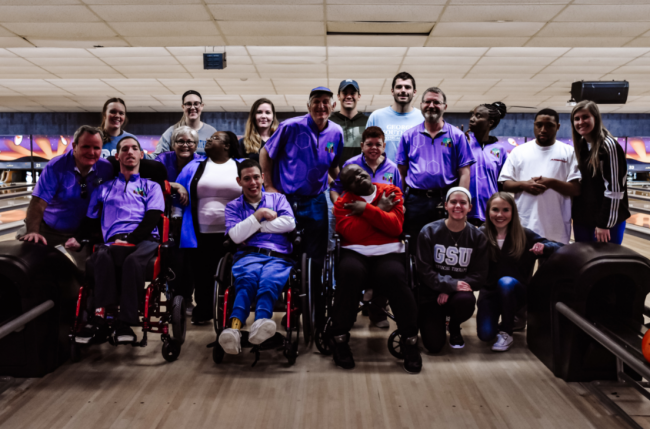
Twelve students in the Doctor of Physical Therapy (DPT) program at Georgia Southern University were awarded scholarships totaling more than $17,000 from the Savannah American Business Clubs (AMBUCS). “This is a recognition of the dedication we have to AMBUCS and helping others in our community,” said scholarship recipient and AMBUCS student leader Alexandra Adams. “Most of us are paying for our education with loans, and the scholarship helps relieve some of the financial burden that comes with pursuing a graduate degree. I am very thankful that AMBUCS has considered me for this scholarship the past two years.” The organization has hosted a League of Exceptional Bowlers on Saturdays for more than 50 years. The DPT students join the Savannah AMBUCS league to assist bowlers with physical and intellectual disabilities to promote an inclusive and competitive environment. In addition to the hands-on experiences, DPT students have the opportunity to interact with different members of the community. “It shows our commitment to the inclusion of our community and our passion for encouraging movement for everyone, despite their limitations, to increase their quality of life,” Adams said. “The program reinforces our classroom training, as well as, enhances our communication skills with others. Each member of our DPT program gets as much of a benefit from attending AMBUCS as the bowlers do.” A century-old membership organization dedicated to helping people with disabilities, the Savannah AMBUCS awards scholarships to students pursuing careers in the allied health professions and who volunteer with AMBUCs. If you’re a journalist looking to cover this story or would like to learn more about the physical therapy and other programs at Georgia Southern University – then let us help. Barry Joyner is the dean of Georgia Southern University’s Waters College of Health Professions - simply click on his icon to arrange an interview today.


As the COVID-19 pandemic unfolded and healthcare organizations began experiencing shortages of personal protective equipment (PPE), faculty, staff and students at Georgia Southern University stepped up to fulfill a need. Making use of the 3D printers on the Statesboro and Armstrong campuses, as well as at the FabLab at the Business Innovation Group’s (BIG) downtown Statesboro location, the campus communities quickly began production of protective face shields and respirators. “We can’t afford to sit back and wait for things to happen,” said Dominique Halaby, DPA, director of the BIG. “We have to make them happen. We have this responsibility to make a difference, to be a part of that front line, whether it’s immediately in our community, our state or our respective area.” To date, the Department of Manufacturing Engineering has sent 200 3D-printed protective face shields with headbands to Augusta, Georgia, for healthcare workers at Augusta Medical Center, while the BIG has sent 100 face shields and 10 “Montana Masks,” a 3D-printable respirator filtration mask that can be fitted to a healthcare provider’s face and sanitized between uses, to Atlanta-area hospitals. The Department of Mechanical Engineering on the Armstrong Campus has also printed Montana Masks that will be delivered to workers in the St. Joseph’s/Candler Hospital System (SJCHS) in Savannah, Georgia, while the Respiratory Therapy Program in the Waters College of Health Professions donated 10 ventilators to the Georgia Emergency Management Agency. “I am unbelievably proud of our faculty, staff and students who have their own families to take care of, but are putting themselves on the line to help our medical professionals in this time of critical need,” said Mohammad Davoud, Ph.D., dean of the Allen E. Paulson College of Engineering and Computing. Wayne Johnson, Ph.D., professor of mechanical engineering, believes providing these materials to the Savannah community during a time of critical need is reinforcing a longtime commitment to the region. “The Armstrong Campus of Georgia Southern has a long history of working within the Savannah community, and during this pandemic, it was especially important for mechanical engineering faculty and students at the Armstrong Campus to step up during a time of great need,” said Johnson. “ Our work with SJCHS to develop, test and donate 3D-printed respirators may also lead to other research and development collaborations in the post-COVID-19 future.” In addition to benefiting area healthcare workers, Johnson believes this project is a great way for students to put their classroom skills into practice. If you would like to learn more about how the students, staff and faculty at Georgia Southern University are helping out during the COVID-19 crisis – the let our experts help. Wayne Johnson is an expert in additive manufacturing, mechatronics, biomechanics and engineering education. He is available to speak with media about this great initiative, simply click on his icon to arrange an interview today.

Rensselaer Team Seeks Alternative Approach to Controlling Viruses
As researchers worldwide scramble to formulate a vaccine to combat COVID-19, a team at Rensselaer Polytechnic Institute is pursuing a potentially powerful solution to pandemic control: a viral trap that is easily adapted to different classes of viruses, enabling a “plug-and-play” approach to virus detection and antiviral activity. Jonathan Dordick, an endowed professor of chemical and biological engineering at Rensselaer, and Robert Linhardt, an endowed professor of chemistry and chemical biology, said the team is exploring how their work — in the areas of viral detection, therapy, and inhibition — could be used against COVID-19 and other viruses in the future. Their team views such innovative approaches as a vital hedge against the growing threat of global pandemics. The viral trap works by mimicking the latch points on a human cell that a virus must bind to before infecting a person by disgorging its genetic instructions into the cell. In research on the Dengue virus with Xing Wang, now a professor of chemistry at the University of Illinois, recently published in Nature Chemistry, the team folded a snippet of DNA into a five-pointed star, and attached decoy latch points that align perfectly with the virus’ own molecular grappling hooks. The result was the world’s most sensitive test for Dengue, and a novel means of capturing and ultimately killing the virus. In previous research, the team demonstrated the same approach for Influenza A, and it can likely be expanded to other viruses like COVID-19. In another approach, Dordick demonstrated how enzymes incorporated into paint, can form a catalytic coating capable of killing the Influenza A Virus. The research, published in Applied Microbiology and Biotechnology, suggests enzyme systems could further be incorporated into swabs, wipes, or coatings, to target and kill various viruses, including COVID-19.

