
Experts Matter. Find Yours.
Connect for media, speaking, professional opportunities & more.
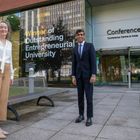
Rishi Sunak kickstarts Help to Grow scheme at Aston Business School
"It was a pleasure to host the chancellor at Aston Business School today. As a small business leader you have to know about all the key business functions and how to optimise them to drive high performance in your business." Paula Whitehouse, Aston Business School Paula Whitehouse (L) & Rishi Sunak (R) The Chancellor of the Exchequer met with Aston University’s deputy vice-chancellor engagement and associate dean enterprise of the College of Business and Social Sciences to launch Help to Grow: Management The scheme will support senior managers of small and medium-sized businesses to boost performance, resilience, and long-term growth The 12-week programme is 90% funded by the Government and participants can complete it alongside full-time work. The Chancellor has called on the leaders of small and medium-sized businesses to sign up to a new programme designed to hone their expertise as he attended one of the first courses in the UK today (August 2). Rishi Sunak joined a class taking part in the government-funded Help to Grow: Management scheme at Aston Business School, Aston University, alongside small business owners, to see first-hand how it is giving them the tools they need to innovate, grow and help drive the recovery from the pandemic. The Chancellor delivered a talk to participants at Aston Business School on the critical role small businesses can play in boosting UK productivity. He then took part in a group activity and led a discussion about their own business models and opportunities for growth. The scheme, which was announced at the March Budget and opened for applications in May, will give 30,000 SMEs access to world-class business expertise on everything from financial management to marketing and is a pivotal part of the government’s Plan for Jobs. Rishi Sunak, the chancellor of the exchequer, said: “Small businesses are key to our innovation and economy and will therefore be an essential part to our recovery from the pandemic, which is why we are levelling up their skills through the Help to Grow schemes. “I want to bring some of the best bits of management training from around the world to help boost productivity here in the UK. “Help to Grow: Management will ensure our brilliant SMEs seize every opportunity to grow, fuelling our Plan for Jobs by boosting productivity in all corners of the UK.” Experts in small business and entrepreneurship from Aston University have played a significant role in developing the programme. Paula Whitehouse, curriculum director for Help to Grow: Management and associate dean enterprise of the College of Business and Social Sciences, said: "It was a pleasure to host the chancellor at Aston Business School today. As a small business leader you have to know about all the key business functions and how to optimise them to drive high performance in your business. “Help to Grow: Management will combine this essential business education with the creation of a like-minded business network and support for the practical application of the learning to ensure businesses get immediate results. “I am excited to be working with Small Business Charter business school colleagues all over the country to roll out the Help to Grow: Management curriculum and ultimately to be introducing many more business leaders from the West Midlands into Aston's vibrant entrepreneurial community." Mark Hart, professor of small business and entrepreneurship at Aston University and associate director of Aston Centre for Growth, said: “The launch of the Government’s Help to Grow: Management programme for SMEs is a welcome addition at a critical time to the range of support available to small business leaders across the UK. “Small firms will drive the recovery as they have always done in previous economic downturns and equipping their leaders with the leadership and management skills from the UK’s leading business schools will ensure that they will build even more resilient, innovative and sustainable businesses capable of responding to the emerging opportunities in their chosen markets. “This is a practical, intensive 12-week programme designed by some of our top academics to provide the skills required to improve the performance and productivity of small firms across all sectors of the economy”. Mark Hart (L) & Rishi Sunak (R) take part in a class at Aston Business School


Brexit: UK services are losing out to EU rivals – but Asia could be big winner
"Seven months after Britain’s exit from the EU, the chilly effects on UK trade are being felt. Total exports of UK goods and services were down by 13% (£36 billion) and imports down 22% (£66 billion) for January to May 2021 compared to the same period in 2019." Professor Jun Du, Aston Business School Singapore looks like one of the big winners from Brexit. joyfull In a separate new ONS report into UK services, exports and imports fell 12% and 24% in the first quarter of 2021 compared to the same period in 2019. To some extent this is due to the pandemic, but the decline with EU countries was more severe (exports down 15% and imports by 39%), which suggests Brexit was relevant too. The difference between services exports to EU and non-EU countries was particularly marked in sectors like construction (-43% vs +24%), maintenance and repair (-62% vs +11%), and manufacturing services (-40% vs -12%). It seems to confirm that the UK’s services offering has been made less competitive by the EU-UK Trade and Cooperation Agreement hardly covering such business. This has left EU members free to decide whether to allow different UK providers into their markets. But as we shall see, other services exporting countries outside the EU may also benefit as a result. In our recent paper, Ireland looked like the big winner. It has probably benefited from firms relocating and business being re-routed from the UK, not to mention low corporation tax and a young well-educated workforce. Between 2016 and 2019, Ireland’s services exports rose 24% (that’s €144 billion or £123 billion), driven by financial services, IT and transport. Speculation still abounds about which other EU cities will benefit in the medium term. Amsterdam surpassed London as Europe’s largest share-trading centre in January by absorbing much trade in euro-denominated assets, though London has been back on top recently. Other potential winners include Frankfurt (banking), Luxembourg (banking and asset management) and Paris (financial, professional and business services). Even a less serious contender like Berlin can attract tech talents thanks to its culture clusters and affordability. On the other hand, most financial traders have so far remained in London. The city is still strong in hosting stock market flotations and other forms of capital raising. And the flow of financial jobs out of London has been a fraction of what remainers predicted. A four-year regulatory transition period for areas like data protection and electronic trade will undoubtedly be helping. London vs EU rivals is only half the story. James Padolsey/Unsplash, CC BY-SA Yet all this misses a bigger picture, namely that Europe’s ability to provide services may have been weakened overall. Imagine a group of US investors wants to invest £1 billion in European shares and other financial assets. In the past it might have set up a fund in London, making use of the city’s network of lawyers, accountants, bankers and other finance professionals, while filtering some of the work to specialists in, say, Paris and Frankfurt for issues related to France and Germany. But now Brexit means the fund can’t invest in certain EU securities from London. The investors would have to set up a second fund in, say, Dublin to get exposure to all the EU assets they want. The additional expense and time involved makes them decide it will be more lucrative to set up an Asia-focused fund in Singapore instead. When you multiply this effect across every sector, it is potentially huge. Certainly some investors will decide to either switch attention from the UK to EU countries, or to live with the extra cost of doing business across both the UK and EU. But others are deciding that an opportunity somewhere else in the world now looks more attractive. The danger is that this adds up to a global shift in economic weight over time. In fact, we could be seeing signs of this already. Winners and losers In follow-on research that we have yet to publish, we have been analysing the services exports of the major service providers in Europe and globally, using trade data jointly collected by the World Trade Organization (WTO) and the Organisation for Economic Cooperation and Development (OECD). The data shows the UK was and is the biggest services exporter in Europe and second only to the US worldwide, but appears to have been losing ground since Brexit. Ireland and the Netherlands are the major growth stories in Europe, while China, India and Singapore are leading the way elsewhere. Services exports by country, 2019 vs 2015 Trends in services exports. Left: 2015 data in solid coloured bars; 2019 change in yellow markers. Right: Green bars represent accelerating service growth; red bars represent decelerating growth. BaTIS The UK’s services growth trend fell 11% in the 2016-2019 period compared to 2010-15. This backs up our recent published research finding that the UK’s global share of exported services fell from 8.9% in 2005 to 7% in 2019. Meanwhile, France, Spain, Italy and Belgium’s growth has also been declining, while Germany, the Netherlands, Switzerland, Luxembourg, Austria and also the US were static. Ireland was the fastest growing services exporter among all, but Singapore and India gained momentum too. Strikingly, we see increasing growth in Asia between 2016 and 2019 in sectors like travel, financial, IT and creative services. This includes extraordinary growth in Singapore in finance, business, insurance and pension provision, and also in China in numerous segments. It looks like nothing short of a boom. Shanghai has been on the up and up. Krzystsztof Kotkowicz, CC BY-SA This may partly reflect the industrial transformation taking place in the Asian developing world from manufacturing to services. It may also capture a long-term shift of services centres from the west to the east – a reshuffle on a truly global scale. But at the same time, it’s evidence that Brexit has weakened the UK as the European centre for services. Yes, business shifted to Ireland (and Luxembourg) to some extent, but that could be hiding a wider collective setback. The question for the years ahead, for the UK and its European services peers, is whether they can come up with arrangements that help maintain their collective strengths – and to what extent they can exploit opportunities elsewhere, particularly on developing countries, where US services providers have traditionally been far ahead. This article was co-written by Professor Jun Du and Dr Oleksandr Shepotylo.


Over 2850 people supported by eye health education and vision screening delivered by Villa Vision
“Aston University and Aston Villa Foundation have a strong social purpose and the successful delivery of Villa Vision in our local schools demonstrates this perfectly. Eyesight problems shouldn’t hold any child back.” Jack Dromey, MP for Birmingham, Erdington The Villa Vision initiative is raising awareness of the importance of eye health to children in schools and individuals in local community setting It is a joint project between the Aston Villa Foundation, Aston University’s Optometry School and optical lens supplier Essilor Vision for Life Jack Dromey, MP for Birmingham Erdington, visited Aston University campus to learn more about it Jack Dromey, MP for Birmingham Erdington, visited Aston University campus on Friday July 23 to learn about a unique initiative to deliver good eye health to communities in Birmingham. Villa Vision, a joint project between the Aston Villa Foundation, Aston University’s Optometry School and optical lens supplier Essilor Vision for Life, aims to benefit the local community through the provision of free eye care and to raise awareness of the importance of eye care for all. Pupils from the poorest backgrounds are more likely to suffer from uncorrected vision problems. Left untreated, vision problems may result in the need for more learning support at school and can lead to health and vision consequences in later life. Aston University worked alongside the Aston Villa Foundation and Citizens UK to listen to the local community, which identified that children and adults in the local area face a number of challenges when it comes to accessing eye care, including a lack of parental support, awareness, accessibility, language barriers and a misconception about cost. In addition, it has been shown that children from less affluent areas are nearly 30% less likely to have an eye test than children from more affluent areas, with this number significantly increasing among adults. Funded by the Premier League and the Professional Footballers’ Association (PFA), the project is designed to fill a crucial lack of knowledge surrounding the importance of having an eye test and how preventative measures can ensure, among a host of benefits, a lifetime of good vision. The Villa Vision team is delivering a programme of eye-health awareness lessons in the classroom, as well as free vision and colour vision screening, followed by a more comprehensive eye test and free glasses to those children who require them, using a fully operational custom-designed mobile eye care unit. So far, the initiative has engaged with over 1750 local children and adults through classroom workshops and have vision and colour vision screened around 1100 local primary aged children. Jack Dromey, MP for Birmingham, Erdington, said: “Aston University and Aston Villa Foundation have a strong social purpose and the successful delivery of Villa Vision in our local schools demonstrates this perfectly. Eyesight problems shouldn’t hold any child back.” “Poor vision can often go unnoticed, particularly amongst children so Villa Vision will provide the opportunity for children to have a free vision screening check at school. In addition to this, for those children requiring further investigation the initiative will also provide a full eye examination and glasses if required for free using a fully equipped mobile eyecare unit.” Nikhil Sonpal, Villa Vision project manager and optometrist said: “Children may not always recognise whether there is something wrong with their vision and it is particularly damaging if vision problems go undetected. “We understand that, particularly in more deprived communities, many children and adults may face a number of significant challenges and barriers when it comes to accessing eye care services,” Mr Sonpal added. Dr Angela Jeffery, director of regional strategy at Aston University, said: “Engaging with communities on Villa Vision has provided insights into the challenges local people face and helped to shape Aston University’s Civic Agreement.” “Our approach to public engagement draws on innovative community-facing activities across the University and we are constantly developing new and exciting ways of engaging with the public and look to the diverse communities around us to contribute, collaborate and coproduce initiatives with us.” Professor Leon Davies, professor of optometry and physiological optics and head of the School of Optometry at Aston University said: “We are delighted to be working with Aston Villa and Essilor to share our clinical and research expertise in providing evidence-based eye care. “Designed for our region, Villa Vision will benefit our local community through the provision of free eye care and by raising awareness of the importance of eye health for all.”


Migrants "forced onto even riskier paths" by UK/France deal to patrol Channel: Dr Maurice Stierl
The UK and French governments have agreed a deal to tackle the rise in people trying to cross the Channel. Read full story on BBC News here. Dr Maurice Stierl, an expert on migrants' and refugees' rights at borders from the University of Warwick (UK), offers his expert comment: "The suggested deal between the UK and France to increase police presence along the northern coasts of France may decrease Channel crossings, though merely temporarily and in no way sustainably. The history of sea migration, both in the Channel and the Mediterranean, shows that increased policing does not end crossings but merely produces lengthier, costlier, and more dangerous migration routes. "Migrants will seek to evade the police presence and be forced onto even riskier paths. In overall figures, and despite being portrayed by the government as an “invasion”, Channel migration is not a significant phenomenon, and the UK is well-equipped to adequately deal with maritime migration, care for those in need, and provide routes to asylum. "Unfortunately, the UK government has only one recipe when dealing with migration, which is to criminalise migration, reinforce border controls, and undermine the right to seek asylum. In this way, already-vulnerable people are not only placed into ever-more precarious situations but are also scapegoated for a range of social ills and policy failures that the government wants to distract the public from." For further information, contact: Luke Walton, International Press Manager, University of Warwick L.Walton.1@warwick.ac.uk +44 (0) 7823 362 150


Aston University secures £2.2m grant to reduce carbon footprint
“The projects that we are investing in at Aston University are expected to save in the region of 2.2 million kWh annually, which will save around 430 tonnes of carbon dioxide equivalent.” Andrew Bryers, Sustainability Manager Aston University £2.2m funding awarded to Aston University by Phase 2 Public Sector Decarbonisation Scheme Public sector being supported in taking a whole building approach to decarbonisation Aston University projects will save around 430 tonnes of carbon dioxide equivalent Aston University has been successful in its bid for a government grant of over £2 million to reduce its carbon emissions. The £2.2m funding has been awarded by the Phase 2 Public Sector Decarbonisation Scheme (PSDS) managed on behalf of the Department of Business, Energy and Industrial Strategy (BEIS) by delivery partner Salix Finance. The scheme supports the public sector in taking a 'whole building' approach to decarbonising their estates. It puts the sector at the forefront of decarbonising buildings in the UK, placing it in a leadership role to create exemplar projects in communities that pave the way to help the country meet its carbon budgets and net zero commitments. The grant funding secured by Aston University will be invested in a variety of carbon reduction projects including: Andrew Bryers, sustainability manager at Aston University, said: “One of the greatest challenges today in meeting the UK’s 2050 net zero target is decarbonising the way buildings are heated. In fact, most of the buildings in the public sector still rely on fossil fuel-based heating and as these heating systems approach the end of their working lives it is an ideal opportunity to transition to low carbon heating.” “The projects that we are investing in at Aston University are expected to save in the region of 2.2 million kWh annually, which will save around 430 tonnes of carbon dioxide equivalent.”

Aston University graduates among highest paid in the country, new data reveals
"We continue to regularly meet with industry to ensure that the content of our courses meets the needs of the labour market, which is reflected in these findings." Saskia Loer Hansen, Deputy Vice-Chancellor Engagement Median earnings of employed Aston University graduates are £33,400 five years after graduation - the 20th largest in the UK Range of subject disciplines offered at Aston University have high median salaries Graduates from allied health subjects had the 5th largest median salary five years after graduation at £37,200. Graduates of Aston University are among the highest paid in the country five years after graduating, according to new data released by the Department for Education. The 2021 Longitudinal Education Outcomes (LEO) data shows that employed Aston University graduates have the 20th largest median salary overall five years after graduation at £33,400, compared with £24,900 sector average Subject level data in the LEO reveals that graduates from allied health subjects at Aston University had the fifth-largest median salary five years after graduation at £37,200, which is over £11,000 more than the sector average. It’s also good news for sociology and social policy graduates, with the median earnings in those subjects at £32,500 five years after graduation, the fourth largest in the country. Graduates from the materials and technology courses at Aston University earn a median salary of £42,000 five years after graduation which reflects the performance of the University’s logistics graduates. Speaking on the LEO data, Saskia Loer Hansen, Deputy Vice-Chancellor Engagement at Aston University, said: “We are delighted to see this recognition that our graduates are highly employable and go on to secure fulfilling and well-paid jobs once they have graduated. “It is fantastic to see the University appearing in the top 20 when it comes to median salaries five years after graduating, with an increase of £200 compared to last year’s results. “This is the 5th year of LEO and Aston University has always fared well and is among the top 20 largest median salaries five years after graduation for the 2nd year in a row. “We continue to regularly meet with industry to ensure that the content of our courses meets the needs of the labour market, which is reflected in these findings. It once again shows Aston University offers great value for money when it comes to employability. “We also work hard to ensure that students have a positive learning experience when they study with us and I am confident that the quality of this experience contributes to the great longer-term employment outcomes for Aston University graduates as measured by LEO.” The LEO analysis also shows that the University’s new graduates quickly earn good incomes with a median salary of £23,000 one year after the end of their courses, which is £4,400 higher than the sector average of £18,600.

England’s identity: fans sing football’s coming home, but what is home?
Sport matters to national identity. The pageantry of flags, emblems and anthems (both official and unofficial) load sport with symbolism and imagery of the nation. One of the key reasons governments spend billions of dollars to host sporting mega events is to build or reinforce a sense of national identity. However, national identity is fluid, not fixed. Sport offers an arena in which national identity can adapt and change. In England, where many civic institutions represent Britain as a whole, the men’s national football team is particularly important to English identity. In 1996, the country hosted the European Championships tournament. This coincided with the so-called awakening of English national identity, symbolised by the supplanting of the union flag with the waving of the Saint George’s cross at Wembley football stadium and the singing of a new fans’ anthem, Three Lions (Football’s Coming Home). In recent years, celebrating Englishness has often been linked to a narrow and exclusive imagery, which is said to marginalise ethnic minorities and those with a more socially liberal perspective, and has been tied to a football culture often associated with hooliganism. Yet now, as England have reached the finals of the Euros for the first time, the team and its manager, Gareth Southgate, have put football at the centre of a debate about English identity for the opposite reason. Is a more proud, inclusive version of Englishness emerging? Multicultural teams in a globalised world A recent graphic promoted by the UK’s Museum of Migration shows a stark picture of what England’s starting 11 would look like without immigration over the past two generations. With only three players without a parent or grandparent born overseas, the national team is held up as a microcosm of a diverse, multicultural population (although the absence of England’s significant Asian communities is glaring). To paraphrase historian Eric Hobsbawm, the imagined community of multicultural England seems more real as a team of eleven named people. As Southgate said before the 2018 World Cup: “In England we have spent a bit of time being a bit lost as to what our modern identity is. I think as a team we represent that modern identity and hopefully people can connect with us.” In many ways, this is old news. Sport in England and the UK (akin to national identity) has always been a multinational affair, owing to its colonial ties with the countries of the former British Empire. Whether it was Jamaican-born John Barnes scoring against Brazil in 1984, Kevin Pietersen (South African born) winning the Ashes in 2005, or Greg Rusedski (Canadian born), Johanna Konta (Australian born) or, more recently, Emma Raducanu (Canadian born) performing at Wimbledon, British sport has long reflected its colonial history and the tensions and contingencies that brings. Nor is this issue unique to England or the UK. In 1998, the French World Cup-winning team was both celebrated and attacked by pro- and anti-migrant voices for the multiracial makeup of their “rainbow team”, as a large proportion of its players – including its star Zinedine Zidane – had ethnic backgrounds in former French colonies in Africa and the Caribbean. The imperial legacies of Belgium, Netherlands and Portugal are also evident in the diversity of their respective squads. Beyond former colonial powers, most national teams are now more ethnically diverse than they were 30 years ago, due to globalisation and the naturalisation of foreign athletes. England’s quarter-final opponents Ukraine have fielded Brazilian born players Júnior Moraes and Marlos this year, and their captain Andriy Yarmolenko was born in Russia. In addition to historical, cultural and linguistic connections, there is a clear performance imperative: teams that embrace ethnic diversity often outperform teams that don’t. ‘Englishness’ and immigration What is significant about this moment is the wider political context in the UK – particularly the uncertainty over what is “English” national identity and, critically, what should it be. All this comes amid the fray of polarised debate over the issues of immigration and race in England, and the UK more generally. The prospect of a tighter, points-based system of immigration, which has now been introduced, was one of the key themes of the Leave campaign in the 2016 EU referendum. Had such a system been installed several decades ago, the graphic about the English team’s immigration history may well have been approaching reality. And without the talents of Raheem Sterling, Kalvin Phillips, Kieran Trippier and others, England fans may well have been lamenting another disappointing tournament campaign. Amid the euphoria of reaching a final, there remains much soul-searching, as well as division, among the English on the key questions of “who are we” and “what exactly do we want to celebrate”? Fans, quite rightly, are celebrating the achievements of the whole English team, as well as the activism of individual heroes like Sterling and Marcus Rashford. Yet while many fans embrace the diversity of the team, the booing of their own players taking the knee against racism – a gesture that originated in the US – shows that identity politics can still divide, on and off the pitch. In spite of the positive image of diverse modern England projected by this group of players and manager, it is unrealistic to expect football to navigate the current “culture war” and be able to consolidate a more progressive, inclusive vision of Englishness – at least on its own. Other civic, and possibly political, institutions are needed if England is going to mean more than “the 11 men in white shirts at Wembley”. Notwithstanding how people identify themselves in terms of their nationality, research shows that both hosting a football tournament and making successful progression through it can have a positive impact on national feelings of happiness and well-being. If England beat Italy at Wembley on Sunday and win Euro 2020, a feel-good factor will inevitably abound, which may be a springboard to unite a country that is still deeply divided.


Experts explore the gap between research and practice in disaster management
The COVID-19 pandemic has attracted public attention to crisis management globally, writes Aston University's Oscar Rodriguez-Espindola. Although authorities and international organisations are still actively and diligently trying to mitigate the impact of the pandemic, some of the attention is shifting towards understanding the decisions made and learning from our experience. Indeed, this experience has inadvertently shown different areas for improvement for emergency management systems. The experience gained during the pandemic should lead governments and organisations to refine crisis management processes to prepare for challenges ahead. Leveraging research and specialist groups have been essential to support and inform decisions, as these can provide key insights guiding policy decisions. However, the integration of research and practice should not take place at the response stage only, but as part of the core crisis management system at every stage. It is crucial to maintain and strengthen the relationships between research and practice forged during the pandemic for different emergencies in the future. With the increasing number of different disasters happening and the threats stemming from climate change, it is not surprising that between 1994 and 2013 around 1.35 million lives have been claimed annually by natural disasters. Therefore, the value of partnerships between research and practice needs to be strengthened and implemented globally. Academics from Aston University in the UK and the Universidad Autónoma de Occidente in Mexico have investigated the current status of the integration of research and practice for crisis management. A systematic literature review of decision models for humanitarian logistics has been used to understand the way these models have reflected the real conditions experienced by decision-makers and catered to their priorities. Afterwards, interviews with two civil protection authorities of the state of Sinaloa, Mexico, have been undertaken to understand the conditions faced by them for crisis management, their processes and their view of decision models to support crisis management in the country. Next, a multicriteria decision analysis was used to capture their preferences regarding the objectives set for humanitarian operations to develop an analysis of their priorities. Practice needs to be informed by research, but for that guidance to be impactful, research needs to have a thorough understanding of the conditions and challenges faced by practice. The literature focused on models for humanitarian logistics has shown that the engagement of academics with practitioners in the design of solutions to support decision-making has been declared in less than a quarter of the contributions, as shown in Table 1. That means the design of solutions is based on prior secondary information or founded on a theoretical basis, which is not necessarily reflecting the current reality faced by authorities. It is noteworthy that there is an increasing trend in the number of articles involving practitioners in recent years, with more than half of them published in the previous three years. Despite that growth, however, the relative percentage of contributions incorporating practitioners has never been beyond 40% of all the models published in any year, which highlights that there is still a long way to go to support research development. Table 1: Involvement of practitioners in the design of models for humanitarian logistics Our interviews highlighted that authorities perceive the potential of systems to improve information management forecasting and decision-making, but they also unveiled the concerns about these systems providing unrealistic or unfeasible solutions. Optimisation models are formulations in which a metric is maximised or minimised subject to a series of constraints. If the objective does not reflect the objectives and priorities of decision-makers, then results can be less relevant for decision-makers. For instance, models solely aiming to minimise cost would struggle to give useful solutions to authorities focused primarily on providing support to all the victims equally. Therefore, the lack of involvement from decision-makers can lead practitioners to be cautious about using decision-making models. To examine the link between contributions in the literature and the objectives and priorities of authorities, data about them was gathered and analysed using a technique known as Fuzzy-TOPSIS. The purpose was to identify the importance given to different objectives by authorities for different activities in order to rank them based on importance as shown in Table 2. Although humanitarian logistics are characterised by a focus on the overarching ideas of saving lives and reducing suffering, it is still surprising to note that cost was the least important objective for authorities. Conversely, more than three-quarters of the models surveyed are using cost as the main objective function, which makes it the most prominent objective in humanitarian logistics. As preferences from authorities seem considerably more focused on maintaining a reliable flow of support, with high levels of service and ensuring to reach the most affected population, our findings suggest a misalignment between research and practice. Hence, neglecting to incorporate practitioners in decision-making models for humanitarian logistics can lead to omitting their needs and priorities, rendering the models less effective to provide workable solutions. Table 2: Ranking of objectives from civil protection authorities Additionally, it is important that research guides and influences practice in relevant aspects for further development. For instance, understandably, the chaotic and urgent conditions faced by authorities in humanitarian logistics force them to prioritise response over any other considerations. Our interviews confirmed this, as they mentioned that even though sustainability is becoming a crucial element in regular times, it is undermined by the urgency of the response and only included in recovery activities. This is an aspect worth looking into because research has shown that sustainability can be integrated into crisis management, even with the potential to provide improvements in terms of efficiency. Hence, a more thorough integration between research and practice would allow to positively influence activities on the field based on findings and results proposed and tested by cutting-edge investigations. Overall, our findings suggest that despite the increasing remarks about the intention of joining research and practice, there is still a significant divide between them. Reducing that divide can be beneficial for both sides. More practice-informed research can allow to development of feasible solutions that can enhance the support provided to disaster victims in practice, whereas more research-informed practice can provide stronger foundations for effective decision-making and guide research to focus on key aspects to make it more impactful. Therefore, it is essential to put more emphasis on integrating research and practice from the roots, to make their interaction more fruitful. Current trends seem to be going towards that direction, especially with the current focus on the impact on research, but further efforts are required to motivate researchers and practitioners to work together to improve crisis management. This article was co-written by Oscar Rodriguez-Espindola, Pavel Albores, Hossein Ahmadi, Soumyadeb Chowdhury, Prasanta Dey from Aston University and Diego Chavira and Omar Ahumanda from the Universidad Autónoma de Occidente. This work was supported by an Institutional Links grant, ID 527666998, under the Newton UK-Mexico partnership. The grant is funded by the UK Department for Business, Energy and Industrial Strategy and delivered by the British Council. For further information, please visit www.newtonfund.ac.uk

Gas boiler ban: how to make sure everyone can afford low-carbon heating
Most of us only think about central heating when it stops working or when the fuel bills arrive. So reports of an impending ban on gas boilers in the UK – and news that green alternatives such as heat pumps can cost over £10,000 – might have been a nasty shock for many. Most UK households rely on gas boilers, which are more efficient than ever, but still burn fossil fuels. As a result, domestic heating accounts for over a third of greenhouse gas emissions and almost half of energy consumption nationwide. Tackling climate change means changing how we heat our homes. But this is possible without turning warmth and comfort into unaffordable luxuries. Our research has looked at how business models can break this trade-off between people and the planet. One involves reimagining heating as a service. When buying a boiler, a customer typically pays someone to buy and install it. They then sign a contract with an energy company to provide the fuel and find another service provider to fix the boiler when it breaks down. Wouldn’t it be simpler to sign one contract with one company that could guarantee a steady supply of heat? A manufacturer would be responsible for installing the heating system and for ensuring it works. Since the manufacturer would be paid for delivering heat, you wouldn’t be billed for repairs or have to pay steep upfront installation costs – you’d simply have to keep up with flat monthly payments. By aligning the objectives of all parties, “heat as a service” allows the risks and rewards of investing in new technologies like heat pumps to be shared. Fuelling poverty Low-carbon technologies such as heat pumps can go a long way to achieving net zero targets. Unlike a boiler, heat pumps move heat from warm to cold spaces rather than generate it, operating in a similar way to air conditioning. Heat pumps run on electricity and can reduce greenhouse gas emissions if their power comes from low-carbon sources. Waste heat from sewage plants and other facilities can even be redirected to supply home central heating systems with the right infrastructure, such as district heat networks. But most UK homes have gas on tap, and new heating technologies are expensive to install and manage. Much of the required infrastructure needs to be funded. Heat pumps decarbonise home heating by replacing fossil fuel burning boilers. I AM NIKOM/Shutterstock Over two million households in England suffer from fuel poverty. This means that paying fuel bills would leave them with nothing left over for food and other necessities. More efficient, low-carbon heating can bring those bills down, but when faced with the decision to heat or eat, is it fair to expect people to invest in expensive technology? If these technologies are unaffordable, can we hope for the needed revolution in domestic heating? The slow adoption of rooftop solar panels and electric cars demonstrates what a hard sell these technologies can be for cash-strapped consumers. Technology is not enough. Instead, we need to change the business logic for bringing technology into our homes. Heat as a service Digital technology has made it easier for almost everything we use, from music to cars and clothing, to be delivered as a service. Record stores selling albums now compete with online streaming services which offer a vast library of music ready to be played with a monthly subscription. Taxi drivers and car dealers have had to adjust to ride-sharing services and even fast-fashion companies are now threatened by online rental services, which help old clothes find new purpose. Businesses offer software as a service and even manufacturing as a service, which take away the need for upfront investment and unexpected bills and allow customers to access and pay for what they need with a single fee or subscription. Heat as a service does something similar by cutting out the complexity of installing, maintaining and fuelling a boiler or heat pump. In the winter of 2017, over 100 UK homes were offered a heat plan, which guaranteed an indoor temperature for an arranged monthly fee. Customers often struggle to keep track of how much they spend on heating, so the plan offered some peace of mind. The trial involved collaboration between local authorities, an energy company and a boiler manufacturer, plus digital tool providers that helped monitor and control the temperature. Most participants found they were more comfortable and were more likely to consider low-carbon heating on its own, and particularly as part of an arrangement like heat as a service. Paying for heating technologies that are kinder to the planet is likely to be too expensive for lots of people. Relying on households to make these preparations on their own would also be disastrous for decarbonisation. A recent report by the International Energy Agency forecasted that less than 5% of the total emissions reductions needed to reach net zero by 2050 can be expected to come from such behaviour changes among the general public. Rather than expecting households to buy heat pumps, states and energy utilities should offer them low-carbon heating as a service. This article was co-written by Ahmad Beltagui, Andreas Schroeder, and Omid Omidvar, of Aston University


Victory for Kim Leadbeater, relief for Keir Starmer. Peter Byrne/PA Images/Alamy Stock Photo Parveen Akhtar, Lecturer in Political Science, Aston Centre for Europe at Aston University, dissects the close vote. The Batley and Spen by-election was a close contest that went right down to the wire with few commentators risking calling the result before it was announced. At 5:25am it was declared. Kim Leadbeater was the new Labour MP for Batley and Spen, beating her nearest rival, the Conservative candidate Ryan Stephenson, by 323 votes. It was close but a clear victory for Labour. Leadbeater’s acceptance speech was always going to be poignant. This was the seat held by her older sister, Jo Cox, at the time of her murder in 2016. Cox, who won the seat for Labour in 2015, was killed by a terrorist who held extreme right-wing views and targeted Cox because of her work with refugees. But what was striking – if also sobering and shocking in equal measure given the context – was that Leadbeater also had recourse to thank West Yorkshire police for their protection of her during the campaign. “Sadly”, she said, “I have needed them more than ever.” In fact, even before her victory had been declared, she released a statement pointing to the “intimidation and violence of those who had convened in the constituency with the sole aim of sowing division”. Discord, division and dirty tricks A total of 16 candidates put their hats in the ring for the race in Batley and Spen – a number of whom represented far-right political parties. But it was the presence of George Galloway standing as an independent for the Workers Party which seriously threatened to undermine Labour’s chances of retaining the seat it had held since 1997. Galloway was determined to woo traditional Labour supporters, including the significant Muslim constituent in Batley and Spen. Capitalising on escalating tensions in the Middle East, Galloway sought to paint the Labour leader Sir Keir Starmer as anti-Muslim. His intention was to set up the vote as a referendum on Starmer’s leadership, to split the Labour vote and ultimately force Starmer out of office. To this end, he also attempted to attract white working-class voters by building a narrative of the Labour leader as “woke” rather than for the working class. In the run-up to July 1 there were deeply disturbing reports coming out of Batley and Spen detailing the intimidation and abuse of candidates. There were accusations of dog-whistle racism and homophobia, fake leaflets and foul play. The campaign descended into one of the most bitter and divisive by-elections of recent years. Tracy Brabin, who had won the seat after the murder of Cox and whose win in the West Yorkshire mayoral election triggered the by-election, described witnessing her group of canvassers “being egged, pushed and forced to the ground and kicked in the head”. It was by no means the only time such disturbing strategies have been exploited. In fact, similar divisions were present in the 2015 general election in Bradford West, an election in which Galloway was again present, this time fighting to retain his seat. At a hustings at the university, the then conservative candidate, George Grant, captured the “wild west” nature of the campaign by likening it to a 19th-century rotten borough rather than a 21st-century parliamentary democracy. That election too descended into discrediting individuals and delving into their private lives rather than concentrating on the issues faced by people on the ground. Changing nature of campaigns Electioneering is by its very nature divisive, effectively asking the electorate to vote for party or candidate A and not party or candidate B. But dirty tricks or underhand tactics used to discredit opponents are by no means inevitable. And yet, while the notion of a sense of fair play and decency may be engraved in the nation’s idea of itself, the 2019 general election demonstrated how easy it is to resort to electioneering in bad faith in the age of social media. From faking fact checks to manipulating videos, the 2019 election threw up a whole catalogue of ways in which to unduly undermine political opponents. Indeed, divisive and personal campaigns may become more prevalent in an era of online campaigning. Something not unique to the UK, of course. The 2020 US presidential election was also divisive in nature as were the state elections in India’s West Bengal earlier this year. In Batley and Spen, in the end, as the Leadbeater pointed out in her speech, the people voted for hope not hate. Yet the constituency is deeply divided and will take much work to bring together. Leadbeater was the only major candidate on the ballot box who was local to the area. While the others leave, she remains, in her words, “the best person” to get on with the job of reconciliation.