
Experts Matter. Find Yours.
Connect for media, speaking, professional opportunities & more.

The Christopher J Hewitt Prize for exceptional student citizenship in the College of Life and Health Sciences at Aston University has been awarded to Hanan Tahir a fourth year MPharm student, in recognition of his support in helping colleagues to develop and achieve their goals through mentoring and for his positive and supportive outlook, felt by all those around him. The prize is named after and in tribute of Professor Christopher J Hewitt FREng who was pro-vice chancellor and executive dean of the School of Life and Health Sciences and professor of biological engineering from November 2014 until July 2019. Chris sadly passed away on 25 July 2019 at the age of 50; an eminent scientist and truly devoted family man. To commemorate Chris’s life and to celebrate the values that he held dear, the Christopher J Hewitt Prize was established in 2021 to recognise exemplary citizenship through support of other students, contribution to the Aston University community or achievement in the face of adversity. The judging panel, which consisted of four research fellows and Chris’s widow Sandra Hewitt, felt that Hanan had achieved a lot through his work with Aston University student societies, where he is president of the Aston Pharmacy Society. Hanan also set up a mentoring scheme for first and second year students to help ease them into University life after the Covid-19 pandemic. The judges noted the substantial amount of charity work undertaken by Hanan including hiking up Snowden to raise £9000 for Syrian Refugees. They were also impressed by the nominations outlining the sense of fun and joy Hanan has helped to foster amongst his student peers. On receiving his award, Hanan said: "It's within our human nature to care for and support each other. We've grown to be so successful because we have always chosen to look out for others rather than isolate and try to go it alone. And I have always believed that an integral key to happiness is community. “I am honoured to have received this award. I am even more honoured that my efforts have been noticed and recognised. Aston University has always put inclusivity and community in everything it does and I hope that we all continue to emanate the values of this University as we progress through our lives." Sandra Hewitt, Chris’s widow, added: “It was an honour to once again be able to be part of the judging panel for the Christopher J. Hewitt Memorial Prize. Again, this year the candidates all exhibited the qualities and values of the prize, however we felt Hanan was a worthy winner for all the reasons mentioned above. Chris worked hard but he liked to party harder so the fact that Hanan’s nominations also mentioned his sense of joy and fun was especially relevant." Professor Anthony Hilton, executive dean of the College of Life and Health Sciences, said: “I am delighted Hanan is this year’s recipient of the Christopher J Hewitt Prize. It makes me exceptionally proud to see members of the College demonstrating the culture and values we hold dear and being held in such high regard by their peers.” The panel also highlighted the exceptional achievements of Negin Gholampoor for her work as the Aston Medical School representative to the British Medical Association and for striving to improve the systems around her and effect change for the benefit of her peers. A special mention was made for Erika Pond for her commendable display of citizenship when providing CPR to a stranger in need. For more information about the College of Health and Life Sciences please visit our website and for information about studying Pharmacy at Aston University go to our course pages.


Professor of biotechnology appointed as new executive editor of prestigious journal
A biotechnology professor in the College of Health and Life Sciences at Aston University has been appointed as the new executive editor of the journal, BBA Biomembranes. Professor Roslyn Bill is sharing the role with Professor Burkhard Bechinger of the University of Strasbourg and will be jointly responsible for the editorial direction of the journal, including overseeing the peer review process of submissions. Roslyn's own area of research focuses on membrane protein structure, function and regulation. She is particularly interested in the regulation of aquaporin water channels in the brain and their development as drug targets to prevent life-threatening brain swelling. BBA Biomembranes is part of a family of 10 Biochimica et Biophysica Acta (BBA) journals, which are celebrating their 75th year of continuous publication in 2022. They were the first international journals to cover the joint fields of biochemistry and biophysics. Commenting on her appointment, Roslyn said: “I am delighted and honoured to join BBA Biomembranes as Executive Editor in BBA’s 75th anniversary year. “The journal has an international reputation for publishing high-quality articles in all aspects of membrane biology and biophysics. I look forward to working with the BBAMEM team to drive the journal’s continuing success.” Areas of research covered by BBA Biomembranes include: membrane structure, function and biomolecular organization, membrane proteins, receptors, channels and anchors, fluidity and composition, model membranes and liposomes, membrane surface studies and ligand interactions, transport studies and membrane dynamics. For more information on Professor Bill’s research, visit the research pages. For more information about studying in the School of Biosciences at Aston University, please visit our website.


School of Optometry ophthalmic equipment will furnish three polyclinics – presented by Canon Medical for the duration of the Birmingham 2022 Commonwealth Games Aston University clinical and academic staff volunteers are part of a team running the clinics The polyclinics presented by Canon Medical are due to open to athletes on 22 July. Aston University optometrists and dispensing opticians from its School of Optometry have been preparing various pieces of ophthalmic equipment needed to furnish three eye health polyclinics presented by Canon Medical at the Birmingham 2022 Commonwealth Games. The polyclinics presented by Canon Medical will be hosted at the Birmingham 2022 villages at the University of Warwick & University of Birmingham. The equipment, which is on loan from the School of Optometry, includes slit lamps, ophthalmoscopes, visual field screeners and tonometers. It was loaded up on Saturday 16July and Monday 18 July and was then transported to the three sites in preparation for the opening of the service on 22 July. Athletes and the wider Birmingham 2022 community will be able to access emergency eye care at the clinics. Athletes who need emergency access to glasses and contact lenses will also be able to get them from the polyclinics. The service is being run by volunteers who have had role-specific training provided by the Games medical team. Aston University’s volunteers are academic and clinical staff from the School of Optometry. Leon Davies, professor of optometry & physiological optics at Aston University, has led the clinic set up and is also a polyclinic volunteer. He said: “It is an honour to support the Birmingham 2022 Commonwealth Games through loaning our ophthalmic equipment, and I am proud of my colleagues who have volunteered to help run the clinics. “We are excited to provide athletes’ eye care whilst they are here in Birmingham. We appreciate some may have travelled long distances so on arrival might need to seek advice regarding a range of eye health issues. This could include anything from dry eye (due to a long flight), seasonal problems affecting eye health, or an issue with their spectacles or contact lenses.” The polyclinics presented by Canon Medical will be open every day from 7am – 11pm from 22 July to the end of the Games on 10 August. For more information about the School of Optometry including our research and courses, please visit our website.


Could eating fruit more often keep depression at bay? New research
Study found frequent fruit eaters had greater positive mental wellbeing The study surveyed 428 adults and looked at the relationship between their consumption of fruit, vegetables, sweet and savoury food snacks and their psychological health The more often people ate fruit, the lower they scored for depression and the higher for mental wellbeing. People who frequently eat fruit are more likely to report greater positive mental wellbeing and are less likely to report symptoms of depression than those who do not, according to new research from the College of Health and Life Sciences, Aston University. The researchers’ findings suggest that how often we eat fruit is more important to our psychological health than the total amount we consume during a typical week. The team also found that people who eat savoury snacks such as crisps, which are low in nutrients, are more likely to report greater levels of anxiety. Published in the British Journal of Nutrition, the study surveyed 428 adults from across the UK and looked at the relationship between their consumption of fruit, vegetables, sweet and savoury food snacks, and their psychological health. After taking demographic and lifestyle factors such as age, general health and exercise into account, the research found that both nutrient-rich fruit and nutrient-poor savoury snacks appeared to be linked to psychological health. They also found that there was no direct association between eating vegetables and psychological health. Based on the survey, the more often people ate fruit, the lower they scored for depression and the higher for mental wellbeing, independent of the overall quantity of fruit intake. People who frequently snacked on nutrient-poor savoury foods (such as crisps) were more likely to experience ‘everyday mental lapses’ (known as subjective cognitive failures) and report lower mental wellbeing. A greater number of lapses, was associated with higher reported symptoms of anxiety, stress and depression, and lower mental wellbeing scores. By contrast, there was no link between these everyday memory lapses and fruit and vegetable intake or sweet snacks, suggesting a unique relationship between these nutrient-poor savoury snacks, everyday mental lapses, and psychological health. Examples of these frustrating little everyday mental lapses included forgetting where items had been placed, forgetting the purpose of going into certain rooms, and being unable to retrieve names of acquaintances whose name was on the ‘tip of the tongue’. Lead author, PhD student Nicola-Jayne Tuck commented: “Very little is known about how diet may affect mental health and wellbeing, and while we did not directly examine causality here, our findings could suggest that frequently snacking on nutrient-poor savoury foods may increase everyday mental lapses, which in turn reduces psychological health. “Other studies have found an association between fruit and vegetables and mental health, but few have looked at fruit and vegetables separately – and even fewer evaluate both frequency and quantity of intake. “Both fruit and vegetables are rich in antioxidants, fibre and essential micronutrients which promote optimal brain function, but these nutrients can be lost during cooking. As we are more likely to eat fruit raw, this could potentially explain its stronger influence on our psychological health. “It is possible that changing what we snack on could be a really simple and easy way to improve our mental wellbeing. Conversely, it is also possible that the forthcoming restriction of processed snack foods at checkouts, due to come in this October, could not only improve the country’s physical health, but mental health too. “Overall, it’s definitely worth trying to get into the habit of reaching for the fruit bowl.” For more information about the School of Psychology, please visit our website.

The economy may be slowing - but remains strong according to Georgia Southern expert
Georgia Southern’s Economic Monitor Q1 reports regional economy slows, retains strength Georgia Southern University’s latest Economic Monitor, which reflects Q1 2022, reports that growth in the Savannah metro economy moderated during the opening quarter of the year. “The broadest indicators of economic activity — overall regional employment and electricity sales to residential, industrial and commercial users — continue to signal strength,” stated Michael Toma, Ph.D., Georgia Southern’s Fuller E. Callaway Professor of Economics. “After good performance in the fourth quarter, there was a mild pull-back during the first quarter in tourism and port activity. In general, the regional economy maintained its forward momentum, but slowed its rate of acceleration. Toma also noted that the Savannah metro economy will grow approximately 2% through the remainder of 2022, noticeably slower as compared to the rebound year of 2021. The economic future is somewhat murkier now as inflation surges, the Federal Reserve tightens, and global energy and commodities markets remain rocked by Russia’s invasion of Ukraine, he said. Overall Strength, but Some Sectoral Weakness The business index for the Savannah metro economy increased 1.3% in the opening quarter of 2022, roughly half the pace of the previous quarter. The index of current economic activity increased to 207.3 from 204.7. The index was buoyed by solid employment growth of 1.6% during the quarter and electricity sales growth of 2.1%. Indicators of port activity, tourism and retail sales slowed during the quarter. Metro Savannah employers added 3,100 jobs pushing total regional employment to 197,500 — more than 5,000 jobs and 3% higher than the pre-pandemic peak of 192,100 in the fourth quarter of 2019. The Georgia Department of Labor recently completed its annual benchmarking process for employment in which the monthly payroll survey data is benchmarked against headcount data. Total employment data did not change significantly but business and professional industry services were revised downward while the information sector, including the film and entertainment industry, was revised upward substantially. A full media release detailing key indicators such as Employment Trends, Housing Market, and that Slowing Regional Growth Expected is attached. About the Indicators The Economic Monitor provides a continuously updated quarterly snapshot of the Savannah Metropolitan Statistical Area economy, including Bryan, Chatham and Effingham counties in Georgia. The coincident index measures the current economic heartbeat of the region. The leading index is designed to provide a short-term forecast of the region’s economic activity in the upcoming six to nine months. Looking to know more - then let us help. The Economic Monitor is available by email and at the Center’s website. If you would like to receive the Monitor by email send a ‘subscribe’ message to CBAER@georgiasouthern.edu. For more information or to arrange an interview - simply reach out to Georgia Southern Director of Communications Jennifer Wise at jwise@georgiasouthern.edu to arrange an interview today.


MEDIA RELEASE: Ten travel tips Ontarians should consider before flying this summer
CAA South Central Ontario (CAA SCO) has compiled a list of ten things that Ontarians should be aware of if they are considering travelling this summer – both inside and outside the country. “Those who are considering booking a trip should make sure they understand the scope of what travel looks like at the moment,” said Nadia Matos, manager external communications, CAA SCO. “The checklist for planning a trip has changed and we want to help people navigate this new environment. “Airports are experiencing delays with varying degrees of impact, and Ontarians should be prepared.” Through consultation with its top travel agents, CAA SCO has identified ten key considerations that potential travelers may not be aware of. Anyone who is considering travel in the current environment should remember that travel requirements and regulations are continually changing. Expect itinerary changes. CAA SCO travel agents say our members are experiencing schedule changes for flights. Subscribe to the airline’s text message service to be immediately notified of any changes, and book connecting flights with more time in between than you normally would if available. A travel agent is also a valuable resource if this happens. Consider packing a carryon instead of checking luggage. Potential baggage delays mean that your luggage may not arrive with you or take extra time to be unloaded off the plane. If you bring a carryon, make sure it fits the size requirements for all the airlines you are flying on, and with any tour operators. When using a carryon to travel, you still need to follow the 3-1-1 rule: three ounces of liquid, gel, aerosol, cream or paste that fit in one quart-sized resealable bag. If you are checking luggage, make sure your carryon has your hygiene essentials, any medications, and a change of clothing. Expect longer wait times at the airport. The old standby of being at the airport one hour before takeoff for domestic flights and two hours before international flights no longer apply. CAA currently recommends arriving at the airport a minimum of two hours before domestic flight departures and at least three hours for international flights. Make sure all your documentation is in order before you book. Your passport should still be valid six months after your travel date, as this is required in several countries. Passports themselves are taking longer than usual to renew, so it should be done several months before you travel. Each destination has varying documentation requirements, so make sure you fully understand what information you need to have ready and in what format. Buy travel insurance and understand what is covered. Make sure you have $5 million in coverage for emergency medical situations and that illness related to COVID-19 is included. Understand your entitlements for situations like denied boarding in the event of a positive test, trip cancellation or delays, what luggage is covered and what isn’t. Car rentals need to be booked months in advance. High demand as well as a shortage of vehicles means a shortage of rental cars. Some rental agencies, particularly on the east and west coasts, are not allowing vehicles to be rented in one city and left in another. A travel agent can help you navigate this. COVID-19 is still a major consideration. Confirm the COVID-19 situation at destination prior to booking. Understand the risk level associated with travel to a particular destination by checking the Government of Canada Travel Advice and Advisories website. Individual travel advisories remain on a country-by-country basis. It is important that Ontarians understand the ongoing uncertainty associated with international travel, whether that be related to the continued community transmission of COVID-19, or state of health care systems in destinations hit hard by the pandemic. Canadians returning home must have all required documentation loaded onto the ArriveCAN App or website. Stay connected. It is important to have access to trusted, up-to-date information while travelling so you can monitor changing conditions and requirements and adapt accordingly. Bookmark the Global Affairs Canada website prior to departure and check it regularly while abroad. It is also a good idea to sign up for Registration of Canadians Abroad and stay in touch with a family or friend that has knowledge of your travel plans. Find these and more information at www.caasco.com/travel Confirm change and cancellation flexibility with your travel service provider. Many airlines and hotels have been providing more flexibility when it comes to refunds and changes to bookings. Make sure you understand any key dates related to cancellation and changes and whether you are entitled to a refund or a future travel voucher or credit at the time of booking. Be patient, be kind. Around the globe, airlines are dealing with staff shortages and luggage handling back-ups. Keep in mind that the staff at the airports are there to help you, and that things may take longer than usual.



Aston Institute of Health and Neurodevelopment hosts showcase event to highlight research expertise
Research showcase held to highlight research underway at the Aston Institute for Health and Neurodevelopment Researchers met with local clinicians and funding bodies to talk through their latest developments The event will take place each year with a plan to invite guests back to update them on how the institute has progressed. Aston Institute of Health and Neurodevelopment (IHN) held its inaugural research showcase event on Thursday 7 July at Conference Aston. The yearly event is an opportunity to highlight its research projects and meet with the Institute’s external partners, funding bodies and professional colleagues. Guests were invited to join IHN’s research and teaching team to learn more about its vision and hear about individual research projects currently underway. The centre’s co-directors Professor Jackie Blissett and Professor Gavin Woodhall talked about IHN’s vision which includes: • unlocking the potential of research to support child health and development • answering the questions that matter to children and young people, their families and the services that support them • developing the next generation of research leaders in child health and development. Researchers working on projects including treatments for drug resistant epilepsy, childhood eating behaviour, improving support for people with rare neurogenetic conditions and diagnosis of paediatric brain cancer using magnetic resonance imaging and artificial intelligence met with external partners and clinicians to talk them through their latest projects and developments. The event was also attended by Aston University Interim Vice-Chancellor, Saskia Loer Hansen, Executive Dean of the College of Health and Life Sciences, Anthony Hilton and other members of the University executive team, together with academic researchers in the University’s College of Health and Life Sciences. There was also an opportunity to meet all the Institute’s researchers, ask questions and network. Professor Jackie Blissett, co-director of Aston Institute of Health and Neurodevelopment, said: “After a successful launch of our new £2.8 million MRI scanner earlier this year, it is great that we were able to come together again and showcase all of our research that goes on in IHN, particularly to our external partners, including local clinicians and funding bodies. “This is our inaugural research showcase and we plan to invite guests back to Aston University each year to update them on how the institute has progressed with its research. “As a research institute that puts children and young people at the heart of what we do, it is important to be in touch with all of our partners from a cross section of the community to update them on all of our latest developments and find ways to collaborate further – particularly in clinical settings.” For more information about research being undertaken at AIHN please go to our website. If you are interested in the courses we have available in this area please go here.


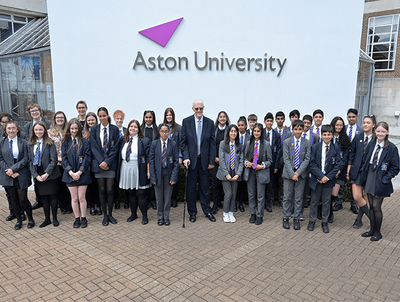
Dr Keith Bradshaw OBE and the West Midlands Mayor met students on the Introduction to Healthcare programme at Aston University ‘NHS outbreak’ experience day The Introduction to Healthcare programme is generously funded by Keith Bradshaw 55 local school students attend the one-day event on Aston University campus. Dr Keith Bradshaw OBE and West Midlands Mayor Andy Street have visited Aston University to meet Year 9 students who were attending a healthcare experience day on campus as part of the University’s Introduction to Healthcare programme. 55 school students took part in a full day of activities experiencing some areas of the healthcare professions. In one activity, the students acted as NHS finance directors during a disease outbreak, where they were asked to make financial decisions, such as choosing which departments in a hospital would be allocated funds from a £1 million budget. The students listened to pitches from different NHS departments before creating a presentation outlining which areas would get some of the budget and the reasons why. The exercise allowed them to develop their teamwork, as well as reasoning and presentation skills. Keith Bradshaw, a prominent businessman and philanthropist, generously funds the Keith Bradshaw Introduction to Healthcare programme, which is designed to increase students' awareness of the various careers within the healthcare sector and support students with their journeys into higher education. Working with students in Years 8, 9 and 10 from schools within the Solihull, Birmingham and Black Country area, the programme aims to educate young people about opportunities within healthcare and the importance of achieving the right GCSE grades to pursue those professions. The programme was launched in 2018 following the success of Aston University’s Pathway to Healthcare Programme. Keith said: “It’s been a pleasure to meet students attending the healthcare programme and hearing more - through their presentations - about their ideas on how they might manage an NHS budget and in which areas they would choose to allocate funds. “One of the key objectives of this programme is to support young people so they can develop and deploy their skills for the benefit of the local community. “We must get the most out of our young people, so they can support our health and welfare and live fulfilling and rewarding lives, which is why this programme – intended to widen participation into healthcare – is so very important.” Andy Street, Mayor of the West Midlands, said: “I was pleased to have the chance to visit the Introduction to Healthcare experience day, to learn more about the programme and to hear directly from the participating students. “A key part of my mayoral mission is to help young people from across our region to raise their aspirations and support the creation of high-quality job opportunities for them here in the West Midlands. “So, I congratulate Aston University on their wonderful widening participation efforts and will certainly play my part in advocating to Government the merits of funding and expanding these sorts of pathway programmes that do so much to help young people from all backgrounds to not only aspire to brilliant jobs but also be practically supported on the best possible route into these professions.” For more information about the Introduction to Healthcare Programme at Aston University please visit our website.

Beyond the Media Pitch: How to Secure Better Coverage in Today’s Noisy Market
At our webinar earlier this month, we were joined by Wilf Dinnick, a communications and media professional with more than 25 years of global experience as a journalist working in national broadcast, digital and early-stage startups. Wilf has covered major stories for news networks including ABC News, CNN, CBC News and Al Jazeera and is a past winner of the prestigious Edward R. Murrow Award. This vast experience on both sides of the camera has given him a keen understanding of what it takes to secure media coverage in today’s environment. Here are 3 key takeaways you missed: #1 The Odds of your Media Pitch Resulting in Coverage are Disappointingly Low - And the Trend is Not Good Wilf Dinnick discussed the sobering stats from a study of over 400,000 pitches conducted by Propel media that reveal that only ⅓ of emails sent to journalists are opened. But equally disappointing is the fact that only 3% of pitches result in coverage and this trend appears to be continuing. What Dinnick went on to explain is that “journalists see many pitches as an interruption as most fail to clearly demonstrate relevance to the stories they want to publish for their audience. #2 Journalists are Busier than Ever. So You Need to Connect with Them In Places they are Going for Story Ideas and Expert Sources Dinnick also shared some important data that reveals how journalists are spending their time. Where they get their story ideas and how they search for experts. This helps explain the diminishing rate of return on traditional media pitches. For instance, Twitter remains dominant as a platform used by journalists to quickly discover trending stories. So making your story ideas more discoverable with appropriate hashtags on social is an important way to promote your experts in the flow of the conversation as a story is breaking or emerging. Wilf also highlighted the importance of dialling into the daily news cycle by looking in the same areas journalists are going for their ideas. The latest research reveals that journalists find newspapers and magazines most valuable. Why? Sites such as the Washington Post, CNN, BBC, New York Times and Axios are well funded and resourced to develop the longer format, well-researched stories. They often focus on exclusive stories and break important news that is echoed through other outlets. And they set the pace of the news cycle as it echos through regional news outlets where journalists look to localize the story for their audiences. Closely monitoring these sites allows you to be in touch with the key stories and offer clear value to journalists, by offering your experts who can help explain key developments in the context of their research or localize the story for a regional audience. #3 There are Ways to Beat the Odds and Improve your Media Coverage by Following Proven Best Practices When Pitching Despite the poor odds when pitching journalists, there is hope for media relations and PR pros. Dinnick unpacked a number of important best practices that can substantially improve your odds. Drawing on research from a number of media organizations that track journalist engagement, he laid out a number of guidelines that you should be following when putting together your media pitches. Some of these included: Timing Your Pitch Journalists are more receptive to pitches early in the day between the hours of 5am and 11am. This is when the stories are breaking and work is being assigned - and journalists are looking for expert sources. Also, there is evidence that pitching earlier in the week on a Monday or Tuesday yields better results. Keeping it Brief The research Dinnick presented on the profound changes that have been happening in Newsrooms and the overload that journalists are experiencing underscores the importance of being to the point with journalists. That begins with understanding how journalists are spending their day - glued to mobile devices. “This impacts how you need to write subject lines that generate curiosity and fit into mobile devices, given the limited set of characters they can display,” said Dinnick. He also shared stressed research that shows the body copy of a pitch should be under 200 words. Mind the Links Loading a journalist up with lots of links to research, videos, and media coverage in the body copy of your pitch may seem like a good idea to help them evaluative a story idea But this is a no-no. It creates unnecessary clutter and detracts from the key messages you want them to focus on. Instead, journalists report they want as few links as possible. Wilf Dinnick recommends 1-2 links max. It’s important to note that this will present a challenge if you don’t have your content organized into comprehensive expert profiles which include important information that journalists want to see such as past media and speaking appearances, research, publications, education/credentials, affiliations etc. There was a lot to take away from this session which was jam-packed with research and best practices for media relations and PR pros. However, perhaps the most important lesson was how to ”flip” the traditional approach to pitching 180 degrees - starting the pitch process by first developing “owned” content that gets published to your website. As Wilf Dinnick stated, “you have to think like a journalist” as you approach the story ideas you want to pitch. Start with owned content and publish stories that focus on your experts which clearly show them to be relevant and credible while making their work more engaging and human through visual media helps “set the table for the journalist.” If it’s well structured and engaging, it gives journalists the added context they need to immediately understand how your pitch is relatable to their audience. What’s most powerful about this approach is that it helps media relations and PR pros avoid the “earned media trap.” Instead of being overly focused on coverage, we can think more strategically about the value we bring to the organization as storytellers to create quality “owned” content that boosts search engine (SEO) authority and PageRank as well as site engagement with visitors to boost reputation, relationships and revenues. It was clear from the many examples shared by healthcare organizations, universities and associations that this approach is where the real gains can be made. And how media relations and PR pros can show more tangible value to their organizations. Stay tuned for more on this topic of owned content and how it helps improve your media coverage as we explore this in our next post. To see the entire webinar, make sure to sign up for BrightTalk to watch the full webinar here.



Professor Jun Du and Dr Oleksandr Shepotylo from Aston University analysed the effects of the end of the Brexit transition period on UK exports This equals to a nearly 16% of UK total exports in the first half of 2019 and 70% of the documented total reduction in the EU exports in the same period The research suggests non-tariff measures (NTMs) are responsible for the fall in trade between the UK and EU. New research by experts at Aston University for the Enterprise Research Centre (ERC) has found that UK exports experienced a large, negative, statistically significant decline in 2021 at the end of transition after the EU-UK Trade and Cooperation Agreement (TCA) was put in force. The TCA is a free trade agreement signed on 30 December 2020 between the European Union (EU), the European Atomic Energy Community (Euratom) and the United Kingdom (UK). Professor Jun Du and Dr Oleksandr Shepotylo used a Synthetic Difference in Differences (SDID) estimator to construct a counterfactual of the UK had it not exited the EU and entered the TCA, to compare its trading performance. This was done by comparing the actual performance of the UK with the modelled performance in 2021 with the same periods of 2018-2020. They also examined the extent to which the overall TCA effect has been due to the increased frictions due to non-tariff measures (NTMs). They estimate that this amounts to a 22 per cent reduction in exports to the EU and a 26 per cent reduction in imports from the EU over the first half of 2021, relative to the counterfactual scenario of the UK remaining in the EU. The research confirmed that NTMs are responsible for the adverse TCA effect on UK trade with the EU and that the magnitude of loss was significant. It was equivalent to a reduction of £12.4 billion in UK exports over the first six months period of 2021, notably in food and drink, wood and chemicals sectors. This equals to 15.6% of UK total exports in the first half of 2019, and 70% of the documented total reduction in the EU exports in the same period. Jun Du, professor of economics at Aston University, lead on internationalisation research at the ERC and director of the Centre for Business Prosperity (CBP), said: “These results underscore the heavy costs of erecting trade barriers on the UK’s side with its largest trade partner. “Trade frictions, due to sanitary and phytosanitary (SPS) measures (measures to protect humans, animals, and plants from diseases, pests, or contaminants), are acute problems due to the EU exit. “Reducing some of the NTMs between the EU-UK, by exploring mechanisms such as equivalence in SPS measures or other ways to reduce businesses’ burden to the minimum level possible. “More complicated and challenging are the technical barriers to trade, but they could potentially cause significant damage to the UK economy. Maintaining and broadening the established arrangements of the current TCA provision, despite being limited, through some form of mutual recognition of specific practices or international regulations for selected sectors, should be the ambition of UK government to ease the TBT (technical barriers to trade). “Future EU-UK co-operation is critical and mutually beneficial but requires political will and strong leadership.” Dr Oleksandr Shepotylo, a senior lecturer in Economics, Finance and Entrepreneurship Department at Aston Business School, co-wrote the working paper and said: “Continued alignment with the EU regulations was a demand from many businesses throughout the Brexit process, and it is expected to be still important post Brexit. This must be conveyed to policy makers. “In the short term, preparedness and adaptability have rewarded and will continue to reward businesses facing challenges and disruptions. The need for learning and training remains paramount. “In the medium and longer term, businesses will have to stay competitive to retain access to the global market, to perform better in it, and to gain more benefit from it. This is the case for all firms even if the ways to achieve it may differ. In addition, businesses need to consider adopting new business models through which they can balance the need for lean production with resilience, as well as weighing up economic, social, and environmental gains. Despite the many considerable challenges, there are boundless avenues where opportunities for breaking through are present.” You can read the full report on the ERC website here.
