
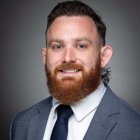
Brandon Amacher profile photo

Brandon Amacher

Director of the Emerging Tech Policy Program Utah Valley University

  • Orem UT

Amacher is an expert in advanced tech security, cybersecurity policy, malicious disinformation and national security

Contact
Utah Valley University logo

Utah Valley University

View more experts managed by Utah Valley University

Spotlight

2 min

With the 2026 midterm elections approaching, artificial intelligence is becoming an increasingly visible part of the political information landscape. AI-generated campaign advertising is already appearing in U.S. races, while concerns about deepfakes, misinformation and election security are receiving growing attention. But what happens when voters simply can't tell what is real? New research led by Brandon Amacher, Director of Utah Valley University's Emerging Tech Policy Lab, offers a striking look at that question. The study involved 632 participants from a politically representative sample of the U.S. population and compared reactions to authentic political videos with AI-generated versions. Brandon Amacher is Director of the Emerging Tech Policy Lab at Utah Valley University, where he leads research and technical intelligence initiatives focused on protecting U.S. national security and assessing the strategic impact of artificial intelligence, cybersecurity, and other advanced technologies. View his profile Researchers found no statistically significant difference in the ability of authentic and deepfake videos to change participants' previously held opinions. Perhaps more concerning, participants struggled to identify the synthetic content even after being told they may have encountered a deepfake. The findings raise timely questions as voters encounter more AI-generated material online: Can voters still trust what they see? Are traditional approaches to media literacy enough? And what can election officials, technology companies and policymakers do as synthetic media becomes increasingly convincing? Amacher can provide insight into the research, the rapidly changing deepfake landscape and what AI-generated media could mean for election security and public trust. If you're interested in speaking with Brandon Amacher, click on his profile below.

Brandon Amacher

Media

Biography

Brandon Amacher is Director of the Emerging Tech Policy Lab at Utah Valley University, where he leads research and technical intelligence initiatives focused on protecting U.S. national security and assessing the strategic impact of artificial intelligence, cybersecurity, and other advanced technologies. A recognized voice in technology policy and security, he has appeared as a subject matter expert with outlets including the BBC, PBS NewsHour, The Japan Times, and Dr. Phil Primetime. Brandon also serves as an instructor in UVU’s Center for National Security Studies, teaching courses on advanced technology security policy and cyberwarfare. In addition, Brandon provides professional training on topics ranging from artificial intelligence to election security for government, industry, and law enforcement audiences. Prior to UVU, he worked at leading cybersecurity firms including Mandiant and FireEye, where he advised enterprise and federal clients on threat intelligence, nation-state threats, and strategic cybersecurity initiatives.

Industry Expertise

Security

Areas of Expertise

Artificial Intelligence Security & Policy
Malicious Disinformation
Cybersecurity Policy
Critical Infrastructure Cybersecurity
Cyberwarfare
Cyber Espionage
Advanced Tech Security

Accomplishments

Adjunct Faculty of the Year

Utah Valley University Center for National Security Studies

Marshall Award for Outstanding Scholarship

UVU Center for National Security Studies - 2020

Part-Time Faculty of the Year

UVU Center for National Security Studies - 2022

Education

Georgetown University

M.A.

Applied Inteligence, Cyber Inteligence

Utah Valley University

B.S.

National Security Studies & Business Management

Languages

  • English

Media Appearances

Study shows many struggle to identify deepfakes as AI advances

KUTV  online

2026-05-07

Brandon Amacher, who leads out on research into technology and national security, said people tend to trust information delivered through deepfakes nearly as much as content from real people.

View More

AI deepfakes are coming from your bank accounts

KSL's Inside Sources  online

2026-05-04

Brandon Amacher, Director of the Emerging Policies Tech Lab at Utah Valley University, joins Inside Sources to explain how the latest updates with text and words on pictures could make things even trickier.

View More

Residents raise concerns about data centers' environmental impact, long-term resource use

KUTV  online

2026-05-04

“Most people don’t understand what these data centers are or how they work,” said Brandon Amacher, Director of Emerging Tech Policy at Utah Valley University. “It’s like getting this massive black box dropped into your community without really knowing what it does or the resources it’s going to draw on.”

View More

Courses

Cybersecurity Policy

NSS 4150

Articles

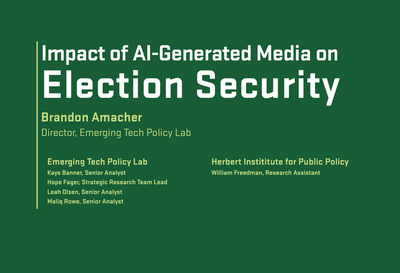
Impact of AI-Generated Media on Election Security

Herbert Instititute for Public Policy

2026-06-01

AI-generated deepfakes represent a rapidly escalating threat to democratic processes and informed political participation. This study, the second in a series by a cross-disciplinary coalition of UVU faculty, staff, and students, extends prior research by examining whether synthetic video content can influence real political opinions in a realistic social media context, and whether ordinary citizens can reliably detect these deepfakes.

View more

Research Summary: Impact of AI Generated Media

UVU Center for National Security Studies

2024-10-28

AI generated deepfakes are a growing concern with regard to election security and disinformation. Deepfake content has already been used in attempts to influence elections or geopolitics several times all over the globe, including in Utah. This problem will increase in severity as generative AI improves, and it becomes more difficult for voters to discern between authentic content and deepfakes. A cross-disciplinary coalition of UVU faculty, staff, and students has conducted a study to measure the impact of deepfake content versus real media, monitor viewers’ non-conscious responses to deepfakes, and ascertain how well participants can identify deepfakes retrospectively.

View more