James E. Malackowski is a top IP expert with substantial experience as a Board Director for leading technology corporations, research organizations, and companies with brand management issues.
Mr. Malackowski has served as an expert in U.S. Federal Court, U.S. Bankruptcy Court, State Court, Court of Chancery, the Ontario Superior Court of Justice, the Federal Court of Australia, the U.S. Patent and Trademark Office Patent Trial and Appeal Board, and global arbitrations on questions relating to intellectual property economics including the subject of valuation, reasonable royalty, lost profits, price erosion, commercial success, corrective advertising, creditor allocations, Hatch Waxman Act market exclusivity, business significance of licensing terms including RAND obligations and exhaustion, venture financing including expected risk / return, the existence of markets or potential markets to assess copyright fair use, and equities of a potential injunction.
Mr. Malackowski’s experience extends to matters of general business valuation and commercial disputes, both domestic and foreign. Mr. Malackowski has publicly addressed policy issues affecting international trade and has provided expert opinions concerning antidumping and countervailing duties imposed by the U.S. Department of Commerce as well as testimony on domestic industry, bond, and remedies before the International Trade Commission.
Mr. Malackowski is a frequent speaker on emerging technology markets and related financial measures. He has addressed mass media audiences including Bloomberg Morning Call, Bloomberg Evening Market Pulse, Bloomberg Final Word, CNBC Closing Bell, CNBC On the Money, CNBC Street Signs, CNBC Worldwide Exchange, CBS News Radio and Fox Business National Television as well as other recognized news-based internet video channels. Mr. Malackowski is a current or past judge for numerous new venture competitions awarding financial grants recognizing intellectual property protected products and services developed by students, university faculty, and professional entrepreneurs.
Mr. Malackowski has more than twenty issued U.S. patents. He is a frequent instructor for graduate studies on IP management and markets. Recently, Mr. Malackowski has lectured on application of intangible asset valuation models to corporate Environmental, Social, and Governance (ESG) standards, including applicability of United Nations Sustainable Development Goals (SDGs) to investment decisions.
Industry Expertise
Financial Services
Business Services
Investment Management
Non-Profit/Charitable
Research
Areas of Expertise
Regulatory and Reporting Obligations
Corporate Accounting Investigations
Advisory Services
Management Consulting
Business Strategy
Financial Services
Intellectual Property
Intangible Assets
Accomplishments & Recognitions
The LES Gold Medal
2025 The Licensing Executives Society International (LES)
IP Hall of Fame Q. Todd Dickinson Award
2022 IP Hall of Fame Academy
IP Hall of Fame Inductee, 87th member
2022 IP Hall of Fame Academy
IAM Patent 1000: The World’s Leading Patent Professionals
2015-2021 IAM Magazine
Regional Semifinalist
2019 and 2020 EY Entrepreneur Of The Year®
IAM Global Leaders
2020 IAM Magazine
50 Intellectual Property Trailblazers & Pioneers
2014 The National Law Journal
Chicago Area Entrepreneurship Hall of Fame Inductee
2013 The Institute for Entrepreneurial Studies at the University of Illinois at Chicago College of Business Administration
Media Appearances
Interview with James E. Malackowski, the Founder of Ocean Tomo – Patent Auctions, Managing Patent Portfolios, Blockchain in the Field of IP, the Market For Data Rights
IP Fridays podcast online
2025-01-31
In this episode of IP Fridays, I speak with James E. Malackowski, an intellectual property (IP) pioneer best known for founding Ocean Tomo. James shares how Ocean Tomo introduced the world’s first large-scale public auctions for patents, trademarks, and copyrights. He also explains how these auctions helped create market-based “price discovery” for IP assets—something that had never been done so openly before.
Multinationals in Australia will feel Pepsi tax defeat for years
Clayton Utz online
2023-12-21
Having found that a royalty arose, the court needed to quantify it. It ultimately accepted that a relief from royalty method was most appropriate, adopting part of the analysis of the ATO’s expert, James Malackowski, in arriving at a rate of 5.88% of net revenue.
Strategy 300 Global Leaders 2024 - James E Malackowski
IAM online
2023-11-30
James Malackowski is co-founder of Ocean Tomo, a part of J.S. Held. Along with Supreme Court Justice Stephen Breyer, he was inducted as the 87th member of the IP Hall of Fame. On more than 100 occasions, Mr Malackowski has served as an expert in various US and international courts, the USPTO PTAB and global arbitrations on questions relating to IP economics, licensing and damages.
James E. Malackowski, chief executive officer of Ocean Tomo, the intriguingly named1426696761715 merchant bank that assembled this data, predicts that the tangibles/intangibles balance will shift back a bit in the next few years as various forces (higher labor prices in China, cool new manufacturing technologies, etc.) “fuel a return to tangible domestic investments.”
The Obama Administration vetoed an International Trade Commission patent ruling, banning the sale of older iPhones and iPads. Jim Malackowski, Ocean Tomo, shares what this may mean for all valuing companies.
United States Intellectual Property Alliance - USIPA : Founding Board Member and Member of the Executive Committee
The World Economic Forum: 2011 Network of Global Agenda Councils
University of Notre Dame – Venture Builders Community : Judge
Young President’s Organization : Member YPO Gold Miami
Private Directors Association : Member
Licensing Executives Society International, Inc. : Past President
National Inventors Hall of Fame : Past Director
Articles
The Growing Importance of the Chief Intellectual Property Officer: A Strategic Imperative for the Knowledge Economy
Ocean Tomo | JS Held LLC
2025
Discussion in the corporate boardroom is evolving rapidly. As the global economy has fundamentally shifted from one driven by tangible assets to one powered by intangible value, a new C-suite position has earned a seat at the table, a voice that is frequently regarded as essential for strategic leadership: the Chief Intellectual Property Officer (CIPO). This transformation reflects not merely a trend, but an economic reality demanding executive-level attention to intellectual property and intangible asset management.
Evolving Landscape of Technology Rights Enforcement
JD Supra
2025
Established 25 years ago at the turn of the century by the World Intellectual Property Organization (WIPO), World IP Day celebrates the unique contributions made by global inventors and creators. Over the past half century, intangible asset value has skyrocketed from 17% of S&P 500 market value in 1975, to 68% in 1995, to more than 90% today. Ocean Tomo leadership and their predecessor firms have been an active participant in IP markets for decades and have seen this evolution firsthand.
Peeling Back the Value: Why Art Is Worth More Than Meets the Eye
Claims Journal
2025
Not since “Banksy’s Girl with Balloon” unexpectedly self-destructed on the Sotheby’s auction floor has a work of art made such a sensation as the “duct-taped banana.”
When Italian-born, New York-based artist Maurizio Cattelan debuted “Comedian” at Gallery Perrotin’s booth at Art Basel Miami Beach in 2019, it drew such a massive crowd it had to be removed from the wall. It immediately went viral and stimulated worldwide discussions and debates about the nature and value of art. It caused equal parts outrage and intrigue and left many asking – how is this conglomeration art?
Emerging IP monetisation solutions: The institutionalisation of an IP exchange
International Journal of Intellectual Property Management
2012
This paper examines whether moving licensing from the traditional bilateral contract model to an exchange model will lead to more efficient price discovery and, ultimately, more liquidity in the market for IP rights transfer. Using the recently created Chicago-based Intellectual Property Exchange International (IPXI) as a model, we address the rationale for such an exchange and the mechanisms by which it can operate. We contend that IPXI's business model, which is built around unit licence right (ULR) contracts - which may be seen as a paid-up non-exclusive licence to the purchaser - addresses some of the current inefficiencies in IP management. However, the market efficiency that is needed to turn IP rights into a liquid asset inevitably takes time to evolve. Without community support for and participation in the exchange, from both buyers and sellers, the market cannot be established.
What Is Patent Quality? A Merchant Banc’s Perspective
les Nouvelles
2008
The question “What is Patent Quality?” is one that has long been answered not by the authors of this paper but by the marketplace itself. It has been defined by the actions of patent holders in their decisions to maintain patents of quality and abandon patents of lesser quality and value. Ownership of quality patents has been rewarded by both public and private markets with a scale and precision that simply has not been well understood. Our statistical research shows not only that the marketplace appreciates quality patent assets, but that many of the attributes which drive quality assessment by market participants are well correlated to those that affect investor returns.
A medium is disclosed that incorporates instructions including: a user interface module that receives from a user a first work-targeting input, the first work associated with intellectual property; an asset identifier module that identifies automatically, based on a relation to the first work-targeting input, the first work; the user interface module receiving, as a first work-adapting input, from the user, an input for adapting, modifying or creating a derivative work from the first work; and an adaptation generator module that generates automatically a record of a grant in rights in the adaptation of the first work according to the first work-adapting input, and provides a report of the grant in the adaptation of the first work to the user.
Eyewear with exchangeable temples housing a radio frequency transceiver
9244292
2016
A wireless ad hoc pico network is formed by eyewear having a radio frequency transceiver and other devices such as a computer, a bracelet and a telephone having similar transceivers mounted on them. Master slave relationships are configurable. Other devices, such as a radio, a CD player, a hand held global positioning satellite system and a heart rate monitor, having similar transceivers, can also be connected with the transceiver of the eyewear. The transceivers operate on a globally available, unlicensed radio band of 2.45 gigahertz (GHz).
EYEWEAR WITH EXCHANGEABLE TEMPLES HOUSING A RADIO FREQUENCY TRANSCEIVER
20160109729
2015
A wireless ad hoc network may be formed by eyewear having a radio frequency transceiver with other devices having compatible radio frequency transceivers. The transceivers may operate in an unlicensed radio frequency band at 2.45 GHz. The eyewear may include at least one detachable temple, and the radio frequency transceiver of the eyewear may be embedded in the at least one detachable temple. Other devices may also be embedded in the at least one detachable temple. The at least one detachable temple may be electrically connected to a frame of the eyewear when in an open position.
Marketplace for trading intangible asset derivatives and a method for trading intangible asset derivatives
9058628
2015
A marketplace for trading derivative financial contracts includes a forum that publishes a financial contract and allows the financial contract to be traded by one or more market participants. The financial contracts are based on one or more underlying intangible assets of one or more entities. The price of the contract is derived from a measure of value of the one or more underlying assets of the particular financial contract. The forum may include an exchange for trading financial contracts and may also host trading of over-the-counter financial contracts.
SYSTEM AND METHODS FOR VALUING AND TRADING INTANGIBLE PROPERTIES AND INSTRUMENTS
20140358764
2014
A system and methods providing an exchange network for valuing and trading of intangible instruments, such as one or more rights to an intangible property including a given intellectual property (patents, copyrights, trademarks, trade dress, trade secrets and/or the rights of publicity). The system and methods permits a party to access a database of the intangible instruments including data relating to identifying value of the instrument. The system and methods permits a party to perform due diligence on the intangible instrument and, as a result, to formulate a bidding strategy for the intangible instrument that the bidder believes is appropriate. If the bidder and the owner reach agreement on the price, a transaction for the intangible instrument is executed between the parties.
A medium is disclosed that incorporates instructions including: a user interface module that receives from a user a first work-targeting input, the first work associated with intellectual property; an asset identifier module that identifies automatically, based on a relation to the first work-targeting input, the first work; the user interface module receiving, as a first work-adapting input, from the user, an input for adapting, modifying or creating a derivative work from the first work; and an adaptation generator module that generates automatically a record of a grant in rights in the adaptation of the first work according to the first work-adapting input, and provides a report of the grant in the adaptation of the first work to the user.
Financial instrument based on content and methods for valuation
8831985
2014
The present invention is a system and methods by which an investment vehicle can be established that is directed to one or a very limited specific form of content. More specifically, the system and methods of the present invention creates a financial instrument directed to specific content—such as a specific technology or specific artistic or literary work—that may be issued, thereby providing investors with the opportunity to invest in the specific content or aspect of that specific content.
METHODS AND SYSTEMS FOR UTILIZING INTELLECTUAL PROPERTY ASSETS AND RIGHTS
20140304191
2014
A method of utilizing an intellectual property grouping owned by a patent entity to generate income. The method includes acquiring rights in a first intellectual property asset from a seller on behalf of a patent investment entity, providing compensation to the seller in exchange for the first intellectual property asset, granting less than all of the rights in the first intellectual property asset to the seller of the intellectual property asset in exchange for a stream of payments, wherein granting less than all of the rights in the first intellectual property asset creates residual rights in the first intellectual property asset, and utilizing the residual rights in the first intellectual property asset to generate income for the patent investment entity.
System of providing information to a telephony subscriber
8880031
2014
An information fulfillment system provides information to a user having a wireless communication device. Upon manual or automatic input of an access code to the wireless communication device, the fulfillment center delivers information based on the access code. Automatic verification, connection, and/or billing modification processes are provided for implementation of the system and method.
FINANCIAL INSTRUMENT BASED ON CONTENT AND METHODS FOR VALUATION
20140358764
2014
The present invention is a system and methods by which an investment vehicle can be established that is directed to one or a very limited specific form of content. More specifically, the system and methods of the present invention creates a financial instrument directed to specific content—such as a specific technology or specific artistic or literary work—that may be issued, thereby providing investors with the opportunity to invest in the specific content or aspect of that specific content.
With majors in Accountancy and Philosophy. Graduated Summa Cum Laude.
Licenses and Certifications
CLP
Certified Licensing Professional Certificate Number 1606 Issued July 1, 2008; Recertification through November 30, 2023.
Registered Certified Public Accountant
State of Illinois Certificate Number 41,187 License No. 239.007831 Issued October 3, 2006; Expires September 30, 2024.
Certified in Financial Forensics, CFF™
American Institute of Certified Public Accountants Certificate Number 391 Issued July 31, 2008; Expires August 1, 2024.
Accredited in Business Valuation, ABV™
American Institute of Certified Public Accountants Certificate Number 4278 Issued May 31, 2014; Expires August 1, 2024.
Accredited in Blockchain Fundamentals for Accounting and Finance Professionals
American Institute of Certified Public Accountants Certificate Number 15860970 Issued 2018; Exprires 2020.
Spotlight
·
2 min
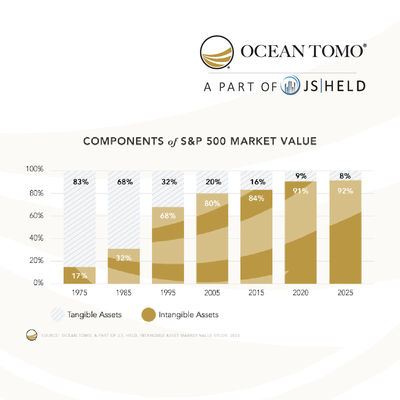
Global consulting firm J.S. Held announces the release of the Ocean Tomo Intangible Asset Market Value (IAMV) study. With this release, the study now reflects a panel of 50 years of data in the US market and 20 years of data in foreign markets.
The study examines the components of market value, specifically the role of intangible assets, across a range of global indexes. IAMV is shown as of calendar year end by subtracting net tangible asset value from market capitalization.
Commenting on the Components of S&P 500® Market Value, economic expert and study author Matthew Johnson observes, “the composition of corporate value has undergone a fundamental transformation over the past five decades.” In 1975, tangible assets—property, plant, equipment, inventory, and other physical capital—represented 83% of the market value of companies comprising the S&P 500 index, with intangible assets accounting for only 17%. By the end of 2025, this relationship had completely inverted: intangible assets now constitute approximately 92% of S&P 500 market capitalization, while tangible assets have been reduced to a mere 8%. Johnson adds, “This 75 percentage point shift represents what Ocean Tomo has defined as ‘economic inversion’— a wholesale transformation in the nature of value creation whereby economic worth has migrated from what can be ‘touched’ to what can be ‘thought’."
The magnitude and implications of this transformation are comparable to the Industrial Revolution of the 18th and 19th centuries. Just as the Industrial Revolution fundamentally restructured economic activity from agrarian and craft-based production to mechanized manufacturing, the intangible revolution has redefined the sources and measurement of corporate value in the 21st century. Ocean Tomo Co-founder and J.S. Held Chief Intellectual Property Officer, James E. Malackowski observes, “While the Industrial Revolution required a century to unfold fully, the intangible revolution has occurred within a single human lifespan, with particularly rapid acceleration occurring in the 1985-2005 period when intangible asset market value increased from 32% to 79%—a remarkable 47 percentage point surge in just two decades.”
The 2020-2025 period deserves special attention: S&P 500 IAMV remained stable at approximately 90% despite the Federal Reserve implementing the most aggressive monetary tightening cycle in four decades. Dr. Nikki Tavasoli, PhD, shares, “Traditional financial theory predicts that intangible-intensive firms should be highly sensitive to interest rate changes due to their long-duration cash flows and limited collateral value.” She adds, “The observed stability challenges this prediction and requires explanation, which we address in a forthcoming paper.”
In 2005, the IAMV study was expanded beyond the S&P 500 to explore the components of value in several key international markets. Stock market indexes from Europe, China, Japan, and South Korea were selected and analyzed to determine the comparable role of intangible assets.
To learn more about the 2025 Intangible Asset Market Value Study, please visit:
Media Contact Kristi L. Stathis, J.S. Held
1 786 833 4864
Kristi.Stathis@JSHeld.com JSHeld.com
·
2 min
Under current corporate accounting practices, artificial intelligence (AI) companies’ most valuable resources – large language models, training datasets, and algorithms – remain “off the books” or uncapitalized. As the importance of AI continues to grow in the global knowledge-based economy, financial statements are becoming less representative of a company’s true worth, creating a recognition gap.
In this article, James E. Malackowski, Eric Carnick, and David Ngo present several conceptual frameworks to bridge this gap. They explain how the triangulation of three valuation approaches can reveal both the tangible investment base and the intangible, strategic upside of AI assets. In turn, these approaches provide board-level visibility into where AI capital resides and how it contributes to enterprise value.
James E. Malackowski is the Chief Intellectual Property Officer (CIPO) of J.S. Held and Co-founder of Ocean Tomo, a part of J.S. Held. Mr. Malackowski has served as an expert on over one hundred occasions on intellectual property economics, including valuation, royalty, lost profits, price erosion, licensing terms, venture financing, copyright fair use, and injunction equities. He has substantial experience as a Board Director for leading technology corporations, research organizations, and companies with critical brand management issues. This article is the second installment in our three-part series, Artificial Intelligence as Intellectual Property or “AI as IP™”, which explores how artificial intelligence assets should be treated as a form of intellectual property and enterprise capital. The first article, “A Strategic Framework for the Legal Profession”, explored the legal foundations for recognizing and protecting AI assets. The upcoming third article, “Guide for SMEs to Classify, Protect, and Monetize AI Assets”, will provide practical steps for small and mid-sized enterprises to turn AI into measurable economic value.
To explore the topic further, simply connect with James through his icon below.
·
2 min
Intangible assets now make up more than 90% of S&P 500 market value — yet many organizations still lack a dedicated executive role to manage them strategically. This is where the Chief Intellectual Property Officer (CIPO) comes in.
In this expert-backed piece, J.S. Held's Chief Intellectual Property Officer James E. Malackowski, CPA, CLP, and his colleague David Ngo unpack the economic forces shaping this role, the skills CIPOs bring to the table, and why forward-thinking companies are making IP leadership a boardroom priority.
What you’ll learn: The economic forces driving the rise of CIPO leadership
How CIPOs bridge legal, technical, and commercial priorities to unlock value
The growing relevance of CIPOs in consulting, insurance, and AI-driven industries
Practical strategies for integrating IP leadership into portfolio and risk management
Why the next decade will define the CIPO’s role in corporate success
With deep expertise in IP strategy, valuation, and litigation, Malackowski and Ngo offer a clear, compelling case for elevating IP leadership to the C-suite.
Looking to connect with the experts? Click on their profiles to arrange an interview or gain deeper insights into intellectual property strategy, risk, and valuation.
James E. Malackowski, CPA, CLP Chief Intellectual Property Officer, J.S. Held | Co-founder and Senior Managing Director, Ocean Tomo
Global leader in intellectual property valuation, strategic advisory, and expert testimony. Recognized among IAM’s “World’s Leading IP Strategists” and a pioneer in IP exchange models.
David Ngo Senior Analyst, Intellectual Property Disputes Financial Expert Testimony, Ocean Tomo, a part of J.S. Held
Specialist in quantifying economic damages in IP disputes and valuing intangible assets, with expertise in applying economic and financial analysis to complex litigation.
For any other media inquiries, contact : Kristi L. Stathis, J.S. Held +1 786 833 4864 Kristi.Stathis@JSHeld.com.