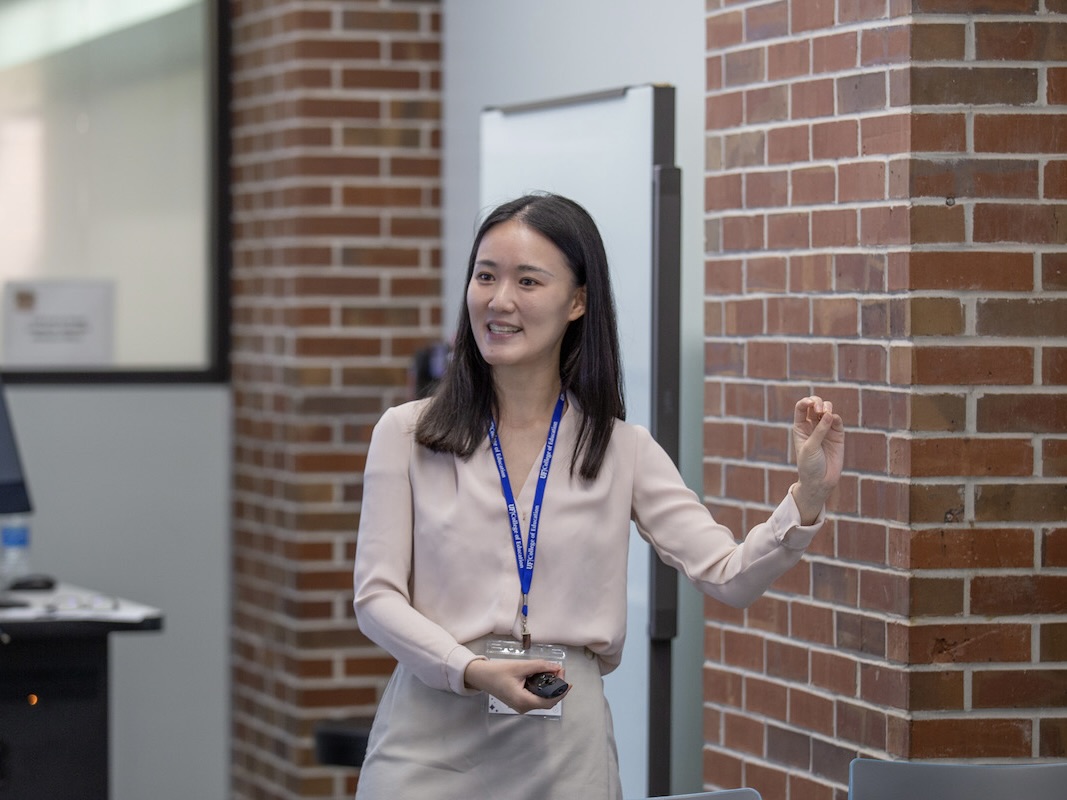
Jinnie Shin profile photo

Jinnie Shin

Assistant Professor University of Florida

  • Gainesville FL

Jinnie Shin is an assistant professor of research and evaluation methodology.

Contact
University of Florida logo

University of Florida

View more experts managed by University of Florida

Biography

Jinnie Shin is an assistant professor of research and evaluation methodology in the School of Human Development and Organizational Studies in Education in the College of Education. Jinnie has expertise in the application of theory-based natural language processing and learning analytics in education research. Her primary research interest is investigating how to bridge the gap between psychometric and artificial intelligence in education research.

Areas of Expertise

Learning Analytics
Educational Assessment
Artificial Intelligence
Natural Language Processing

Articles

Development Practices of Trusted AI Systems among Canadian Data Scientists

AI, Ethics and Society

Jinnie Shin, et al.

2020-06-30

The introduction of Artificial Intelligence systems has demonstrated impeccable potential and benefits to enhance the decision-making processes in our society. However, despite the successful performance of AI systems to date, skepticism and concern remain regarding whether AI systems could form a trusting relationship with human users. Developing trusted AI systems requires careful consideration and evaluation of its reproducibility, interpretability and fairness.

View more

More efficient processes for creating automated essay scoring frameworks: A demonstration of two algorithms

Language Testing

Jinnie Shin and Mark J. Gierl

2020-07-04

Automated essay scoring has emerged as a secondary or as a sole marker for many high-stakes educational assessments, in native and non-native testing, owing to remarkable advances in feature engineering using natural language processing, machine learning and deep-neural algorithms. The purpose of this study is to compare the effectiveness and the performance of two AES frameworks.

View more

Building an intelligent recommendation system for personalized test scheduling in computerized assessments: A reinforcement learning approach

Behavior Research Methods

Jinnie Shin and Okan Bulut

2021-06-15

The introduction of computerized formative assessments in the classroom has opened a new area of effective progress monitoring with more accessible test administrations. With computerized formative assessments, all students could be tested at the same time and with the same number of test administrations within a school year. Alternatively, the decision for the number and frequency of such tests could be made by teachers based on their observations and personal judgments about students. However, this often results in rigid test scheduling that fails to take into account the pace at which students acquire knowledge.

View more

Spotlight

2 min

Finding the right internship can be an important step for students, but it’s not always clear which opportunities will lead to the strongest growth. To help solve that problem, University of Florida researchers have developed an AI-powered tool that helps students identify internships most likely to accelerate their technical and professional development. Unlike traditional recommendation engines, Pro-CaRE not only predicts which opportunities will lead to stronger outcomes, it also explains why each suggestion is a good fit. In testing data collected from the students, Pro-CaRE’s predictions proved highly accurate, accounting for more than 72% of the differences in learning gains among participants. While the pilot is being tested in engineering, the tool could be adopted for other disciplines. “Internships are one of the most critical parts of an engineering education, but students often struggle to know which experiences will actually help them grow,” said Jinnie Shin, assistant professor of research and evaluation methodology in the UF College of Education. “What makes Pro-CaRE unique is that it doesn’t just offer a list of options. It provides personalized recommendations backed by data and it tells students clearly why an opportunity is a good match for them.” Pro-CaRE creates matches by analyzing each student’s coursework, major, background and self-reported interest, confidence and self-efficacy in engineering skills. It then compares that profile with a carefully chosen set of similar peers to refine suggestions. The result is more precise guidance that adapts to students at different stages of their degree programs. “Students shouldn’t have to guess or hope that an internship will be worthwhile,” Shin said. “With Pro-CaRE, they can approach opportunities knowing they’re backed by evidence, whether the role is onsite, hybrid or remote and whether it’s at a startup or a Fortune 500 company.” The system is designed to work across a wide range of companies and contexts, giving students flexibility while ensuring their choices align with their personal and professional goals. Each recommendation comes with a clear “why this?” explanation, so students can make confident decisions and discuss options more effectively with advisors. Pro-CaRE was developed by a cross-disciplinary UF team combining expertise in education and engineering. Alongside Shin, the project’s co-principal investigators include Kent Crippen in the College of Education and Bruce Carroll in the Herbert Wertheim College of Engineering. The team is exploring external funding opportunities to expand the usage and test the efficacy on a larger scale. “Ultimately, our goal is to empower students to invest their time in experiences that will have the greatest impact,” Shin said. “Pro-CaRE bridges the gap between what students hope to gain and what internships can truly deliver.”


Jinnie Shin