Jonathan Bloch

Curator | Professor University of Florida

  • Gainesville FL

Jonathan Bloch is a paleontologist focused on the fossil record of vertebrates at the Florida Museum of Natural History.

Contact

University of Florida

View more experts managed by University of Florida

Biography

Jonathan Bloch is a curator of vertebrate paleontology in the Department of Natural History at the Florida Museum of Natural History. Jon's research focuses on fossil vertebrates from the Cenozoic with an emphasis on addressing questions surrounding the first appearance and early evolution of the modern orders of mammals, including primates. He does related field-based research in Florida, Wyoming, Montana, Panama, Indonesia, and Colombia.

Areas of Expertise

Primate Evolution
Paleontology
Fossil Vertebrates
Paleobiology
Vertebrate Paleontology

Media Appearances

Florida fossil porcupine solves a prickly dilemma 10-million years in the making

Florida Museum  online

2024-05-28

There’s a longstanding debate simmering among biologists who study porcupines. There are 16 porcupine species in Central and South America, but only one in the United States and Canada. DNA evidence suggests North America’s sole porcupine belongs to a group that originated 10 million years ago, but fossils seem to tell a different story.

View More

Panama Canal expansion rewrites history of world’s most ecologically diverse bats

Florida Museum  

2024-02-20

Most bats patrol the night sky in search of insects. New World leaf-nosed bats take a different approach. Among the more than 200 species of leaf-nosed bats, there are those that hunt insects; drink nectar; eat fruit; munch pollen; suck blood; and prey on frogs, birds, lizards and even other bats.

View More

Graveyard of Extinct Elephants From 5 Million Years Ago Found in Florida

Newsweek  online

2023-05-26

Paleontologists from the Florida Museum of Natural History made an exciting discovery when they uncovered a graveyard of extinct relatives of elephants dating back to 5 million years ago. The remains were first discovered early last year by Jonathan Bloch, the curator of vertebrate paleontology at the museum, and his team at the Montbrook Fossil Dig site in Levy County, according to blog posts posted by the museum.

View More

Social

Articles

An extinct north American porcupine with a South American tail

Current Biology

Natasha S. Vitek, et. al

2024-05-27

New World porcupines (Erethizontinae) originated in South America and dispersed into North America as part of the Great American Biotic Interchange (GABI) 3-4 million years ago. 1 Extant prehensile-tailed porcupines (Coendou) today live in tropical forests of Central and South America.

View more

A new early Miocene bat (Chiroptera: Phyllostomidae) from Panama confirms middle Cenozoic chiropteran dispersal between the Americas

Journal of Mammalian Evolution

Gary S. Morgan, et. al

2023-11-29

Fossils of an insectivorous bat from the early Miocene of Panama are described as a new genus and species, Americanycteris cyrtodon (Chiroptera: Phyllostomidae: Phyllostominae). Americanycteris is a large phyllostomine bat, similar in size to the living species Chrotopterus auritus.

View more

Virtual endocast of late Paleocene Niptomomys (Microsyopidae, Euarchonta) and early primate brain evolution

Journal of Human Evolution

Chelsea L. White, et. al

2023-02-01

Paleogene microsyopid plesiadapiforms are among the oldest euarchontans known from relatively complete crania. Size estimates of smaller-bodied uintasoricines are similar to those inferred for the common ancestor of Primates, so the virtual endocast of Niptomomys may provide a useful model to study early primate brain evolution.

View more

Media

Spotlight

2 min

Giant croclike carnivore fossils found in the Caribbean

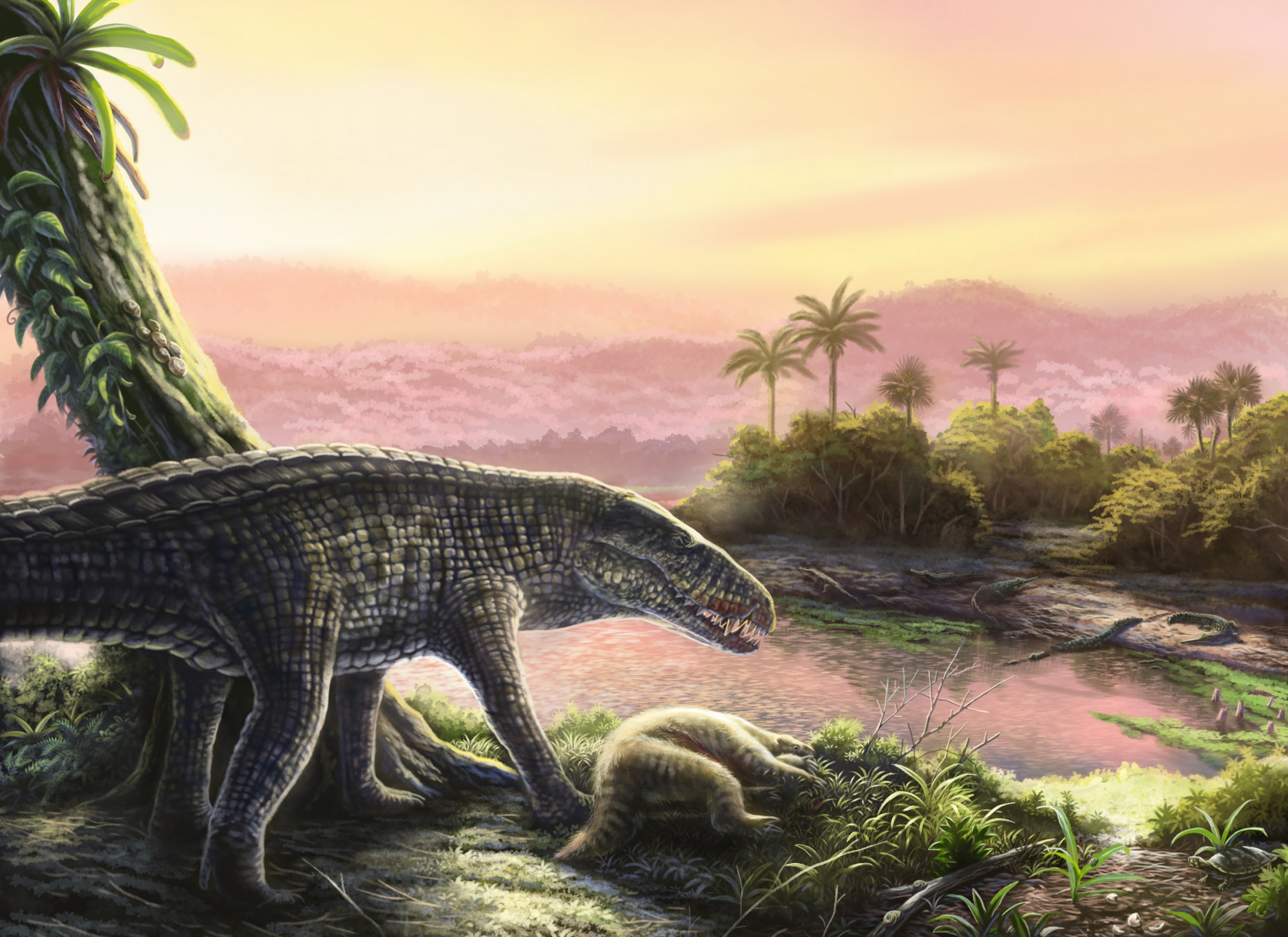
Imagine a crocodile built like a greyhound — that’s a sebecid. Standing tall, with some species reaching 20 feet in length, they dominated South American landscapes after the extinction of dinosaurs until about 11 million years ago. Or at least, that’s what paleontologists thought, until they began finding strange, fossilized teeth in the Caribbean. “The first question that we had when these teeth were found in the Dominican Republic and on other islands in the Caribbean was: What are they?” said Jonathan Bloch, curator of vertebrate paleontology at the Florida Museum of Natural History. This initial confusion was warranted. Three decades ago, researchers uncovered two roughly 18 million-year-old teeth in Cuba. With a tapered shape and small, sharp serrations specialized for tearing into meat, they unmistakenly belonged to a predator at the top of the food chain. But for the longest time, scientists didn’t think such large, land-based predators ever existed in the Caribbean. The mystery deepened when another tooth turned up in Puerto Rico, this one 29 million years old. The teeth alone weren’t enough to identify a specific animal, and the matter went unresolved. That changed in early 2023, when a research team unearthed another fossilized tooth in the Dominican Republic — but this time, it was accompanied by two vertebrae. It wasn’t much to go on, but it was enough. The fossils belonged to a sebecid, and the Caribbean, far from never having large, terrestrial predators, was a refuge for the last sebecid populations at least 5 million years after they went extinct everywhere else. A research team described the implications of their finding in a new study published in the Proceedings of the Royal Society B. The study’s lead author, Lazaro Viñola Lopez, conducted the research as a graduate student at the University of Florida. He knew his team members had come upon something exceptional when they unearthed the fossils. “That emotion of finding the fossil and realizing what it is, it’s indescribable,” he said. Read more ...


Jonathan Bloch