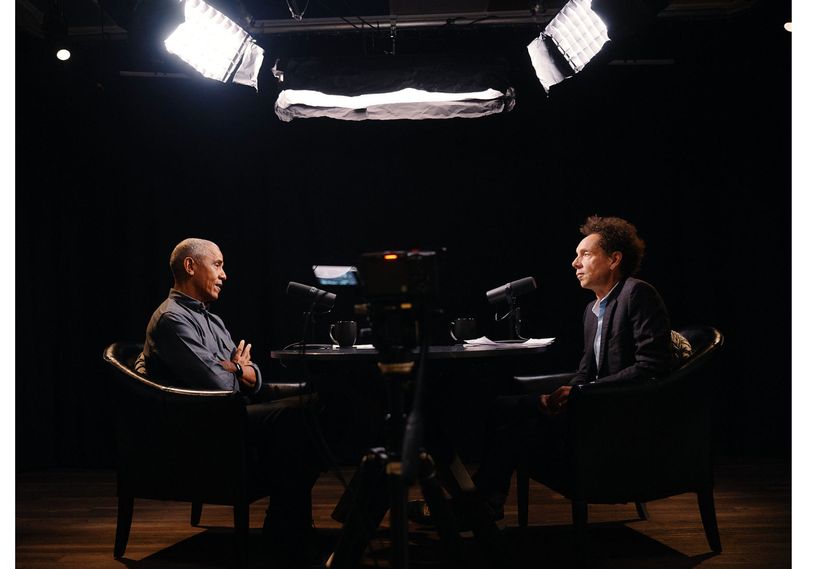
As the United States marks its 250th anniversary, a major new podcast series is drawing renewed attention to the Reconstruction era and its lasting impact on American democracy.
Reconstruction: The Unfinished Promise, hosted by Malcolm Gladwell and featuring former President Barack Obama, examines the turbulent decades following the Civil War and the ongoing struggle to define citizenship, equality, and political participation in the United States.
Among the historians featured in the series is Manisha Sinha, a leading scholar of the Civil War, abolition, and Reconstruction. Her participation brings decades of research and scholarship to a national audience at a time when Americans are revisiting the people, events, and ideas that shaped the nation.
Manisha Sinha is the James L. and Shirley A. Draper Chair in American History at UConn and past president of the Society for Historians of the Early American Republic. She is an expert in American political history, the Civil War, and Reconstruction. View her profile Sinha is the author of The Rise and Fall of the Second American Republic: Reconstruction, 1860–1920, a widely acclaimed examination of Reconstruction that challenges conventional timelines and interpretations of the era. Her work argues that Reconstruction was not confined to the years immediately following the Civil War, but instead represented a broader struggle over democracy, citizenship, civil rights, and political inclusion that continued well into the twentieth century.
In interviews discussing her research, Sinha has emphasized the transformative nature of Reconstruction and its importance in understanding the development of modern America. Her scholarship explores how debates over voting rights, constitutional protections, racial equality, and citizenship during Reconstruction continue to influence public life today.
As interest in Reconstruction grows through America 250 programming and broader public discussions about democracy and civil rights, Sinha's expertise offers valuable historical context for understanding the era's enduring significance.
Connect with an Expert Manisha Sinha is available to discuss:
The history and legacy of Reconstruction Why Reconstruction remains relevant today The concept of America's "Second Republic" The evolution of citizenship and voting rights in the United States The relationship between Reconstruction, civil rights, and democratic reform Historical perspectives connected to America 250 commemorations How historians are rethinking the traditional timeline of Reconstruction For journalists and audiences seeking deeper insight into one of the most important periods in American history, Sinha offers expert analysis on the debates, achievements, and unresolved questions that continue to shape the nation more than 150 years later.
·
2 min
What should be the fate of the large statue commemorating John Mason that adorns the Connecticut State Capitol Building? He’s a historic figure and founder of the Connecticut Colony. He also left a legacy of violence and murder, with more than 400 Indigenous people, including 175 women and children, killed under his command.
And whether to let his statue stand or remove it has engaged a debate from leading experts, historians, relatives of Mason, and the Indigenous community across the state.
UConn’s Manisha Sinha was asked to lend her expertise to the situation:
Manisha Sinha, a University of Connecticut professor of 19th century U.S. history, said she is a veteran of debates about the fate of statues memorializing Confederate leaders as well as founding fathers who owned slaves. “I have advocated for the taking down of statues that commemorate Confederate leaders and generals, who I see as traitors to the American republic, fighting for the worst cause in American history, as General Grant put it, in the cause of human bondage,” Sinha said. “On the other hand, I have opposed the taking down of statues of some of our founding fathers, revolutionary figures who did not defend slavery as a positive good.” Sinha said history can be complex, and great men of history can be flawed. “The Mason massacre is not a complex story,” she said. “It was a sheer massacre of non-combatants and of women, children and elders. We cannot excuse this by pointing to internecine warfare among Native Americans.” Mason’s statue is not necessary to teach history, she said. “I think it is high time that you think of removing John Mason’s statue,” Sinha said. “It cannot be contextualized. We do not remember history by statues, especially not in the monumental 19th century forms. We actually end up commemorating people, making them heroic.” November 18 – The CT Mirror This is a sensitive and very important topic as America reconciles with its past and moves forward as a country. And, if you are a journalist covering this topic, then let our experts help with your in-depth coverage and questions.
Manisha Sinha is the Draper Chair in American History at the University of Connecticut and the author of "The Slave's Cause: A History of Abolition." She is an expert in the era of America during the 19th Century and available to speak with media regarding this topic – simply click on her icon now to arrange an interview today.
·
2 min
The upcoming U.S. presidential election is happening in unprecedented times and during what could be the most divisive era in more than a century and a half.
This week, one of the University of Connecticut’s historical experts, Manisha Sinha, was featured by CNN to explain her point that America is indeed facing its biggest election in 160 years.
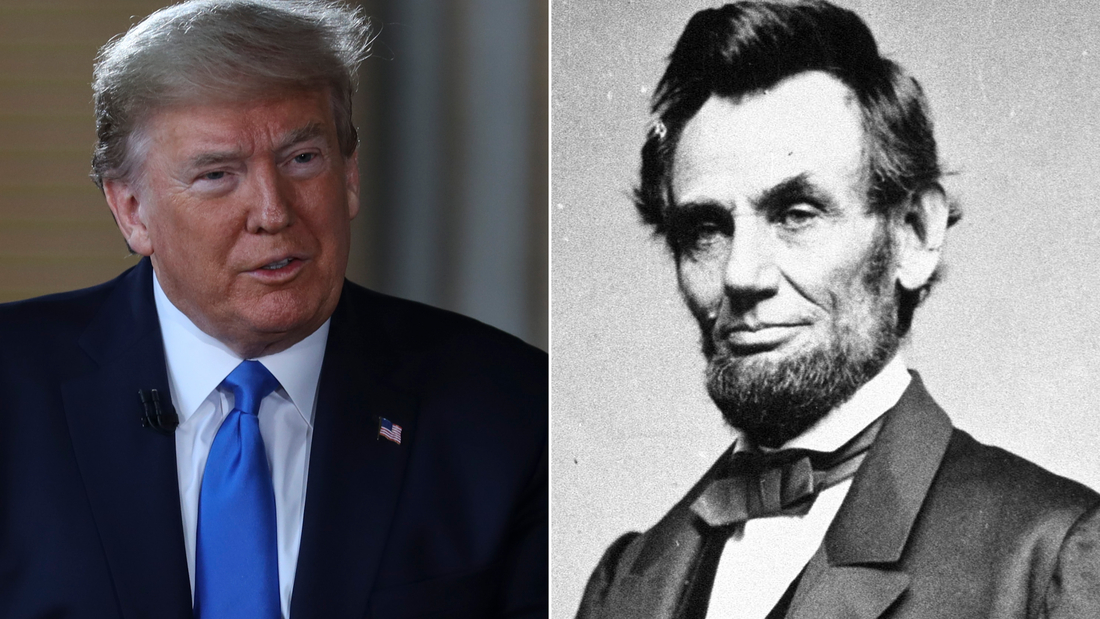
“The 2020 presidential election is certainly as consequential as that of 1860. It is, as Biden is fond of saying, a battle for the 'soul of America.' The fate of the American republic once again hangs in the balance. Like the slaveholders of the 1850s, Trump, his followers and enablers are in a position to pose an existential threat to American democracy. Like many slaveholders, Trump refuses to commit to a peaceful transfer of power if he loses. "If history appears first as tragedy, then as farce, the counterparts of southern secessionists and proslavery theorists today are QAnon conspiracy theorists, neo Confederates, and the right-wing Boogaloo boys. Much of the contemporary Republican Party that refuses to repudiate Trump is like those southern Whites who may not have had a direct stake in slavery but went with their states, who ultimately chose slavery before the republic. The choice -as the Republicans of the Lincoln Project, who have broken with their party, put it -is between America and Trump.” Dr. Sinha’s full op-ed is available on CNN.com and is a must-read for anyone looking to put this year’s election into historical context.
And, if you are a journalist looking to cover this topic, let our experts help with your coverage.
Manisha Sinha is the Draper Chair in American History at the University of Connecticut and the author of "The Slave's Cause: A History of Abolition." She is available to speak with media regarding this topic – simply click on her icon now to arrange an interview today.
Biography
Manisha Sinha is the James L. and Shirley A. Draper Chair in American History at UConn and past president of the Society for Historians of the Early American Republic. She was born in India and received her Ph.D. from Columbia University where her dissertation was nominated for the Bancroft prize.
She is the author of The Counterrevolution of Slavery: Politics and Ideology in Antebellum South Carolina, which was named one of the ten best books on slavery in Politico. Her multiple-award-winning second monograph The Slave’s Cause: A History of Abolition was long-listed for the National Book Award for Non-Fiction. It was named Editor’s Choice in The New York Times Book Review, book of the week by Times Higher Education to coincide with its UK publication, and one of three great History books of 2016 in Bloomberg News.
She is the recipient of several awards and fellowships, including the John Simon Guggenheim Memorial Foundation Fellowship in 2022. She is the Eighth recipient of the James W.C. Pennington Award for 2021 from the University of Heidelberg, Germany.
Her latest book, The Rise and Fall of the Second American Republic: Reconstruction, 1860-1920, published by Liveright (W.W. Norton) in 2024, was widely reviewed in the mainstream press and awarded the biennial President’s Book Award from the Society for Historians of the Gilded Age and the Progressive Era in 2026.
Professor Sinha has written for The Times Literary Supplement, The New York Review of Books, The New York Times, The Wall Street Journal, The Washington Post, The New York Daily News, Time Magazine, CNN, The Boston Globe, Dissent, The Nation, Jacobin, and The Huffington Post and has been interviewed by the national and international press. She has been on National Public Radio, PBS, NBC, Democracy Now, BBC News, C-SPAN, Pacifica, Euro News, Canadian Television News, Canadian Broadcasting Company, Australian Broadcasting Corporation, New Zealand Television, China Global News, Jon Stewart’s The Daily Show, TLC’s Who Do You Think You Are, and was an advisor and on-screen expert for the Emmy nominated documentary, The Abolitionists (2013), which is a part of the NEH funded Created Equal series.
Areas of Expertise
U.S. History
Civil War and Reconstruction
Southern History
Women's History
African American History
Political History
Feminism
Abolition
Slavery
Education
Columbia University
Ph.D.
Affiliations
Society of Historians of the Early American Republic, President (2024)
American Antiquarian Society, Council Member
Massachusetts Historical Society, Fellow
Editorial Board, Slavery and Abolition (journal)
Lapidus Center for the Historical Analysis of Transatlantic Slavery at the Schomburg, New York Public Library, Council of Advisors
McNeil Center for Early American Studies -- University of Pennsylvania, Advisory Council
Connecticut Museum of Culture and History, Board of Trustees
Accomplishments
John W. Blassingame Award for Distinguished Scholarship and Mentorship in African American History,
2024-11-05
The John W. Blassingame Award is awarded by the Southern Historical Association every three years. The prize recognized Sinha’s distinguished scholarship in African American history and dedicated mentorship of African American students.
2022 Guggenheim Fellow
2022-05-10
The 2022 fellowship class comprises artists and scholars from throughout the United States and Canada and includes those whose expertise varies from the natural sciences to social sciences, humanities to creative arts. Sinha is one of five to receive awards for research in U.S. history and was among nearly 2,500 fellowship applicants.
2021 Universität Heidelberg James W.C. Pennington Award
2022-06-01
The Pennington Award is bestowed by the Heidelberg Center for American Studies and the Faculty of Theology. It commemorates the American pastor and former slave James W.C. Pennington, who. received an honorary doctorate from the Ruperto Carola in 1849, making him the first African American to receive this academic honor from a European university.
The Civil Rights Era Is Collapsing Before Our Eyes
The New York Times print
2026-05-22
For students of history, what Tennessee did on May 7 felt like a premonition. One hundred and fifty years ago, when this nation’s first experiment with interracial democracy began to collapse, Tennessee — a former slave state and the birthplace of the Ku Klux Klan — was the first domino to drop. In 1870, the Tennessee legislature rewrote the State Constitution to disenfranchise Black men. As the historian Manisha Sinha writes in “The Rise and Fall of the Second American Republic,” Tennessee “provided a template to other Southern states” for how to “overthrow Reconstruction.” Within three decades, Black representation, in Congress and in local and state offices across the former Confederacy, would be wiped out.
Florida Creates a More Conservative U.S. History Course to Rival A.P.
The New York Times print
2026-05-07
Manisha Sinha, a historian at the University of Connecticut, noted that, in emphasizing Europe, the course framework offered little on American Indigenous history before European contact. She argued that this was a dated approach to U.S. history, “especially in a place like Florida, with a long history of Native presence and major encounters and wars.”
Manisha Sinha, American History chair at the University of Connecticut, said she believes the last two No Kings protests were among the largest protests in U.S. history.
“I’m not sure what the turnout will be on March 28 but certainly their last two attempts have been extremely successful and were nationwide, in big cities as well as small towns and hamlets,” Sinha said.
The sheer size of participation suggests the movement is authentic, she said.
Today we are delighted to welcome a guest host, Dr. Chelsea Gibson of SUNY Binghampton, and the co-editor of the SHGAPE Blog. who is interviewing three of the 2026 SHGAPE prize winners:
Manisha Sinha winner of the 2026 Presidents’ Book Prize for The Rise and Fall of the Second American Republic: Reconstruction, 1860-1920 (Liveright, 2024)
Juneteenth and MLK Day removed as free-fee days at national parks
ABC News tv
2025-12-07
The National Park Service will offer free admission on President Donald Trump's birthday but is eliminating it for Martin Luther King Jr. Day and Juneteenth.
The Rise and Fall of the Second American Republic with Manisha Sinha
Historians & Their Histories Podcast online
2025-09-15
On this special episode of Historians & Their Histories, guest host Megan Kate Nelson interviews Manisha Sinha, Draper Chair in American History at the University of Connecticut. They discuss Prof. Sinha's latest publication, The Rise and Fall of the Second American Republic: Reconstruction, 1860-1920. Prof. Sinha tells us about the scholars that influenced her understanding of Reconstruction as well as how she is reconceptualizing the history of this period.
5 Years After George Floyd’s Murder, the Backlash Takes Hold
The New York Times print
2025-05-25
But Manisha Sinha, who teaches American history at the University of Connecticut, sees the resurgence of old power structures as intentional though not inescapable.
“I don’t think that there’s something inevitable or cyclical about it,” Dr. Sinha said. “As historians, we know that things just don’t happen on their own.”
From the Confederacy to the Gilded Age: Manisha Sinha on the "sorry history" that inspires MAGA
Salon online
2025-04-04
Whether the country is good or evil is the wrong debate: like most people, and every other nation on earth, it’s a bit of both. Progress has always come in uneven fits, with hypocrisies galore — killing Nazis while putting Japanese-Americans in concentration camps — and a loud chorus of reactionaries claiming that every step toward fulfilling the promise of equal rights is itself part of the march to tyranny, classically liberal rhetoric perverted to defend white dominion over others as the true definition of freedom.
“It can be a depressing story if you look at the downfall and the kind of backlash and reaction to progressive change,” Manisha Sinha, a history professor at the University of Connecticut, said in an interview, “but it can also be inspiring to think about all the people who fought against injustices and inequality — and ultimately prevailed.”
Black women “were the pioneers when it came to establishing women’s abolition societies,” says Manisha Sinha, chair in American history at the University of Connecticut and author of The Slave's Cause: A History of Abolition. The first of these societies was the Salem Female Anti-Slavery Society, which Black women founded in Massachusetts in 1832.
“Only later on did white women join that society,” Sinha says. “In fact, the white abolitionist William Lloyd Garrison, in his paper [The Liberator], rebuked white women for lagging behind Black women in forming anti-slavery societies.”
Trump is trying to undo the 14th amendment. Historians are horrified.
The Independent online
2025-01-25
The question of whether Trump can successfully end birthright citizenship will almost certainly make it to the Supreme Court. But what the nine Justices will do is less clear.
“I think we are in for a rocky ride right now in terms of that contestation, and we should probably be prepared for it,” Dr. Manisha Sinha, an American history professor at the University of Connecticut, told The Independent.
Times have changed. Civiqs data for January 17, 2025 showed 41% of registered voters now support Black Lives Matter and 43% oppose it.
“The Black Lives Matter movement reached an apex with the George Floyd murder, and since then it’s been under attack,” said University of Connecticut historian Manisha Sinha, author of The Rise and Fall of the Second American Republic, a history of Reconstruction and the backlash to it. “Not just the Black Lives Movement, but any sort of attempt to talk about Black history. We’ve just seen this enormous right-wing movement; they seem to be the ones more energized now.”
Various new approaches have been offered over the years – but few as ambitious as Manisha Sinha’s in The Rise and Fall of the Second American Republic: Reconstruction, 1860–1920. Reconstruction has been recast as a state of war; the postwar nation as a “stockade” or garrison state; the period as a process of “Greater Reconstruction”, defined as much by the Indian wars as by the abolition of slavery; as proof of the fundamental “illiberalism” of the US. Recently historians such as Heather Cox Richardson have argued that, in fact, the South – and not the Union – won the Civil War, a recurrence model that posits a direct line from the particular pro-slavery conservatism of the (defeated) Confederacy to the movement conservatism and racism of the Trump-era Republican party.
Experts say Project 2025 is a ‘radical transformation of American political life'
NBC Connecticut tv
2024-09-13
It’s normal for think tanks across the political spectrum to create plans and model policies, but political science professors say Project 2025 goes further.
“It would basically kneecap the U.S. government,” University of Connecticut Professor Manisha Sinha said.
Failures of the Reconstruction: The Rise and Fall of the Second American Republic
Prevail with Greg Olear online
2024-08-16
Greg talks with the historian Manisha Sinha and discusses her book “The Rise and Fall of the Second American Republic: Reconstruction, 1860-1920.” The book explores the period between the Civil War and World War I, highlighting the importance of Reconstruction in shaping the country. Sinha explains her motivation for writing the book and the significance of the Second American Republic. She also draws parallels between Andrew Johnson and Donald Trump, emphasizing the consequences of showing mercy to Confederates. Sinha delves into the horrors of the first Ku Klux Klan and the violent opposition to Reconstruction. The conversation explores the end of Reconstruction, the Compromise of 1877, the nadir of American democracy, the conquest of the West, and the legacy of Reconstruction. It also delves into the question of how a society can atone for its national sins. Plus: coup right, with Coup-Vite!
This hour on The Colin McEnroe Show, we discuss President Biden's decision not to run for reelection. We'll look at the historical precedent for this decision, talk about Vice President Kamala Harris, and hear about the role of the press in all of this.
Lamont backs Biden despite concerns about ‘playing defense'
NBC Connecticut tv
2024-07-09
At the same time, incumbents usually have an advantage in campaigns. Parties opting to switch away from a sitting president have especially not had success.
“If you dump an incumbent president, which has happened rarely in American history, usually the party in power loses,” University of Connecticut professor Manisha Sinha said.
Abolitionism & the Seven Strategies, with Manisha Sinha
Practical Radicals Podcast online
2024-06-18
In the struggle to abolish slavery — the social movement that arguably set the template for all that followed — organizers used all seven strategies we identify in Practical Radicals. According to our guest, historian Manisha Sinha, the abolitionists were “radical in their goals . . . but pragmatic in implementation” — the quintessential practical radicals.
How The Republican Party Went From Anti-Slavery to Pro-Imperialism
KPFA Radio radio
2024-06-11
Guest: Manisha Sinha is the Draper Chair in American History at the University of Connecticut. She is the author of The Slave’s Cause: A History of Abolition which won the Frederick Douglass Book Prize, and her latest, The Rise and Fall of the Second American Republic: Reconstruction, 1860-1920.
“Unprecedented in the History of American Republicanism”: Historian on Trump Verdict & GOP Extremism
Democracy Now online
2024-05-31
In a historic verdict, a New York jury found former President Donald Trump guilty on all 34 felony counts in his criminal hush money and election interference trial. Trump is now the first former president to be convicted of a felony and faces up to four years in prison. “All this is unprecedented in the history of American republicanism,” says U.S. historian Manisha Sinha. “A man like Trump could very much upend this over-200-year historical experiment in representative government.”
A Furious, Forgotten Slave Narrative Resurfaces After Nearly 170 Years
The New York Times print
2024-05-23
Manisha Sinha, a leading historian of abolition at the University of Connecticut, called it “a major discovery” and “a wow,” which adds to our understanding of the evolution of Black antislavery activism.
Historians have known John Jacobs as a barely documented player in radical abolitionist circles of the 1840s, who sometimes lectured alongside Frederick Douglass, his neighbor in Rochester, N.Y.
In 1851, Douglass broke with the white abolitionist William Lloyd Garrison, rejecting his view of the Constitution as an irredeemable “covenant with death.” But unlike Douglass, Sinha said, “Jacobs doesn’t give up on his radical indictment of the United States.”
‘The Rise and Fall of the Second American Republic’ Review: The Dream That Died
The Wall Street Journal print
2024-04-04
Lynch is one of the remarkable figures recovered from historical neglect by Manisha Sinha in “The Rise and Fall of the Second American Republic,” an ambitious and expansive history of the tumultuous period known as Reconstruction.
In her new book, “The Rise and Fall of the Second American Republic,” the historian Manisha Sinha not only has taken on this vast subject, but has greatly expanded its definition, both temporally and spatially. Her Reconstruction embraces the Progressive Era, women’s suffrage, the final wars against Native Americans, immigration and even U.S. imperialism in the latter 19th and early 20th centuries. She covers these difficult issues with remarkable skill and clarity.
“The history of abolition was portrayed, at least in academia, as a predominantly bourgeois conservative movement,” Manisha Sinha, Draper Chair in American History at the University of Connecticut, Storrs, explains. “African Americans were the leading thinkers, tacticians of the movement, and that their importance had been really belittled by scholars who either tended to emphasize racism in the movement or those who simply ignored their presence.”
Slave memoirs yanked the veil off of America’s facade
MSNBC online
2024-02-13
Slave memoirs “were real indictments of slavery as practiced in the United States South,” said Manisha Sinha, a historian and author of “The Rise and Fall of the Second American Republic.”
“They emphasize the torture, they emphasize the separation of families, they emphasize the slave trade that would reduce human beings to property.”
Supreme Court to decide if insurrection clause can block Trump from Colorado ballot
PBS News Hour tv
2024-02-07
Manisha Sinha is a Civil War historian at the University of Connecticut and one of the many researchers who submitted amicus briefs in this case.
"The reason why the framers decided to do this was because they wanted to discourage political domestic violence, which is exactly what is happening in the postwar South at this time."
Can Trump run? Historic case will test Supreme Court.
Christian Science Monitor online
2024-02-07
The scarcity of Section 3 cases over the centuries “tells you there haven’t been many instances of an insurrection against the United States,” says Manisha Sinha, a professor of American history at the University of Connecticut who joined a historians’ amicus brief arguing that Mr. Trump is disqualified.
Nevertheless, the 14th Amendment “is the foundation of modern democracy in the United States,” she adds. While Section 3 may be infrequently used, “it’s not something we can pick and choose to obey or to implement.”
The Supreme Court Can’t Let Fear of Trump Supporters Force Its Hand
Slate online
2024-02-05
When a violent mob stormed the Capitol on Jan. 6, 2021, most of us looked on with frozen horror. But the minds of Civil War historians turned to Section 3 of the 14th Amendment, designed to bar former Confederates from holding public office during Reconstruction. And while the history is not well known to the majority of us, Section 3 is what the Colorado case hangs on, and it is very well known to the many historians who signed amicus briefs laying all this out.
Professor Manisha Sinha is one of 25 historians who signed on to one such brief. Her work is also cited in a second amicus brief from another group of eminent historians, including Jill Lepore. I spoke with Sinha on a recent episode of Amicus.
Why America Is Just Now Learning to Love Thaddeus Stevens, the ‘Best-Hated Man’ in U.S. History
Smithsonian Magazine print
2023-12-01
Many of Stevens’ boldest ideas never came to fruition, such as seizing enslavers’ land to redistribute it to the formerly enslaved. Even so, he was unmatched as a political strategist. “It’s amazing what he does after Lincoln is assassinated,” says Manisha Sinha, a historian and author of The Slave’s Cause: A History of Abolition. By the end of 1865, President Andrew Johnson—whom Stevens called a “damned scoundrel”—had issued pardons to Confederate leaders, some of whom were then elected to Congress. Stevens, though by then nearing the end of his life, reminded the Confederate states who had won: He led the effort in Congress to require Southern states to ratify the 14th Amendment before those states could regain federal representation.
These local schools are named for people with racist histories. Is it time for a change?
Daily Comet online
2023-07-17
Manisha Sinha, Draper Chair in American History at the University of Connecticut, has written and lectured extensively on 21st Century American adjustments to the sins of the nation’s past, including removal of statutes and changing of street, building and school names that honor Confederate officers and others involved with the rebellion. She is particularly concerned about schools.
“Children are attending these schools, and Confederate leaders and generals had absolutely no redeeming quality to them,” Sinha said in an interview. “They promoted white supremacy in the South. They committed treason against the Republic. We should not be commemorating Confederate leaders, and we should not be commemorating segregationists.”
Trump indictment no 'witch hunt,' UConn professor says
The Day of New London print
2023-03-31
Manisha Sinha, who spoke from Los Angeles, where she was attending an Organization of American Historians' conference, dismissed Trump supporters' claims that his indictment Thursday was the result of a politically motivated "witch hunt."
"That couldn't be further from the truth," Sinha said. "He was not indicted by the Democratic Party, not even by (Manhattan District Attorney) Alvin Bragg but by fellow citizens serving on a grand jury. ... As everyone is saying, it's an unprecedented situation to have a former president indicted. But Trump's presidency itself was pretty unprecedented ― riddled with scandal and wrongdoing."
As politics grew increasingly violent in the 1850s, Americans understood that unresolvable conflicts over the extension of slavery and the disproportionate political power of the slaveholders could lead to disunion and war. In the view of some historians, activism outside Congress, driven by radical abolitionists as well as pro-slavery ruffians, forced the major parties to seek compromises to hold the country together, only to fall short because of the immensity of the problem and intransigence of the Slave Power. This political turmoil produced prolonged and acrimonious contests for House speaker, a history that suddenly became relevant again when the House needed 15 ballots over five days to elect California Rep. Kevin McCarthy. In this episode, University of Connecticut historian Manisha Sinha, a leading authority on the history of slavery and abolition, talks about the parallels between past and present as Americans witness today's political polarization worsening.
On the second anniversary, , investigative journalist covering democracy for ProPublica, Will Be Wild podcast co-host and the author of (W.W. Norton and Co, 2020), reflects on the January 6th attack on the U.S. Capitol, and what has happened in the intervening years. , professor of American history at the University of Connecticut and the author of many books including the forthcoming The Rise and Fall of the Second American Republic: A Long History of Reconstruction, 1860-1900, provides historical context to make sense of the anniversary of this horrific event.
Jan. 6 committee just made history. How will history judge it?
Christian Science Monitor online
2022-12-19
In the modern era, Watergate was “pretty bad – or at least that’s what we thought then,” says Manisha Sinha, professor of American history at the University of Connecticut.
But the number and seriousness of the offenses surrounding the aftermath of the 2020 election surpass even those of Watergate, says Professor Sinha.
They involved blocking the peaceful transfer of power, and included the storming of the Capitol.
“Even though we’ve had instances of political violence in this country, especially in the South after the Civil War ... [Jan. 6] was still, for many Americans, something they hadn’t seen in their lifetimes,” says Professor Sinha.
Is American democracy breaking? How would we know?
Christian Science Monitor online
2022-11-18
The mythic vision of the U.S. is that it was founded in freedom and has steadily expanded democracy ever since. That’s not what really happened, says Manisha Sinha, professor of American history at the University of Connecticut who studies slavery and Reconstruction.
“If you study U.S. history you realize that it has never been linear, it has always been challenged, and we have backslid at many points,” she says.
Historians advise the president. The problem? The scholars were all white.
NPR radio
2022-09-04
Reconstruction was a bold plan to repair the wounds of slavery, and build out of the ashes of civil war a multiracial democracy. Rather than accept equality, it was violently overturned by Southern whites.
"At the turn of the century we lost everything," says University of Connecticut Professor Manisha Sinha.
"It all went down the drain because of a very reactionary Supreme Court and because of state laws and local authorities who were willing to subvert elections and not allow people to vote."
One Year After the Capitol Attack, and Why It Could Happen Again
Diverse Issues in Higher Education online
2022-01-06
Dr. Manisha Sinha, the James L. and Shirley A. Draper Chair in American History at the University of Connecticut and an expert on the Civil War and slavery, taught a seminar on Reconstruction last January.
“Most of my students could draw the parallels between what happened then and now,” said Sinha. “The main takeaway that I tried to convey was how contested and fragile American democracy has been, something that had not occurred to many Americans, including my students.”
Connecticut’s ‘time of reckoning’ with a colonial hero’s horrific past
Connecticut Mirror online
2021-11-18
Manisha Sinha, a University of Connecticut professor of 19th century U.S. history, said she is a veteran of debates about the fate of statues memorializing Confederate leaders as well as founding fathers who owned slaves.
“I have advocated for the taking down of statues that commemorate Confederate leaders and generals, who I see as traitors to the American republic, fighting for the worst cause in American history, as General Grant put it, in the cause of human bondage,” Sinha said. “On the other hand, I have opposed the taking down of statues of some of our founding fathers, revolutionary figures who did not defend slavery as a positive good.”
Sinha said history can be complex, and great men of history can be flawed.
Activist David Ruggles fought kidnappers, helped free 600 slaves
Texas News Today online
2021-09-04
Manisha Sinha, a history professor at the University of Connecticut, said the emerging Black abolitionists in this period were engaged in a “two-pronged fight.”
“I think it’s really important for us to understand that for free Black people, this fight was personal,” Sinha said. “They were fighting against slavery in the South, but they were also fighting against racism at home. They faced segregation in every walk of life.”
How Tulsa massacre spent most of last century unremembered
Associated Press online
2021-05-29
“If we don’t understand the nature of the harm ... we can’t really have a full reckoning with the possibility of any kind of redress,” he said.
Manisha Sinha, a professor of American history at the University of Connecticut, agreed.
“It’s really important for Americans to learn from the past, because you really cannot even understand some of our current-day political divisions and ideas unless you realize that this conversation over both the nature and the parameters of American democracy is an ongoing and a really long one,” she said.
Historians Correct Nikki Haley After George Washington Tweet
Newsweek print
2021-02-16
History professors highlighted the inaccuracies in Haley's post and joked about the number of errors she'd made.
"Historian here, the Constitution created the presidency and not vice versa. But maybe the Continental Army flown into airports managed to reverse time?" wrote Manish Sinha of the University of Connecticut.
Sinha was referring to remarks by former President Donald Trump about troops during the Revolutionary War taking over airports. There were no airplanes or airports in the late 18th century.
Politicians Quote Abraham Lincoln a Lot. Historians Say They Don't Always Do His Words Justice
Time Magazine print
2021-02-11
This side of Lincoln also tends to get lost when calls for unity quote his second inaugural address from 1865, saying “with malice toward none, with charity for all” and “let us strive on to finish the work we are in; to bind up the nation’s wounds.” During the debates on whether or not to impeach Trump a second time, the Republican House Minority Whip Rep. Steve Scalise quoted those lines to argue against a rushed impeachment and for moving forward.
“What bothers me the most is the way in which people today remember Lincoln as mainly a forgiving peacemaker and quote him selectively instead of as the President who made ‘total war’ upon slavery and understood the Civil War as divine judgement for the national sin of slavery,” says Manisha Sinha, a historian at the University of Connecticut.
The Capitol Insurrection Revived The Story Of A Legendary Abolitionist
KCUR 98.3 - Kansas City radio
2021-01-19
The namesake of Sumner Academy in Kansas City, Kansas, was almost killed on the U.S. Senate floor for his "Crime Against Kansas" speech in 1856. Now, a photo from the insurrection this month has people remembering U.S. Sen. Charles Sumner's story. UConn's Manisha Sinha comments to KCUR in Kansas City.
2020 was a remarkably difficult year — not only because of the pandemic
Washington Post print
2020-12-31
The year was, as the saying goes, one for the history books. So how will future generations look back at 2020?
Many historians will see it as “a really consequential year,” Manisha Sinha, a scholar of slavery, abolition and the U.S. civil war at the University of Connecticut, predicted.
News of the pandemic, economic collapse and other major events, such as the divisive U.S. election and its aftermath, seemed at times to shroud other important developments around the world. “That just goes to show,” Sinha said, the degree to which “things have been upended so much both domestically and internationally.”
Manisha Sinha, a professor of history at the University of Connecticut and the author of “The Counterrevolution of Slavery,” pointed out in an email that there was one time when there was a substantial rejection of the outcome of a presidential contest:
"Indeed it happened in 1860 when most Deep South states refused to accept the election of Abraham Lincoln to the presidency on an antislavery platform and seceded from the Union."
After bitterly divided election, what's next for America
CNN online
2020-11-09
After nearly five breathless days of vote-counting, the American people -- and the world -- got the news Saturday: Joe Biden would be the next president of the United States. So, where to now, nation? CNN Opinion asked 26 commentators to consider the question: What does the outcome of this election say about America in 2020? The opinions are their own.
‘Game-Changer’: Kamala Harris Makes History As Next Vice President
WBEZ Chicago radio
2020-11-08
Harris, 56, will bring a legion of firsts to the vice presidency: A daughter of immigrants from India and Jamaica, she will be the first woman, the first Black person, the first Indian American and the first Asian American to hold the office. She will also be the first graduate of a historically Black college and first member of a Black sorority to do so.
“It sends a message about what kind of country we are today,” said Manisha Sinha, a professor of American history at the University of Connecticut. “An interracial democracy that represents people, men and women, from all over the globe. I think that’s a very good thing for American democracy. And for me personally, it gives me a sense of national belonging that may not have been there before to some extent.”
It has been nearly 20 years since we elected the first Black president of the United States. But will this nation ever be ready for a woman president?
Michelle Obama doesn’t seem to think so. In an interview from Jan. 23, the former first lady (making history alongside President Barack Obama) lamented that the country demonstrated its unreadiness by rejecting two experienced, competent women—one white, the other a woman of color—for probably the least competent man in United States history to occupy the office of the presidency.
Women’s equality might very well be the last barrier for American democracy to overcome—although the fight for women’s rights can be traced back to the origins of this nation, right alongside the fight for abolition and racial justice.
Opinion: How the Supreme Court got things so wrong on Trump ruling
CNN
2024-03-04
As our country confronts another crisis of American republicanism unleashed by former President Donald Trump and his followers’ reluctance to accept the results of the 2020 presidential election, we are rediscovering the importance of the Reconstruction-era 14th Amendment to the Constitution.
Midterm elections are usually not history-making stuff. Few have been memorable. But in the 2022 midterms, as in the 1866 elections, the fate of American democracy hangs in the balance. If there is a moment from history that our current political moment most resembles, it is the 1866 midterm elections, held a year after the end of the Civil War.
The party in power has historically lost midterm elections with a few exceptions. Political pundits have repeated this conventional wisdom this year, with predictions of a November debacle for Democrats.
What this 18th century poet reveals about Amanda Gorman's success
CNN
2021-02-01
Amid the phenomenal response to Amanda Gorman, who delivered a poem to wide acclaim at President Joe Biden's inauguration, lurked a bleaker current: responses that summoned for me the story of enslaved early American poet Phillis Wheatley. In 1773, Wheatley became not just one of the first Black women but one of the first American women to be published when her book of poems, "Poems on Various Subjects, Religious and Moral," was printed in London. Wheatley traveled to England with her master's son when her book was published, and according to biographer Vincent Carretta, probably returned to America only on the condition she be granted her freedom.
The 2020 presidential election is one of the most crucial in American history.
Political pundits have taken to discussing past presidential elections, especially those that have been politically controversial and close, searching for a historical precedent.
The so-called Revolution of 1800 put Jeffersonian Republicans in charge and drove the Federalist Party to extinction.
The average person may be forgiven for thinking that the South actually won the Civil War. Despite a brief experiment in interracial democracy during the Reconstruction years, for much of its history the region has upheld a regime of brutal racial subordination. In the late 19th century, after the overthrow of Reconstruction, many of its state governments disenfranchised Black men, instituted racial segregation, condoned racial terrorism and violence, and kept a majority of Black and white Southerners economically bound through sharecropping, debt peonage, convict lease labor, and tenancy. By the 20th century, Franklin Roosevelt called the South the nation’s No. 1 economic problem, resistant to unionization and social policies. Even today it leads in indices for poverty and weak educational systems.
When I arrived in the United States in 1984, an Indian graduate student wanting to study African-American history, I was an anomaly. Most of my fellow South Asians were in STEM doctoral programs. During the Reagan years, I supported the Reverend Jesse Jackson’s Rainbow Coalition and the Democratic Socialists of America in their attempt to push the Democratic Party and the United States to the left. Still, I could have ill-imagined that one day an African-American man would become the president or that a woman of Jamaican and Indian descent would be a candidate for the vice presidency.
Are you ready for Trump's Gettysburg Address? "As a Civil War historian, I am appalled"
CNN
2020-08-11
President Donald Trump announced recently that he would like to deliver his acceptance speech for the Republican nomination for the presidency either at the White House or the Gettysburg battlefield in Pennsylvania. It is no surprise that Trump is eager to overthrow all presidential norms and use his official residence, the White House, as a backdrop for his convention address.
Last week, in defense of her father, Ivanka Trump tweeted out a quotation she wrongly attributed to Alexis de Tocqueville: “A decline of public morals in the United States will probably be marked by the abuse of the power of impeachment as a means of crushing political adversaries or ejecting them from office.”
The misquotation came from an opinion essay in The Wall Street Journal that has since been corrected. What is fascinating about this incident though, is that the quotation actually comes from an 1889 book, “American Constitutional Law,” that defends Andrew Johnson against his impeachment in 1868. By the time the book was written, emancipation and the attempt to guarantee black rights lay in shambles, and conservatives rallied to the defense of Johnson, one of the most reviled presidents in American history.