Michael Jaffee

Professor | Chair University of Florida

  • Gainesville FL

Dr. Michael Jaffee is board-certified in neurology, psychiatry, sleep medicine, and brain injury medicine.

Contact

University of Florida

View more experts managed by University of Florida

Biography

Dr. Michael Jaffee is the chair of the Department of Neurology at the University of Florida and the Bob Paul Family Professor of Neurology where he is the founding director of the Trauma, Concussion, & Sports Neuromedicine Program (TRACS) and has developed an innovative multidisciplinary clinic and a state of the art concussion research and educational program. Before coming to UF, Dr. Jaffee spent 21 years in the U.S. Air Force, where he managed a network of 18 sites. Dr. Jaffee has been committed to developing innovative educational and research collaborations between the Department of Defense, federal and state agencies, academic institutions, and other stakeholders.

Areas of Expertise

Alzheimer Disease
Sleep Disorders
Concussion
Dementia
Traumatic Brain Injury

Media Appearances

UF Health Neurology and Neurosurgery Ranked 30th in the Country by U.S. News and World Report

UF Health  online

2023-08-01

University of Florida Health Shands Hospital, a leader in health care in Florida, was again recognized by U.S. News & World Report’s Best Hospitals survey for excellence in adult patient care, with five medical specialties ranked. Combined with the four pediatric specialties ranked in the nation’s top 50 by U.S. News & World Report in June, UF Health Shands has nine specialties recognized.

View More

Michael S. Jaffee, M.D., named chair of UF Department of Neurology

UF Health  online

2023-03-10

University of Florida neurologist Michael S. Jaffee, M.D., an expert in brain injury and sleep medicine, has been named chair of the UF College of Medicine’s department of neurology.

View More

Mike Jaffee Featured on Brain&Life Podcast

UF Brain Injury, Rehabilitation, and Neuroresilience Center  radio

2023-03-09

Dr. Mike Jaffee, center director, was recently featured on the Brain&Life Podcast. In the episode, Dr. Jaffee discusses the different types of concussions and traumatic brain injuries along with the typical progression of symptoms and various treatment protocols. Listen to the episode below or through the Brain&Life podcast website.

View More

Social

Articles

Preliminary evidence of transcutaneous vagus nerve stimulation effects on sleep in veterans with post-traumatic stress disorder

Journal of Sleep Research

Sarah A. Bottari, et. al

2024-02-01

Sleep problems are common among veterans with post-traumatic stress disorder and closely associated with hyperarousal symptoms. Transcutaneous vagus nerve stimulation (tVNS) may have potential to improve sleep quality in veterans with PTSD through effects on brain systems relevant to hyperarousal and sleep-wake regulation. The current pilot study examines the effect of 1 h of tVNS administered at "lights out" on sleep architecture, microstructure, and autonomic activity.

View more

Effects of sleep disturbance on trauma-focused psychotherapy outcomes in posttraumatic stress disorder: A systematic review

Annals of the New York Academy of Sciences

Sarah A. Bottari, et. al

2023-08-01

This study aimed to synthesize existing research on the effects of sleep disturbances on trauma-focused psychotherapy outcomes in adults with posttraumatic stress disorder (PTSD). A systematic review using PubMed, PsycINFO, Embase, Web of Science, and PTSDpubs was performed up to April 2021. Two independent reviewers screened articles for inclusion, performed data extraction, and assessed risk of bias and certainty of the evidence.

View more

Distinct cortical and subcortical predictors of Purdue Pegboard decline in Parkinson's disease and atypical parkinsonism

NPJ Parkinson's Disease

Bradley J. Wilkes, et. al

2023-06-05

Objective measures of disease progression are critically needed in research on Parkinson's disease (PD) and atypical Parkinsonism but may be hindered by both practicality and cost.

View more

Media

Spotlight

3 min

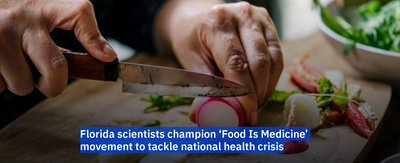
Florida scientists champion ‘Food Is Medicine’ movement to tackle national health crisis​

University of Florida researchers are calling for a national transformation in how we address the ongoing epidemic of obesity and Type 2 diabetes, starting with a fundamental shift in how we approach health, agriculture and food. Published recently in the Proceedings of the National Academy of Sciences, the article argues that fruits and vegetables must be treated not just as food — but as medicine.  With 73% of U.S. adults and 35% of children classified as overweight or obese, the authors warn that the crisis is not only an individual health issue but a national economic and security threat.  Andrew Hanson, Ph.D., a co-author and professor of horticultural sciences at UF/IFAS, emphasized a sense of urgency and collective responsibility toward solving this health crisis.  “This isn’t business as usual. We’re taking a public-interest view. This is the kind of thing we all need to be talking about. It’s too important not to,” he said.  The article proposes a roadmap for change, including creating five National Institutes of Health-supported “Food Is Medicine” centers across the U.S., with Florida as a leading candidate; scaling up domestic fruit and vegetable production to meet national dietary needs; partnering with food producer and processors to make healthy foods more accessible, affordable and appealing; and reforming medical and nutrition education to include horticultural sciences and vice versa. The article highlights that only 1 in 10 adults meets the recommended daily intake of fruits and vegetables, and that U.S. production falls far short of what’s needed to support a healthy population. The authors call for a dramatic expansion of fruit and vegetable production, especially high-impact crops like berries, leafy greens and carrots.  Christopher Gunter, Ph.D., professor and chair of the UF/IFAS Department of Horticultural Sciences, said the team’s goal is to push the role fruit and vegetables crops can play in improving human health into the national consciousness. “As a discipline, horticulture and the science of fruit and vegetables have been largely ignored in this conversation,” Gunter said. “Our goal is to move the needle on health with fruit and vegetables.”   Hanson said about 80% of the nation’s cropland is used to grow soybeans, corn and wheat — most of which are processed into products with low nutritional value that contribute to the obesity and Type 2 diabetes epidemic.  Mike Jaffee, M.D., a co-author and professor of neurology in the UF College of Medicine, stressed the broader implications of a high-vegetable diet on brain health.  “Obesity and insulin resistance are linked to inflammation and neurodegeneration. We’re living longer, but our brains aren’t keeping up. That’s where the real cost to individuals and the health care system comes in,” he said.  Gunter agreed, adding, “This epidemic reduces the longevity and productivity of our citizens. It limits the momentum communities need to grow healthy and resilient families.”  Hanson pointed out that higher socioeconomic groups are better positioned to meet dietary recommendations, making this not just a health issue, but a deeply embedded social and economic one.  “This crisis takes an unduly large toll on people with lower incomes and less time. To eat enough fruits and vegetables in the current system, you need substantial income and time to prepare food. That’s a luxury many don’t have,” he said.  The authors argue that farmers bring essential knowledge to the table.   “They understand how environmental factors impact nutritional quality,” Gunter said.

Michael Jaffee
