

Michael Knodler Jr.
William W. Boyer Endowed Professor of Civil and Environmental Engineering and Director of the UMass Transportation Center University of Massachusetts Amherst
- Amherst MA
Michael Knodler's main areas of research and teaching are related to transportation safety, operations, design, and education.

University of Massachusetts Amherst
View more experts managed by University of Massachusetts Amherst
Expertise
Biography
Social Media
Video
Education
University of Massachusetts Dartmouth
B.S.
Civil & Environmental Engineering
University of Massachusetts Amherst
M.S.
Civil Engineering
University of Massachusetts Amherst
Ph.D.
Civil Engineering [Emphasis: Transportation Engineering]
Links
Select Recent Media Coverage
No, You’re Not Hallucinating—There’s a Decimal Point on That Speed Limit Sign. Here’s Why
Reader's Digest print
2026-08-06
And how do you even comply with this?
Speed limit signs can either fade into the background or startle us to attention, often depending on how fast we might be going. Familiarity plays a role too. We expect to see 25 mph in a quiet residential neighborhood and 55 or 65 mph on a busy highway. But what if you were driving along and saw 8.2 mph, or 14.4? Most speedometers don’t even display tenths of a mile per hour, so how is a driver supposed to follow a rule of the road like that?
Why does green mean go and red mean stop?
Vermont Public radio
2026-05-01
Why is there traffic? How do traffic lights work? How do they know when to turn red and green? Why does green mean go and red mean stop? Why are cars able to go faster than they are allowed to go with the speed limit? Why do we drive on the right side of the road in the United States? Why are some roads bigger than others? Answers to your traffic questions with Mike Knodler, professor and director of the Transportation Center at the University of Massachusetts.
Hybrid traffic lights cause confusion among drivers
NBC Boston tv
2025-10-31
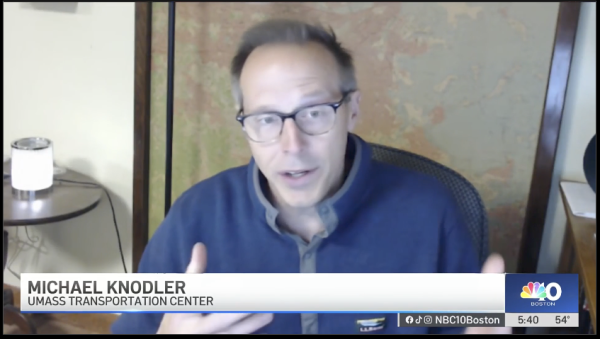
Researchers at the UMass Amherst Transportation Center found that dozens of signals in Massachusetts are leaving drivers and pedestrians with questions.
"Vision Zero" for no traffic deaths has a long way to go in Massachusetts
WBZ News tv
2024-03-28
Michael Knodler, director of the UMass Transportation Center, comments on the idea of “Vision Zero,” or the goal of eliminating serious/fatal car crashes, in Massachusetts. “It’s really a change in philosophy, in terms of how we approach roadway design,” he says. “We know human factor is a big part of [crashes] and we know humans are going to make mistakes, so given those two things, let’s design a roadway system that recognizes that.”

Highway safety advocates: Mass. traffic laws are improving
MassLive online
2023-10-05
Michael Knodler, professor of civil and environmental engineering and director of the University of Massachusetts Transportation Center, says Massachusetts is taking steps to improve traffic safety. “The state is recognizing the value of human life — in drivers, bikers and pedestrians. Equal access to safety is a primary focus for the state,” Knodler says.
UMass Amherst Opens Aviation Center With High-Tech Simulator
Government Technology online
2023-04-27
The 8,500-square-foot center was built with $4.75 million in state Military Asset and Security Strategy Task Force money and a $500,000 Buehler Foundation grant that funds the high-tech air traffic control tower simulator. It was proposed a decade ago with the idea of creating a partnership with the civilian airport and U.S. Air Force at Westover Air Reserve Base, said Michael A. Knodler Jr., director of the UMass Transportation Center.
The 'Zipper Merge' May Seem Aggressive, But It's Actually A Highway Congestion Reliever
WBUR online
2019-04-19
On a recent morning in Amherst, Mike Knodler, a civil engineer and director of the Traffic Safety Research Program at UMass Amherst, stood by the side of the road next to a yellow merge sign. “We have a regular joke, which is you can't be an outstanding traffic engineer unless you're out, standing in traffic,” Knodler said.
Mike Knodler is a proponent of the zipper merge. “This group seems to alternate merging, and it worked perfectly because they did sort of sequence — it was 1:1,” Knodler said.
Select Publications
Developing a Geospatial Safety Analysis Tool: A Systematic Approach to Identify Safety-Critical Horizontal Curve Segments and Hazardous Contributing Factors
Journal of Transportation Engineering, Part A: Systems2023
Transportation agencies make substantial efforts to implement safety improvement countermeasures to mitigate safety hazards. However, region-specific safety considerations, rather than accepting more general, widespread methods, and the most ideal investment decisions to improve safety, are often unclear. This is of increased concern for horizontal curve segments, because they are locations of elevated safety risk. Yet, there exists a gap in literature on the development and use of a geospatial tool to investigate horizontal curve safety. To fill this gap, a methodological approach to create a region-specific geospatial horizontal curve safety tool was developed in this research.
Investigating the Safety Impact of Segment-and Intersection-Level Bicycle Treatments on Bicycle–Motorized Vehicle Crashes
Transportation Research Record2023
Bicycle treatments are installed to elevate motorists’ awareness of the presence of bicyclists and to enhance bicycle safety and mobility. To date, no studies have compared the safety benefits of sharrows and protected- and conventional bike lanes, or intersection-level treatments like bike boxes and intersection-crossing pavement markings. One factor that limits bicycle safety research is the lack of adequate bicycle exposure data. For this study, a crowdsource app was used for estimating networkwide bicycle demand data for Portland, OR. Crash prediction models were developed for road segments and signalized intersections to associate bicycle treatment presence and type with crash frequency.
Driver performance at horizontal curves: bridging critical research gaps to increase safety
Traffic Safety Research2022
Horizontal curve segments are locations of critical safety concern given their high crash rates. Extensive research has identified that behavioral factors influence the occurrence of such crashes. However, the most beneficial countermeasure for a curve is not always implemented or is implemented inefficiently due to a lack of full understanding of driver behavior at curves compared to tangent roadway segments. The aim of this research is to identify the conditions that impact safety at curve locations compared to tangent segment locations. This is completed through a literature review of current research relating to curve safety issues and a safety analysis of curve and tangent segment data using a novel dataset that includes curve data throughout a region.
The impact of sex on motor vehicle crash injury outcomes
Journal of Transportation Safety & Security2022
Female and male drivers have different size proportions and anthropometry. However, in the United States and throughout the world, male crash dummies are the norm in vehicle testing and female crash dummies with representative anthropometric characteristics has not yet been used in testing to date. Given this discrepancy, female driver safety is not considered at the same level as male driver safety in the vehicle design and testing process. This research investigates the gap in literature of injury locations experienced by female and male drivers in comparable crashes using a newly created linked dataset of crash and emergency medical services (EMS) data in the Commonwealth of Massachusetts.
Crash proximity and equivalent property damage calculation techniques: An investigation using a novel horizontal curve dataset
Accident Analysis & Prevention2022-03-29
Despite the numerous breakthroughs in crash analytics, there remains a lack of consensus among safety practitioners as to the optimal method for locating high crash locations. Two critical components in the traffic safety analysis process not agreed upon are 1) how the crash distance to a target location is included in the analysis and 2) how crashes are weighted based on crash-related characteristics ...
