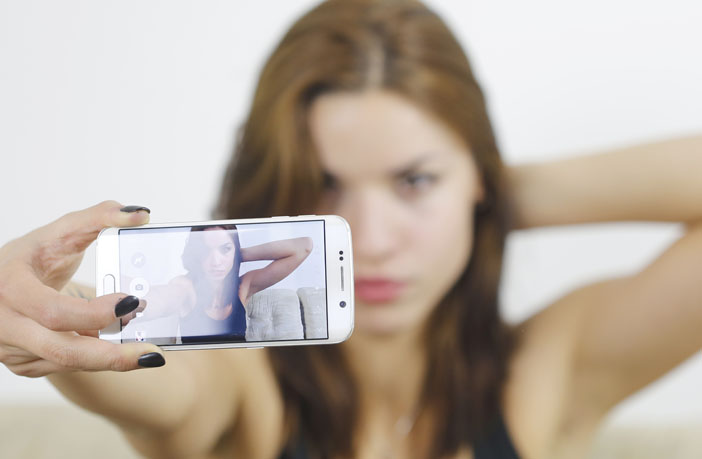
Psychological Science Professors Miriam Liss and Mindy Erchull’s research on selfie behaviors, self-objectification and depressive behaviors in women was recently published in the psychology journal, Sex Roles. Women are given the message that they are valued for their physical attractiveness above other qualities, and the study examines how self-objectification interplays with online behaviors.
A study recently published in the journal Sex Roles sheds new light on the relationship between selfie behaviors, self-objectification, and depressive symptoms in women. Since women often receive the message that they are valued primarily for their physical attractiveness, the researchers were interested in exploring how self-objectification was related to online behaviors. “I have been collaborating with Mindy Erchull on issues related to objectification theory for several years. I had also begun to be interested in the effects of social media on people’s experiences and had recently taught a senior seminar on the topic,” explained the study’s lead author, Miriam Liss, a professor of psychological science at University of Mary Washington. “Mindy and I became interested in how objectification relates to experiences with social media — particularly Instagram, which is a platform that is based on posting visual images. Other studies on the topic had largely looked at how feelings of self-objectification can be a consequence of social media. We wanted to look at how self-objectification can change how one behaves when taking and posting selfies.” For their study, the researchers surveyed 164 female students from a public liberal arts university in the Southeastern United States. The survey assessed photo manipulation, average number of selfies, body surveillance, perceived social media deception, and depressive symptoms. Most of the participants reported taking 2-5 selfies before posting one to Instagram, while approximately 5 percent reported taking more than 20 on average. The researchers found that women who took a larger number of selfies before choosing one to post to Instagram tended to have higher levels of body surveillance and more symptoms of depression. PsyPost, January 12 The article and details of the study are below. If you are a journalist looking to learn more about this topic or if you are interested in speaking with Professor Miriam Liss or Professor Mindy Erchull – simply click on either expert’s icon to arrange an interview today.
Media
Social
Biography
Cat calls, honking and whistling aren’t just annoying to the object of unsolicited sexual advances; they can be traumatic. That’s the discovery psychologist Mindy Erchull and her colleagues at the University of Mary Washington found after interviewing nearly 350 women for the study on sexual objectification “Stop Looking at Me!,” published in the Psychology of Women Quarterly. “Women who undergo more evaluation of their bodies by others and women who experience more unwanted sexual advances also had more body shame and more trauma symptoms,” said Dr. Erchull, an expert in sexualization of women, feminism and feminist identity. In addition to her recent research, she has conducted research on how jealousy is perceived by men and women, and its relationship to violence.
Honored by the American Psychological Association as an emerging leader, Dr. Erchull has extensive expertise in social psychology, health psychology, psychology of women, women’s health, social influence, and statistics and research methods. She also serves as a consulting editor for Psychology of Women Quarterly, Women’s Reproductive Health, and Gender Issues. In addition, she also regularly reviews manuscripts for other journals including Sex Roles, Health Care for Women International and Basic and Applied Social Psychology.
She has presented her work at numerous conferences including meetings of the American Psychological Association, the Association for Psychological Science and the Association for Women in Psychology. She has also published articles on her research in such academic journals as Psychology of Women Quarterly, Sex Roles, Personality and Social Psychology Bulletin, and Health Psychology, most recently “Desire for Marriage and Children: A Comparison of Feminist and Non-feminist Women” in Gender Issues.
Areas of Expertise
Feminism
Psychology of Women
Objectification and Sexualization of Women
Body Image
Menstruation
Social Influence
Accomplishments
Emerging Leader, awarded by the American Psychological Association
2014-08-15
The recognition honors psychologists who have made a substantial contribution to women in psychology and show promise of an extensive, influential career.
Education
Connecticut College
B.A.
Undergraduate Studies
Arizona State University
M.A.
Graduate Studies
Arizona State University
Ph.D.
Graduate Studies
Affiliations
Member-at-Large Society for General psychology. division of the American Psychological Association
Society for Menstrual Cycle Research 2015 Awards Coordinator
Program Chair Society for the Psychology of Women
Consulting Editor Psychology of Women Quarterly
Editorial Board Gender Issues
Associate Editor for reCycling a blog by the Society for Menstrual Cycle Research
Media Appearances
Selfies and Mental Health
WVTF Radio IQ online
2020-02-24
The practice of taking your own picture, then posting it to the Internet is a big part of youth culture, but psychologists at the University of Mary Washington say selfies may be a sign of trouble for young women. Which is why psychology professor Miriam Liss chose to take a closer look. She and her colleague Mindy Erchull studied 165 female students at their school – the University of Mary Washington.
What Parents Can Learn From a Town That Produced 11 Olympians
New York Times online
2018-02-09
They intuitively sense what a 2013 study in the Journal of Child and Family Studies concluded: that overprotective or helicopter parents thwart a child’s basic psychological need for autonomy and competence, resulting in an uptick in depression and lower life-satisfaction levels.
Mental health is a feminist issue because women’s experiences have often been, and continue to be, pathologized,” says Dr. Mindy J. Erchull, professor of psychological science at the University of Mary Washington in Virginia. “Women are more likely to be referred to as ‘crazy’ for example — both in daily conversation and in the media. Women have also had typical life experiences characterized as ‘disordered.’”
Mindy Erchull, University of Mary Washington Associate Professor of Psychological Science, will be featured in an encore presentation on the radio program With Good Reason from May 28 through June 3. The program is titled “The Innocence Project.” Erchull suggests that women who see jealousy as a positive thing may be more likely to find themselves in abusive relationships.
UMW Psychology Professor Featured on With Good Reason
publicnow.com online
2016-12-01
Assistant Professor of Psychological Science Mindy Erchull will be featured on the radio program With Good Reason Dec. 3-9.
When it comes to love, jealousy is sometimes thought of as “natural” or even desirable. But a recent survey led by Mindy Erchull (University of Mary Washington) suggests that women who see jealousy as a positive thing may be more likely to find themselves in abusive relationships.
The object of one’s desire: How perceived sexual empowerment through objectification is related to sexual outcomes
Sexuality & Culture
2014-01-02
There is a debate as to whether or not gaining a sense of sexual empowerment through being an object of sexual desire results in empowerment. This debate has been largely theoretical, but there are now operationalizations of self-sexualization, enjoying sexualization, and perceiving sex as a source of personal power which allow for the collection of data on this topic. The current study examined whether these constructs were related to attitudinal and behavioral indicators of sexual satisfaction and sexual agency. An online sample of young, heterosexual, sexually active women was recruited. Our constructs of interest were related to some positive sexual outcomes, including sexual esteem and sexual assertiveness. At the same time, these constructs were related to having faked orgasm, and both self-sexualization and the belief that sex can be a source of power were related to greater frequency of having faked an orgasm. Additionally, none of the variables was significantly related to sexual satisfaction or ease of orgasm. Thus, while there may be some positive sexual outcomes associated with these variables, there are other indicators that a sense of empowerment through objectified sexuality may interfere with true sexual subjectivity.
Exploring perceptions of slut-shaming on Facebook: Evidence for a reverse sexual double standard
Gender Issues
2015-03-02
Although there is a widespread belief that women are judged more harshly for sexual activity than men, research on the existence of the sexual double standard has been mixed. We investigated the sexual double standard and “slut-shaming” by asking participants to provide perceptions of both a target of “slut-shaming” and a “shamer.” Male and female participants viewed a blinded Facebook conversation in which the male or female target, or “slut,” was shamed by either a male or female “shamer.” We found evidence for a reverse sexual double standard; male “sluts” were judged more harshly. Furthermore, the “shamer” was negatively evaluated, especially when shaming a woman. Our participants also indicated a belief in a societal sexual double standard. They perceived the “shamer” to be more judgmental and less congratulatory when the “slut” was female. Furthermore, qualitative data indicated that female “sluts” were believed to be labeled as such for lower levels of sexual behavior (e.g., sexy clothing or dancing), than was the case for male “sluts” (e.g., sex with multiple partners). Our data indicate that individual beliefs are changing more quickly than social perceptions.
The role of romantic attachment in women’s experiences of body surveillance and body shame
Gender Issues
2015-02-02
Self-objectification, body surveillance, and body shame have been widely researched in the context of early attachment and interpersonal relationships; however, no research to date had been conducted on the role of romantic attachment styles. In the current study, we examined the role of romantic attachment in women’s (n = 193) experiences of body surveillance and body shame. We hypothesized a model in which anxious and avoidant attachment positively predicted body shame through the intervening variable of body surveillance and then revised the model to incorporate a direct path from anxious attachment to body shame. The revised model had good fit to our data. Our research suggests that body surveillance and body shame are outcomes of insecure romantic attachment in adulthood. While this was true for both insecure attachment styles, anxious attachment, in particular, was a stronger predictor of both body surveillance and body shame. We discuss the potential implications of these findings in the context of prior research on self-objectification and relationship contingency, self-esteem, and rejection fears.
Stop Looking at Me! Interpersonal Sexual Objectification as a Source of Insidious Trauma
Psychology of Women Quarterly
2014-11-26
Objectification has been conceptualized as a form of insidious trauma, but the specific relationships among objectification experiences, self-objectification, and trauma symptoms have not yet been investigated. Participants were women with (n = 136) and without (n = 201) a history of sexual trauma. They completed a survey measuring trauma history, objectification experiences (body evaluation and unwanted sexual advances), constructs associated with self-objectification (body surveillance and body shame), and trauma symptoms. The relationships among the variables were consistent for both women with and without a history of sexual trauma. Our hypothesized path model fit equally well for both groups. Examination of the indirect effects showed that experiencing unwanted sexual advances was indirectly related to trauma symptoms through body shame for those with and without a history of sexual trauma. Additionally, for women with a history of sexual trauma, the experience of body evaluation was indirectly related to trauma symptoms through the mediating variables of body surveillance and body shame. The data indicate that the experience of sexual objectification is a type of gender-based discrimination with sequelae that can be conceptualized as insidious trauma. Clinicians may consider the impact of these everyday traumatic experiences when working with women who have clinical symptoms but no overt trauma history.
Professor of Psychology Miriam Liss recently presented a poster titled “The dark side of romance: Romantic beliefs predict intimate partner violence” at the annual meeting of the Association for Psychological Science in San Francisco, Calif., with her collaborators Mindy Erchull, Hester Godfrey ’14, Leanna Papp ’14, and Lauren Waaland-Kreutzer ’14...