Rachael Seidler

Professor University of Florida

  • Gainesville FL

Rachael Seidler researches the neural control of movement in health and disease, with a specific focus on motor learning.

Contact

University of Florida

View more experts managed by University of Florida

Biography

Rachael Seidler's research focuses on the neural control of movement in health and disease, with a specific focus on motor learning. She uses a range of neuroimaging and neuromodulation techniques coupled with precise measures of movement and cognitive function to determine the neurocognitive underpinnings of motor control. Rachael has expertise working with a variety of populations including healthy young and older adults, patients with Parkinson’s disease, and NASA astronauts in both basic science and intervention experiments. Her work has been supported by the NIH, the NSF, NASA, the National Space Biomedical Research Institute and a variety of private foundations. Active work in her lab includes investigation of human brain plasticity with spaceflight and experiments investigating which cognitive processes support skill acquisition and how they map onto underlying neural pathways. She is a member of the Astraeus Space Institute.

Areas of Expertise

Space
Parkinson's
Cognitive Ageing
Neuroscience and the Brain
Neuroplasticity
Spaceflight Human Research

Media Appearances

NASA Selects Proposals to Study Astronaut Health and Performance for Moon and Mars Missions

NASA  online

2021-05-13

NASA's Human Research Program will fund seven proposals to help protect astronaut health and performance during future long-duration missions beyond low-Earth orbit. The selected proposals will investigate biological, physiological, and behavioral adaptations to spaceflight. The seven selected projects will contribute to NASA’s long-term plans, which include crewed missions to the Moon and Mars.

View More

Brains of Astronauts Show Deterioration Similar to Aging

Psychology Today  online

2019-02-04

“The white matter changes were primarily in regions that control movement and process sensory inputs,” said Rachael Seidler, a professor of applied physiology and kinesiology at the University of Florida, and a coauthor of the study. When the human body is weightless in Earth orbit, the usual cues of gravity are missing, which could alter the typical inputs from senses. For example, the vestibular system provides people with a sense of balance and an awareness of how they are oriented in space. “A portion of the vestibular system also depends upon gravity for its signaling, so these inputs are also altered,” Seidler told Psychology Today.

View More

Spaceflight changes your brain pathways

UF News  online

2019-01-23

The deterioration was the same type you’d expect to see with aging, but happened over a much shorter period of time. The findings could help explain why some astronauts have balance and coordination problems after returning to Earth, said Rachael Seidler, a professor with UF’s College of Health and Human Performance.

View More

Show All +

Social

Articles

Brain activity during walking in older adults: Implications for compensatory versus dysfunctional accounts

Neurobiology of Aging

Tyler Fettrow, et al.

2021-06-25

A prominent trend in the functional brain imaging literature is that older adults exhibit increased brain activity compared to young adults to perform a given task. This phenomenon has been extensively studied for cognitive tasks, with the field converging on interpretations described in two alternative accounts. One account interprets over-activation in older adults as reflecting neural dysfunction, whereas another interprets it as neural compensation.

View more

Visuomotor Adaptation Brain Changes During a Spaceflight Analog With Elevated Carbon Dioxide (CO2): A Pilot Study

Frontiers in Neural Circuits

Ana Paula Salazar, et al.

2021-06-07

Astronauts on board the International Space Station (ISS) must adapt to several environmental challenges including microgravity, elevated carbon dioxide (CO2), and isolation while performing highly controlled movements with complex equipment. Head down tilt bed rest (HDBR) is an analog used to study spaceflight factors including body unloading and headward fluid shifts.

View more

GABA levels in ventral visual cortex decline with age and are associated with neural distinctiveness

Neurobiology of Aging

Jordan Chamberlain, et al.

2021-03-23

Age-related neural dedifferentiation—a decline in the distinctiveness of neural representations in the aging brain—has been associated with age-related declines in cognitive abilities. But why does neural distinctiveness decline with age? Based on prior work in nonhuman primates and more recent work in humans, we hypothesized that the inhibitory neurotransmitter gamma-aminobutyric acid (GABA) declines with age and is associated with neural dedifferentiation in older adults.

View more

Show All +

Spotlight

4 min

The health challenges astronauts Butch Wilmore and Suni Williams face after 9 months in space

On June 5, 2024, astronauts Butch Wilmore and Suni Williams embarked on a brief mission to the International Space Station. But equipment failures turned what was supposed to be an eight-day trip into a grueling 9 month spaceflight. This week, Wilmore and Williams finally returned to Earth. While their safe return is cause for celebration, the journey doesn’t end when astronauts touch down on Earth. They now face the significant task of recovering from the physical and psychological toll of long-duration spaceflight. As part of the University of Florida’s ongoing research into astronaut health, Rachael Seidler, Ph.D., a leading expert in spaceflight-associated health changes, is studying the long-term effects of space travel on astronauts’ brains and bodies. Seidler’s research focuses on understanding how the central nervous system and brain structure adapt to the challenges of space travel, as well as how these changes affect performance, balance, and mobility once astronauts return to Earth. “While the physical and psychological challenges astronauts face after returning from long-duration space missions are well-documented, the research we do at UF is helping us understand the intricacies of their recovery process,” said Seidler, deputy director of the Astraeus Space Institute at UF. “By following astronauts like Butch and Suni before, during, and after their missions, we can track how the human body responds to the extreme conditions of space.” Behavioral and Brain Changes Post-Flight Seidler’s research tracks astronauts’ physical and neurological recovery by observing them both during their missions and after they return. "One of the most immediate challenges astronauts face when they return to Earth is mobility and balance. These issues often recover more quickly compared to others, but it takes time for astronauts to readjust to gravity,” Seidler said. "The balance, mobility, and walking difficulties astronauts experience during the first weeks back are typically resolved in a short period, but brain function and structure require longer recovery periods." Seidler’s research indicates that astronauts’ brains exhibit compensation when they return to Earth following spaceflight. This compensation occurs through the recruitment of additional neural pathways in order to return to their preflight performance levels. However, the recovery of brain function is a gradual process. "This brain functional compensation is typically no longer observed within one to six months post-flight," Seidler said. However, not all changes are reversible. "Brain structural changes, particularly related to fluid shifts in space, show little to no recovery even after six months to a year," Seidler said. Two significant structural changes include the brain physically sitting higher in the skull and the expansion of the brain’s ventricles — fluid-filled cavities in the brain — which can increase in volume by 25% or more. These changes are thought to result from the fluid shifts caused by microgravity, and they present long-term health considerations for astronauts. Long-Term Health Effects: Understanding the Impact As Wilmore and Williams embark on their recovery journey, the long-term impact of these changes becomes a critical focus for researchers like Seidler. "The long-term health impacts are crucial to understand because they could affect how astronauts recover and perform in their daily lives post-mission," she said. Seidler’s team at UF is conducting a new study in which they are tracking astronauts for up to five years post-flight to better understand these long-term effects. "We’ve had astronauts in space for up to a year, and we know how to manage their physical health during those missions," Seidler said. "But the effects of space on the brain and body extend beyond the mission, and our work helps inform strategies to manage recovery." Collaborating with NASA and Studying Spaceflight-Associated Neuro-Ocular Syndrome Seidler's work is also part of a broader collaboration with NASA and other scientists to assess astronaut long-term health. The project is particularly focused on Spaceflight-Associated Neuro-Ocular Syndrome, which affects up to 70% of astronauts. This condition involves structural changes to the eye and optic nerve, leading to vision problems that may impact astronauts’ function. "Neuropsychological assessments can help to measure astronauts’ brain health, while studies of the ocular system help identify potential vision issues that may arise during and after long-duration space missions," she said. Simulating Space Conditions on Earth In addition to studying astronauts on Earth and in space, Seidler’s team conducts experiments to simulate the effects of spaceflight on human physiology. The UF lab runs experiments in head-down tilt bed rest studies, which keep participants lying down for weeks to months at a time to simulate the lack of gravity. "This type of study helps us understand how fluid shifts in the body during space travel affect mobility, balance, and brain structure," Seidler explained. "In addition, other publications have reported that astronauts describe that vestibular galvanic stimulation feels similar to what they experience when they first arrive in space and when they return to Earth. We have equipment to induce these effects in the lab." Looking Toward the Future As space missions continue to grow longer and more complex, UF’s research is more important than ever. "We’re studying these issues now to ensure that future astronauts are prepared for the physical and cognitive challenges that await them in deep space," Seidler said.

Rachael Seidler

1 min

Opinion: Hey Florida! Want to go to Mars? Here’s what it will do to your body

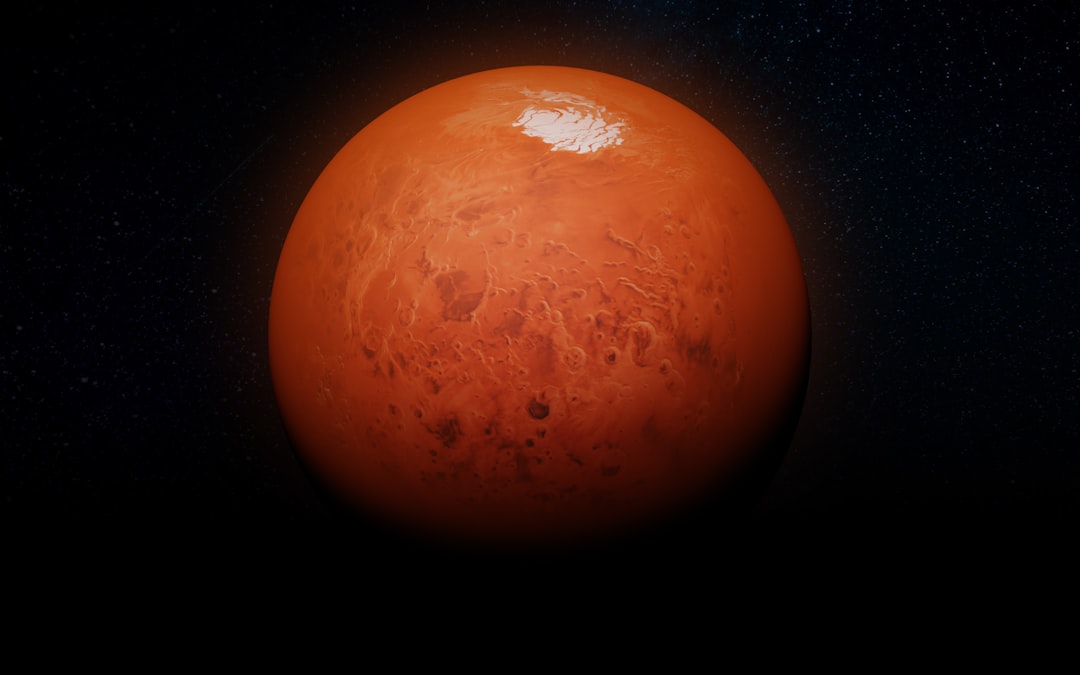
The president is eager “to plant the stars and stripes on the planet Mars.” Would you sign up for that mission? What would happen to your body in the three years you would be gone? As the United States continues to prioritize space travel, you might wonder why anyone would want to travel to Mars and whether it’s even ethical to expose humans to such extreme physiological conditions. The world is watching as the astronauts on the Boeing Starliner remain stuck in space until at least March due to a capsule malfunction. So many questions have arisen about the impacts of people spending extended periods of time in space, and we don’t have all the answers yet. However, because I study how spaceflight affects human physiology and performance, I have some ideas. The first 10 minutes of your journey will be exciting, but it’s the next months and years we really need to worry about. We have solved some of the problems but not all. After you lift off, the high g-forces will paste your body against the crew couch as you accelerate, but there’s really not too much to fear. A typical launch results in only about half the acceleration experienced by a fighter pilot in a tight turn. You might feel lightheaded, but astronauts have dealt with this for generations. Read the full article in the Tampa Bay Times here:

Rachael Seidler

2 min

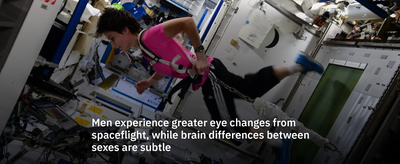
Men experience greater eye changes from spaceflight, while brain differences between sexes are subtle

A new study into how spaceflight impacts the human brain and eyes revealed notable sex differences in brain fluid shifts, with female astronauts showing a greater reduction in fluid around the uppermost part of the brain than their male counterparts. Led by Rachael D. Seidler, Ph.D., director of the University of Florida’s Astraeus Space Institute and professor of applied physiology and kinesiology, the study analyzed data from astronauts to determine how factors such as sex, age and body metrics relate to structural brain and eye changes after space travel. The findings, published in August in npj Microgravity, provide key information for protecting astronaut health on long-duration missions to the moon and Mars. This is one of the first studies to look at sex differences in the physiological response to spaceflight. “The data on sex differences in response to spaceflight are scant, given the historically low number of female astronauts.” — Rachael D. Seidler, Ph.D., director of the University of Florida’s Astraeus Space Institute In addition to changes in fluid around the brain, the team also found that a form of eye compression, a hallmark of Spaceflight Associated Neuro-ocular Syndrome known as globe flattening, was the most consistent eye change among crew members. “By far the most prevalent sign of eye changes that we observed was globe flattening, suggesting that this should be the primary monitoring target for ocular health,” Seidler said. “Interestingly, eye changes were more prevalent in males than females.” Globe flattening, when the back of the eyeball becomes slightly indented or pushed inward, might sound minor, but it can have significant effects on vision and raise concerns for long-duration space missions. Surprisingly, there was no strong link between brain structural changes and eye changes, suggesting that the effects on the eyes and brain may arise from distinct mechanisms rather than shared physiological causes. The research underscores UF’s growing leadership in space health science. Through the Astraeus Space Institute, Seidler leads multidisciplinary collaborations that connect neuroscience, physiology and space research to advance human performance and safety in spaceflight. “We used UF's HiPerGator computing cluster for our analyses in this study, enabling us to analyze our data at high speeds,” Seidler said. Read the full study in npj Microgravity.

Rachael Seidler