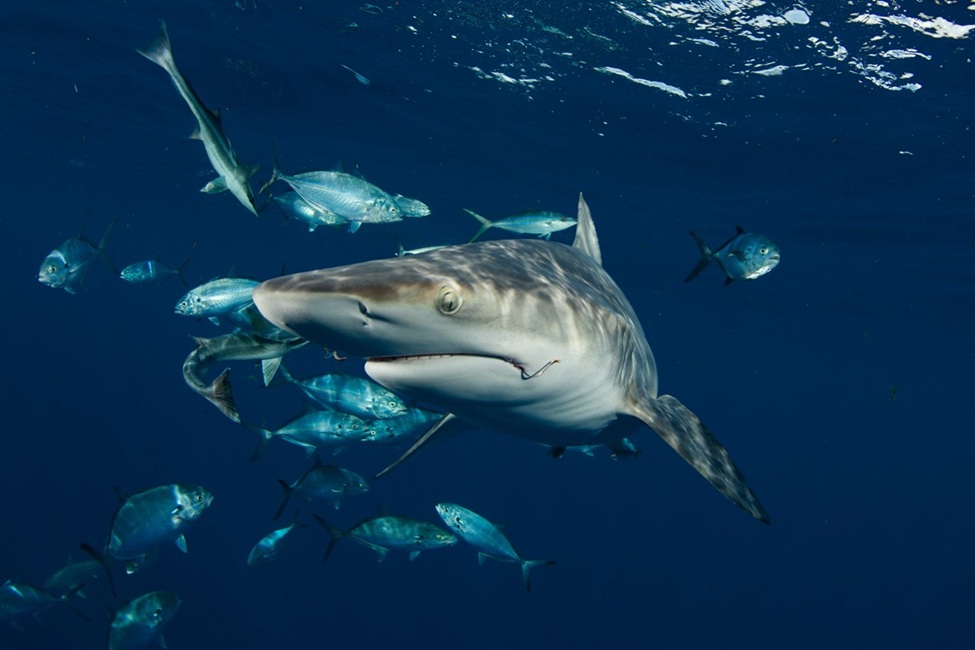
As ocean temperatures continue to rise, researchers are seeing major changes in the migration patterns of blacktip sharks, and that could mean more encounters between sharks and humans along North America’s east coast.
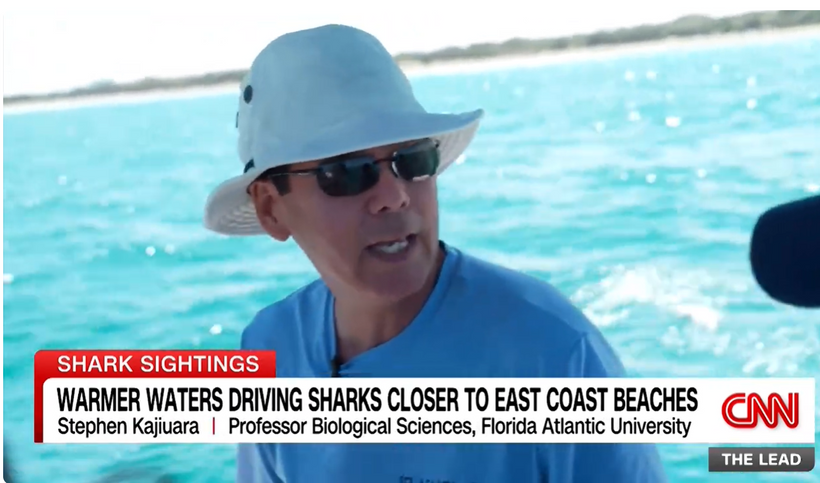
A recent CNN feature highlighted groundbreaking research led by Stephen Kajiura of Florida Atlantic University, whose team is tracking blacktip sharks using GPS tags and onboard cameras to better understand how warming waters are reshaping marine ecosystems.
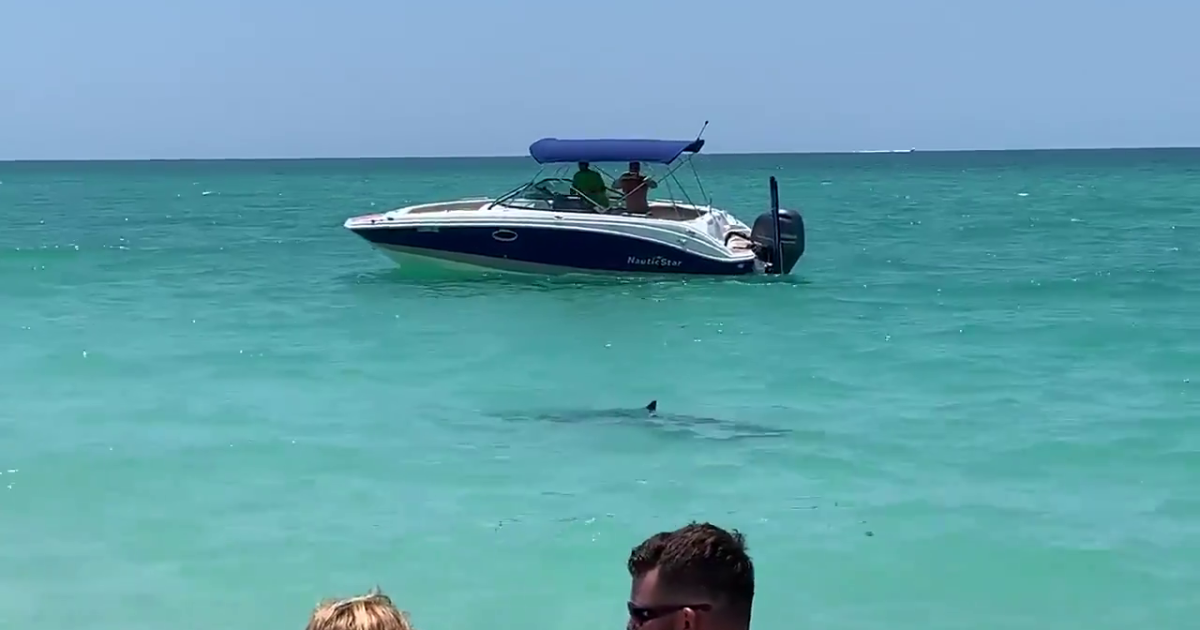
According to Kajiura, average winter water temperatures have risen by roughly 1°C over the past decade, causing blacktip sharks to shorten their traditional southern migration and remain farther north for longer periods. That shift is increasing shark activity near heavily populated beaches, including Florida’s New Smyrna Beach — often referred to as the “shark bite capital of the world” — and even farther north into areas like Long Island, where shark encounters have historically been rare.
Stephen Kajiura is a Professor of Biological Sciences at FAU. He studies the sensory biology and behavior of sharks and their relatives as well as their seasonal migrations in southeast Florida. View his profile The research is helping scientists better predict when and where sharks are likely to gather near shorelines. Kajiura notes that blacktip sharks often hunt in the same shallow waters used by surfers and swimmers, where reflective movement from hands or feet can sometimes resemble bait fish. While shark bites remain uncommon, understanding migration behavior is becoming increasingly important for public safety, beach management, and climate research.
Journalists covering climate change, marine biology, shark migration, or beach safety can connect with Stephen Kajiura to discuss how warming oceans are changing shark behavior and what coastal communities should expect in the years ahead.
·
4 min
Study Snapshot: Shark bycatch is a major global problem, with millions of sharks caught unintentionally each year in fisheries targeting tuna, swordfish and other species. Even in U.S. waters, sharks are frequently caught on longlines, and many are discarded dead. Because sharks grow and reproduce slowly, these high bycatch rates threaten already vulnerable populations and disrupt marine ecosystems. Researchers at FAU’s Charles E. Schmidt College of Science have developed a patent-pending zinc-and-graphite device to address the problem. The metals generate a small electric field that repels sharks from baited hooks while leaving target species unaffected. In Florida field trials, the device reduced shark bycatch by more than 60%. Inexpensive, scalable and practical for fishers, this technology has the potential to dramatically reduce bycatch and support more sustainable fisheries. For decades, sharks have been the unintended victims of longline fisheries aimed at tuna and swordfish. Rising accidental catches have contributed to population declines and created serious challenges for both conservation and commercial fishing. And the impacts go beyond the sharks themselves – every time a shark takes the bait, hooks are lost to target species, gear gets damaged, costs climb, and crews face added risks when handling or releasing the animals.
Although some gear modifications can reduce bycatch, they often also cut into catches of valuable species, making it hard to protect sharks without putting fisheries at a disadvantage.
To tackle this challenge, researchers at Florida Atlantic University’s Charles E. Schmidt College of Science have developed an innovative, patent-pending shark deterrent. The device works by pairing zinc and graphite in seawater. The zinc reacts with the graphite to produce a small electric field in the surrounding seawater through a galvanic chemical reaction. This electric field can be detected by the sharks, repelling them from the bait without affecting target fish.
To test the efficacy of the zinc/graphite treatment at deterring elasmobranch species, longline fishing gear was deployed to target demersal sharks (live and hunt near the sea floor) off the Florida panhandle and Massachusetts, and pelagic sharks (live and hunt in open water) in the Gulf of America.
The results of the field trials, published in the Canadian Journal of Fisheries and Aquatic Sciences, delivered striking results. In Florida, the zinc/graphite treatment reduced the catch of coastal sharks on demersal longlines by 62% to 70% compared to untreated hooks. The effect was particularly strong for Atlantic sharpnose (Rhizoprionodon terraenovae) and blacktip sharks (Carcharhinus limbatus), two common coastal species.
“Sharks have an incredible ability to sense even the smallest electric fields, and our tests show that this new approach can be used to keep them away from baited hooks,” said Stephen Kajiura, Ph.D., senior author, inventor and a professor in the FAU Department of Biological Sciences. “At the same time, important target species like tuna and swordfish are completely unaffected. What makes this approach so exciting is its practicality – zinc and graphite are inexpensive, widely available, and already familiar to fishers because zinc is commonly used to prevent corrosion on boats. This means it could be adopted quickly and cost-effectively, providing a real solution to reduce shark bycatch while supporting sustainable fisheries.”
Importantly, the treatment did not reduce catches of commercially important fish species. Preliminary pelagic trials suggest swordfish and yellowfin tuna were caught at similar or slightly higher rates on treated hooks, showing the approach could protect sharks without hurting the catch of target species.
The study also outlines practical considerations for real-world use. Because the electric field is strongest close to the hook, each line would need its own zinc-graphite device. The zinc anode slowly wears down, but it’s cheap and easy to swap out.
Shark bycatch is a widespread and pressing problem, both in the United States and around the world. Globally, millions of sharks are caught unintentionally every year in fisheries targeting other species, and some estimates suggest tens of millions fall victim to bycatch annually. In U.S. waters, despite strict regulations, sharks are still caught incidentally on longlines and other gear. Because sharks reproduce slowly and have long lifespans, these high bycatch rates can push populations toward dangerously low levels. The scope of shark bycatch, from small coastal fisheries to large international fleets, makes it a global conservation challenge with serious ecological consequences.
“Our approach could be scaled up to pelagic longline fisheries, where millions of sharks are caught as bycatch annually,” said Kajiura. “Even a 60% to 70% reduction in shark bycatch, like that observed in Florida demersal trials, could have a dramatic impact on global shark populations. The zinc/graphite treatment offers a practical, affordable and environmentally responsible tool for reducing shark bycatch while maintaining commercial catch rates.” Study co-authors are FAU graduate students Tanner H. Anderson and Kieran T. Smith; co-inventor on the patent application; Cheston T. Peterson, a Ph.D. student at Florida State University; Bryan A. Keller, Ph.D., a foreign affairs specialist at NOAA Fisheries; and Dean Grubbs, Ph.D., a full research faculty and associate director of research at FSU.
This research was supported by the Florida SeaGrant awarded to Kajiura and Grubbs.
The patent-pending device works by pairing zinc and graphite in seawater, creating an electric field that can be detected by the sharks, repelling them from the bait without affecting target fish.
·
2 min
It was a rare occurrence, and for Florida Atlantic University’s resident shark expert Stephen Kajiura, Ph.D. – it happened twice. Kajiura has photographed millions of sharks – but this sighting was no regular day on the water. “The first sawfish was near Boca Raton and was seen swimming southbound in shallow water. He estimated it to be about 9 feet long. The second one was near MacArthur State Park on Singer Island and a little larger. Sawfish can grow as large as 17 feet in length. Kajiura's sawfish encounters are the latest in a regular string of encounters reported by anglers, divers and researchers. In recent years, sawfish have been caught and released by Florida anglers fishing from beaches for sharks, or in inlets for tarpon. Sawfish have become regular catches for anglers fishing the waters of the Indian River Lagoon, Everglades National Park or the waters of Charlotte Harbor. “ TC Palm – USA Network That was last month, however, just recently, a large hammerhead shark was coming dangerously close to shore, raising some cause for concern about swimmer safety. Lifeguards closed the Nokomis Public Beach for close to an hour until the enormous fish had departed for deeper waters. The encounter left some scared and some curious – looking to catch a glimpse or picture of the gigantic shark. So, what do you do when a shark comes close to shore? How dangerous is it? How can experts or event he public tell when a shark is aggressive or just passing by? Sharks do call the ocean home – what do we all need to do to exist in harmony? Are you covering? Do you need to know more about sharks, the dangers they pose and what we really need to be concerned about and even break down some of the myths and legends about just how concerned humans need to be about these predators? Let our experts help. Stephen Kajiura, Ph.D., is a professor and researcher at Florida Atlantic University. He’s also an expert in sharks and shark behavior. Stephen is available to speak with media – simply click on his icon to arrange an interview.
Multimedia
Social
Biography
Stephen Kajiura's lab is primarily interested in the integration of sensory biology and behavior with functional morphology. He employs behavioral assays, field observations, and comparative morphology to test hypotheses about the evolution of biological structures. He has concentrated primarily on the elasmobranch fishes, which provide an opportunity to investigate various sensory modalities among closely related but morphologically dissimilar species. In addition, he maintains an active research program studying the annual blacktip shark migration. This work incorporates aerial surveys, transmitter instrumentation, and field observations. He also examines the seasonal abundance of the prey of the blacktip sharks, as well the movements of the great hammerhead sharks that prey upon them.
Outside/Inbox: How do shark noses work underwater?
NPR online
2023-05-12
Say you’re walking along and you smell smoke. You might not see it, but you have some sense if it's near or far, and you might be able to follow that smell right to the source. You might even be able to tell if it’s a hamburger or just some wood burning.
Sharks do the same thing, though they have different physiology, according to Stephen Kajiura, professor and head of the Shark Lab at Florida Atlantic University.
Critically endangered great hammerhead shark found dead on Alabama beach was pregnant with 40 pups
FOX News online
2023-04-27
Researchers captured drone footage of blacktip sharks evading a 12-foot-long hammerhead shark in Florida. (Stephen M Kajiura/Florida Atlantic University)
We Just Hear This Shrill Scream. Then It Was Over. The Sharks Got Him
Newsweek online
2022-11-19
Stephen M. Kajiura, professor of Biological Sciences at Florida Atlantic University, told Newsweek: "Tiger sharks can be very large and quite capable of consuming large prey, including adult humans."
Great White Shark Feeding Frenzy Could Be Triggered by Mass Whale Stranding
Newsweek online
2022-09-27
"[Whale] blubber has a high energy content," professor Stephen Kajiura from Florida Atlantic University, told Newsweek. "You need big jaws to chomp through the side of a whale.
'They've always been close to shore;' experts anticipate more shark encounters
CBS12 online
2022-05-02
Florida Atlantic University biology professor Stephen Kajiura tells CBS12 News Blacktip sharks tend to be smaller, on average around 5 feet. He says their size allows them to get closer to the shore. Based on his research, Blacktip sharks account for more shark bites in Florida.
Florida shark feeding dives: Why it's time to ban this practice for the animal's sake
TCPalm online
2022-01-14
Steve Kajiura, head of the shark research program at Florida Atlantic University in Boca Raton, said shark tours are not all created equal. Some do good, but some may harm without realizing it.
Oil Spills May Ruin Electric Sensing Abilities of Stingrays
Inside Science online
2020-09-30
"It’s kind of out of sight, out of mind," said Stephen Kajiura, a biologist at Florida Atlantic University in Boca Raton and one of the two co-authors of a new study published recently in the journal Zoology that looks at how oil affects the ability of stingrays to hunt.
Most stingrays live in coastal saltwater environments rather than the open ocean, said Stephen Kajiura, professor of biology at Florida Atlantic University. However, there is one species of stingray that lives in open ocean waters, called the pelagic stingray (Pteroplatytrygon violacea), he said.
Overfishing erased sharks from many of the world's reefs, researchers say
UPI online
2020-08-27
"A lot of these sharks are highly migratory species, and the problem is we might enact protections in the U.S. but that only works while they're here," Kajiura said. "So it's important to have these protections become global as possible."
Shark vs. Surfer Clip: How You Can Be Mistaken For Food [EXCLUSIVE]
Screen Rant online
2020-07-31
Screen Rant's exclusive Shark vs. Surfer clip brings viewers to Marjorie's Sunset Surf where Professor Stephen Kajiura explains just how sharp shark jaws really are and how a sunset surf provides the perfect setting for a shark to confuse a human for something else on the surface.
FAU study shows adult blacktip sharks use shallow water to avoid hammerheads
WPTV online
2020-05-14
“In two of the three videos, the hammerhead shark actively chased one or more blacktips toward the shore but was unsuccessful at capturing its prey,” said FAU Dr. Stephen Kajiura in a written statement. “The chases ended with the hammerhead making a sharp turn away from its intended prey and the shore, back into deeper waters. The chasing events showed the hammerhead struggling as it experienced difficulty following the blacktips into the shallow waters.”
See how blacktip sharks evade hungry hammerheads in these tense drone videos
CNET online
2020-05-14
The videos were captured close to the shore of Palm Beach County and they're as heart-pounding as any scene from an action movie. "The chasing events showed the hammerhead struggling as it experienced difficulty following the blacktips into the shallow waters," said FAU biologist Stephen Kajiura, co-author of the study.
Lower number of shark bites off Florida coast may not be good news. Here's why.
USA Today online
2020-01-25
FAU shark expert Stephen Kajiura began tracking the blacktips’ yearly sojourn a decade ago by meticulously counting each raisin-shaped shadow in photos taken during flights over the region as the toothy travelers headed south for the winter.
Dr. Stephen Kajiura doesn’t think you should be afraid of sharks. Of course, that’s to be expected from one of the preeminent shark researchers in the world.
Droves of Blacktip Sharks Are Summering in Long Island for the First Time
Live Science online
2019-08-12
"These blacktips are going way the heck up to Long Island in big numbers — not just a few, but 25, 30 percent of the population," Stephen Kajiura, a shark expert at Florida Atlantic University, told Live Science. "It blows your mind when you see it."
Great white sharks, others catching fishermen's eyes off Florida's Atlantic coast
The Daytona Beach News-Journal online
2019-03-14
Further to the south, Stephen Kajiura and other researchers at Florida Atlantic University’s Elasmobranch Research Laboratory have seen large schools of blacktip sharks in the ocean off Palm Beach during research in February and March.
Blacktip sharks begin annual migration to Florida's south Atlantic coast
Tampa Bay Times online
2019-02-28
Dr. Stephen Kajiura, a researcher at Florida Atlantic University, has been tracking the migration patterns of these apex predators by air and sea. Now Kajiura's latest tool is providing thorough details about their every move.
Thousands of sharks make annual migration off Florida coast
Orlando Sentinel online
2019-02-27
"We welcome blacktip sharks back to South Florida because they are critically important to our ecosystem," said Stephen Kajiura, a professor of biological sciences at FAU in a report on the FAU website. "They sweep through the waters and ‘spring clean’ as they weed out weak and sick fish, helping to preserve coral reefs and sea grasses."
Number of shark bites dropped last year, both in Florida and worldwide
Tampa Bay Times online
2019-01-28
The blacktips migrate back and forth along the Atlantic coast, from Virginia and the Carolinas to Florida each year. Stephen M. Kajiura, a scientist at Florida Atlantic University, has spent the past decade keeping tabs on that migration when it reaches Florida...
The use of an unoccupied aerial vehicle to survey shark species over sand and rocky-reef habitats in a marine protected area
Journal of Fish Biology
Stephen Kajiura et al
2021
Aerial surveying of elasmobranchs has traditionally been completed with manned aircraft, particularly for large species like basking sharks (Cetorhinus maximus) (Squire Jr, 1990, Crowe et al., 2018) and whale sharks (Rhincodon typus) (Gifford et al., 2001; Ketchum et al., 2013; Rowat et al., 2009). Advances in wireless communications and battery technology have led unoccupied aerial vehicles (UAVs), commonly known as “drones,” to become integral tools in shark research (Butcher et al., 2021). UAVs have either a fixed-wing design, capable of covering large distances, or a multirotor design, capable of covering shorter distances but with the ability to hover (Colefax et al., 2018). Multirotor UAVs are particularly applicable for surveying coastal areas where there is contrast between the target species and habitat substrate.
Over the past decade, drones have become a popular tool for wildlife management and research. Drones have shown significant value for animals that were often difficult or dangerous to study using traditional survey methods. In the past five years drone technology has become commonplace for shark research with their use above, and more recently, below the water helping to minimise knowledge gaps about these cryptic species. Drones have enhanced our understanding of shark behaviour and are critically important tools, not only due to the importance and conservation of the animals in the ecosystem, but to also help minimise dangerous encounters with humans. To provide some guidance for their future use in relation to sharks, this review provides an overview of how drones are currently used with critical context for shark monitoring. We show how drones have been used to fill knowledge gaps around fundamental shark behaviours or movements, social interactions, and predation across multiple species and scenarios. We further detail the advancement in technology across sensors, automation, and artificial intelligence that are improving our abilities in data collection and analysis and opening opportunities for shark-related beach safety. An investigation of the shark-based research potential for underwater drones (ROV/AUV) is also provided. Finally, this review provides baseline observations that have been pioneered for shark research and recommendations for how drones might be used to enhance our knowledge in the future.
Volitional Swimming Kinematics of Blacktip Sharks, Carcharhinus limbatus, in the Wild
Drones
Stephen Kajiura et al
2020
Recent work showed that two species of hammerhead sharks operated as a double oscillating system, where frequency and amplitude differed in the anterior and posterior parts of the body. We hypothesized that a double oscillating system would be present in a large, volitionally swimming, conventionally shaped carcharhinid shark. Swimming kinematics analyses provide quantification to mechanistically examine swimming within and among species. Here, we quantify blacktip shark (Carcharhinus limbatus) volitional swimming kinematics under natural conditions to assess variation between anterior and posterior body regions and demonstrate the presence of a double oscillating system. We captured footage of 80 individual blacktips swimming in the wild using a DJI Phantom 4 Pro aerial drone. The widespread accessibility of aerial drone technology has allowed for greater observation of wild marine megafauna. We used Loggerpro motion tracking software to track five anatomical landmarks frame by frame to calculate tailbeat frequency, tailbeat amplitude, speed, and anterior/posterior variables: amplitude and frequency of the head and tail, and the body curvature measured as anterior and posterior flexion. We found significant increases in tailbeat frequency and amplitude with increasing swimming speed. Tailbeat frequency decreased and tailbeat amplitude increased as posterior flexion amplitude increased. We found significant differences between anterior and posterior amplitudes and frequencies, suggesting a double oscillating modality of wave propagation. These data support previous work that hypothesized the importance of a double oscillating system for increased sensory perception. These methods demonstrate the utility of quantifying swimming kinematics of wild animals through direct observation, with the potential to apply a biomechanical perspective to movement ecology paradigms.
The yellow stingray (Urobatis jamaicensis) can discriminate the geomagnetic cues necessary for a bicoordinate magnetic map
Marine Bilogy
Kyle Newton, Stephen Kajiura
2020
Elasmobranch fishes (sharks, skates, and rays) are hypothesized to use environmental cues, such as the geomagnetic field (GMF), to navigate across the ocean. However, testing the sensory and navigation abilities of large highly migratory fishes in the field is challenging. This laboratory study tested whether the yellow stingray, Urobatis jamaicensis, could detect and distinguish between the GMF cues used by other magnetically sensitive species to actively determine their location. Stingrays were divided into two cohorts for initial behavioral conditioning: one was trained to associate a change in GMF intensity with an aversive stimulus, whereas the other was trained using a change in GMF inclination angle. Individuals from each cohort remained naïve to the GMF conditioning stimulus used to condition the other cohort. The combined group learned the initial association within a mean (±SE) of 184.0±34.8 trials. Next, stingrays from each cohort were randomly exposed to their original GMF conditioning stimulus and the novel GMF stimulus. The original magnetic stimulus continued to be reinforced, whereas the novel stimulus was not. The group demonstrated a significantly different response to the original (reinforced) and novel (non-reinforced) stimuli, which indicates that stingrays could distinguish between the intensity and inclination angle of a magnetic field. This experiment is the first to show that a batoid (skate or ray) can detect and distinguish between changes in GMF intensity and inclination angle, and supports the idea that elasmobranchs might use GMF cues to form a magnetically based cognitive map and derive a sense of location.
Adult blacktip sharks (Carcharhinus limbatus) use shallow water as a refuge from great hammerheads (Sphyrna mokarran)
Journal of Fish Biology
Melanie Doan, Stephen Kajiura
2020
A refuge can be any space that keeps an organism safe from danger. Prey usually seek protection in the closest refuge available to minimize cost while maximizing survival. Aerial drone footage of blacktip sharks, Carcharhinus limbatus, along the coast of southeast Florida, USA, shows adult blacktips fleeing to the shallow water adjacent to the beach when confronted with or chased by a predatory great hammerhead shark, Sphyrna mokarran. To authors’ knowledge, this is the first evidence of adult C. limbatus using shallow waters as a refuge.
Effect of Deepwater Horizon Crude Oil Water Accommodated Fraction on Olfactory Function in the Atlantic Stingray, Hypanus sabinus
Scientific Reports
EJ Cave, SM Kajiura
2018
The Deepwater Horizon oil spill was the largest accidental marine oil spill in history, releasing nearly 5 million barrels of crude oil. Crude oil causes both lethal and sublethal effects on marine organisms, and sensory systems have the potential to be strongly affected. Marine fishes rely upon the effective functioning of their sensory systems for detection of prey, mates, and predators. However, despite the obvious importance of sensory systems, the impact of crude oil exposure upon sensory function remains largely unexplored. Here we show that olfactory organ responses to amino acids are significantly depressed in oil exposed stingrays. We found that the response magnitude of the electro-olfactogram (EOG) to 1 mM amino acids decreased by an average of 45.8% after 48 h of exposure to an oil concentration replicating that measured in coastal areas. Additionally, in oil exposed individuals, the EOG response onset was significantly slower, and the clearing time was protracted. This study is the first to employ an electrophysiological assay to demonstrate crude oil impairment of the olfactory system in a marine fish. We show that stingrays inhabiting an area impacted by an oil spill experience reduced olfactory function, which would detrimentally impact fitness, could lead to premature death, and could cause additional cascading effects through lower trophic levels.
Magnetic field discrimination, learning, and memory in the yellow stingray (Urobatis jamaicensis)
Animal Cognition
KC Newton, SM Kajiura
2017
Elasmobranch fishes (sharks, skates, and rays) have been hypothesized to use the geomagnetic field as a cue for orienting and navigating across a wide range of spatial scales. Magnetoreception has been demonstrated in many invertebrate and vertebrate taxa, including elasmobranchs, but this sensory modality and the cognitive abilities of cartilaginous fishes are poorly studied. Wild caught yellow stingrays, Urobatis jamaicensis (N = 8), underwent conditioning to associate a magnetic stimulus with a food reward in order to elicit foraging behaviors. Behavioral conditioning consisted of burying magnets and non-magnetic controls at random locations within a test arena and feeding stingrays as they passed over the hidden magnets. The location of the magnets and controls was changed for each trial, and all confounding sensory cues were eliminated. The stingrays learned to discriminate the magnetic stimuli within a mean of 12.6 ± 0.7 SE training sessions of four trials per session. Memory probes were conducted at intervals between 90 and 180 days post-learning criterion, and six of eight stingrays completed the probes with a ≥75% success rate and minimum latency to complete the task. These results show the fastest rate of learning and longest memory window for any batoid (skate or ray) to date. This study demonstrates that yellow stingrays, and possibly other elasmobranchs, can use a magnetic stimulus as a geographic marker for the location of resources and is an important step toward understanding whether these fishes use geomagnetic cues during spatial navigation tasks in the natural environment.
Etmopterus lailae sp. nov., a new lanternshark (Squaliformes: Etmopteridae) from the Northwestern Hawaiian Islands
Zootaxa
DA Ebert, YP Papastamatiou, SM Kajiura, BM Wetherbee
2017
A new species of lanternshark, Etmopterus lailae (Squaliformes: Etmopteridae), is described from the Northwestern Hawaiian Islands, in the central North Pacific Ocean. The new species resembles other members of the “Etmopterus lucifer” clade in having linear rows of dermal denticles, and most closely resembles E. lucifer from Japan. The new species occurs along insular slopes around seamounts at depths between 314–384 m. It can be distinguished from other members of the E. lucifer clade by a combination of characteristics, including a longer anterior flank marking branch, arrangement of dermal denticles on the ventral snout surface and body, flank and caudal markings, and meristic counts including number of spiral valve turns, and precaudal vertebrate. A key to species of the Etmopterus lucifer-clade is included.
Pulse trawling: Evaluating its impact on prey detection by small-spotted catshark (Scyliorhinus canicula)
Journal of Experimental Marine Biology and Ecology
Stephen Kajiura et al
2017
Pulse fishing may pose a promising alternative for diminishing the ecosystem effects of beam trawling. However, concerns about the impact on both target and non-target species still remain, amongst others the possible damage to the electro-receptor organs, the Ampullae of Lorenzini, of elasmobranchs. The current study aimed to examine the role of pulsed direct current (PDC) used in pulse trawls on the electro-detection ability of the small-spotted catshark, Scyliorhinus canicula. The electroresponse of the sharks to an artificially created prey-simulating electrical field was tested before and after exposure to the pulsed electrical field used to catch flatfish and shrimp. No statistically significant differences were noted between control and exposed animals, both in terms of the number of sharks exhibiting an electroresponse prior to and following exposure as well as regarding the timing between onset of searching …
Quantification of Massive Seasonal Aggregations of Blacktip Sharks (Carcharhinus limbatus) in Southeast Florida
PloS One
Stephen M Kajiura, Shari L Tellman
2016
Southeast Florida witnesses an enormous seasonal influx of upper trophic level marine predators each year as massive aggregations of migrating blacktip sharks (Carcharhinus limbatus) overwinter in nearshore waters. The narrow shelf and close proximity of the Gulf Stream current to the Palm Beach County shoreline drive tens of thousands of sharks to the shallow, coastal environment. This natural bottleneck provides a unique opportunity to estimate relative abundance. Over a four year period from 2011–2014, an aerial survey was flown approximately biweekly along the length of Palm Beach County. A high definition video camera and digital still camera mounted out of the airplane window provided a continuous record of the belt transect which extended 200 m seaward from the shoreline between Boca Raton Inlet and Jupiter Inlet. The number of sharks within the survey transect was directly counted from the video. Shark abundance peaked in the winter (January-March) with a maximum in 2011 of 12,128 individuals counted within the 75.6 km-2 belt transect. This resulted in a maximum density of 803.2 sharks km-2. By the late spring (April-May), shark abundance had sharply declined to 1.1% of its peak, where it remained until spiking again in January of the following year. Shark abundance was inversely correlated with water temperature and large numbers of sharks were found only when water temperatures were less than 25°C. Shark abundance was also correlated with day of the year but not with barometric pressure.