
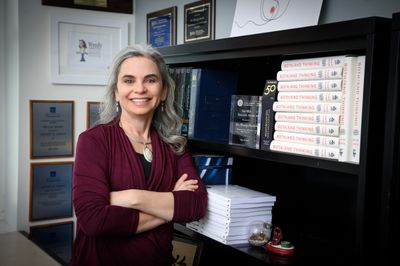
Wendy Smith

Professor, Management University of Delaware

  • Newark DE

Prof. Smith's research focuses on strategic paradoxes – how leaders and senior teams effectively respond to contradictory agendas.

Contact

University of Delaware

View more experts managed by University of Delaware

Spotlight

2 min

How corporate competition can spur collaborative solutions to the world's problems

Why can’t large competitive companies come together to work on or solve environmental challenges, AI regulation, polarization or other huge problems the world is facing? They can, says the University of Delaware’s Wendy Smith. While it's difficult, the key is to have these companies collaborate under the guise of competition. Smith, a professor of management and an expert on these types of paradoxes, co-authored a recent three-year study of one of the most profound collaborations. Her team looked at the unlikely alliance of 13 competitive oil and gas companies that eventually formed Canada’s Oil Sands Innovation Alliance (COSIA), which works with experts worldwide to find innovative solutions for environmental and technical challenges in the region. Smith and her co-authors found that those companies were willing to collaborate, but only when collaboration was cast in the language, practices and goals of competition. Given the scope of our global problems, companies must continually work together to offer solutions. Creating that collaboration becomes critical, Smith said. This research offers important insight about how these collaborations are possible. Among the study's key findings: Competition can drive cooperation — if leaders harness it. It would make sense to assume that competition undermines collaboration. But the study finds that those who championed alliances used competitive dynamics to strengthen cooperation among rival firms. Rather than suppressing rivalry, leaders leveraged competition as a mechanism to enable joint action toward shared environmental goals. This reframes how organizations can manage tensions between competition and cooperation in partnerships. For example, COSIA leaders created competition between partners to see who would contribute the most valuable environmental innovations. Partners could only gain as much benefit from other company’s innovations commensurate with what they shared. A “Paradox Mindset” is key to complex collaborative success. The research identifies the importance of what the authors call a paradox mindset, which sees competition and cooperation not as opposites to be balanced but as interrelated forces that can be used in tandem. Leaders in the study who adopted this mindset were more thoughtful and creative about how to engage both competitive and collaborative practices in the same alliance. Traditional balance isn’t the goal — process over stability. Instead of pursuing a simplistic “balance” between competing and cooperating, the study shows that effective alliances evolve through process, where competition remains visible and even useful throughout the lifecycle of the alliance. To connect with Smith directly and arrange an interview, visit her profile and click on the "contact" button. Interested journalists can also send an email to MediaRelations@udel.edu.


Wendy Smith

Social

Biography

Wendy Smith earned her Ph.D. in organizational behavior at Harvard Business School, and is currently a professor of management at the Alfred Lerner College of Business & Economics and Co-director of the Women’s Leadership Initiative at the University of Delaware.

Wendy’s research focuses on strategic paradoxes – how leaders and senior teams effectively respond to contradictory agendas. She studies how organizations and their leaders simultaneously explore new possibilities while exploiting existing competencies, and how social enterprises simultaneously attend to social missions and financial goals. Her research has been published in journals such as Academy of Management Journal, Academy of Management Review, Administrative Science Quarterly, Harvard Business Review, Organization Science and Management Science. In 2018, she won the University of Delaware’s first Mid-Career Excellence in Scholarship Award. In 2015, she won the Lerner College Outstanding Scholar Award.

Wendy teaches leadership, organizational behavior and business ethics. She has taught MBAs and undergraduates at University of Delaware, Harvard and University of Pennsylvania – Wharton. Wendy was awarded the University of Delaware MBA Teaching Award in 2016. Wendy has also taught executive and senior leadership teams how to manage interpersonal dynamics, emotional intelligence, high performing teams, organizational change and innovation, managing in times of crisis, and managing strategic paradoxes.

Wendy’s book Both/And Thinking was published by Harvard Business School Press in August 2022.

Industry Expertise

Research
Education/Learning
Writing and Editing

Areas of Expertise

Organizational Behavior
Interpersonal Dynamics
Women in the Workplace
Leadership
Emotional Intelligence

Answers

What does a both/and thinking process look like?
Wendy Smith

Both/and thinking enables more creative, sustainable solutions. Valuing opposing sides and seeking connections between them opens us to more creative and sustainable options. Consider Einstein’s Theory of Relativity. He developed this idea by trying to figure out how an object could be at motion and at rest at the same time. Or consider Paul Polman, CEO of packaged goods company Unilever from 2008-2018. He used both/and thinking to craft the Unilever Sustainable Living Plan, doubling the company’s profits while reducing their environmental footprint. Both/and thinking invites us to approach our dilemmas by embracing, rather than resisting, these paradoxes.  If we want to apply both/and thinking, the first step is to change the question. We usually frame dilemmas as tradeoffs. While in college, I asked an either/or question. Should I study and teach ideas as an academic or use those ideas to have impact as a leader and consultant? Rather than wait for divine intervention, I could have just flipped a coin. In time, I came to ask a different question: How can I study and teach ideas to have a positive impact on people’s lives? A whole new world of possible answers starts to emerge. Imagine if we changed the questions that we ask around political issues. Today, even everyday conversations sound like candidates arguing their case. What if we changed the question? What if we stopped arguing over who is right and who is wrong? What if instead, we assumed that people with different political views have valid and values-based perspectives, just as we do. What if instead of telling them about our perspective, we ask them to share their experiences and understandings, and see what we can learn from them?

Media Appearances

How many women does it take to change a broken Congress?

The Conversation  online

2018-12-29

The new United States Congress has 127 women in the House and Senate, including two Muslim-American women, two Native American women and a 29-year-old.

View More

Stumped By False Dilemmas? Try Both/And Thinking

Forbes  online

2022-10-03

An insightful guide in making “dilemma-nade” can be found in Both/And Thinking: Embracing Creative Tensions to Solve Your Toughest Problems by Wendy K. Smith and Marianne W. Lewis.

View More

Both/And Thinking: Embracing Creative Tensions to Solve Your Toughest Problems

Next Big Idea Club  online

2022-10-17

Wendy Smith is a professor of management and faculty director at the Women’s Leadership Initiative at the University of Delaware. Marianne Lewis is the dean of Carl H. Lindner College of Business at the University of Cincinnati, prior to which she was the dean of the Cass Business School in London, England.

View More

Show All +

Articles

Reflections on the 2021 AMR Decade Award: Navigating Paradox Is Paradoxical

Academy of Management Review

2022

Over the past decade, paradox theory has developed impressively. Such advances have been fueled by a rising collective experience of paradox—as change, scarcity and plurality intensify awareness of conflicting, interdependent and persistent forces—and by a global community of paradox scholars—notably creative, dedicated and mutually supportive.

View more

From a Label to a Metatheory of Paradox: If We Change the Way We Look at Things, the Things We Look at Change

Academy of Management Collections

2022

Over the last 30 years, mounting insights into paradox have enabled a paradigm shift in organizational theory from linear, static, and rational toward more holistic, dynamic, and dualistic thinking. To gain insight into the nature and development of this scholarship, we curated articles from Academy of Management journals. We identified four approaches to paradox—as a label, a lens, a theory, and a metatheory.

View more

Today’s Most Critical Leadership Skill: Navigating Paradoxes

Leader to Leader

2022

The authors, well-known for their research into the concept of paradox, explain that “It is one thing to label challenges as paradoxical and another to know what to do about them. In our own research, we have explored that question in depth over the last 25 years. We bring that research together into an integrated model.”

View more

Show All +

Research Grants

Institute for Global Studies

University of Delaware

2016

Ocean Frontier Institute

Canada

2020

General University Research Grant

University of Delaware

2016

Accomplishments

Delaware Today, Women in Business Award

2019

Awarded annually to 20 women in business in the state of Delaware

Responsible Research in Management Award

2020

Awarded to best annual paper addressing responsible management for “Bowing Before Dual Gods” (ASQ, 2019)

Academy of Management Research, Decade Award

2021

Awarded to the paper that has had the most impact across a decade for “Toward a Theory of Paradox: A Dynamic Equilibrium Model” (AMR, 2011)

Show All +

Education

Harvard University

PhD

Organizational Behavior

2006

Yale University

BA

Political Psychology

1996

Harvard University

MA

Psychology

2004

Affiliations

  • Academy of Management Journal : Editorial Board Member
  • Academy of Management : Member
  • European Group for Organization Studies : Member