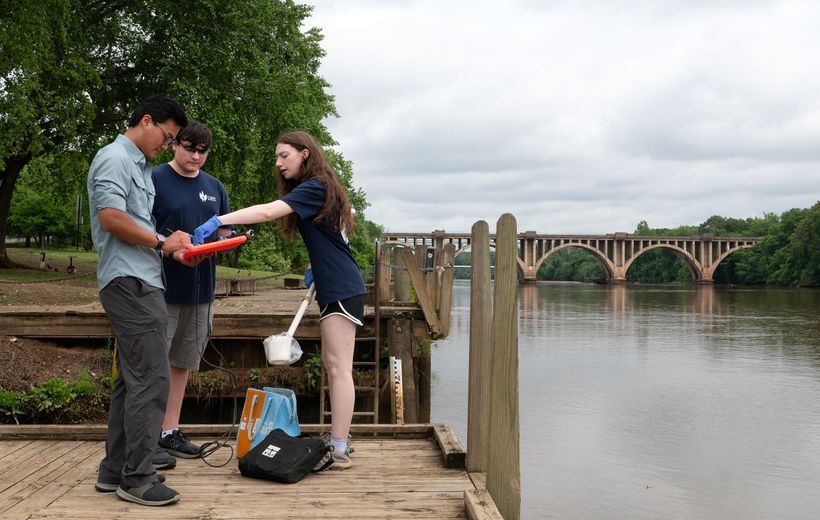
A recent article in the Fredericksburg Free Press highlighted a new University of Mary Washington initiative that is testing the Rappahannock River weekly for fecal coliform bacteria and sharing the results publicly. Led by Associate Professor of Earth and Environmental Science Tyler Frankel, the program aims to provide residents with accessible information before swimming, fishing, paddling, or otherwise enjoying one of the region's most important waterways.
Dr. Tyler Frankel is an Assistant Professor in the Department of Earth and Environmental Sciences at the University of Mary Washington. He is an expert on ecotoxicology, specifically the impact of pharmaceutical, industrial waste products, & pesticides on aquatic wildlife. View his profile The project addresses a significant gap in environmental monitoring. While bacteria levels can change rapidly following rainfall and other environmental conditions, routine testing has historically been limited. Frankel and his student research team are collecting samples from five locations along the river and building a long-term database that can help identify contamination trends and potential pollution sources. The effort also provides valuable hands-on research opportunities for students while generating information with direct public health benefits.
“There isn’t really a program that exists like that for the Rappahannock where the public can get access to weekly data sets.” — Tyler Frankel, Associate Professor of Earth and Environmental Science, University of Mary Washington The research focuses on fecal coliform bacteria, including E. coli, which can enter waterways through sewage, failing septic systems, agricultural runoff, pets, wildlife, and other sources. Elevated levels can pose health risks to people who come into contact with contaminated water, making timely and accessible monitoring an important tool for both recreation and environmental stewardship.
Connect with an Expert Interested in discussing water quality monitoring, bacterial contamination in rivers, watershed management, citizen science, or environmental health risks?
Connect with Tyler Frankel, Associate Professor of Earth and Environmental Science at the University of Mary Washington, for expert insight into water quality testing, pollution tracking, environmental monitoring, and the science behind protecting freshwater ecosystems.
Biography
Dr. Frankel is an Associate Professor in the Department of Earth and Environmental Sciences at the University of Mary Washington. He maintains an active ecotoxicology research program focused on the impacts of pharmaceuticals, industrial waste products, and pesticides on aquatic wildlife. He is a member of the Society of Environmental Toxicology and Chemistry and has served on the executive committee for the Chesapeake and Potomac Regional Chapter of the Society of Environmental Toxicology and Chemistry. While at UMW, he has published eight journal articles in peer-reviewed journals and has been awarded over $480,000.00 in external funding.
Areas of Expertise
Impact of Pharmaceutical, Industrial Waste Products and Pesticides on Aquatic Wildlife
Ecotoxicology
Aquatic Toxicology
Accomplishments
Peer Reviewer for Leading Environmental and Aquatic Science Journals
Serve as reviewer of multiple peer-reviewed impact-factored journals, including Environmental Pollution, Environmental Science and Technology, North American Journal of Aquaculture, and Environmental Toxicology and Chemistry.
Visiting Assistant Professor
The Department of Environmental Science and Technology at the University of Maryland, College Park.
Board Leadership in the Society of Environmental Toxicology and Chemistry (SETAC)
Current member of the Board of Directors of the Chesapeake and Potomac Regional Chapter (CPRC) of the Society of Environmental Toxicology and Chemistry (SETAC) and member of SETAC North America.
Education
University of Maryland
Ph.D.
Animal and Avian Sciences
2016
University of Maryland
M.S.
Animal and Avian Sciences
2013
University of Maryland Baltimore County
Biological Sciences
2011
Affiliations
Society for Environmental Toxicology and Chemistry
American Fisheries Society
Society for Integrative and Comparative Biology
North American Society for Comparative Endocrinology
Media Appearances
Trump plans record fireworks show, internal docs warn of smoky skies
Politico; MSN online
2026-07-07
The drought means that pollutants may linger longer in the Potomac than they would under normal conditions, said Tyler Frankel, an associate environmental science professor at the University of Mary Washington. Contaminants can easily get trapped in the river near Theodore Roosevelt Island due to “tidal slosh,” a phenomenon where the water flows both upstream and downstream, Frankel said.
UMW team tests the waters-literally-with weekly coliform monitoring along Rappahannock
Fredericksburg Free Press online
2026-06-05
Two University of Mary Washington students lower a pole into the Rappahannock River at City Dock. They collect a cupful of water and pour it into a small bottle. Next, another device is lowered into the river to measure dissolved oxygen, temperature, pH and salinity.
Scientists issue warning after discovering cancer-causing contaminants in major waterways: ‘This is a really big deal’
MSN online
2024-02-09
According to the study’s lead author, Tyler Frankel, who was quoted in Phys.org, coal ash contaminants increase in concentration as they work their way up through the food web, threatening a number of predatory fish and birds. “These waterways serve as important routes for several migratory fish species and sensitive nursery habitats for various endemic species,” Frankel said, per Phys.org. “Our work highlights the importance of considering this exposure pathway in conservation strategies.”
Cancer-causing metals leak into water near coal ash landfills
Mirage News online
2024-01-08
Researchers from the University of Mary Washington have discovered alarming levels of cancer-causing metals in both the sediments and fish of a Chesapeake Bay tributary situated near a coal ash landfill. This research, led by Dr. Tyler Frankel, highlights previously overlooked dangers posed by trace metal contamination in aquatic ecosystems.
Initiation of a long-term study to track fecal coliform contamination in the Rappahannock River and share results with scientific community
Chesapeake-Potomac Regional Chapter of the Society of Environmental Toxicology and Chemistry (CPRC SETAC) 2026 Spring Meeting Towson, Maryland, USA
2026-04-09
Assessing the effects of lead and cadmium contaminated sediments on viability and locomotor behavior in the amphipod Hyallela azteca
Chesapeake-Potomac Regional Chapter of the Society of Environmental Toxicology and Chemistry (CPRC SETAC) 2026 Spring Meeting Towson, Maryland, USA
2026-04-09
Evaluating embryonic development, locomotor behavior, and bioaccumulation in cadmium exposed Planorbella duryi snails under SSP-RCP warming scenarios
Chesapeake-Potomac Regional Chapter of the Society of Environmental Toxicology and Chemistry (CPRC SETAC) 2026 Spring Meeting Towson, Maryland, USA
2026-04-09
Spatio-temporal and bioaccumulation analysis of trace metal concentrations within sediment and dagger blade grass shrimp in Chincoteague Bay, USA
American Geophysical Union (AGU) 2024 annual meeting Washington, D.C., USA
2024-12-09
The Effects of Cadmium Exposure in the Presence of Climate Change on Embryonic Development in the Seminole Ramshorn Snail (Planorbella duryi).
SETAC North America 2025 Annual Conference Ft. Worth, Texas, USA
2024-11-17
Assessing Trace Metal Bioaccumulation in Several Fish Species Near A Coal Ash Landfill (Dumfries, VA)
SETAC North America 2025 Annual Conference Ft. Worth, Texas, USA
2024-11-17
The Presence, Concentration, and Potential Ecological Impacts of Trace Metal Contaminants in the James River Near Multiple Anthropogenic Contamination Sources (Bremo Bluff, VA)
SETAC North America 2025 Annual Conference Ft. Worth, Texas, USA
2024-11-17
Assessing the Presence, Concentration, and Biological Uptake of Trace Metals and PFAS Near the Dahlgren Naval Support Facility (Dahlgren, Virginia)
SETAC North America 2025 Annual Conference Ft. Worth, Texas, USA
2024-11-17
The presence, concentration, and potential ecological impacts of trace metal contaminants in the James River near a coal ash repository (New Canton, VA)
CPRC SETAC 2024 Spring Meeting Baltimore, Maryland, USA
2024-04-08
The Presence, Distribution, and Concentration of Microplastics in the Lower Basin of the Chesapeake Bay, USA Near Wastewater Treatment Plants.
SETAC Annual 2019 Meeting Toronto, Canada
Assessing the impacts of methoxychlor exposure on the viability, reproduction, and behavior of the Seminole ramshorn snail (Planorbella duryi)
SETAC Annual 2019 Meeting Toronto, Canada
What's in Your Water? Investigating the Effects of Human-Sourced Pollutants on Aquatic Environments
2019 UMW Alumni Reunion Weekend Fredericksburg, Virginia, USA
Effects of short-term exposure to the gestagens progesterone and levonorgestrel on the development of juvenile apple snails (Pomacea canaliculata)
SETAC Annual 2017 Meeting Minneapolis, Minnesota, USA
Male fathead minnows exhibit decreased sperm motion characteristics and increased nest acquisition success due to levonorgestrel exposure
SETAC Annual 2017 Meeting Minneapolis, Minnesota, USA
Research Grants
Contaminants from Landfills on the Mattaponi Native American Reservation
Eastern Woodland Revitalization Grant
Investigating the presence and concentration of contaminants from landfills on the Mattaponi Native American reservation.
Contamination Threats to the Mattaponi Reservation
Green & Healthy Homes, EPA Thriving Communities Grant Program - Region 3
2025-01-01
Uncovering contamination threats to the Mattaponi reservation and the culturally vital American Shad.
Impacts of Munitions Testing on the Potomac River
Ernst and Young Foundation Grant
Investigating the impacts of munitions testing on the Potomac River.
Contamination in the Yeocomico River
Bevans Oyster Company
Donation from Bevans Oyster Company for assessing fecal bacteria contamination in the Yeocomico River.
Greener Crop Protection Products
FMC New Investigator Award Grant
2022-01-01
Developing a novel behavioral assay for use in the assessment of greener crop protection products.
Ecological Adverse Effects of Coal Ash Repositories on Freshwater Wetlands
Morris Animal Foundation First Award Grant
Assessing the ecological adverse effects of coal ash repositories on freshwater wetlands: From individuals to species assemblages.
Articles
Assessing the presence, concentrations, and potential ecological impacts of trace metal contamination in the Potomac River Test Range Complex middle danger zone
Environmental Monitoring and Assessment
Frankel, T., Hanna, S., and Giancarlo, L.
2026-05-01
This study evaluated the presence, spatial distribution, and ecological risk of trace metal contamination in the Potomac River Test Range Complex (PRTR) middle danger zone, a heavily utilized military testing site with over a century of munitions activity. Surface water, near-bed water, and surficial sediment samples were collected from 21 sites and analyzed for trace metals (Al, As, B, Cd, Co, Cr, Cu, Fe, Mg, Mn, Ni, Pb, and Zn) using inductively coupled plasma optical emission spectroscopy. Contamination levels were interpreted using the Heavy Metal Pollution Index (HPI) for water samples and the Geoaccumulation Index (Igeo) and Potential Ecological Risk Index (PERI) for sediments. Ward’s multivariate cluster analysis with silhouette optimization was applied to assess spatial relationships between contamination patterns and historical projectile-density zones. Surface waters were generally low in contamination, whereas near-bed waters exhibited higher metal concentrations with multiple sites classified as critically polluted. Sediments showed widespread anthropogenic enrichment (Igeo Classes 1–3), with elevated ecological risks (PERI) concentrated in areas of dense historical munitions activity. Cluster analyses revealed clear spatial separation between high- and low-intensity use zones, supporting a linkage between munitions testing and localized contamination. These findings demonstrate that military activities contribute measurably to metal contamination superimposed on broader watershed inputs. This study represents one of the first field-based, multi-matrix assessments of contamination within the PRTR, advancing beyond prior evaluations that utilized modeling and screening approaches. This integrated framework provides improved resolution of contamination pathways and strengthens targeted monitoring, ecological risk assessment, and management of impacted aquatic systems.
Coal fly ash is a highly heterogeneous waste product that becomes concentrated with metals after combustion that have been shown to act as neurotoxins and/or carcinogens in both wildlife and humans. As such, increased understanding of the presence, concentrations, and potential ecosystem impacts is needed. The Chesterfield power station contains more than 15 million tons of ash and is located adjacent to the James River, which serves as a tributary to the Chesapeake Bay. Our study investigated (1) the presence and concentrations of aluminum (Al), aresnic (As), cadmium (Cd), chromium (Cr), copper (Cu), iron (Fe), magnesium (Mg), manganese (Mn), lead (Pb), selenium (Se), and zinc (Zn) in surface water, deep water, and sediment samples obtained from the surrounding area and (2) the presence of various teleost species, using environmental DNA (eDNA) sampling. Universal cokriging was used to estimate the spatial variability of metals in sediments and the extent of pollution interpreted using enrichment factors (EF). Little contamination was observed in water samples compared to sediment samples. Elevated concentrations of Al, As, Cd, Cr, Fe, Pb, and Zn were observed in areas immediately adjacent to the coal ash landfills. Arsenic, Cd, and Pb showed increased EF in sites adjacent to the landfills, suggesting that the contamination observed is due to anthropogenic factors. Environmental DNA analyses revealed the presence of 22 teleost species, several of which have been identified as threatened, endangered, diadromous, and/or consumed by anglers who use the James River. Collectively, our results provide novel insight regarding the impacts of coal ash on an important Chesapeake Bay watershed and guidance for future risk assessment.
Investigating the effects of three trace metals on the viability, embryonic development, and locomotor behavior of the Seminole ramshorn snail at environmentally relevant concentrations
Water Environment Research, 96(1), e10978
Tanner, T., Giancarlo, L., & Frankel, T.
2024-01-01
Trace metal contamination is a widespread issue due to its many natural and anthropogenic sources and known carcinogenic, teratogenic, and reproductive effects. As previous invertebrate trace metal research has primarily focused on model species (Daphnia magna, Chironomidae, etc.), our understanding of effects on non-model invertebrate species remains relatively poor. As such, this study assessed the exposure effects of cadmium, arsenic, and lead on viability, locomotor behavior, and embryonic development of the Seminole ramshorn snail (Planorbella duryi). Exposure treatments of CdCl2, Na2HAsO4 • 7H2O, or Pb (NO3)2 were prepared at concentrations of 0, 0.01, 0.1, 1, and 10 mg/L and confirmed using inductively coupled plasma optical emission spectroscopy (ICP-OES). Individual adult P. duryi were exposed for 7 days with viability assessed every 24 h, and locomotor behavior was accessed on Days 1 and 7 using ToxTrac v2.97 automated behavior software. Individual embryos from newly laid (
Investigating the potential impacts of coal ash runoff on the freshwater Seminole ramshorn snail (Planorbella duryi) under laboratory conditions
Chemosphere
Frankel, T., Crowell, C., Giancarlo, L., Hydorn, D., and Odhiambo, B.K.
2023-01-01
Coal fly ash is an industrial waste product generated by coal fired powerplants which has been shown to contain elevated concentrations of several toxic trace metals. When stored in landfills or other repositories, these trace metals can enter nearby surface waters via a number of routes including leaching or runoff. Our study examined 1) the presence and concentration of eleven trace elements in a range of lab-created coal ash leachate solutions at neutral pH using ICP-OES, 2) the physiological effects of these leachate solutions on a freshwater gastropod (Planorbella duryi), and 3) the ability of these trace metals to bioaccumulate in the tissues of exposed individuals. As, Cd, Cu, Mg, Mn, and Pb were detected in solutions at increasing concentrations concurrent with ash concentration. Exposure to leachates caused significant delays in embryonic development, reduced juvenile shell growth, decreases in egg and clutch production, and the display of avoidance behaviors. Tissues of exposed snails contained elevated concentrations of As, Cd, Cu, and Cr, with bioconcentration factors 177,550 times higher in cadmium and 85,468 times higher in arsenic in the highest treatment compared to control organisms. Our results highlight the potential harmful effects of coal ash leachates on a novel freshwater invertebrate species using several unique methodologies, providing key information regarding their potential impacts on surrounding aquatic ecosystems.
Assessing the presence, concentration, and impacts of trace element contamination in a Chesapeake Bay tributary adjacent to a coal ash landfill (Possum Point, VA)
Environ Pollut.
Frankel TE, Tyler E, Willmore C, Odhiambo BK, Giancarlo L.
2023-12-15
Coal ash (CA) is an industrial waste product that has been shown to contain several neurotoxic constituents such as cadmium, selenium, mercury, lead, and arsenic. Contaminant-laced leachates enter the environment via seepage, runoff, permitted discharge, or accidental spills from CA storage ponds or landfills which may pose a risk to wildlife residing in receiving waterways. In this study, we assessed 1) the presence and concentration of thirteen trace elements (Al, Ca, Mg, Cr, Cd, As, Se, Pb, Cu, Zn, Mn, Fe, B) in surface water and sediment grab samples using ICP-OES, 2) the temporal variability of trace elements using Pb-210 dated sediment core samples, 3) differences in species diversity using environmental DNA (eDNA) analyses, and 4) the presence and concentration of trace metals in banded killifish (Fundulus diaphanus) epaxial muscle tissue collected from waterways surrounding the Possum Point Power Station (Stafford, VA). Results showed the highest concentrations of As, Cd, Cr, Cu, Fe, Mg, Se, Zn, and B in Quantico Creek (QC) adjacent to the coal ash ponds and elevated average cadmium and zinc concentrations compared to both upstream and downstream locations along the Potomac River. Sediment core profiles and Pb-210 analyses showed historical enrichment of several trace elements in QC beginning after the commissioning of the power plant in 1948. When compared to upstream and downstream sites, species diversity was drastically reduced in Quantico Creek based on eDNA identification. Muscle tissues of banded killifish collected in Quantico Creek displayed increased Al, Cd, and Zn concentrations compared to upstream and downstream sites. Collectively, our results demonstrate the potential impacts of coal ash landfills on aquatic ecosystems and suggest that further research is needed to fully inform risk assessment and remediation efforts.
Sulfoxaflor causes mortality, decreased locomotion, and altered interactions in pavement ants (Tetramorium caespitum)
Journal of Environmental Science and Health Part B Pesticides Food Contaminants and Agricultural Wastes
Frankel, T. and Frankel, J.
2021-01-01
This study investigated the exposure effects of sulfoxaflor, a next-generation sulfoximine insecticide, on the viability, locomotor behavior, and nest-mate interactions of the pavement ant (Tetramorium caespitum). Adult worker ants were exposed to 0, 1, 5, 12.5, 25, or 50 mg/L of sulfoxaflor via oral ingestion for 48 h. This short-term exposure to concentrations as low as 1 mg/L had wide ranging effects on multiple locomotive parameters (average speed, mobile average speed, total travel distance), nest-mate interactions (aggression and antennation), and body morphology (abdominal curving). Exposure to sulfoxaflor for 24 h manifested in decreased locomotion, altered intraspecific interactions and the development of abdominal curvature in the 25 and 50 mg/L treatments. Such alterations in mobility and conspecific behavioral parameters would clearly impact the ability of exposed individuals to successfully satisfy resource demands and presents a risk to colony survival.
Assessing the Impacts of Methoxychlor Exposure on the Viability, Reproduction, and Locomotor Behavior of the Seminole Ramshorn Snail (Planorbella duryi)
Environmental Toxicology and Chemistry (2020)
Frankel, T.E., Bohannon, M.E. and Frankel, J.S.
In the present study, the effects of short-term methoxychlor exposure on the viability, reproduction, and locomotor behavior of adult seminole ramshorn snails (Planorbella duryi) was assessed. To examine impacts on viability and behavior, individuals were exposed to a water control, vehicle control, or 12.5, 50, 100, 250, 500, or 1000 μg/L of methoxychlor for 48 h; and differences in mortality and locomotor behavior assessed using the freely available ToxTrac software.
Exposure to levonorgestrel increases nest acquisition and decreases sperm motility in male fathead minnows (Pimephales promelas)
Environmental Toxicology and Chemistry (2018)
Frankel, TE, Yonkos, LT, Ampy, FR, and Frankel, JS.
Progestins are utilized as a component of human contraceptives, and commonly enter the environment via wastewater treatment plant effluent. Certain progestins activate fish androgen receptors and cause decreases in fecundity and masculinization of females. We used a nest acquisition assay and computer‐assisted sperm analysis to examine the effects of levonorgestrel on male fathead minnow (Pimephales promelas) reproductive fitness.
Exposure effects of levonorgestrel on oogenesis in the fathead minnow (Pimephales promelas)
Environmental Toxicology and Chemistry (2017)
Frankel, TE, Yonkos, L and Frankel, JS.
The synthetic progestin levonorgestrel is commonly utilized in human oral contraceptives. It enters the environment as a component of wastewater treatment plant effluent, and has been measured at low ng/L concentrations in surface waters. It has been shown to activate fish androgen receptors, causing the physical masculinization of females, changes in reproductive behavior, and decreases in fecundity.
Exposure to the contraceptive progestin, gestodene, alters reproductive behavior, arrests egg deposition, and masculinizes development in the fathead minnow (Pimephales promelas)
Environmental Science and Technology (2016)
Endogenous progestogens and pharmaceutical progestins enter the environment through wastewater treatment plant effluent and agricultural field runoff. Lab studies demonstrate strong, negative exposure effects of these chemicals on aquatic vertebrate reproduction. Behavior can be a sensitive, early indicator of exposure to environmental contaminants associated with altered reproduction yet is rarely examined in ecotoxicology studies.
Aqueous exposure to the progestin, levonorgestrel, alters anal fin development and reproductive behavior in the eastern mosquitofish (Gambusia holbrooki)
General and Comparative Endocrinology (2016)
Endogenous progestogens are important regulators of vertebrate reproduction. Synthetic progestins are components of human contraceptive and hormone replacement pharmaceuticals. Both progestogens and progestins enter the environment through a number of sources, and have been shown to cause profound effects on reproductive health in various aquatic vertebrates.