
Trisha L. Andrew
Professor of Chemistry and Chemical Engineering
- Amherst MA UNITED STATES
Trisha L. Andrew is a materials scientist whose work focuses on wearable devices, smart garments and textile dyeing/finishing.
Expertise
Biography
Andrew's lab recently developed a flexible, chalk-based coating which can be added to fabrics that has been found ittoreduced the temperature underneath clothes by up to 15 degrees compared to untreated fabrics.
In 2023, she led a team that solved the 80-year old quest to make a synthetic textile modeled on polar bear fur.
She is a David and Lucile Packard Foundation Fellow, a National Academy of Sciences Kavli Fellow, a L’Oréal USA For Women in Science Fellow, and was named as one Forbes’ magazine “30 Under 30” Innovators in Energy.
Social Media
Video
Education
Massachusetts Institute of Technology
Ph.D.
Chemistry
2012
University of Washington
B.Eng.
Electrical Engineering
2005
University of Washington
B.Sc.
Chemistry
2005
Links
Select Recent Media Coverage
Coating clothes with this simple material could cool your body by up to 8 degrees
CNN tv
2024-08-24
Researchers at the University of Massachusetts Amherst have developed a flexible, chalk-based coating which can be added to fabrics. ... “We start with your cotton T-shirt… and we just apply this coating on either one or both faces of the fabric,” Trisha L. Andrew, a chemist and materials scientist at UMass, told CNN. “The coating is entirely surface level. It does not penetrate or change the cotton fibers."

UMass Chemistry Chalks Up a New Way to Keep Cool
UMass Amherst online
2024-08-21
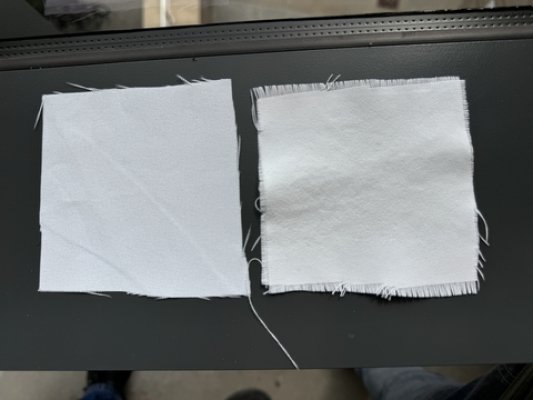
Who hasn’t wished for clothing that stays cooler during the sultry days of summer? Thanks to the work of Trisha L. Andrew, professor of chemistry, chemistry graduate student Evan D. Patamia and undergraduate Megan K. Yee, we may all be a little closer to comfort. The team has devised a durable chalk-based fabric coating that cools the air underneath the treated fabric by up to 8 degrees Fahrenheit.
Why Does the Same Temperature Feel Hotter or Colder in Different Places?
Scientific American online
2024-02-01
Trisha Andrew, professor of chemistry at UMass Amherst, discusses how fabrics behave differently in an article about why the same temperature can feel different. “Unlike synthetics, which are mostly plastics, natural materials actually absorb a small amount of moisture, drying out the air in between layers so that you have less of a conductive channel to radiate heat away from your body,” she says.

The best stain removers to add to your laundry routine, according to experts
NBC News
2023-11-04
Trisha Andrew, professor of chemistry at UMass Amherst, is among the experts who contributed to an article selecting the best laundry stain removers.

Analyze This: A new fabric mimics polar bears’ pelts for warmth
ScienceNewsExplores online
2023-06-19
A new fabric traps heat by mimicking polar bears’ pelts. Polar bears have black skin covered by fur that looks white. But that fur isn’t like normal hair, says Trisha Andrew. “It has a very unique structure.” A materials engineer, Andrew works at the University of Massachusetts Amherst.

Scientists unravel the secrets of polar bear fur
Earth.com online
2023-04-11
In a groundbreaking development, three engineers from the University of Massachusetts Amherst, led by Trisha Andrew, have successfully created a synthetic fabric that emulates the properties of polar bear fur, concluding an 80-year-long quest to develop such a textile.

New Textile Unravels Warmth-trapping Secrets of Polar Bear Fur
UMass Amherst online
2023-04-10
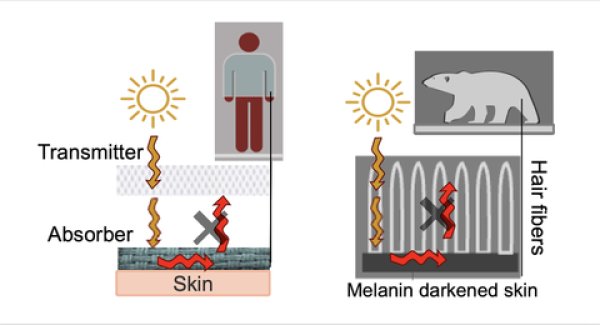
“But the fur is only half the equation,” says the paper’s senior author, Trisha L. Andrew, associate professor of chemistry and adjunct in chemical engineering at UMass Amherst. “The other half is the polar bears’ black skin.”
New Polar Bear-Inspired Fabric Is 30% Lighter Than Cotton and Far Warmer
SciTechDaily online
2023-04-11
“But the fur is only half the equation,” says the paper’s senior author, Trisha L. Andrew, associate professor of chemistry and adjunct in chemical engineering at UMass Amherst. “The other half is the polar bears’ black skin.”

Mass Appeal UMass developing smart tech wearables for better health monitoring
WWLP-TV tv
2022-04-11
The availability of wearable tech devices, like a smart watch, has grown considerably over the last few years and some researchers at UMass Amherst are creating cutting edge technology to make these devices crucial in ensuring good health for all of us. Trisha Andrew, a Professor of Chemistry and Chemical Engineering at the University of Massachusetts in Amherst, is with me now to talk about what they are working on.

UMass Amherst Materials Chemists Tap Body Heat to Power ‘Smart Garments’
UMass Amherst online
2019-01-22
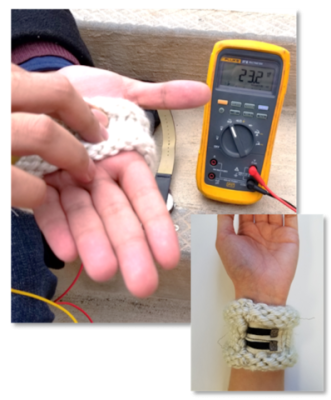
Many wearable biosensors, data transmitters and similar tech advances for personalized health monitoring have now been “creatively miniaturized,” says materials chemist Trisha Andrew at the University of Massachusetts Amherst, but they require a lot of energy, and power sources can be bulky and heavy.
Select Publications
Humidity‐Resistant, Broad‐Range Pressure Sensors for Garment‐Integrated Health, Motion, and Grip Strength Monitoring in Natural Environments
Advanced Materials TechnologiesS. Zohreh Homayounfar, Ali Kiaghadi, Deepak Ganesan, Trisha L. Andrew
2022-12-26
Wearable electromechanical sensors are essential to improve health monitoring and off‐site point‐of‐care applications. However, their practicality is restricted by narrow ranges of detection, failure to simultaneously sense static and dynamic pressures, and low durability. Here, an all‐fabric pressure sensor with high sensitivity in a broad range of pressures, from subtle heart pulses to body posture, exceeding that of previously‐reported sensors is introduced.
Solar thermal textiles for on-body radiative energy collection inspired by polar animals
ACS Applied Materials & InterfacesWesley Viola, Peiyao Zhao, and Trisha L. Andrew
2023-04-05
Humans use textiles to maintain thermal homeostasis amidst environmental extremes but known textiles have limited thermal windows. There is evidence that polar-dwelling animals have evolved a different mechanism of thermoregulation by using optical polymer materials to achieve an on-body “greenhouse” effect. Here, we design a bilayer textile to mimic these adaptations. Two ultralightweight fabrics with complementary optical functions, a polypropylene visible-transparent insulator and a nylon visible-absorber–infrared-reflector coated with a conjugated polymer, perform the same putative function as polar bear hair and skin, respectively.