Noam Lupu profile photo

Noam Lupu

Gertrude Conaway Vanderbilt Professor of Political Science

  • Nashville TN UNITED STATES

Expert in political behavior, partisanship and political parties, class and inequality, representation, and legacies of violence.

Contact

Spotlight

4 min

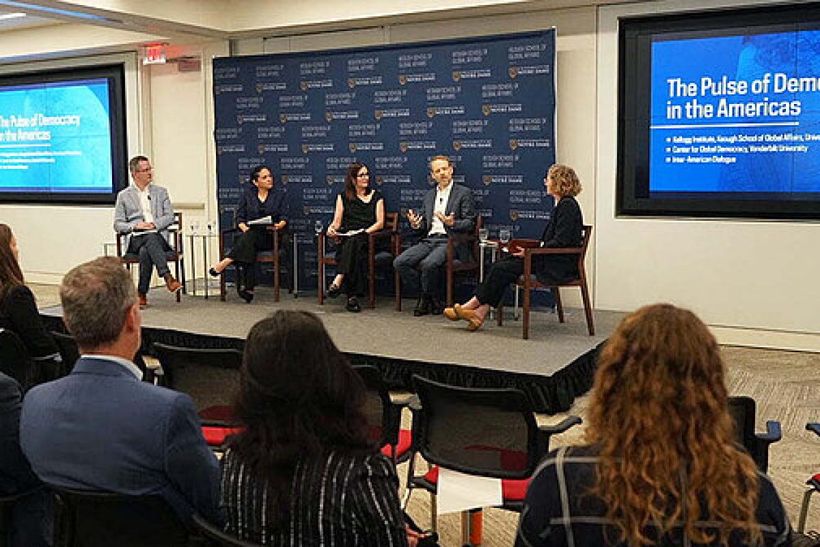
After more than a decade of erosion, support for democracy has stopped falling and begun a modest but widespread recovery across the Americas. The findings are detailed in the 2026 Pulse of Democracy, released by Vanderbilt University’s Center for Global Democracy and the Kellogg Institute, part of the University of Notre Dame’s Keough School of Global Affairs. The 2026 AmericasBarometer includes 25,282 interviews across 21 nationally representative surveys in countries across the Americas. The survey examines how citizens perceive and experience democracy and governance, including their views on democratic legitimacy, trust in institutions, corruption, citizen security, migration, political participation and government performance. This year’s study again includes the United States and Canada alongside Latin America and, for the first time, Cuba. The report finds that support for democracy increased across nearly every country surveyed between 2023 and 2026, marking the first broad regional upturn in a generation. Although citizens across much of the region report improvements in economic and physical security, they remain far less convinced that governments are honest, capable and responsive to their needs, highlighting the need to strengthen trust in government and accountability. “The modest recovery in support for democracy is real and encouraging, but it is also fragile,” said Noam Lupu, director of Vanderbilt University’s Center for Global Democracy and the Gertrude Conaway Vanderbilt Professor of Political Science. “People are reporting improvements in their economic and physical security, but they still want governments that are honest, capable and responsive.” Among the report’s key findings: About two-thirds of Latin Americans express support for democracy in 2026, up 6 percentage points from 2023. Support increased in nearly every country and across age groups and educational levels rather than being driven by any single demographic group. Substantial differences remain across countries, however, and the recovery follows nearly a decade of comparatively low democratic support. In most countries, fewer people say their national economy has worsened compared with 2023, and household food insecurity has declined from its pandemic-era peak. Still, roughly one in four people across the region report experiencing food insecurity, and improvements are unevenly distributed. The share of people who feel unsafe in their own neighborhoods has been declining steadily for nearly a decade and fell again in 2026. Crime victimization has declined only modestly, however, and substantial differences remain across countries. Citizens who experience greater economic security, less food insecurity, lower exposure to crime and fewer experiences with corruption express higher support for democracy. On average, several of these conditions improved across the region between 2023 and 2026, coinciding with the broader increase in democratic support. Everyday corruption has changed little, satisfaction with local public services remains low, and citizens’ evaluations of political leaders vary widely. The findings suggest that improvements in material conditions can bolster democratic goodwill, but persistent failures of governance and representation continue to hold it back. The share of adults reporting an intention to emigrate fell from 31 percent in 2023 to 25 percent in 2026, returning roughly to pre-pandemic levels. Improving conditions in countries of origin coincide with the decline, while migration pressures remain substantial and vary considerably across countries. “The findings offer some encouraging signs, but they also underscore the work that remains,” said Ann Mische, acting director of the Kellogg Institute and associate professor of sociology and peace studies at the University of Notre Dame. “Improving people’s daily lives matters, but strengthening democracy also requires institutions that people trust.” New data and expanded public resources Alongside the Pulse of Democracy, Vanderbilt’s Center for Global Democracy and LAPOP Lab are releasing the 2026 AmericasBarometer data and updated Data Playground, along with questionnaires, technical documentation, and other resources, free of charge. About the AmericasBarometer The AmericasBarometer is the flagship survey project of Vanderbilt University’s Center for Global Democracy and its LAPOP Lab, a global leader in comparative public opinion research. Since 2004, it has collected more than 433,000 interviews across 35 countries, creating an extensive comparative record of how citizens across the hemisphere perceive and experience democracy and governance. The surveys use nationally representative samples of voting-age adults and cover topics including democratic legitimacy, trust in institutions, corruption, citizen security, migration, political participation and government performance. About Vanderbilt University’s Center for Global Democracy The Center for Global Democracy (CGD) is Vanderbilt University’s leading social science institute dedicated to research and innovation in democratic politics. Its research examines how citizens perceive, experience, and support democracy across countries and over time. Its research portfolio includes the LAPOP Lab, a global leader in international survey research and home to the AmericasBarometer. About the Kellogg Institute The Kellogg Institute, part of the Keough School of Global Affairs at the University of Notre Dame, is a leading center for interdisciplinary research dedicated to understanding, strengthening, and renewing democracy worldwide.
Noam Lupu

3 min

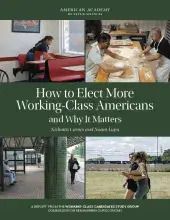
A new report released by the American Academy of Arts & Sciences aims to explain the near-absence of elected politicians from working-class occupations at all levels of government in the in the U.S., despite making up more than half of the U.S. labor force, and highlights strategies that can give working-class Americans a seat at the table in our elected institutions. In How to Elect More Working-Class Americans and Why It Matters, authors Noam Lupu (Vanderbilt University) and Nicholas Carnes (Duke University) describe how the shortage of politicians from the working class harms trust in government, runs contrary to our national ideals, and makes it difficult for our political institutions to understand and respond to the needs of working people in a fast-changing economy. Carnes and Lupu sought input from the working group that convened to support a recommendation of the Academy’s Commission on Reimagining Our Economy to increase working-class candidates. A main focus of the report is understanding and addressing the barriers that keep working-class Americans from running for office. How to Elect More Working-Class Americans and Why It Matters includes detailed descriptions of how parties, unions, interest groups, funders, and policymakers can increase the number of working-class candidates and officeholders. “Our democracy and our economy will grow stronger when more Americans feel included and invested,” said Laurie Patton, president of the Academy. “To address declining trust and engagement in our government, we need workable evidence-backed solutions that are driven by good ideas and good will. Nick Carnes and Noam Lupu provide a blueprint for how a policymakers, leaders and citizens across the country can increase the number of working-class candidates and benefit all who care about strengthening America.” The report represents the culmination of a decade-and-a-half of research. “Working-class people almost never go on to hold elected office in the U.S.,” said Nick Carnes, Z. Smith Reynolds Distinguished Professor of Public Policy Studies at Duke’s Sanford School of Public Policy. “In this report, we look to the available research to dispel myths about the working class and highlight the real obstacles that prevent working-class Americans from holding office.” “At a time when both major parties are seeking to win over working-class Americans, we hope this document will provide clear and actionable advice for anyone hoping to support working-class people serving their communities as elected officeholders,” said Noam Lupu, Gertrude Conaway Vanderbilt Professor of Political Science at Vanderbilt University. The challenge is not that workers are unqualified or uninterested in public service; it’s that running for office in our nation is burdensome. Candidates have to spend an enormous amount of time, money, and personal resources to run for office, making it difficult for working-class Americans to take time away from work and devote the resources necessary to mount a successful campaign. The report builds on the Academy’s enduring commitment to strengthening democracy, beginning with the organization’s founding in 1780 and embodied most recently with the Our Common Purpose initiative, and the Commission on Reimagining Our Economy, which recognized the inextricable link between democracy and economy. Adam Bonica, Stanford University; Andrea Louise Campbell, Massachusetts Institute of Technology; Katherine J. Cramer, University of Wisconsin–Madison; Jake M. Grumbach, University of California, Berkeley; Alexandra Killewald, University of Michigan; Jane Mansbridge, Harvard University; Tali Mendelberg, Princeton University; Lara Putnam, University of Pittsburgh; and Kay Lehman Schlozman, Boston College served on the advisory group with Carnes and Lupu on this project.

Noam Lupu

Biography

Noam Lupu is Professor of Political Science and Director of the Center for Global Democracy. He studies comparative political behavior, partisanship and political parties, class and inequality, representation, and legacies of violence. He is the author of Party Brands in Crisis(Cambridge University Press, 2016) and coeditor of Unequal Democracies (with Jonas Pontusson, Cambridge University Press, 2024) and Campaigns and Voters in Developing Democracies (with Virginia Oliveros and Luis Schiumerini, University of Michigan Press, 2019). His research has appeared in American Journal of Political Science, American Political Science Review, Comparative Political Studies, Journal of Politics, Political Analysis, and World Politics, among other outlets. He has also received numerous prestigious awards and fellowships.

Areas of Expertise

Comparative Politics
Latin American Politics
Legacies of Violence
Representation
Class and Inequality
Political Parties
Partisanship
Political Behavior

Education

Princeton University

Ph.D.

Politics

Princeton University

M.A.

Politics

Selected Media Appearances

Why working‑class people account for around 1% of lawmakers in the US – and only 2% in the average democracy around the world

The Conversation  online

2026-08-20

Both major U.S. political parties regularly tout their commitment to working-class Americans and claim to be the party of the working class. However, neither the Democrats nor the Republicans nominate many candidates who spent substantial time in working-class jobs.

View More

Trump's approval rating drops among White working-class voters

USA Today  online

2026-07-12

“The decline is significant given that White working-class voters were a pretty stable support between 2016 and 2020 for Trump after trending Republican since the early 1990s,” said Noam Lupu, a Vanderbilt University political science professor.

View More

Trump’s True Colors, Revealed

The New York Times  online

2025-07-01

Noam Lupu, a political scientist at Vanderbilt, wrote by email: “I think there’s a more general puzzle here: that Republican policies seem disproportionately to hurt smaller communities and Democratic policies seem disproportionately to help them — even though majorities in these communities vote for Republicans.”

View More