You might also like...
Check out some other posts from ExpertFile
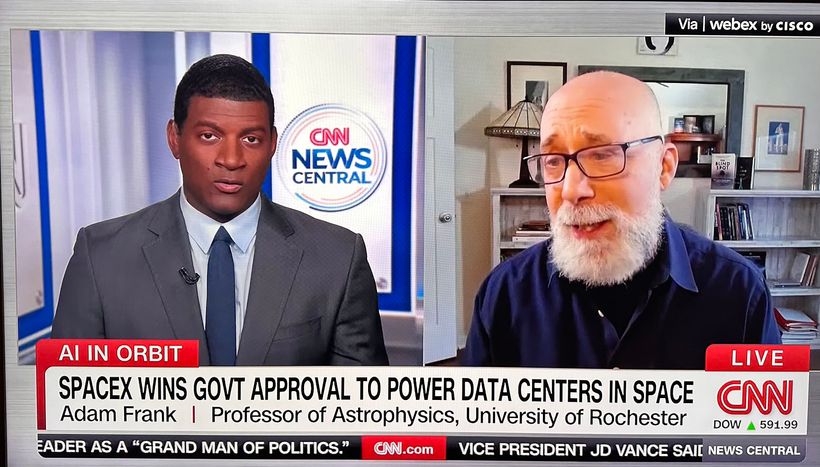
University of Rochester professor Adam Frank appeared on CNN News Central this afternoon to unpack what SpaceX's plan for up to 1 million satellites means for the night sky, orbital debris and the race to power AI. He is available for interviews on this story.
Background: The FCC has approved SpaceX's request to put up to 1 million satellites in orbit to create space-based data centers. SpaceX has acknowledged the technology is unproven, and some astronomers are pushing back.
Frank on the physics: "space is a vacuum, so it's really more like a thermos than it is a refrigerator." Frank on the risk in orbit: "We are already very close to the point where we have so many objects in low Earth orbit that if one of them collides with the other, it'll produce a cascade, a catastrophic cascade of debris that will literally make low Earth orbit uninhabitable." Areas of expertise: Astrophysics, Outer Space, Space Travel, US Space Program, NASA, Asteroids, Moon, Mars, and Civilizations and Climate Change.
Adam Frank is the Helen F. and Fred H. Gowen Professor of Physics and Astronomy at the University of Rochester, a leading expert on how stars form and die, and a frequent on-air commentator for CNN and NPR.
To book an interview: Hit the Contact button on his ExpertFile profile.

Grand Theft Auto VI (GTA 6) is more than just another blockbuster video game. Few franchises have had such a lasting influence on popular culture, combining immersive storytelling, social satire and a fiercely loyal global fan base. From the business of gaming to the ways virtual worlds reflect American society, GTA continues to raise questions that reach well beyond the gaming industry.
What makes Grand Theft Auto such an enduring cultural phenomenon? How does Rockstar balance open-world freedom with compelling storytelling? Can its trademark satire still push boundaries? And what does research tell us about the relationship between violent video games and real-world behaviour?
For journalists exploring these questions, five university experts offer perspectives drawn from academic research and firsthand industry experience. Connect with an expert below for your next story. Why does Grand Theft Auto command such strong fan loyalty? Michael Lewis Professor of Marketing — Emory University, Goizueta Business School Few entertainment franchises have built the kind of following enjoyed by Grand Theft Auto. GTA V sold more than 230 million units worldwide, and the extraordinary anticipation surrounding GTA VI demonstrates just how powerful the franchise has become. What keeps players engaged with a game series for years, and how do companies maintain that loyalty across generations?
Lewis studies fandom, consumer loyalty and marketing, including research on how video game players engage with games and spend money. His published work has examined how expanding a game's availability across platforms affects playing habits and purchasing behaviour. His broader expertise in fandom and brand loyalty offers a perspective on what drives the commercial success of major entertainment franchises and how companies maintain consumer interest over time.
How do you tell a great story when players control the action? Marianne Krawczyk Senior Lecturer, School of Film and Television — Loyola Marymount University Grand Theft Auto gives players an enormous amount of freedom, but memorable characters and compelling stories remain central to its appeal. As video games grow bigger and more complex, how do developers keep players invested in a story when they control so much of what happens next?
Krawczyk is an award-winning video game writer whose credits include God of War, Far Cry, Prince of Persia and Driver. She won a BAFTA Games Award for her work on God of War II and has received Writers Guild Award nominations. Her experience writing for major gaming franchises offers an insider's perspective on creating memorable characters, developing stories and bringing interactive worlds to life.
Has American culture become too outrageous for GTA to satirize? Paolo Pedercini Associate Professor — Carnegie Mellon University Grand Theft Auto has never been shy about mocking American society. From its obsession with money and celebrity to its portrayals of crime, consumerism and political corruption, the franchise has made social satire a central part of its identity. But in an era of viral Florida headlines, social media excess and increasingly polarized politics, can GTA VI still shock players or make them laugh at the absurdities of modern life?
Pedercini is a game developer, artist and educator whose work explores the relationship between video games and ideology. Through his "molleindustria project", he has created games addressing issues including capitalism, labour and environmental justice. His experience creating politically and socially conscious games offers a perspective on how games use humour, exaggeration and interactive storytelling to comment on society.
Do violent games like GTA 6 affect real-world behaviour? Patrick Markey, PhD Professor of Psychological and Brain Sciences — Villanova University Car chases, shootouts and criminal activity have been part of Grand Theft Auto since the franchise began. They've also made it a frequent target of criticism, particularly among those concerned about the influence of violent video games on younger players. Does playing a violent game actually make someone more aggressive? And what does the research say?
Markey researches the relationship between violent video games and human behaviour, including aggression. He is co-author of Moral Combat: Why the War on Violent Video Games Is Wrong, which examines the scientific evidence behind claims about gaming and violence. His work offers journalists a research-based perspective on one of the longest-running controversies in the video game industry.
Why is Vice City more than just a backdrop for GTA 6? Zachary N. Whalen Professor of English — University of Mary Washington For many GTA fans, the cities are just as memorable as the characters. Players have spent countless hours exploring the streets of Liberty City, Los Santos and Vice City, often doing little more than driving around and discovering what's there. GTA VI's return to its fictional version of Miami connects a new generation of players with a setting that longtime fans already know.
Whalen studies video games, digital literature and storytelling, and has published scholarly work examining Grand Theft Auto itself. His chapter Cruising in San Andreas: Ludic Space and Urban Aesthetics in Grand Theft Auto explores the relationship between gameplay and virtual urban environments. He also co-edited Playing the Past: History and Nostalgia in Video Games. His research offers a perspective on why GTA's fictional cities are so memorable, how players experience these environments and the role nostalgia plays in returning to familiar game worlds.
For journalists covering Grand Theft Auto VI and the broader gaming industry, these experts from Emory University, Loyola Marymount University, Carnegie Mellon University, Villanova University and the University of Mary Washington bring academic research and industry experience relevant to a wide range of stories. Explore their ExpertFile profiles for more information about their backgrounds, expertise and potential interview topics.
Looking for additional sources? Visit ExpertFile's Find an Expert directory or use our mobile app for iOS and Android to discover experts on this and other topics.

ExpertFile, the Visible Authority platform for knowledge-based organizations, today launched ProfileIQ, an AI agent that researches and drafts expert profiles built to be found, understood and cited by search engines and AI platforms.
AI answer engines decide whom to cite based on the evidence they can find and verify. Yet ExpertFile's analysis of hundreds of university websites regularly finds expert directories that are out of date, inconsistently formatted and failing basic usability and accessibility tests. The result is that credible experts go uncited and AI tools turn to other sources.
Here’s how ProfileIQ builds each profile Rather than generating a profile from a single prompt, ProfileIQ draws on multiple sources, including ExpertFile's proprietary expertise data and methodology built over more than a decade, to gather and cross-check an expert's work before drafting. Each profile includes:
Topic and keyword tags matched to what journalists, prospects and AI tools search for. Schema markup that identifies the expert, their expertise and their organization in a structure required by AI and search platforms. Standardized fields that present credentials and roles consistently. ORCID iD matching to find published articles, papers and other research by the right expert, even when researchers share a name. Linked research and media, from articles to videos and books. Editorial Standards with copy that follows each client's brand guidelines and rules, such as AP Style. Every draft goes to the communications team for review. Customizable admin workflows let teams manage every profile from a single dashboard, and nothing is published without sign-off. "AI platforms are fast becoming the first stop for anyone looking for an expert, and they cite what they can verify," said Robert Carter, Co-Founder and VP of Product at ExpertFile. "Yet many organizations have world-class expertise that is effectively invisible to these systems. ProfileIQ gives them a practical way to fix that across hundreds of experts, not one profile at a time." "Expert profiles often fall into a gap. Experts, communications, marketing and IT all touch them, so no one truly owns them, even as they grow more critical for AI search," said Peter Evans, Co-Founder and CEO of ExpertFile. "ProfileIQ handles the research and structuring, while experts and communications teams stay in full control of what gets published." Instead of tracking experts in spreadsheets, chasing bios by email and copying details between tools, teams start from a complete, structured draft that they review, refine and approve. That gives communications staff more time for the storytelling, media relations and strategy, while ProfileIQ keeps research and media appearances and other content current for AI platforms and website visitors.
ProfileIQ is available now and included for all ExpertFile clients. Organizations can request a free trial at get.expertfile.com/freetrial