Apanaskevichiella: Georgia Southern’s tick detective honored with genus classification

Sep 9, 2025

3 min


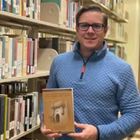
Dmitry Apanaskevich, Ph.D., doesn’t look like a traditional detective.


He won’t be found chasing down clues in back alleys or interrogating shady characters in a dimly lit room. But he does have that inquisitive, investigative passion that fuels his unique work — serving as the assistant curator at the U.S. National Tick Collection, housed in Georgia Southern University’s Math/Physics Building on the Statesboro Campus.


“I’ve been fascinated by animals my entire life,” he says. “I’ve always wanted to be a biologist.”


That fascination gave birth to a decades-long career studying ticks, part of the Arachnida class, leading to a lifetime full of discovery and distinction. He was recently awarded one of the highest honors a biologist can receive: a newly recognized genus of soft ticks named Apanaskevichiella.


The genus was discovered through advanced genomic work by world-renowned tick phylogeneticist Stephen Barker, Ph.D., of the University of Queensland. Barker is a long-time collaborator, and the naming of the newly discovered genus is his way of honoring Apanaskevich.


“It has turned out to be a very pleasant surprise,” said Apanaskevich. “To have a genus named after me is already more than I ever expected. It means my work has made a lasting mark — and that’s a rare and humbling gift.”


But his love for ticks came about accidentally.


Apanaskevich received his education in Russia, earning a bachelor’s and a master’s at St. Petersburg State University. He went on to obtain his Ph.D. at the Zoological Institute of Russian Academy of Sciences. It was during this period of his life when his professors ignited what would become a decades-long fascination with the tiny arthropods.


“In my early days as an undergrad, my professors had a major influence on me,” he explained. “The professor who offered the most interesting topic would win.”


One day, a professor handed him a jar filled with mayflies, tasking him with describing each species. It was a request that would change his life forever.


“He completely won me over with that,” said Apanskevich. “Discovering new species became my dream.”


He became obsessed, spending hours glued to the microscope, developing a huge passion for tiny parasites.


“Parasites like ticks might look like they’re small, but they’re quite large,” he explained. “That being said, you need to use a microscope when examining them, especially if you’re trying to find and identify those more minute details.”


Finding and analyzing those small details is as much of an art as it is a science, he said.


“You have to be able to see things that others can’t,” explained Apanaskevich. “You can provide objective data like measurements and comparisons all day, but the artistic, subjective part of this research is how the biologist can analyze and find connections between the thousands, even millions of specimens.”


Ambition and curiosity have fueled his journey through the scientific world. But now, he has something else that makes him tick.


“My kids are proud of it,” he said, a grin spreading across his face. “They’re pretty proud of me. And really, that’s enough for me.”


If you're interested in knowing more about the work Dmitry Apanaskevich is doing at Georgia Southern University or looking to speak with him — simply contact Georgia Southern's Director of Communications Jennifer Wise at jwise@georgiasouthern.edu to arrange an interview today.

Powered by

You might also like...

Check out some other posts from Georgia Southern University

Georgia Southern University expert available to provide geopolitical analysis on the Iran war featured image

1 min

Georgia Southern University expert available to provide geopolitical analysis on the Iran war

The Middle East has entered an active state of war marked by a cycle of retaliatory strikes across Iran and the Persian Gulf. Three major uncertainties now dominate the global outlook: the long-term survival of the Iranian government, the fate of Iran’s nuclear infrastructure, and the security of critical oil transit routes. Georgia Southern University Professor of Political Science and International Studies Jacek Lubecki, Ph.D., is available to speak about the military operation in Iran and its implications for regional stability and global security. Lubecki is an expert in comparative politics and military security studies, with a focus on the Middle East and Eastern Europe, particularly Poland. His research examines terrorism, counterinsurgency and military strategy. His work has been published in journals including Europe-Asia Studies, East European Politics and Societies, The Polish Review, The New Ukraine and The Armchair General. He has co-authored several books, including Globalization, Nationalism, and Imperialism: A New History of Eastern Europe (2023), which examines domestic and global security challenges, and Defending Eastern Europe: The Defense Policies of New NATO and EU Member States (2021). Lubecki speaks Polish, English, French, Russian, Spanish, Italian, German and Arabic with varying levels of fluency. Lubecki is available for interviews in person at Georgia Southern’s Statesboro Campus or virtually.

Georgia Southern University expert available for interviews about Venezuela's political shift after U.S. intervention and the Cuba-Venezuela Connection featured image

1 min

Georgia Southern University expert available for interviews about Venezuela's political shift after U.S. intervention and the Cuba-Venezuela Connection

The January U.S. military action in Venezuela is altering political connections and calculations across the Western Hemisphere, with deep implications for Cuba. The long-standing belief in the United States’ strategic patience regarding adversarial and destabilizing governments has been decisively overturned and threatens the Cuban government’s vulnerability to collapse. Georgia Southern University Associate Professor of International Studies Christopher M. Brown, Ph.D., is a recognized expert in the democratization and democratic theory of Latin American countries and the Caribbean Basin. He offers expert analysis on the shifting political landscape in Venezuela and the long-term resilience of the Havana-Caracas axis. Brown is a National Endowment for Humanities Scholar with the José Martí Institute at the University of Tampa and participated in a Faculty Exchange with the University of Havana. He has authored several books focused on the failed democratic systems in Latin America and most recently published a book titled “Responding to the Venezuelan Migration Crisis: Insights for the Caribbean” (with Georgina Chami Ph.D., University of the West Indies, St. Augustine, Trinidad and Tobago, and Nalanda Roy, Ph.D., Georgia Southern University). His monograph, “Failed Democracies in Latin America and the Caribbean” (Palgrave-Macmillan) was published in August 2023 and he is currently completing, “Democratization of Cuba” (Palgrave-Macmillan), which will be published in June 2026. Brown is available in person at the Statesboro Campus or virtually.  Simply contact Georgia Southern's Director of Communications Jennifer Wise at jwise@georgiasouthern.edu to arrange an interview today.

Georgia Southern professor to present “Steel and Sweat: Knights, Soldiers and the Making of the Tactical Athlete” featured image

2 min

Georgia Southern professor to present “Steel and Sweat: Knights, Soldiers and the Making of the Tactical Athlete”

The Georgia Southern University College of Arts and Humanities will host the next installment of the Moveable Feast lecture series with an in-depth discussion of the evolution of combat training from the tumultuous Middle Ages to the modern-day military. Professor of Spanish Grant Gearhart, Ph.D., will present “Steel and Sweat: Knights, Soldiers and the Making of the Tactical Athlete” Feb. 19, at 6 p.m., at Service Brewing in Savannah. Gearhart, who is also the coordinator of experiential learning for the Department of World Languages and Cultures, says the presentation is all about connecting modern military training with the physical contests of centuries past. “I wanted to bring back interest in research on the Middle Ages, considering there is a declining interest in the topic within academia,” Gearhart explained. “To connect the past with present in a way that’s digestible for all audiences is something that I feel passionate about bringing to the public.” His research focuses on the evolution of fighting styles and explores how these styles reflect the ethics and values of the cultures in which they were developed. “Today’s soldiers are more than just military personnel, they are athletes,” said Gearhart. “Being a former college athlete sparked my interest in doing this research on the connections between athletics and warriors. I want to show how our modern ideas of soldiers as tactical athletes have historical grounding in the Middle Ages.” The Moveable Feast series is an immersive learning experience that brings lectures into spaces relevant to their topics. The event is free and open to the public.

View all posts