Navigating Grief During the Holiday Season

Baylor experts suggest four strategies to help deal with grief and difficult emotions during the holidays

Dec 6, 2025

4 min

Candi Cann, Ph.D.


The holiday season is a time of joy, togetherness and celebration, but for many – especially those who are grieving the death of a loved one or a deep loss – it can bring a complex mix of emotions, ranging from sadness and sorrow to gratitude and joy.


Baylor University professors Candi Cann, Ph.D., a death scholar and associate professor of religion in the Honors College, and Jo-Ann Tsang, Ph.D., a leading gratitude researcher and associate professor of psychology, offer four strategies for people experiencing difficult emotions and grief during the holidays.


Embrace the spectrum of emotions

Both Tsang and Cann say the key to maintaining balance and authenticity – even while deep in grief – is understanding and accepting where you are emotionally.


“It’s possible and normal to feel different emotions at one time,” Tsang said. “You can feel happiness during the holidays, but also sad that you miss someone who you wish were present. Being grateful does not rule out feeling other emotions; we can cultivate gratitude, but that does not necessitate running away from other emotions.”


Cann pointed out that grief can be complicated if the death or loss is from a difficult relationship.


“It is okay to feel relief in addition to grief and it is important to validate all of your feelings – it’s a complicated grief because it was a complicated relationship,” Cann said.


The importance of self-care

Self-care is vital during this time, Cann said. She encourages grieving people to stay active, eat healthy, go outside to be in nature and get enough sleep.


“It’s totally normal to need more sleep when you're depressed and grieving. You just have to be gracious with yourself about that,” Cann said.


Allowing ourselves to feel emotions like stress, sadness or grief gives us insight into what we value and “can motivate us to take some time for self-care,” Tsang said. Acknowledging that we are stressed might lead us to reach out to others for help with tasks that overwhelm us or to let go of things to reduce stress.


In addition to taking care of your physical health, staying engaged in your community or church and being in community with others is beneficial for mental health, Cann said. But at the same time, be honest with yourself about what you want to do and only accept invitations or participate in activities that you feel you can handle, she added.


The place of gratitude

Tsang suggests approaching challenging emotions with gratitude as it “might also provide context and perspective for our loss and potentially transform our negative emotions.”


“As an example, I might feel frustrated that I am sad but then feel grateful that I have good family and neighbors to check on me and coworkers to help me finish the tasks that I can’t do while I’m down,” Tsang said. “This gratitude might help reduce my frustration by helping me see the support that is present in my life, on which I had not previously reflected.”


At the same time, she reiterated that, in addition to cultivating gratitude, it’s important for people to permit themselves to experience negative emotions such as grief and sadness in response to life circumstances.


“It’s okay if it’s hard to experience gratitude. God meets us where we are,” Tsang said.


Evaluate traditions and embrace memories

Cann suggests evaluating family traditions, choosing those that are most important to continue and starting new traditions that include their loved one.


“A lot of people feel like when that person is gone, the love is gone too, but the love is still there,” Cann said. “You wouldn't feel the grief or the big hole that you now have if you didn't have all of this love in the first place.”


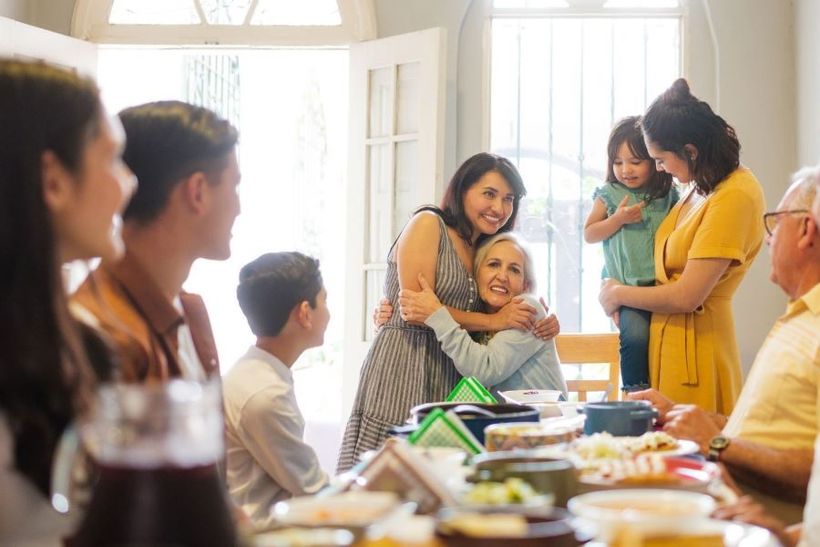
She suggests embracing their loved one’s presence by including a place at the table for Christmas dinner, making their favorite recipe or finding other ways to continue the bonds. By doing these things, “you're including them in your conversation, and you're making space for that person, both literally and symbolically,” Cann said.


Supporting someone who is grieving

Being supportive of someone grieving requires patience and vulnerability.


“Engage with the person and ask how you can best support them, and let them know that you are thinking about them during this time,” Cann said.


Sometimes, friends or family members don’t want to bring up death during the holidays because they don't want to make people sad at a joyful time.


“But the point is, they already are sad, so bringing it up allows them to express it” and feel accepted in their pain, Cann said.


It also is important to remember that not all grief is related to death. There are many types of loss that people experience such as divorce or disease. The Baylor researchers note that we can’t decide or predict what defines another person's grief, but we can offer love and support.


Approaching the holidays when experiencing grief over a death or a deep loss may be painful at first, but using these strategies can help us face the future by celebrating with gratitude what we had in the past.


Ultimately, the holidays are a time for reflection, connection and self-compassion. Allow yourself to feel your emotions fully – whether joyful, challenging or a mix of both – and use them as guides for meaningful action.


Looking to know more or arrange an interview? Simply click on the expert's icon below or contact: Shelby Cefaratti-Bertin today.

Connect with:
Candi Cann, Ph.D.

Candi Cann, Ph.D.

Professor, Baylor Interdisciplinary Core

Leading expert on death, dying & grief, diversity in death & the intersection of death & technology around the world

Digital Death and AfterlifeDeath and TechnologyModern Mourning Practices
Powered by

You might also like...

Check out some other posts from Baylor University

Hunter-Gatherer ‘Egalitarianism’ Is More Complicated Than We Thought featured image

4 min

Hunter-Gatherer ‘Egalitarianism’ Is More Complicated Than We Thought

Hunter-gatherer societies are often portrayed as models of equality, cooperation and selfless food-sharing. However, Baylor University anthropologist Duncan N.E. Stibbard-Hawkes, Ph.D., and an interdisciplinary team of researchers have found that this familiar picture oversimplifies how egalitarianism actually functions in everyday life. Their research, published in the journal PNAS Nexus, examined the Hadza, a contemporary hunter-gatherer population in Tanzania, and found that relatively equal outcomes are often maintained not only by altruism, but through social pressure and what anthropologists call “demand sharing.” In a previous study, Stibbard Hawkes and co-author Chris von Rueden, Ph.D., professor of Leadership Studies at the University of Richmond, conducted a wide-ranging review of hunter-gatherer populations that are typically characterized by equality. They found that, although many of these societies did “function with relative equality, even the most egalitarian hunter-gatherer groups display inequality in one area or another.” To further understand this, Stibbard Hawkes and the research team tested their ideas of egalitarianism through a behavioral economic experiment employing a give-and-take behavioral economy game with Hadza participants. “We find that equality was achieved only under conditions of disadvantageous inequality – where the person playing the game had less than others – suggesting that taking is more important in achieving redistributive equality than giving,” Stibbard Hawkes said. “This mirrors real life – if someone has too much, there’s often a lot of demanding shares from other people.” “Looking at the actual motivations and mechanisms of redistribution and limiting power gives us a more realistic approach and a clearer view of what egalitarianism actually is." - D. Stibbard Hawkes, Ph.D. Behavioral economy games Many anthropologists and ethnographers investigate fairness in societies by employing behavioral economic games, such as the “dictator game.” By giving participants an endowment of tokens, researchers can understand how equality ideals function within that group based on how individuals keep or give away the tokens, Stibbard Hawkes said. “When you play these economic games, people are often more selfish in hunter-gatherer societies than they are in America or Europe,” Stibbard Hawkes said. “Which is surprising because these societies are well known for being egalitarian.” To better reflect real-world Hadza food-sharing practices, Stibbard Hawkes and team redesigned the experiment so participants could take resources as well as give them – and the results changed dramatically. “We changed the rules of these economic games and ended up with equality – but only in the condition where people could take from other people,” he said. “That resulted in a relatively equitable distribution.” Only 40.9% of participants shared when they had more food than others, while 30% claimed additional items. When starting with fewer resources, 58.8% took from their partner – often beyond what was necessary for balance. Across both conditions, taking everything was the most common behavior. Importantly, the motivations behind those outcomes were not always idealistic. “Though we saw a lot of generosity, the individual motivations underlying this equality were actually often quite self‑interested,” Stibbard Hawkes said. Equality without altruism Rather than reflecting an intrinsic desire to be fair, Hadza sharing behavior reflects asymmetric incentives and immediate needs. “If I have a big pile of food and I’m not sharing it,” Stibbard-Hawkes explained, “the people around me are going to say, ‘No, you need to share this, and you’re going to give this to me.’ And, when everyone does this, the result is equality.” He emphasized that these interactions are often personal and direct. “It’s not just a societal expectation,” he said. “It’ll often be a direct dyadic interaction. Someone in the room next to you might be like, ‘Well, you’ve got a lot – you should give me some.’” How egalitarianism works Hunter-gatherer societies have long been used to help explain humanity’s evolutionary history. But Stibbard-Hawkes said popular writing often turns these societies into an idealized moral example. “When this gets roughly translated into popular science books,” Stibbard Hawkes said, “the idea is very much like we lived in this Edenic garden of freedom and plenty where everything was good and there were no difficulties.” That framing, he said, misses how egalitarianism is actually maintained. “Egalitarian societies exist – they’re not mythical,” Stibbard Hawkes said. “But if you actually look at the mechanics of how egalitarianism and relative political equality are maintained, it’s often people who are arguing, demanding shares and even insulting people who have too much.” Market integration and changing norms The study also found that Hadza individuals with greater exposure over the last decade to Tanzania’s broader market economy and farming were slightly more accepting of unequal outcomes. “These are things with a very different resource base, and what I'm finding is that – while traditionally forage foods like hunted meats, people expect sharing – when you ask people about cash or grain, their notions of what should be shared are very different,” Stibbard Hawkes said. Egalitarianism is not a myth Egalitarianism is not a myth—but it is often misunderstood. Generosity is not uncommon – but nor are people in egalitarian societies uniquely altruistic. Rather than arising from innate altruism or a lost utopia, equality in hunter-gatherer societies is actively produced through social pressure, negotiation and demands that limit accumulation and power. “Looking at the actual motivations and mechanisms of redistribution and limiting power gives us a more realistic approach and a clearer view of what egalitarianism actually is,” Stibbard Hawkes said.

National Cancer Research Month: Baylor Researchers at Forefront of New Discoveries featured image

2 min

National Cancer Research Month: Baylor Researchers at Forefront of New Discoveries

May is National Cancer Research Month, which highlights the importance of lifesaving research to the millions of people around the world affected by cancer. Thanks to spectacular advances made by cancer researchers, approximately 18.6 million people in the United States and millions more worldwide are living with, through and beyond their disease. Over the past year, Baylor University Media and Public Relations has reported on Baylor research at the forefront of discovering novel approaches to effective cancer therapies. University researchers are using tumor starvation techniques, natural products, phages, modified bacteria, precision nutrition and more in their trailblazing work on some of the most aggressive cancers, including kidney, pancreatic, oral, colorectal and breast cancers. In a recent article published by the University, it featured the hard work and research of eight Baylor experts driving those discoveries forward: • Kevin G. Pinney is developing a next-generation treatment for kidney cancer that targets the blood vessels feeding tumors. His research focuses on specialized drug conjugates designed to cut off oxygen and nutrients to renal cell carcinoma tumors — essentially starving cancer cells to death. • Daniel Romo is accelerating new therapies for pancreatic cancer using compounds derived from marine natural products. His work on a simplified version of pateamine A could offer a new therapeutic pathway for pancreatic ductal adenocarcinoma, one of the most aggressive and difficult-to-treat cancers. • Joseph Taube is investigating how breast cancers spread and resist treatment. His recent work examines whether a natural compound called Ophiobolin A can trigger inflammatory forms of cancer cell death that may work alongside immunotherapy — particularly in treatment-resistant triple-negative breast cancers. • Leigh Greathouse is combining cancer biology, nutrition science, and AI to personalize cancer prevention and treatment strategies. Her research explores how diet and the gut microbiome influence cancer outcomes and survivorship. • Michael S. VanNieuwenhze is leading groundbreaking colorectal cancer research using modified bacteria to deliver cancer-killing proteins directly into tumor cells. His team is engineering Listeria monocytogenes as a targeted therapeutic delivery system. • Aaron Wright is helping lead a major ARPA-H initiative exploring the use of bacteriophages — viruses that attack bacteria — to reshape the human microbiome and improve health. The project could eventually help prevent diseases linked to oral and colorectal cancers through low-cost phage-based treatments. • Savannah Rauschendorfer is researching how exercise interventions may reduce the harmful cardiac side effects of chemotherapy in adolescent and young adult cancer patients. Her work aims to identify patients at risk of cardiotoxicity earlier and improve long-term survivorship outcomes. • Jonathan Kelber studies the cellular and molecular mechanisms behind aggressive breast and pancreatic cancers. Through his Developmental Oncogene Laboratory, Kelber investigates how cancer cells evolve during tumor progression and tissue regeneration. Together, these researchers showcase how cancer science is rapidly evolving beyond traditional treatments – integrating biology, chemistry, nutrition, exercise science, microbiome research, and artificial intelligence in the search for more effective and personalized therapies.

Expert Perspective: Race and Representation Take Center Stage in Texas’ Democratic U.S. Senate Primary featured image

1 min

Expert Perspective: Race and Representation Take Center Stage in Texas’ Democratic U.S. Senate Primary

As Texas Democrats head toward a competitive 2026 U.S. Senate primary, conversations about race and representation are playing a visible role in the campaign. In a recent Spectrum News segment, Baylor University political analyst Dr. Mia Moody discusses how racial identity, voter perceptions, and candidate messaging are influencing the dynamics of the race. Mia Moody, Ph.D., is a professor and former chair of the Department of Journalism, Public Relations, and New Media in the Baylor University College of Arts & Sciences. She is a nationally recognized expert on mass media and image repair, intersectionality, critical race theory, and the media framing of women and people of color. View her profile The story explores how candidates are navigating issues of representation within a diverse Democratic electorate, and how those discussions could impact turnout and coalition-building ahead of the primary. Watch the full report for expert insight into how race is shaping one of Texas’ most closely watched political contests. The full story is available below:

View all posts