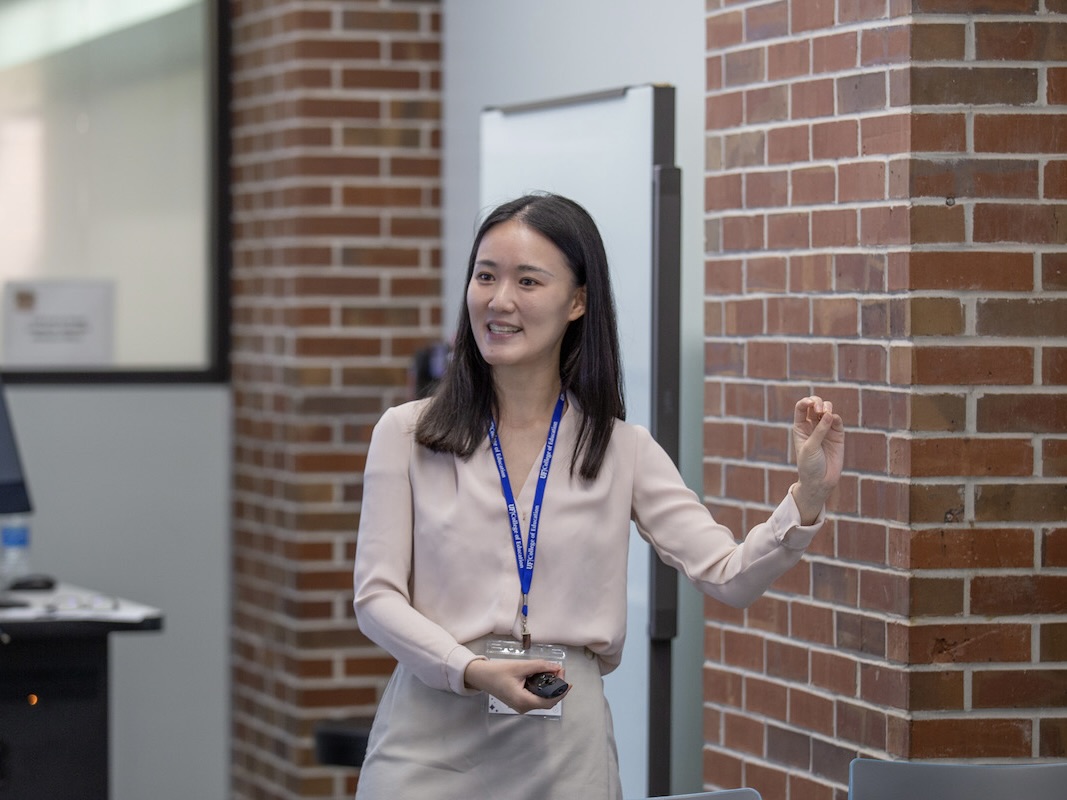

With the MOMitor™ app, Florida mothers have better maternal care right at their fingertips

UF obstetricians and data scientists collaborate on app to tackle pregnancy, postpartum complications

Dec 23, 2025

4 min

Kay Roussos-Ross


A program spearheaded by University of Florida physicians recently expanded to improve care for new mothers throughout the state, using tools they have right at home.


Five years ago, a team of obstetricians and researchers at the UF College of Medicine launched MOMitor™, a smartphone app that allows new mothers to answer health screening questions and check vitals like blood pressure in the comfort of their own homes, using tools given to them by their health care providers. Depending on the data, the clinical team can then follow up with patients as needed for further medical intervention.


Now, the app is expanding beyond North Central Florida — where nearly 4,400 mothers have participated in the program — to other areas in the state. Clinicians are also teaming up with data scientists at the College of Medicine who are using artificial intelligence to study data and identify trends that can lead to more personalized care.


Program expansion


Thanks to funding from the Florida Department of Health to support the state’s Telehealth Maternity Care Program, MOMitor™ has recently expanded for use in Citrus, Hernando, Sumter, Flagler, Volusia, Martin, St. Lucie and Okeechobee counties, said Kay Roussos-Ross, M.D. ’02, MPAS ’98, a UF professor of obstetrics/gynecology and psychiatry who is leading the program.


“The Florida Legislature was really motivated and interested in improving maternal morbidity and mortality, and through this program we’re touching additional parts of the state and helping patients beyond North Central Florida,” she said.


Maternal mortality is a serious concern in the United States, with more than 18 deaths recorded per 100,000 births in 2023, according to the latest data available from the U.S. Centers for Disease Control and Prevention. This is a much higher rate than most other developed countries, Roussos-Ross said.


Common factors that may lead to maternal mortality, which is measured from pregnancy through the first year after giving birth, include infection, mental health conditions, cardiovascular conditions and endocrine disorders.


Many of these complications can go unnoticed or unmonitored, particularly if at-risk mothers are not reporting complications to clinicians. A 2025 study published in the Journal of the American Medical Association shows that up to 40% of women do not attend postpartum visits.


“By leveraging AI, we have the opportunity to target moms and moms-to-be who might be at greater risk of complications ... and encourage them to participate in the program to mitigate these.” — Tanja Magoc, Ph.D.


“Whereas we’re used to seeing patients pretty routinely during pregnancy, after delivery visits quickly drop off and some women don’t make it back for postpartum care, so we may not have an opportunity to continue supporting them,” Roussos-Ross said. “This can often be because of barriers such as housing, transportation or food insecurity. We offer referrals to help with some of these services.”


With MOMitor™, patients can let their clinician know how they are recovering without visiting the clinic, improving access to care in situations where that is not always an easy option for new mothers.


“It’s a way to be proactive,” Roussos-Ross said. “Instead of waiting for a patient to come to us when they haven’t been doing well for a while, we connect with them through the app and follow up when they initially begin not doing well, so we can address concerns more quickly.”


Studying data to personalize care


Roussos-Ross’ team is collaborating with data scientists from the College of Medicine’s Quality and Patient Safety initiative, or QPSi, to determine how AI can assist in finding ways to further improve processes.


“By leveraging AI, we have the opportunity to target moms and moms-to-be who might be at greater risk of complications, such as developing postpartum depression or hypertension, and encourage them to participate in the program to mitigate these complications,” said Tanja Magoc, Ph.D., the associate director of QPSi’s Artificial Intelligence/Quality Improvement Program.


David Hall, Ph.D., a QPSi data scientist, said his team is working alongside the clinical team to analyze data that can be used to create recommendations for patients.


“Everything we do comes from information supported in the patients’ charts,” Hall said. “We also make sure the data upholds compliance standards and protects patients’ privacy.”


“We’re interested in finding out what areas might be hot spots and determining what makes them this way, so we can ... better identify areas where there may be high-risk patients and provide interventions to those who need it most.” — David Hall, Ph.D.


The teams aim to intervene before patients encounter postpartum complications, addressing potential issues before they become significant problems. After taking into account a patient’s personal and family medical history, the team looks at information such as geolocation, drilling down to areas much smaller than the ZIP code level in order to find points of potential concern.


“We’re interested in finding out what areas might be hot spots and determining what makes them this way, so we can study these patterns throughout the state and better identify areas where there may be high-risk patients and provide interventions to those who need it most,” Hall said.


Roussos-Ross said she is proud of the work her team has done to improve patient outcomes through the program so far and is excited to empower more patients.


“Every year, the participants give us recommendations on how to improve the app, which we love. But they also say, ‘This is so great. It helped me think about myself and not just my baby. It helped me learn about taking care of my own health. It made me remember I’m important too, and it’s not just about the baby,’” Roussos-Ross said. “And that is so gratifying, because women are willing to do anything to ensure the health of their baby, sometimes at the expense of their own care. This is a way for us to let them know they are still important, and we care about their health as well.”


Connect with:
Kay Roussos-Ross

Kay Roussos-Ross

M.D.

Dr. Kay Roussos-Ross' focus is the clinical care of high-risk obstetric patients with psychiatric and substance use disorders.

Postpartum Depression/Anxiety/OCDPremenstrual Dysphoric DisorderPerinatal PsychiatryPerinatal Substance Use DisordersPerimenopausal Mood Disorders
Powered by

You might also like...

Check out some other posts from University of Florida

Study finds most cancer patients exposed to misinformation; UF researchers pilot 'information prescription' featured image

3 min

Study finds most cancer patients exposed to misinformation; UF researchers pilot 'information prescription'

Ninety-three percent of patients with a new cancer diagnosis were exposed to at least one type of misinformation about cancer treatments, a UF Health Cancer Center study has found. Most patients encountered the misinformation — defined as unproven or disproven cancer treatments and myths or misconceptions — even when they weren’t looking for it. The findings have major implications for cancer treatment decision-making. Specifically, doctors should assume the patient has seen or heard misinformation. “Clinicians should assume when their patients are coming to them for a treatment discussion that they have been exposed to different types of information about cancer treatment, whether or not they went online and looked it up themselves,” said senior author Carma Bylund, Ph.D., a professor and associate chair of education in the UF Department of Health Outcomes and Biomedical Informatics. “One way or another, people are being exposed to a lot of misinformation.” Working with oncologists, Bylund and study first author Naomi Parker, Ph.D., an assistant scientist in the UF Department of Health Outcomes and Biomedical Informatics, are piloting an “information prescription” to steer patients to sources of evidence-based information like the American Cancer Society. The study paves the way for other similar strategies. Most notably, the study found the most common way patients were exposed to misinformation was second hand. “Your algorithms pick up on your diagnosis, your friends and family pick up on it, and then you’re on Facebook and you become exposed to this media,” Parker said. “You’re not necessarily seeking out if vitamin C may be a cure for cancer, but you start being fed that content.” And no, vitamin C does not cure cancer. Health misinformation can prevent people from getting treatment that has evidence behind it, negatively affect relationships between patients and physicians, and increase the risk of death, research has shown. People with cancer are particularly vulnerable to misinformation because of the anxiety and fear that comes with a serious diagnosis, not to mention the overwhelming amount of new information they have to suddenly absorb. While past research has studied misinformation by going directly to the source — for instance, studying what percentage of content on a platform like TikTok is nonsense — little research has looked at its prevalence or how it affects people. The team first developed a way to identify the percentage of cancer patients exposed to misinformation. UF researchers collaborated with Skyler Johnson, M.D., at Huntsman Cancer Institute, an internationally known researcher in the field. The survey questions were based on five categories of unproven or disproven cancer treatments — vitamins and minerals, herbs and supplements, special diets, mind-body interventions and miscellaneous treatments — and treatment misconceptions. The myths and misconceptions were adapted from National Cancer Institute materials and included statements like “Will eating sugar make my cancer worse?” The team surveyed 110 UF Health patients diagnosed with prostate, breast, colorectal or lung cancer within the past six months, a time when patients typically make initial treatment decisions. Most had heard of a potential cancer treatment beyond the standard of care, and most reported they had heard of at least one myth or misconception. The most common sources were close friends or family and websites, distant friends/associates or relatives, social media and news media. The findings mark a shift in misinformation research, with major implications for the doctor-patient relationship, said Bylund, a member of the Cancer Control and Population Sciences research program at the UF Health Cancer Center. “I still think media and the internet are the source and why misinformation can spread so rapidly, but it might come to a cancer patient interpersonally, from family or friends,” she said. Most patients rarely discussed the potential cancer treatments they had heard about with an oncologist, the study also found. Next, the researchers plan to survey a wider pool of patients, then study the outcomes of interventions designed to decrease misinformation exposure, like the information prescription.

New AI tool matches students with high-impact internships featured image

2 min

New AI tool matches students with high-impact internships

Finding the right internship can be an important step for students, but it’s not always clear which opportunities will lead to the strongest growth. To help solve that problem, University of Florida researchers have developed an AI-powered tool that helps students identify internships most likely to accelerate their technical and professional development. Unlike traditional recommendation engines, Pro-CaRE not only predicts which opportunities will lead to stronger outcomes, it also explains why each suggestion is a good fit. In testing data collected from the students, Pro-CaRE’s predictions proved highly accurate, accounting for more than 72% of the differences in learning gains among participants. While the pilot is being tested in engineering, the tool could be adopted for other disciplines. “Internships are one of the most critical parts of an engineering education, but students often struggle to know which experiences will actually help them grow,” said Jinnie Shin, assistant professor of research and evaluation methodology in the UF College of Education. “What makes Pro-CaRE unique is that it doesn’t just offer a list of options. It provides personalized recommendations backed by data and it tells students clearly why an opportunity is a good match for them.” Pro-CaRE creates matches by analyzing each student’s coursework, major, background and self-reported interest, confidence and self-efficacy in engineering skills. It then compares that profile with a carefully chosen set of similar peers to refine suggestions. The result is more precise guidance that adapts to students at different stages of their degree programs. “Students shouldn’t have to guess or hope that an internship will be worthwhile,” Shin said. “With Pro-CaRE, they can approach opportunities knowing they’re backed by evidence, whether the role is onsite, hybrid or remote and whether it’s at a startup or a Fortune 500 company.” The system is designed to work across a wide range of companies and contexts, giving students flexibility while ensuring their choices align with their personal and professional goals. Each recommendation comes with a clear “why this?” explanation, so students can make confident decisions and discuss options more effectively with advisors. Pro-CaRE was developed by a cross-disciplinary UF team combining expertise in education and engineering. Alongside Shin, the project’s co-principal investigators include Kent Crippen in the College of Education and Bruce Carroll in the Herbert Wertheim College of Engineering. The team is exploring external funding opportunities to expand the usage and test the efficacy on a larger scale. “Ultimately, our goal is to empower students to invest their time in experiences that will have the greatest impact,” Shin said. “Pro-CaRE bridges the gap between what students hope to gain and what internships can truly deliver.”

Using AI tools empowers and burdens users in online Q&A communities featured image

2 min

Using AI tools empowers and burdens users in online Q&A communities

Whether you’ve searched for cooking tips on Reddit, troubleshooted tech problems on community forums or asked questions on platforms like Quora, you’ve benefited from online help communities. These digital spaces rely on people across the world to contribute their knowledge for free, and have become an essential tool for solving problems and learning new skills. New research reveals that generative artificial intelligence tools like ChatGPT are creating a double-edge effect on users in these communities, simultaneously making them more helpful while potentially overwhelming them to the point of decreasing their responses. “On the positive side, AI helps users learn to write more organized and readable answers, leading to a noticeable increase in the number of responses,” explained Liangfei Qiu, Ph.D., study coauthor and PricewaterhouseCoopers Professor at the University of Florida Warrington College of Business. “However, when users rely too heavily on AI, the mental effort required to process and refine AI outputs can actually reduce participation. In other words, AI both empowers and burdens contributors: it enables more engagement and better readability, but too much reliance can slow people down.” The study examined Stack Overflow, one of the world’s largest question-and-answer coding platforms for computer programmers, to investigate the impact of generative AI on both the quality and quantity of user contributions. Qiu and his coauthor Guohou Shan of Northeastern University’s D’Amore-McKim School of Business measured the impact of AI on users’ number of answers generated per day, answer length and readability. Specifically, they found that users who used AI tools to generate their responses contributed almost 17% more answers per day compared to those who didn’t use AI. The answers generated with AI were both shorter by about 23% and easier to read. However, when people relied too heavily on AI tools, their participation decreased. Qiu and Shan noted that the additional cognitive burden associated with heavier AI usage negatively affected the impact on a user’s answer quality. For online help communities grappling with AI policies, this research provides valuable insight into how these policies can be updated in the current AI environment. While some communities, like Stack Overflow, have banned AI tools, this research suggests that a more nuanced approach could be a better solution. Instead of banning AI entirely, the researchers suggest striking a balance between allowing AI usage while promoting responsible and moderated use. This approach, they argue, would enable users to benefit from efficiency and learning opportunities, while not compromising quality content and user cognition. “For platform leaders, the takeaway is clear: AI can boost participation if thoughtfully integrated, but its cognitive demands must be managed to sustain long-term user contributions,” Qiu said.

View all posts