University of Delaware boasts six of the nation's best online graduate degree programs in latest U.S. News & World Report rankings

UD’s online master’s in nursing program jumped 99 spots

Jan 28, 2026

3 min


Six University of Delaware online graduate degree programs are ranked among the best in the nation by U.S. News & World Report in its 2026 U.S. News Best Online Programs, released Jan. 27, 2026.


Both UD’s online master’s in education and online MBA ranked among the top 10% of their respective programs, at No. 25 and 26, respectively. Announced on Jan. 6, the online MBA program recently rose nine spots to No. 32 in the Poets&Quants 2026 Online MBA rankings.


UD’s online master’s in nursing program ranked No. 35 out of 209 programs, rising 99 places over the past year.


New for UD, the online master’s in educational/instructional media design program was recognized by peers at No. 11 in this education specialty ranking.


UD’s online master’s in computer information technology program and online master’s in engineering ranked No. 64 in their respective areas.


“These latest rankings recognize the expertise and dedication of our faculty and staff in delivering UD’s outstanding online graduate programs,” Interim Provost Bill Farquhar said. “We are committed to continually enhancing these programs and all the transformative opportunities that enable our students to meet their educational and career goals throughout their lives.”


U.S. News selects several factors, known as ranking indicators, to assess each program in the categories outlined above. A program's score for each ranking indicator is calculated using data that the program reported to U.S. News in a statistical survey and from data collected in a separate peer assessment survey.


This year’s edition evaluates more than 1,850 online bachelor’s and master’s degree programs using metrics specific to online learning. The rankings include only degree-granting programs offered primarily online by institutions with accreditation from recognized commissions.


While the overall rankings methodology remains largely unchanged, U.S. News reported increased participation in this year’s data collection cycle, with more programs submitting statistical data and completing peer assessment surveys. According to U.S. News, this broader participation may reflect continued growth in online education nationwide.


The University of Delaware offers over 35 online credit and non-degree professional programs. An online program from UD offers the same quality and rigor as an on-campus program and provides the flexibility to accommodate your busy schedule. UD is accredited by the Middle States Commission on Higher Education, and its online and on-campus degree programs have rigorous curricula delivered by experts, offer affordable program options, and provide students access to student support services, career fairs, recruiting opportunities and graduation ceremonies to celebrate student success.


“UD's high-level rankings are in large part due to the positive outcomes that our students experience as a result of taking one of our online degrees or programs,” said Associate Provost for Online Learning and Innovation George Irvine. “Students tell us how much they enjoy learning from our accessible faculty and doing so in engaging and interactive online courses.”


For more information about UD’s online degree programs, visit online.udel.edu.


A complete listing of UD’s high-profile rankings is available on UD’s Institutional Research and Effectiveness Rankings webpage. Please note that the programs and specialties used in rankings may differ slightly from the names of UD’s degree programs.

Powered by

You might also like...

Check out some other posts from University of Delaware

2 min

How corporate competition can spur collaborative solutions to the world's problems

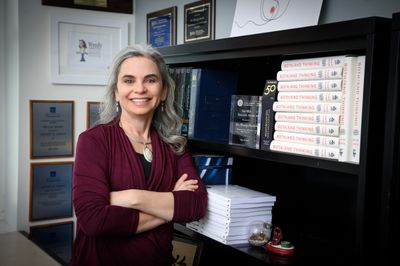
Why can’t large competitive companies come together to work on or solve environmental challenges, AI regulation, polarization or other huge problems the world is facing? They can, says the University of Delaware’s Wendy Smith. While it's difficult, the key is to have these companies collaborate under the guise of competition. Smith, a professor of management and an expert on these types of paradoxes, co-authored a recent three-year study of one of the most profound collaborations. Her team looked at the unlikely alliance of 13 competitive oil and gas companies that eventually formed Canada’s Oil Sands Innovation Alliance (COSIA), which works with experts worldwide to find innovative solutions for environmental and technical challenges in the region. Smith and her co-authors found that those companies were willing to collaborate, but only when collaboration was cast in the language, practices and goals of competition. Given the scope of our global problems, companies must continually work together to offer solutions. Creating that collaboration becomes critical, Smith said. This research offers important insight about how these collaborations are possible. Among the study's key findings: Competition can drive cooperation — if leaders harness it. It would make sense to assume that competition undermines collaboration. But the study finds that those who championed alliances used competitive dynamics to strengthen cooperation among rival firms. Rather than suppressing rivalry, leaders leveraged competition as a mechanism to enable joint action toward shared environmental goals. This reframes how organizations can manage tensions between competition and cooperation in partnerships. For example, COSIA leaders created competition between partners to see who would contribute the most valuable environmental innovations. Partners could only gain as much benefit from other company’s innovations commensurate with what they shared. A “Paradox Mindset” is key to complex collaborative success. The research identifies the importance of what the authors call a paradox mindset, which sees competition and cooperation not as opposites to be balanced but as interrelated forces that can be used in tandem. Leaders in the study who adopted this mindset were more thoughtful and creative about how to engage both competitive and collaborative practices in the same alliance. Traditional balance isn’t the goal — process over stability. Instead of pursuing a simplistic “balance” between competing and cooperating, the study shows that effective alliances evolve through process, where competition remains visible and even useful throughout the lifecycle of the alliance. To connect with Smith directly and arrange an interview, visit her profile and click on the "contact" button. Interested journalists can also send an email to MediaRelations@udel.edu.


1 min

Why homelessness is more than a housing issue for students

More than 4,400 students in Delaware were identified as experiencing homelessness during the 2022–23 school year, a number that continues to rise.  Ann M. Aviles, associate professor in the University of Delaware’s College of Education and Human Development, studies education equity, social policy and services for children and families. She is co-author of a new book, "Serving Students Who Are Homeless: A Resource Guide for Schools, Districts, Educational Leaders, and Community Partners", which offers practical guidance for educators navigating the challenges of student homelessness. Nationwide, more than 1.3 million school-aged children experience homelessness annually. While housing instability is often viewed as a social services issue, research shows it has direct and profound consequences for student learning, engagement and well-being. Housing instability affects every aspect of a student’s daily life. Students may be worried about where they will sleep, whether they will have food or how they’ll get home after school. That uncertainty makes it much harder to focus on learning, Aviles said. A key recommendation in Aviles’ new book is stronger collaboration between schools and community organizations. She encourages districts to develop community resource maps that identify local food pantries, shelters, health providers and other support services. She also emphasizes the importance of public understanding of homelessness as a systemic issue shaped by policy, affordability and access to services. To speak with Aviles further, email mediarelations@udel.edu. 

2 min

Maduro is gone; expert details potential impact on the Caribbean

Globally, the ousting of Nicolás Maduro in Venezuela has been met with a mix of reactions and cautious optimism. The University of Delaware’s Kalim Shah can discuss how regime change will play across the Caribbean and the spillover effect that will ripple throughout the region – and the world – in the years and decades to come. Shah, professor of energy and environmental policy and an expert on the island nations of the Caribbean, says that although public statements have been muted and restrained, there is a shared understanding. “For small island states that have absorbed the effects of Venezuelan collapse for more than two decades, this moment represents the possible end of a long and destabilizing chapter,” Shah said. Caribbean governments are not celebrating regime change, Shah said. Rather, they are responding to the prospect of reduced systemic risk. “A Venezuela that no longer exports large-scale displacement, opaque energy leverage and permissive criminal governance is objectively preferable for the region.” Shah can discuss several aspects of Venezuela’s political history, how the nation has arrived where it is, where it might be headed and the impact this will have on the Caribbean as a whole. Those include: • Venezuela’s political and economic deterioration during the Chávez–Maduro era and how that has translated directly into pressures felt across the Caribbean in the form of migration, fiscal exposure, security risks and regional uncertainty. • How the nation’s institutional collapse coincided with deepening organized crime activity across the Caribbean basin. Data from the United Nations Office on Drugs and Crime consistently places the region within major cocaine trafficking corridors linking South America with North American and European markets. For Caribbean governments, this meant higher interdiction costs, increased exposure to transnational criminal networks and growing pressure on already limited security institutions. • This moment invites a reassessment of China’s expanding footprint in the Caribbean, Shah says. He can discuss the ways in which Beijing has deepened its presence throughout the region. Shah says that as this transition unfolds, five policy developments will determine whether the cautious optimism proves warranted: • The impact on Venezuelan outward migration to the Caribbean. • Whether Caribbean public systems receive durable support rather than short-term humanitarian fixes. • Organized crime and drug trafficking pressures in the Caribbean basin. • External security engagement in the Caribbean. • Whether the region avoids a return to dependency-driven energy and infrastructure politics. “For the Caribbean, hope today is not naïve. It is conditional. The Chávez–Maduro years imposed real costs on the region. Their end creates an opening…but only if policy follows through,” Shah said. To contact Shah directly for interviews, visit his expert page and click on the "contact" button. Interested reporters can also send an email to mediarelations@udel.edu.

View all posts