
How a UF reading program is reaching classrooms worldwide

Mar 18, 2026

3 min

Holly Lane


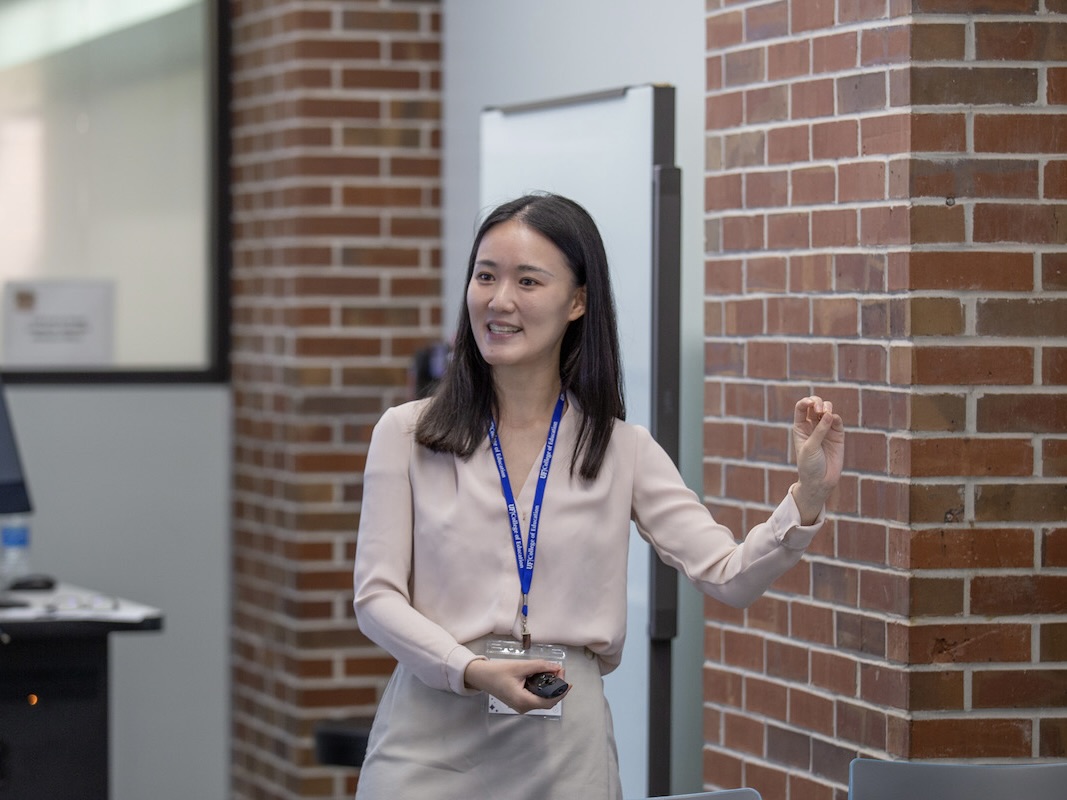
For more than 25 years, Holly Lane, Ph.D., has been laser-focused on a global educational goal: to ensure that students worldwide have access to information about reading. Her passion project, known as the University of Florida Literacy Institute, or UFLI, has already improved the literacy skills of more than 10 million children.


What began as a modest classroom tool now has a Facebook community of over 273,000 members; 18 million online toolbox views; and more than 500,000 instructional manuals in classrooms. And as the UFLI brand gains traction, Lane continues to champion what the acronym means and why the program has been so life-changing.


“When you learn to read, you fly,” said Lane, who serves as the UFLI director and a professor of special education at UF.


UFLI is an ongoing effort by UF faculty and students to improve literacy outcomes for struggling students by addressing two key areas: reader development and teacher development. The program began in 1998 as a tutoring model for beginning readers working with Lane’s pre-service teachers. The idea was that, if teachers understood how to employ effective, evidence-based practices in a one-on-one tutoring session, they could transfer those skills to their small-group or classroom instruction. However, some teachers struggled to make that transition, so a dedicated small-group lesson model was created.


That foundation eventually expanded into a dyslexia support program and caught the attention of a surprising partner, best-selling author and philanthropist James Patterson. Known worldwide for his literacy advocacy and generous support of reading initiatives, Patterson has become a key benefactor for the program.


When the COVID-19 pandemic hit, a challenge turned into a breakthrough. UFLI started its Virtual Teaching Resource Hub and, in the first week, about 70,000 teachers visited the site and downloaded materials. The turning point came when a school in St. Augustine reached out to UFLI, asking for professional development.


“I said, ‘Well, what if we planned the lessons for you instead of teaching you how to plan these lessons?’” Lane said.


What followed was what Lane called her “accidental phonics program.”


“They ended the year with the best scores they'd ever seen, better than their pre-COVID scores, and that was unheard of,” Lane said.


That success led to an effective district-wide pilot in Alachua County with 21 elementary schools. UFLI leaders decided to publish the contents of the program and create a manual that individual teachers could purchase. This concept boomed, and the program even made waves overseas.


“Starting with the virtual teaching hub… we had a huge following in Perth and in Melbourne, and now we have an Australian edition of the manual,” Lane said. “We’ve been in every state and every Canadian province and territory, but we're also now in something like 60-some other countries.”


Patterson has continued his support by directing efforts toward expanding UFLI’s reach in Florida, aiming to bring the program to every district in the state. Looking ahead, Lane is especially excited about UFLI’s new technology.


“We're calling it our assessment and planning portal,” Lane said. “Teachers assess two skills a week, and they enter their data into this program and it spits out small-group lesson plans for the following week that target specific needs of their students.”


The data input system is highly advanced, requiring the teacher to simply hold up work in front of a webcam, and the system then reads the student handwriting and imports the data. The program’s structure also ensures that students apply new concepts daily and revisit them regularly.


But behind it all is a deeply connected community. For Lane, the success of UFLI boils down to people.


“We have an amazing team here,” Lane said. “If anything, that's my superpower, finding really good people who are really good humans but also really good at what they do.”


For more information about UFLI, visit ufli.education.ufl.edu.


Connect with:
Holly Lane

Holly Lane

Associate Professor | Director

Holly Lane leads the UF Literacy Institute, which works to improve literacy outcomes for students who struggle to learn to read and write.

Teacher PreparationReading and LiteracyPhonics
Powered by

You might also like...

Check out some other posts from University of Florida

Using AI tools empowers and burdens users in online Q&A communities featured image

2 min

Using AI tools empowers and burdens users in online Q&A communities

Whether you’ve searched for cooking tips on Reddit, troubleshooted tech problems on community forums or asked questions on platforms like Quora, you’ve benefited from online help communities. These digital spaces rely on people across the world to contribute their knowledge for free, and have become an essential tool for solving problems and learning new skills. New research reveals that generative artificial intelligence tools like ChatGPT are creating a double-edge effect on users in these communities, simultaneously making them more helpful while potentially overwhelming them to the point of decreasing their responses. “On the positive side, AI helps users learn to write more organized and readable answers, leading to a noticeable increase in the number of responses,” explained Liangfei Qiu, Ph.D., study coauthor and PricewaterhouseCoopers Professor at the University of Florida Warrington College of Business. “However, when users rely too heavily on AI, the mental effort required to process and refine AI outputs can actually reduce participation. In other words, AI both empowers and burdens contributors: it enables more engagement and better readability, but too much reliance can slow people down.” The study examined Stack Overflow, one of the world’s largest question-and-answer coding platforms for computer programmers, to investigate the impact of generative AI on both the quality and quantity of user contributions. Qiu and his coauthor Guohou Shan of Northeastern University’s D’Amore-McKim School of Business measured the impact of AI on users’ number of answers generated per day, answer length and readability. Specifically, they found that users who used AI tools to generate their responses contributed almost 17% more answers per day compared to those who didn’t use AI. The answers generated with AI were both shorter by about 23% and easier to read. However, when people relied too heavily on AI tools, their participation decreased. Qiu and Shan noted that the additional cognitive burden associated with heavier AI usage negatively affected the impact on a user’s answer quality. For online help communities grappling with AI policies, this research provides valuable insight into how these policies can be updated in the current AI environment. While some communities, like Stack Overflow, have banned AI tools, this research suggests that a more nuanced approach could be a better solution. Instead of banning AI entirely, the researchers suggest striking a balance between allowing AI usage while promoting responsible and moderated use. This approach, they argue, would enable users to benefit from efficiency and learning opportunities, while not compromising quality content and user cognition. “For platform leaders, the takeaway is clear: AI can boost participation if thoughtfully integrated, but its cognitive demands must be managed to sustain long-term user contributions,” Qiu said.

CEOs 5 times more likely to survive fraud than a personal scandal featured image

2 min

CEOs 5 times more likely to survive fraud than a personal scandal

If the CEO of Astronomer had overseen tax fraud instead of being caught on a kiss cam cuddling his HR chief in an extramarital affair, he might still have a job. That’s because, according to a new study, CEOs are five times more likely to be fired for personal misconduct than for overseeing financial fraud. “For financial fraud, the CEO can easily say, ‘Hey, it wasn’t me,’” said Aaron Hill, Ph.D., an associate professor in the University of Florida Warrington College of Business who led the study. “With personal misconduct, there’s no excuse.” The research, forthcoming in Strategic Organization, examined 59 cases of personal misconduct and compared them with more than 300 financial scandals at publicly traded companies between 1997 and 2020. The personal cases included inappropriate relationships, drug or alcohol incidents, domestic violence, falsifying credentials and derogatory speech. Hill and his colleagues found that boards move decisively when a CEO’s private behavior becomes public. By contrast, financial misconduct — such as accounting restatements that can wipe out billions in shareholder value — often leaves room for a chief executive to deflect blame onto others in the organization. Recent company performance influenced how boards responded, to a point. A CEO whose company was thriving could often survive a financial scandal because directors had both plausible deniability and a strong incentive not to disrupt success. But good numbers offered little protection when the problem was personal behavior. For example, McDonald’s ousted Steve Easterbrook in 2019 over a consensual relationship with a subordinate, even though the company’s stock price had doubled under his leadership. Hewlett-Packard similarly dismissed CEO Mark Hurd after harassment allegations despite his reputation for turning the firm around. “Even strong performance can’t erase certain kinds of misconduct,” Hill said. “There are some things you just can’t excuse.” The study also uncovered how scandals influenced succession decisions. When personal misconduct led to a firing, boards were more likely to promote an insider, signaling that the problem lay with one person rather than the culture of the company. Financial scandals, on the other hand, often prompted boards to recruit outsiders as a way of reassuring markets that the firm was serious about change. “It’s a signaling move,” Hill said. “Bring in an outsider after fraud, and the market reacts positively. Stick with an insider after a personal scandal, and it says the organization itself is sound.” The researchers argue that these choices reveal how boards balance their fiduciary duty with the reputational risks of scandal. While dismissing a CEO can serve as a public relations reset, Hill emphasized that it is almost always a financially motivated calculation. “Boards are supposed to look out for the company and its shareholders,” he said. “But when they decide to keep a CEO after misconduct, I think it sends the wrong message — to employees, to investors and to the public.”

UF develops breakthrough magnet that could transform metal production featured image

3 min

UF develops breakthrough magnet that could transform metal production

Imagine if producing steel parts for agricultural equipment or even aluminum soda cans required only a fraction of the energy it does today. A University of Florida-led innovation may soon make this a reality. In a groundbreaking collaboration backed by a nearly $11 million federal grant, UF researchers have developed a first-of-its kind superconducting magnet that could advance metal production and position the United States as a global leader in alloy production.   “This revolutionary technology has the potential to substantially reduce the cost and energy use of heat treatments in the steel industry, and we are excited to help pave the way for its adoption in industry.” —Michael Tonks, Ph.D., UF’s interim chair of Materials Science and Engineering Funded by the U.S. Department of Energy’s Advanced Manufacturing Office, the project uses Induction-Coupled Thermomagnetic Processing, or ITMP, an advanced manufacturing method that integrates magnetic fields with high-temperature thermal processing. The national consortium of industry, academic and national laboratory partners is now led by Michael Tonks, Ph.D., UF’s interim chair of Materials Science and Engineering, who succeeded Michele Manuel, Ph.D., the project’s long-time leader. “This revolutionary technology has the potential to substantially reduce the cost and energy use of heat treatments in the steel industry, and we are excited to help pave the way for its adoption in industry,” said Tonks. It’s not just any piece of equipment; it’s a custom-built superconducting magnet with a unique ability to combine magnetic fields with high-temperature thermal processing. In partnership with the UF physics department, Oak Ridge National Laboratory, or ORNL, and six companies interested in the technology, the magnet and cylinder induction furnace now sit atop a 6-foot-high platform. The prototype, which costs more than $6 million to purchase and install, is capable of processing steel samples up to 5 inches in diameter making it a rare asset for academic research. Yang Yang, Ph.D., UF materials science research faculty member, estimated ITMP could reduce steel processing time by as much as 80 percent, cutting energy use and operational costs. “Thermomagnetic processing changes a material’s phase stability and kinetic properties, accelerating carbon diffusion in steel, said Yang. “Traditional furnaces cannot achieve these advanced material properties.” The system works by modifying the driving forces for important steel phase changes, which shortens heat treatment. “What normally takes eight hours can be done in just a few minutes.” Yang explained. “The magnetic field acts as an external driving force to make atoms diffuse faster.” Unlike conventional energy sources like electricity or natural gas, the ITMP process uses volumetric induction heating along with high-static magnetic fields to lower energy consumption. The project is still in a pilot phase and requires additional research and testing. At ORNL, researchers emphasized the rarity of UF’s prototype, citing its unprecedented combination of magnetic field strength and ability to process large samples and components. “This could significantly advance U.S. manufacturing and process efficiency for heat treatment of materials such as metal alloys of steel or aluminum,” said Michael Kesler, Ph.D., ORNL research scientist and lead collaborator. Kesler noted successful implementation of this technology could contribute to a reliable energy grid and more efficient industrial electrification. UF researchers contend it could also reduce carbon emissions, supporting cleaner, more sustainable manufacturing processes. The tall, two-level magnet now resides in the Powell Family Structures and Materials Laboratory on UF's East Campus. MSE plans to officially unveil it in December, inviting representatives from national labs, industry and academia. While Engineering students will have future opportunities to use it for research and experiential learning, UF researchers are optimistic about potential industry adoption for industrial manufacturing in the next five to 10 years. The award is part of a $187 million DOE initiative to strengthen competitiveness in U.S. manufacturing. If successful, the innovation could redefine how the world shapes the materials of tomorrow.

View all posts