Inside the Partnership Between Texas Christian University and Taylor Sheridan’s Four Sixes Ranch

Jun 9, 2026

1 min


A unique partnership between Texas Christian University and the legendary Four Sixes Ranch is giving students hands-on experience helping shape the future of one of the most recognizable brands in the American West. Recently featured at a major national rodeo event, the ranch’s newly designed retail booth, created by TCU faculty and students, blends heritage-inspired design with modern merchandising, reflecting the ranch’s growing national profile under the ownership of Taylor Sheridan and Nicole Sheridan.


“We’re now written into the history of the Four Sixes Ranch.”


The collaboration spans fashion merchandising, branding and business strategy, allowing students to contribute directly to product development, retail design and digital marketing initiatives. For students involved, the project offered a rare opportunity to see classroom ideas become real-world products tied to an internationally recognized Texas brand. Faculty members say the partnership reflects TCU’s focus on experiential learning while helping preserve and evolve an important piece of Texas cultural identity.


Check out the video TCU and Four Sixes Ranch, and you can read more about this project in the full article below:


Looking to connect with Chares Freeman, Kevin Smith, Nicole Bettinger or Rima Shrestha about this exciting project? Simply contact Holly Ellman, Associate Director of Communication, at h.ellman@tcu.edu today.

Powered by

You might also like...

Check out some other posts from Texas Christian University

Why Polls Are a Snapshot, Not a Forecast featured image

3 min

Why Polls Are a Snapshot, Not a Forecast

The poll numbers will keep coming between now and Election Day. Keith Gaddie wants you to ask a different question: not who's ahead, but why. Gaddie is the Hoffman Chair of the American Ideal and a professor at Texas Christian University. He says the biggest mistake people make is treating polls like a horse race. A poll is a photo, not a prediction "A poll is just a snapshot of a sample of reality at a particular point in time, and they age out really quickly." The numbers show what one group of people thinks right now. The real work, Gaddie says, is figuring out why they think that way and how it shapes the choices they make. And those opinions are often shallow. Gaddie says that "most of the time, when polling, people haven't thought about a question until you ask them, so their opinions are immediate. It is a knee-jerk reaction to the question." Noise vs. a real trend Poll movement comes from two places. One is the sample itself. Gaddie explains that "any oscillation within 4 or 5 points, if it's happening all the time, that's just from the sample. That's just noise." A real shift looks different: numbers that keep moving in the same direction over time. Don't expect many minds to change. "There are very few true undecideds. Most people are out there actually seeking information to verify prejudice that they have or preference that they have." What does move an election is a true crisis. The 2008 financial meltdown helped lock in Barack Obama's first win, and Gaddie says crises like that tend to work against the party in power. October surprises, on the other hand, are rare. Gaddie says, "They can't be engineered or manufactured." Today's fragmented media makes it harder still. He says, "You can't create a singular story that moves in one direction." Why turnout is the real story Hardcore partisans always vote. The voters in the middle turn out when something gives them a reason, and you can't predict which party they'll back. This year, Gaddie sees a signal in Texas, where more people voted in the Democratic primary than the Republican one. He says, "Primary turnout was at a record level." And in his view, high turnout usually means one thing: "When you get high turnout, you're usually voting for change." The reason, he says, is that "anger and disappointment and desire are much more powerful motives." Presidential years pull more voters because the race is national and the choices feel simple. Midterms are harder because, as Gaddie puts it, "life gets in the way." He adds: "Once you get registered, you have to work really hard to not be able to vote, even in Texas." What to watch instead of the numbers Look at how each candidate presents themselves for the job they're running for. Then compare the reality each candidate describes with the one you see. Gaddie's reminder: "only you know what that is, and we don't all see the same reality." The election isn't over when the votes are counted Gaddie also has a warning about what comes after Election Day. He says, "This election will not be over until the last lawsuit." He believes there are "procedural concerns that everyone ought to have." He points to a line from political scientist V.O. Key that he thinks captures what's at stake: "If a democratic regime is to work successfully, it must be generally agreed that contestants for power will not shoot each other and that ballots will be counted as cast." The takeaway A poll number is where the story starts, not where it ends. Turnout, timing, trust in the process and the candidates themselves will tell you far more about how this midterm plays out. Covering the midterms? Click on Keith's icon below to connect with him. He can speak to: Polling and public opinion Midterm turnout Texas and Southern politics Voting rights and redistricting Democracy and trust in elections

Texas Senate Rematch Puts Tarrant County Back in the Political Spotlight featured image

2 min

Texas Senate Rematch Puts Tarrant County Back in the Political Spotlight

Less than a year after Democrats flipped a Texas Senate seat in Tarrant County, the two candidates are preparing for a November rematch — this time under very different electoral circumstances. Democratic State Sen. Taylor Rehmet defeated Republican Leigh Wambsganss by 14 percentage points in a January special-election runoff for Senate District 9, a district Donald Trump carried by 17 points in the 2024 presidential election. Now Rehmet and Wambsganss will face each other again on Nov. 3, with the winner securing a full four-year term. In a recent Fort Worth Report article examining the race, Adam Schiffer, professor of political science at Texas Christian University, explains why the dynamics of a regular midterm election could be significantly different from those surrounding January's special election. Special elections typically attract lower turnout, and January's runoff featured only Rehmet and Wambsganss. This fall, Tarrant County voters will see more than 70 races on the ballot, creating a much different political environment. “Democrats are extremely energized and motivated to vote right now, and Republicans are a bit dispirited,” Schiffer told the Fort Worth Report. “So that’s the kind of thing that then can work to Rehmet’s advantage.”  Professor Schiffer studies American politics, with an emphasis on the news media, elections, and public opinion. His recent work has covered the hot topics of media bias and presidential primary elections. View his profile Schiffer also points to competing forces that could influence the contest. A larger electorate and greater partisan attention could change the makeup of the voters who participate, while Democratic enthusiasm could continue to benefit Rehmet. The race provides a timely opportunity to examine broader questions about voter turnout, partisan loyalty, candidate positioning and whether the political conditions that produce a special-election upset can carry over into a midterm election. Schiffer can provide expert perspective on the Senate District 9 rematch, Tarrant County's changing political landscape, voter behavior and the role that turnout and partisan enthusiasm can play in closely watched elections. To arrange an interview today, simply click on his profile below.

Patent No. 50: How an Inventor's Mindset Is Shaping TCU Research featured image

2 min

Patent No. 50: How an Inventor's Mindset Is Shaping TCU Research

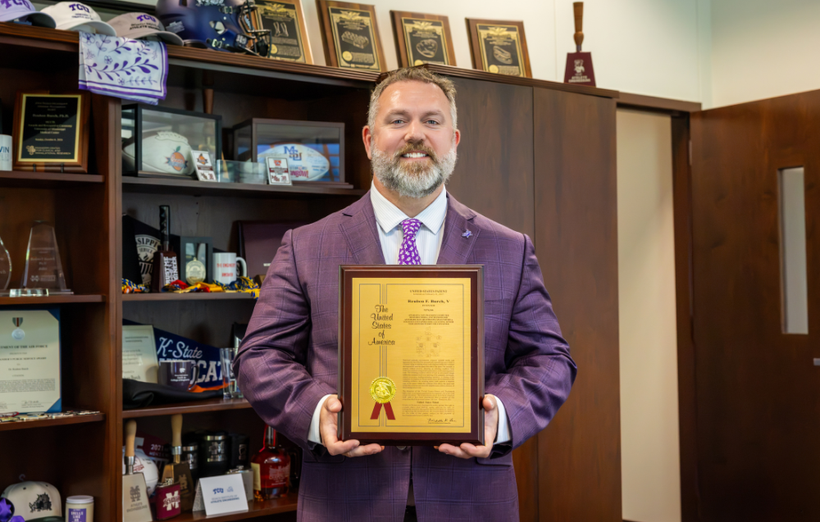
As TCU's vice provost for research, Reuben F. Burch V has spent his career turning research into real-world solutions. This summer, that track record reached a milestone: his 50th patent, earning him the designation "Prolific Inventor." Burch's inventing career began during his years at FedEx Express, where he helped develop the rugged handheld device now used by couriers around the world. His first patent wasn't the handheld device itself, it was the design of a wearable version that freed couriers' hands, making the job safer and more efficient. Patent No. 50 grew out of a different question: how do you study movement where it actually happens, on tracks, on football fields, on rugged terrain, rather than only in a lab? The resulting technology uses a swarm of drones to capture performance data in real-world environments, giving TCU researchers a new way to study athletes of all kinds in their own arenas. "Fifty means just as much to me as my first one did," Burch said, "and it means a lot more that I got it while I'm here at TCU." "Reuben has an extraordinary ability to see around corners," said Jim Weinstein, director of TCU's Roach Institute of Athlete Engineering. "He recognizes problems others haven't yet identified and then creates the technology needed to solve them. This patent isn't just another invention, it's a research capability that will change how we study movement and human performance." That same builder's mindset is now fueling TCU's LEAD ON: Values in Action strategic plan to grow the university's research enterprise. In Burch's first year at TCU, competitive external research awards increased by 79.7 percent, with new partnerships established with Advanced Functional Fabrics of America, Deakin University, and the Fort Worth Nature Center & Refuge, alongside the launch of the Roach Institute for Athlete Engineering. "The researchers were already here," Burch said. "The momentum came from helping unlock their potential." Burch is available to speak with media on athlete engineering, a discipline he founded, and how its principles apply across sports, industrial (repetitive motion tasks), tactical (military and first responder) and at-risk populations. He can also speak to AI, human factors and ergonomics, advanced manufacturing, workforce and economic development, and the changing landscape of research funding and enterprise building in higher education. Read the full TCU story, "Patent No. 50: Reuben Burch Brings Inventor's Approach to TCU Research," here. To arrange an interview or request a comment, click through to Reuben Burch's profile below.

View all posts