

4 min
New clues about how earthquakes work
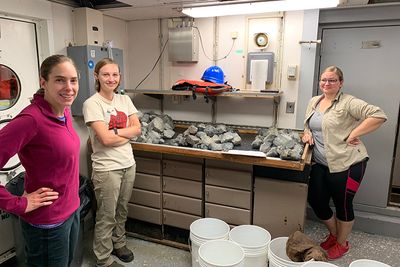
University of Delaware researcher Jessica Warren helped uncover evidence that sections of fast-moving underwater faults may act like “brakes,” controlling the occurrence of big earthquake events on transform faults. Warren can discuss what the findings, released today in the journal Science, mean for earthquake science and future modeling. Situated along a stretch of the equator in the Pacific Ocean, between Indonesia and Central America, the Gofar transform fault is one of the fastest moving faults on Earth — cruising along the seafloor at about 140 millimeters per year. This is over four times faster than the San Andreas fault is moving in California. “Geologically speaking, it's like looking at a moving Acela train next to a SEPTA train on the tracks,” said Warren, a professor of earth sciences at UD. Researchers know that the Gofar transform fault line has experienced a magnitude 6 earthquake about every five to six years over the last three decades. It’s been studied extensively, as these earthquakes occur at the same places along the fault and at the same intensity, time after time. What’s been unknown, until now, is why parts of this fault experience many small microshocks leading up to a main earthquake rupture, then shut down, while other parts of the fault are quiet before the big event and then experience many aftershocks. Now, a multi-institutional team of researchers, including UD’s Warren, reports that sections of the fault without large magnitude earthquakes actually act like brakes in a fast-moving car, controlling the occurrence of big earthquake events on transform faults. This finding is in contrast with currently accepted models of earthquake behavior. The team includes researchers from UD, Indiana University, Woods Hole Oceanographic Institution, Scripps Institution of Oceanography at UC San Diego, the U.S. Geological Survey, Boston College, Western Washington University, the University of New Hampshire and McGill University. In the study, the researchers analyzed two zones along the Gofar transform fault they say have stopped about 15 magnitude 6 earthquakes over the past 30 years. The study findings will inform globally what’s known about how faults and earthquakes behave, at sea and on land. Warren's contributions include leading the initial field research at sea in 2019 on the R/V Atlantis and interpreting results throughout the project, with a focus on connecting the earthquake observations to how rocks in the fault fracture and distort during an earthquake. Why were you studying the Gofar transform fault, in particular? Warren: Geoscientists want to understand faults and earthquakes because they are obviously a big hazard on land. The rocks that make up the seafloor are simpler than those found on land, providing a more controlled space to study earthquakes, despite the challenges of doing research underwater. If you want to understand how faults build up stress and then release it (and where), the Gofar transform fault is amazing, because it experiences earthquakes at reliable intervals of five to six years. This is a lot more regular than any other fault. In 2019, I led a research cruise on the R/V Atlantis that deployed 51 seismometers two miles down on the seafloor to detect these small events. We were able to compare the results of our measurements from 2019 to 2020 to an experiment conducted by my colleague Jeff McGuire on the same fault in 2008. The similarities in the two datasets brought us to the realization that fault sections without large magnitude earthquakes control the overall occurrence of big events on transform faults. When we had that observation in 2008, that might have been a one-off, but getting back this new data and seeing such similar behavior was a new insight into what's happening in the fault. How does that tell you about how earthquakes occur on land? Warren: On land, people spend a lot of time looking at how rainwater and groundwater move in a fault system, and how that influences the behavior of the fault. In the oceans, we have an unlimited amount of water. Once the rock cracks, the water is going to get in there. Being able to look at how a fault changes through the earthquake cycle — which we've now measured most of on this one fault — can help us understand what is universal about how faults work, and how rock friction works. And one of the big players is water. That's why the rock samples that my lab works on matter. Fault structure is another thing that we've been trying to understand. We know from on land that some parts of a fault are linear, while other parts have lots of strands and maybe contain more fractures and that, if you start putting water in the picture, this can limit or change how water moves into the system. Now, we have these very high-resolution maps of the seafloor, where we can see, for the first time, where the fault itself is. One of the next things we want to understand is how fluid gets into the fault, and then how friction in a fault changes when water is there. Why is this important? Warren: The next step is to translate the understanding that we've gained from this specific fault to understanding how faults behave in general. This is the longer path to really understanding earthquake hazards. It's not going to change our hazard models tomorrow, but hopefully it will in the decades to come. To reach Warren directly and arrange an interview, visit her profile and click on the "contact" button. Interested reporters can also email MediaRelations@udel.edu.