Rethinking how data meets the atom

Aug 25, 2026

3 min


Quantum computing is often framed as a hardware race with attention fixed on machines that promise amazing speed. But a foundational mathematical problem remains unresolved.


No complete framework yet exists for converting massive amounts of data generated by fields such as healthcare, disease surveillance, financial transactions and climate monitoring into units a quantum machine can process.


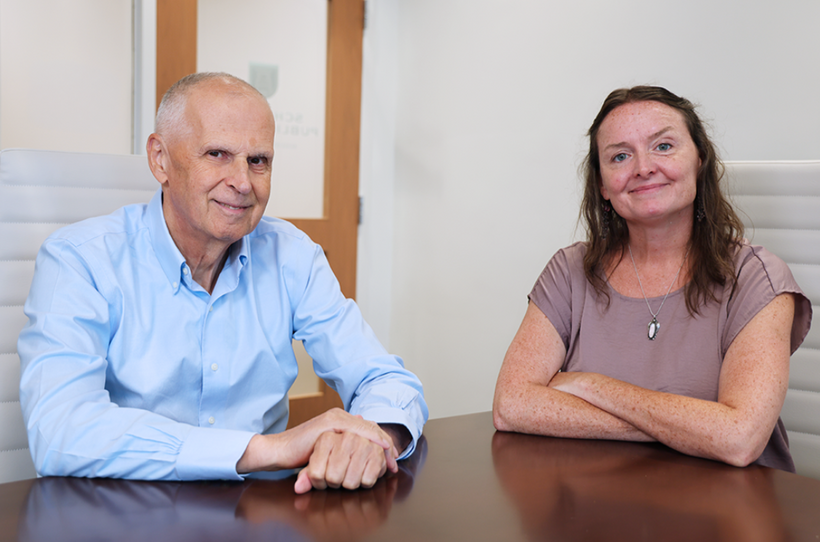
“What exactly we are proposing is this: data is continuous,” said Arni S.R. Srinivasa Rao, PhD, professor and director of the Laboratory for Theory and Mathematical Modeling, Division of Infectious Diseases, Medical College of Georgia at Augusta University. “That means the generation of the data is continuously happening. And how to slice it down into pieces, that is what it is about. The slicing down of the data into smaller pieces, not too small pieces, but smaller enough for the computers to handle them in a meaningful way.”


Rao and Steven G. Krantz, a professor of mathematics at Washington University in St. Louis, published their findings on “The Role of Quantization in Quantum Computing” in the July/August 2026 issue of SIAM News, published by the Society for Industrial and Applied Mathematics.


“Quantization is a mathematical method, nothing to do with quantum computing,” Rao said. “But these two we are trying to mix together.”


The problem with just chopping it up


Classical computers store information as bits, switches that are either off or on, zero or one. Quantum computers use qubits, which can hold combinations of both states simultaneously, which is why they can theoretically process vastly more information at once.


But qubits operate at the atomic level. Getting that data into a quantum machine requires breaking it down into atomic-scale pieces first. The math for doing that well, Rao and Krantz argue, does not yet exist in any complete form.


The hard part is “slicing” it right.


“Not slicing in a random, arbitrary way,” Rao said. “If you slice it in a way which is arbitrary, then you might miss, you might necessarily slice it where no information is required. Information is broken into pieces rather than combining the information. That’s what the mathematics is playing a role here.”


Their research proposes using an ensemble of quantization techniques rather than a single method, with different mathematical tools matched to the different layers inside a dataset. A disease surveillance file might bundle together demographic data, income levels, infection status and housing type, for example. Each layer has its own structure. The partitioning, they argue, should flex to fit the problem rather than forcing every dataset through the same process.


Mixing two worlds that don’t quite line up


The second major contribution is a formally defined measure the authors call “atomic uncertainty.” It quantifies the mismatch between quantized data and the atomic structure that data is supposed to travel through inside a quantum processor.


The mismatch exists because atomic models, the diagrams of electrons and nuclei that physics students study, are approximations. The actual behavior of electrons inside an atom follows probability distributions. There is inherent randomness in there that scientists have not resolved.


Planets are called spheres, and textbooks draw them as smooth perfect balls, Rao explained, but their surfaces are cratered and irregular. The sphere is a useful model, not an accurate description. Atomic structure works the same way.


When quantized data does not fit cleanly into that imperfectly understood atomic structure, the gap becomes computational error. At small scale, manageable. At the scale of real-world data inputs, those errors can compound into results that are simply wrong.


“We are not trying to fix the error. We are trying to see how big the error is,” Rao said.


This study illustrates the concept with a disease-modeling example, building a dataset that layers population age, income bracket, infection status and housing type. When the data is quantized and compared against a model atomic structure, the spaces do not fully align. That leftover mismatch is the atomic uncertainty. In a real quantum system processing actual disease data, it does not disappear but shows up as wrong answers about how a disease spreads.


The next step, Rao said, requires industry partners to take the framework and build hardware around it.


“Designing a computer is different from the actual making a computer,” Rao said. “We designed the method of slicing the larger, huge continuous data into smaller digestible computer bits, that’s called qubits. The industrialists have to build it. Like designing a mobile phone is different from actually making a mobile phone.”

Powered by

You might also like...

Check out some other posts from Augusta University

When Science Can't Be Repeated: Tackling a Crisis in Research featured image

3 min

When Science Can't Be Repeated: Tackling a Crisis in Research

Science depends on a simple but critical principle: Research findings should be reliable enough that other researchers can reproduce them. But what happens when they can't? Biomedical research is confronting what has become known as the “reproducibility crisis,” with major scientific journals estimating that more than 80% of published biomedical research is negatively affected by defects that can make findings non-reproducible or unusable. Now, researchers at Augusta University are taking a closer look at why research goes wrong – and, more importantly, whether those problems can be prevented before findings are published. Backed by a new $2.5 million R01 grant from the National Institutes of Health, researchers in Augusta University's School of Public Health will identify common research defects and develop strategies to help scientists avoid them. The project is led by E. Andrew Balas, MD, PhD, a professor in the Department of Health Management, Economics, and Policy who has spent more than a decade studying the research process itself. “Research quality is not only a matter of detecting errors after they occur. The critical question is, how can we understand the conditions that produce research defects and develop effective ways to prevent them before they compromise scientific results?”  E. Andrew Balas, MD, PhD The consequences extend well beyond the laboratory. Unreliable findings can influence patient care, waste research funding and send other scientists down paths built on results that were never dependable. They can also contribute to something increasingly important for the scientific community: declining public trust. The Augusta University team plans to create a database of common research defects and examine which stages of the research process are particularly vulnerable. Researchers also envision a tool that could eventually allow scientists to enter information about their methodology and identify potential problems before completing and publishing their work. Wendy Burnett, PhD, an assistant professor in the School of Public Health and co-investigator on the study, summed up the stakes: “Years of work and substantial funding may be invested in studies based on results that were never dependable.”  Wendy Burnett, PhD The interdisciplinary project will also examine the human side of the problem, gathering perspectives from researchers, peer reviewers and journal editors to better understand why research defects happen and what may prevent people from recognizing or addressing them. Ultimately, the research asks a question that goes to the heart of modern science: How can we make research more trustworthy before mistakes become part of the scientific record? After the project is complete, Balas and his team hope the results will ultimately impact science and society in many significant ways. “Research has made wonders in our lives – we have life-saving drugs, we have a lifestyle that is healthier than ever before and so forth. If research could produce more valuable, useful, trustworthy, reproducible results, then we will all be better, and it should also increase public trust in research.” For media covering scientific integrity, biomedical research, public trust in science, research funding, peer review or the reproducibility crisis, this work offers a timely look at how the scientific community can improve not only what it discovers, but how those discoveries are made.

Cybersecurity Meets AI: Preparing the Next Generation for a New Kind of Digital Workforce featured image

3 min

Cybersecurity Meets AI: Preparing the Next Generation for a New Kind of Digital Workforce

Cybersecurity and artificial intelligence are rapidly becoming interconnected – creating new opportunities, new vulnerabilities and a growing need for professionals who understand both. At Augusta University, a new $2 million grant from the National Science Foundation will help prepare the next generation of professionals to work at that intersection. The School of Computer and Cyber Sciences received the award through the NSF’s Artificial Intelligence and Cybersecurity Education Innovation and Scholarship for Service Program. The funding will support Augusta University Government-Ready Experts in Resilient CyberAI, or AUGER CyberAI. Michael Nowatkowski, PhD, professor and director of Augusta University’s Cyber Institute and head of Cyber Programs of Study, is the project’s principal investigator. The program reflects a fundamental shift in cybersecurity education. AI can be used as a tool to strengthen cybersecurity, but AI technologies themselves must also be secured. Augusta University is responding by integrating more AI into its cybersecurity curriculum, rather than treating the two disciplines as entirely separate fields. Participating undergraduate, master’s and doctoral students will take at least four cybersecurity courses and two artificial intelligence courses. Students can receive up to three years of funding covering tuition and fees, along with annual stipends of $27,000 for undergraduate students and $37,000 for graduate students. In return, graduates will put those skills to work in public service, with participants required to work for a federal executive branch agency for the same number of years they receive funding. If federal employment is unavailable, the obligation can be fulfilled through state or local government employment. “As cybersecurity and artificial intelligence become more interconnected, we have a responsibility to prepare students with the knowledge and experience needed to meet the evolving needs of the workforce.” – Alex Schwarzmann, PhD Schwarzmann, dean of Augusta University’s School of Computer and Cyber Sciences, says AUGER CyberAI will allow the university to invest in students while mentoring a new generation of professionals prepared to serve the nation. The first cohort will begin in fall 2026, with approximately seven students expected in the inaugural group and another seven anticipated in 2027. Experts on Cybersecurity, AI and the Workforce Michael Nowatkowski is a leading cybersecurity expert whose areas of expertise include defensive cyber operations, cyber operations education, control system security, medical device security and information assurance. He can provide insight into how AI is changing cybersecurity, the skills future cyber professionals will require and how universities can prepare students for an evolving threat environment. View his profile Alex Schwarzmann is a nationally recognized expert in computer science, cybersecurity and distributed systems. His research has been supported by numerous grants from the National Science Foundation and other agencies, and he can provide perspective on computer science education, the changing technology workforce and the growing intersection between AI and cybersecurity.  View his profile For journalists covering artificial intelligence, cybersecurity, cyber threats, technology education, workforce development, government cybersecurity or the future of the technology workforce, Nowatkowski and Schwarzmann can provide expert analysis and perspective. If you’re interested in speaking with Michael Nowatkowski, PhD, or Alex Schwarzmann, PhD, about cybersecurity, artificial intelligence and preparing the next generation of cyber professionals, click on their profiles below.

Beyond the Cadaver: How Virtual Anatomy Is Changing the Way Future Nurse Anesthetists Learn featured image

2 min

Beyond the Cadaver: How Virtual Anatomy Is Changing the Way Future Nurse Anesthetists Learn

For generations, learning human anatomy has meant textbooks, models and traditional cadaver labs. At Augusta University, future nurse anesthetists are also learning with technology that puts a digitized human cadaver at their fingertips. The College of Nursing's Nursing Anesthesia Program is using Anatomage Tables, advanced anatomy systems that allow students to explore the human body digitally and in significant detail. Augusta University's program is the first Certified Registered Nurse Anesthetist program in the nation to have two Anatomage Tables. According to the university, fewer than 10% of programs have access to even one. Michael Wilson, DNAP, assistant professor at Augusta University, regularly teaches with the technology and has played an important role in expanding its use within the program. For students preparing to work in anesthesia, being able to clearly visualize anatomy has direct relevance to their education. The tables can clearly display the nervous system, for example, helping students learn about nerve blocks that are critical to regional anesthesia. “There’s no guesswork with the table.” – Michael Wilson, DNAP Wilson says the technology also allows him to ask students much more detailed anatomy questions than would be possible using a traditional cadaver. Students can book independent lab time with the tables, giving them an opportunity to control the technology themselves and use it for additional study and practice. The technology is already becoming part of how students are assessed. Wilson administered the program's first lab practical using an Anatomage Table, an experience he described as a “huge success and landmark for the university.” Bringing Technology Into Health Sciences Education Wilson combines a background in anatomy and physiology with an interest in technology, using that experience to integrate Anatomage into nursing anesthesia education and explore its potential use with Adult Gerontology Acute Care Nurse Practitioner students. The technology builds on NAP’s legacy of innovation and excellence. Established in 1994, it was among Georgia’s first public programs, is now among the five largest in the nation and has been nationally recognized by U.S. News & World Report as a top graduate program.

View all posts