
10 Years After Colin Kaepernick Took a Knee, the Conversation Is Far From Over - and Our Expert Can Explain Why

Frederick Gooding Jr. is an expert on race, sports and mainstream media, examining how race and racism shape American culture, representation and public discourse.

Sep 3, 2026

3 min

Frederick W. Gooding, Jr.


Ten years ago, Colin Kaepernick transformed a moment before an NFL game into one of the most consequential acts of athlete protest in modern American sports.


What began in 2016 as a protest against racial injustice and police brutality quickly moved far beyond football. Kaepernick became a national flashpoint in debates about race, patriotism, free expression and the role professional athletes should play in challenging social and political institutions.


A decade later, the impact of that decision, and the questions it raised, remain.


The Associated Press recently revisited Kaepernick’s protest and its legacy, including the fact that many people who played or coached alongside him in 2016 remain reluctant to discuss what happened and its aftermath. Kaepernick never played another NFL game after that season, despite having previously led the San Francisco 49ers to a Super Bowl.


For Frederick Gooding Jr., Ph.D., Professor of African American Studies and the Dr. Ronald E. Moore Professor in Humanities at Texas Christian University, that continuing reluctance is itself significant.  


View his profile 


“I think that this reluctance to even talk about it now is indicative of to what degree did the NFL substantively address it.” — Frederick Gooding Jr., speaking to The Associated Press


Gooding told the AP that people should now be more willing to discuss the episode openly, and said Kaepernick “forced people to get uncomfortable.” He also pointed to the power dynamics involved when the NFL later acknowledged that it should have listened more closely to players speaking out about social inequality — after Kaepernick's playing career had effectively ended.


Why This Story Still Matters


The Kaepernick story provides an opportunity to look beyond whether taking a knee was right or wrong and examine what happened afterward.


How much has professional sports actually changed in the decade since Kaepernick's protest? What happens when athletes use their platforms to challenge powerful institutions? Why can some forms of athlete activism become accepted over time while others remain deeply polarizing? And what does the continuing discomfort around Kaepernick tell us about the intersection of race, sports, media and American culture?


Those questions extend well beyond one quarterback or one football league.


For journalists covering the 10th anniversary of Kaepernick's protest, or future stories involving athletes, race, activism and the role of sports organizations in social debates, Gooding can provide perspective on questions including:


  • How Kaepernick changed the relationship between professional athletes, activism and their employers.
  • Why the reaction to athlete protest often reveals broader attitudes about race and power.
  • How media coverage influences public perceptions of athletes who engage in activism.
  • Whether sports organizations have substantively changed since the protests of 2016 and 2020.
  • How Kaepernick fits within the longer history of Black athletes using sports as a platform for social change.
  • Why the intersection of race, sports and popular culture continues to produce some of America's most contentious public debates.


Frederick Gooding Jr. is available to speak with media about Colin Kaepernick's legacy, race and sports, athlete activism, representation, popular culture and the intersection of race and mainstream media. Simply click on his profile now to arrange an interview today.

Connect with:
Frederick W. Gooding, Jr.

Frederick W. Gooding, Jr.

Dr. Ronald E. Moore Professor in Humanities

Race, Racism and Discrimination in Pop Culture and/or Mainstream Media (e.g., movies, music and sports).

Pop CultureRepresentations of RaceSportsMoviesRacism
Powered by

You might also like...

Check out some other posts from Texas Christian University

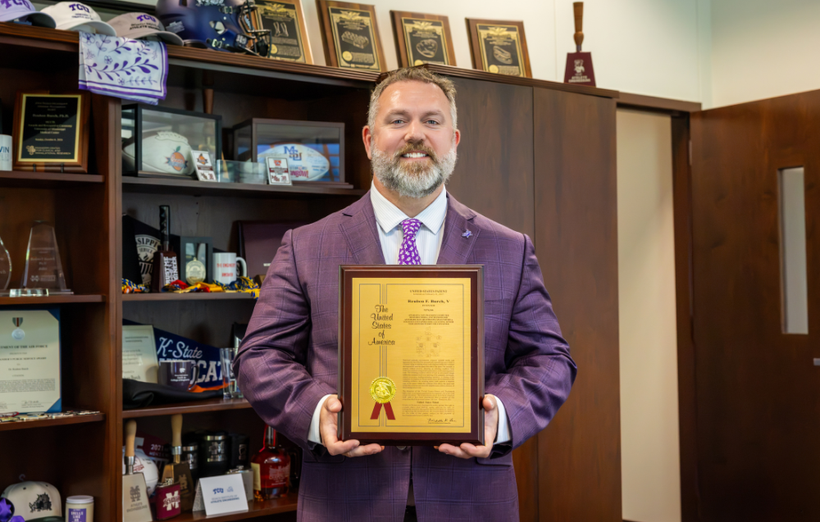
Patent No. 50: How an Inventor's Mindset Is Shaping TCU Research featured image

2 min

Patent No. 50: How an Inventor's Mindset Is Shaping TCU Research

As TCU's vice provost for research, Reuben F. Burch V has spent his career turning research into real-world solutions. This summer, that track record reached a milestone: his 50th patent, earning him the designation "Prolific Inventor." Burch's inventing career began during his years at FedEx Express, where he helped develop the rugged handheld device now used by couriers around the world. His first patent wasn't the handheld device itself, it was the design of a wearable version that freed couriers' hands, making the job safer and more efficient. Patent No. 50 grew out of a different question: how do you study movement where it actually happens, on tracks, on football fields, on rugged terrain, rather than only in a lab? The resulting technology uses a swarm of drones to capture performance data in real-world environments, giving TCU researchers a new way to study athletes of all kinds in their own arenas. "Fifty means just as much to me as my first one did," Burch said, "and it means a lot more that I got it while I'm here at TCU." "Reuben has an extraordinary ability to see around corners," said Jim Weinstein, director of TCU's Roach Institute of Athlete Engineering. "He recognizes problems others haven't yet identified and then creates the technology needed to solve them. This patent isn't just another invention, it's a research capability that will change how we study movement and human performance." That same builder's mindset is now fueling TCU's LEAD ON: Values in Action strategic plan to grow the university's research enterprise. In Burch's first year at TCU, competitive external research awards increased by 79.7 percent, with new partnerships established with Advanced Functional Fabrics of America, Deakin University, and the Fort Worth Nature Center & Refuge, alongside the launch of the Roach Institute for Athlete Engineering. "The researchers were already here," Burch said. "The momentum came from helping unlock their potential." Burch is available to speak with media on athlete engineering, a discipline he founded, and how its principles apply across sports, industrial (repetitive motion tasks), tactical (military and first responder) and at-risk populations. He can also speak to AI, human factors and ergonomics, advanced manufacturing, workforce and economic development, and the changing landscape of research funding and enterprise building in higher education. Read the full TCU story, "Patent No. 50: Reuben Burch Brings Inventor's Approach to TCU Research," here. To arrange an interview or request a comment, click through to Reuben Burch's profile below.

Who Decides Which Stories Children Get to Read? featured image

2 min

Who Decides Which Stories Children Get to Read?

As book bans surge nationwide, Jan Lacina — professor at Texas Christian University and Interim Director for Starpoint and KinderFrogs Schools — explores the benefits of diverse children's literature in her new textbook for educators, "Children's Literature to Read Our World: Text Selection and Strategies for Critical Reflection (Routledge, 2026). The research-grounded guide aims to help teachers intentionally select books for their students, centering age-appropriate books that present Black, Latinx and Asian culture as wellsprings of understanding. It also highlights titles that explore complex issues such as homelessness and poverty, and those that can help educators teach about historical topics like the Holocaust or the Civil Rights Movement. One chapter explores how scented books can be used as a vehicle for multisensory literacy development. Lacina's book arrives at a critical moment, in a critical state. Texas ranked second in the nation for school book bans during the 2024-25 school year, with 1,781 instances of censorship, according to PEN America's latest report. Jan was recently featured in The 74 article "Who Decides Which Stories Children Get to Read?" by Mark Swartz, which explores why access to diverse literature matters and how her new textbook helps educators respond to rising censorship. Read the full article here. We can look back through history and see that there's always been censorship, and I think books have historically been targeted over a long period of time for anti-intellectual censorship efforts. Books are primarily a source for people to learn new ideas and to critically think about a variety of topics within our society. "Books are powerful, and that's what scares people," Lacina said. Reading helps children identify with the protagonist — with their feelings, with their actions — and it's important to read about experiences that are similar to our own, whether they're positive experiences or challenges we might face in life, Lacina said. Lacina is available to speak with media on literacy leadership, children's literature, early childhood and elementary education, and teacher preparation — timely topics as school districts nationwide navigate rising challenges to classroom books. To arrange an interview or request a comment, click through to Jan Lacina's profile below.

Fewer Essays, Fiercer Odds: The New College Application Math featured image

2 min

Fewer Essays, Fiercer Odds: The New College Application Math

A growing number of top colleges — including Tulane, Washington University in St. Louis, and UNC Chapel Hill — are trimming or eliminating supplemental essays, citing student stress and the rise of AI-assisted writing that makes it harder to tell who actually wrote an application. But the shift comes with a catch: fewer barriers to applying tend to mean more applications and lower admit rates. The Wall Street Journal explored the trend, and pointed to Texas Christian University as a case study already living the tradeoff. Heath Einstein is Vice Provost for Enrollment at Texas Christian University, now in his 13th year at TCU after previously serving as dean of admission and director of freshman admission. With more than two decades in admission and college counseling, he is a frequent speaker at national conferences and a voting delegate to the National Association for College Admission Counseling's Assembly, the governing body that sets national admissions-practice standards. He has chaired Texas ACAC's Government Relations and Advancement committees, received the association's Founders' Award, and served as Board Chair of ACCEPT: Admissions Community Cultivating Equity and Peace Today. His expertise spans cultural humility, shared governance, crisis management, staff development, and data analytics.  Einstein was recently featured in The Wall Street Journal article “Colleges Juice Application Numbers by Letting Students Write Fewer Essays” by Roshan Fernandez (July 10, 2026), which examines how cutting supplemental essays is reshaping admissions strategy nationally. “TCU said responses to the questions it cut—about its values and inclusivity—lacked originality. ‘You still see a narrowing to the mean,’ said Heath Einstein, vice provost of enrollment management. ‘Students are still going to respond in ways that they think we want to hear.’ Einstein said the school's aim in expanding application numbers is simply to increase enrollment, not lower its admit rate.” Einstein is available to speak with media on college admissions strategy, the impact of AI on application review, supplemental essays and holistic review, enrollment management, and higher-education leadership through crisis and change — all live issues as the 2026-27 application cycle takes shape. To arrange an interview or request a comment, click through to Heath Einstein's profile below.

View all posts