

Women Mean Business: Why Supporting Female Entrepreneurs Strengthens Communities.

Augusta University’s Stacy Roberts shares how supporting women entrepreneurs can create opportunity, strengthen local economies and build more connected communities.

Oct 6, 2026

2 min

Stacy Roberts, DBA


Every October, National Women's Small Business Month invites us to recognize the women who are building, hiring, mentoring and strengthening their communities through their businesses.


As a proud Augusta University alumna and now a senior lecturer at the James M. Hull College of Business, where I teach entrepreneurship, human resource management and leadership ethics, I have the privilege of watching students begin to imagine businesses of their own. Through the Women's Leadership Academy, which I facilitate, I also see how much potential is unlocked when young women are given mentors, self-awareness tools and real opportunities to lead. Also, as an entrepreneur and leader, I have learned that when women build businesses, they rarely build only a company. They build connection.


Stacy Roberts, DBA, is a Lecturer of Management at the Hull College of Business. She teaches courses related to salesmanship and sales marketing, principles of management, organizational behavior and human resources.


View her profile


Women business owners often create opportunities close to home. They hire neighbors, mentor younger professionals, sponsor youth programs and invest in the places where they feel connected. They truly leave a mark, and that impact does not come easily. Many women entrepreneurs are navigating limited access to capital, smaller professional networks and the challenge of wearing every hat in the business while also carrying responsibilities at home. Yet those same pressures often produce leaders who are resourceful, adaptable and deeply committed to the people they serve. They truly deserved to be valued and supported.


So how can our community get involved this month and beyond?


Buy with intention. Choose women-owned businesses for gifts, services, catering and professional needs. Every purchase matters.


Share and refer. Sponsor women by telling others about them. Leave a review, recommend a business to a colleague or share a post. Visibility is one of the most valuable things a small business can receive.


Open the door. Organizations can include women owned businesses in vendor lists and procurement opportunities. Access is a game changer.


Mentor and be mentored. Experienced leaders can offer guidance and emerging entrepreneurs can seek it out. No one builds alone.


Invest in the next generation. Students and others interested in entrepreneurship should explore coursework, leadership programs, and local small business resources. The ideas forming in classrooms and networks today will become the businesses that anchor our communities tomorrow.


To any woman considering starting a business, remember this. Get clear on your values before you get busy. Build a circle of people who will tell you the truth. Please know your numbers and remember that rest is not a reward for finishing the work. It is part of what allows you to keep doing it.

Connect with:
Stacy Roberts, DBA

Stacy Roberts, DBA

Lecturer

Stacy Roberts is an expert in salesmanship, sales marketing, principles of management, organizational behavior, and human resources.

Principles of ManagementOrganizational BehaviorHuman ResourcesMarketingSalesmanship and Sales Marketing
Powered by

You might also like...

Check out some other posts from Augusta University

Could Popular Weight-Loss Drugs Be Affecting Your Oral Health? Augusta University Researcher Investigates featured image

2 min

Could Popular Weight-Loss Drugs Be Affecting Your Oral Health? Augusta University Researcher Investigates

GLP-1 medications such as Ozempic, Wegovy and Zepbound are transforming treatment for obesity and diabetes, with some now being used to treat obstructive sleep apnea. But could these increasingly popular medications also affect your teeth and gums? A researcher at Augusta University's Dental College of Georgia is investigating that question, highlighting a potential connection between GLP-1 medications, sleep apnea treatment and oral health. John C. Comisi, DDS, DMD, interim chair and professor in the Department of General Dentistry, recently published a review in Clinical Oral Investigations examining how obstructive sleep apnea and GLP-1 medications may influence the oral microbiome — the complex community of bacteria that helps maintain healthy teeth and gums. A New Question About GLP-1 Medications Obstructive sleep apnea can affect oral health through repeated oxygen disruptions, inflammation, mouth breathing and dry mouth. Treating the condition could improve some of these problems, but GLP-1 medications may introduce additional considerations. “OSA affects much more than sleep,” Comisi said. “The changes that occur throughout the body can also change the environment in the mouth. As we increasingly use medications to treat OSA, we need to understand what those treatments may mean for oral health.” Comisi's review suggests that successful treatment of sleep apnea could improve the oral environment by reducing mouth breathing, acid reflux and other contributing factors. However, reports involving semaglutide have also raised questions about dry mouth and changes in saliva, which plays an important role in protecting against tooth decay and gum disease. “There are potentially competing effects happening at the same time,” Comisi said. “Treating sleep apnea could improve several conditions that contribute to an unhealthy oral environment, while the medication itself could potentially affect salivary function. We simply do not have the prospective human studies yet to know what the overall effect will be.” The review, featured in an Oct. 6 Augusta University Jagwire article, calls for additional research tracking patients using GLP-1 medications, including changes in saliva, oral bacteria, cavities and gum disease. It also highlights the importance of communication between dentists and other health care providers, particularly when patients taking GLP-1 medications require dental procedures involving sedation or general anesthesia. With GLP-1 medications becoming increasingly common, understanding their broader effects on oral health is an emerging area of research with important implications for patients and dental professionals. John C. Comisi, DDS, DMD, is interim chair and professor in the Department of General Dentistry at Augusta University's Dental College of Georgia. His expertise provides a valuable perspective on the intersection of dental health, medication use and emerging approaches to patient care. If you're interested in speaking with Dr. John Comisi about GLP-1 medications, sleep apnea, dry mouth, oral health and the implications of these treatments for dental care, contact  AU's External Communications Team mediarelations@augusta.edu to arrange an interview today.

Augusta University Researchers Uncover New Clues to Dangerous Pregnancy Complication featured image

3 min

Augusta University Researchers Uncover New Clues to Dangerous Pregnancy Complication

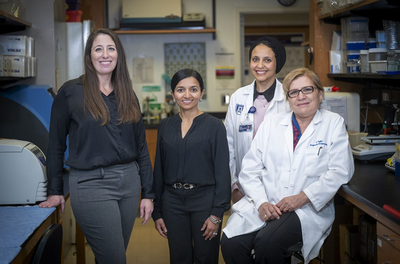
(From left) Jessica Faulkner, PhD, Champa Woodham, MD, Mona Elgazzaz, PhD, and Safia Ogbi (research manager in Faulkner’s lab) A significant discovery by researchers at Augusta University's Medical College of Georgia is shedding new light on preeclampsia, a potentially life-threatening pregnancy complication affecting an estimated 2% to 8% of pregnancies worldwide. Published in Arteriosclerosis, Thrombosis, and Vascular Biology, the research reveals that a protein commonly used to assess preeclampsia risk may also contribute directly to the disease by triggering excess production of the hormone leptin. The discovery establishes a previously unknown connection between two biological markers long associated with preeclampsia and could help researchers identify new approaches to treatment. Jessica L. Faulkner, PhD, associate professor in the Department of Physiology at the Medical College of Georgia and the study's lead author, explained the importance of the findings. “Preeclampsia patients have elevated levels of both sFlt-1 and leptin, but the relationship between those two factors has remained unclear. Our findings show that sFlt-1 directly increases leptin production and suggest that leptin may be an important link between placental dysfunction and the cardiovascular complications of the disease.” Using human placental tissue, cultured cells and animal models, the research team demonstrated that elevated levels of sFlt-1 increase leptin production, contributing to the blood vessel dysfunction characteristic of preeclampsia. When researchers blocked leptin signaling in pregnant mice, much of that dysfunction was reversed. The research was made possible through collaboration between Faulkner's laboratory and the Medical College of Georgia's Maternal-Fetal Medicine program, led by Champa Woodham, MD. Woodham emphasized the importance of connecting laboratory discoveries with clinical care. “Preeclampsia remains one of the most challenging conditions we manage in maternal-fetal medicine because patients can progress from appearing clinically stable to becoming critically ill very quickly. What makes this research particularly exciting is that it takes sFlt-1, a biomarker we are already using clinically to help assess a patient’s risk and gives us a deeper understanding of how it may actually contribute to the disease process.” Mona Elgazzaz, MD, PhD, a postdoctoral fellow in Faulkner's laboratory and the study's first author, highlighted the potential treatment implications. “Uncovering the crosstalk between sFlt-1 and leptin is crucial because it introduces new potential targets for treating preeclampsia by modulating the proteins that regulate leptin production.” The findings are especially significant because current treatment options remain limited, with delivery of the placenta remaining the only definitive cure. Although additional research is needed before these discoveries can translate into clinical treatments, the findings offer a promising new direction for understanding and potentially treating a condition that continues to threaten maternal and infant health worldwide. The study was supported by the National Institutes of Health and the American Heart Association. For journalists covering maternal health, pregnancy complications, cardiovascular disease and emerging medical research, Augusta University's research team offers important expertise on the science behind preeclampsia and the potential implications of this discovery. To learn more or arrange an interview with the researchers, contact AU's External Communications Team mediarelations@augusta.edu to arrange an interview today.

Turning Back the Clocks: Does Daylight Saving Time Affect Our Mental Health? featured image

2 min

Turning Back the Clocks: Does Daylight Saving Time Affect Our Mental Health?

As millions of Americans prepare to turn their clocks back on Nov. 1, questions about the impact of daylight saving time on sleep, mood and mental health are once again coming into focus. Research from Augusta University offers important insights into that relationship. Published in the American Journal of Emergency Medicine, the study, "Effects of Seasonality and Daylight Savings Time on Emergency Department Visits for Mental Health Disorders," examined nearly 140,000 emergency department visits at Augusta University Medical Center between January 2013 and October 2015. Researchers found that while mental health-related emergency visits increased during certain seasons, particularly among patients with depressive disorders, there was no statistically significant increase associated with daylight saving time changes. The findings challenge common assumptions about the relationship between changing clocks and mental health emergencies, while highlighting the complexity of seasonal influences on psychiatric conditions. The research also raises important questions about how hospitals anticipate mental health emergencies, allocate resources and respond to changing patient needs. Two Augusta University Experts Available for Media Interviews: William Vaughn McCall, MD, a psychiatrist and researcher at the Medical College of Georgia at Augusta University, was a co-author of the study. His extensive research on depression, insomnia and sleep disorders provides additional expertise on how disrupted sleep and changes in circadian rhythms can affect mental health. Vahé Heboyan, PhD, Director of the Health and Behavioral Economics Research Lab and Program Director of the PhD in Applied Health Sciences at Augusta University, is a co-author of the study. His expertise provides an important perspective on healthcare utilization, patient behaviour, health economics and the operational challenges facing emergency departments. As daylight saving time approaches, both experts can help journalists explore what the research reveals, what remains uncertain and how seasonal changes may influence mental health and healthcare delivery. If you're interested in speaking with Dr. Vahé Heboyan or Dr. William Vaughn McCall about daylight saving time, depression, seasonal mental health patterns, sleep disorders and emergency healthcare utilization, contact AU's External Communications Team mediarelations@augusta.edu to arrange an interview today.

View all posts