Baylor Expert Shares Tips to Help Kids Maintain, Improve Fitness During Time Out of School

Mar 19, 2020

4 min


Millions of children and teens throughout the United States are relegated to their homes in attempt to help “flatten the curve” and spread of COVID-19.

As parents struggle to carve out a new normal for themselves and their children, a Baylor University professor says physical fitness should still be a priority.


Paul Gordon, Ph.D., professor and chair of Baylor University’s department of health, human performance and recreation, is recognized nationally as a top expert in muscular fitness and health outcomes. His areas of expertise include physical activity and lifestyle-based research related to obesity.


“Beyond improving your health, physical activity will also improve your mental state,” Gordon said. “A sense of accomplishment and satisfaction is often felt after exercise. Consequently, when you need a mood lift either from ‘cabin fever’ as a result of being shut in or the stress of our current health crisis, take an exercise break. It will help you keep your spirits up.” 


In the following Q&A, Gordon shares tips to help parents and children stay fit during the coronavirus pandemic.


Q: With millions of kids now out of school due to coronavirus – and without the benefits of a gym class – what advice would you give parents and guardians about helping those kids maintain or improve fitness?


A: With the onset of school closures and recommendations to limit groups, parents do find themselves challenged to figure out a new routine that encourages healthy living such as opportunities for exercise. Given the current challenges we are facing to prevent the spread of this dangerous disease, parents need to step up and actively oversee their children’s activities. The following points are important considerations:


  • Engage in Active Parenting. Many children/adolescents will be engaging in remote learning formats through much, if not all, of the remaining school year. Consequently, parents will need to assist their kids, particularly the younger children, with access and supervise their work. We cannot expect teachers to have the same control as when they are in class. Similarly, opportunities for engaging in physical activity need to be planned and encouraged and where possible supervised.


  • Some exercise is better than none. This concept is true for adults and kids alike. Don’t give up on getting exercise completely if you can’t plan a full workout. A little is good, and more is better. Remember, exercise is helpful for more than weight control. It improves cardiovascular and skeletal health as well. It can even bolster your immunity response.


Q: Are there exercises that kids from kindergarten on up can do? What would you recommend in terms of time and style of exercise?


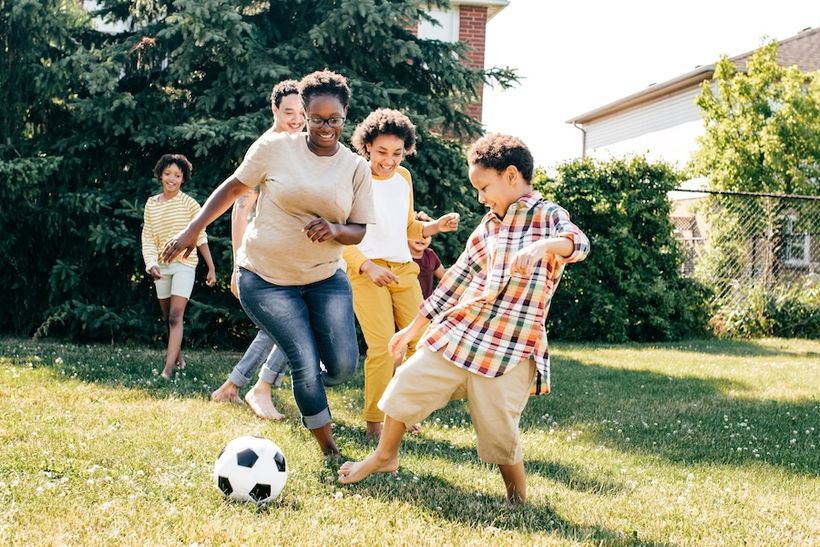
A: Younger children are more likely to engage in activity if they have someone to play with. Parents should engage in active games with their children. If the parent is working from home, take short breaks and play with your child.


Active games that involve running, skipping, jumping and climbing are perfect types of activities. Take them for walks in the park or neighborhood.


Once children hit adolescence, they are more inclined to perform limited stationary exercises such as on a stationary bicycle or cross trainer. Throwing the ball and playing controlled games (tag, kickball, etc.) can be effective. Playing with your child is an excellent way to spend time and build memories that last a lifetime.


Older children can also engage in regular calisthenics such as push-ups, jumping jacks, wall sits, etc. Make it a game or contest and you’ll likely get their involvement.


Q: Do you recommend any online plans or resources for parents to follow?


A: There are a number of online resources available. A few examples are listed below:


Q: What are the negatives associated with being sedentary – whether it’s in front of a television or sitting and spending too much time in front of a screen?


A: A sedentary lifestyle has numerous untoward effects on health. In fact, even individuals who are meeting basic activity levels can be at increased risk for diseases if they are overly sedentary. Increased risk for cancer, cardiovascular disease and metabolic abnormalities (i.e., diabetes) occur from sedentary living. Obesity has reached epidemic levels in our society, and a primary factor is sedentariness. It’s important to take breaks from sitting and get up and walk around. 


ABOUT BAYLOR UNIVERSITY


Baylor University is a private Christian University and a nationally ranked research institution. The University provides a vibrant campus community for more than 18,000 students by blending interdisciplinary research with an international reputation for educational excellence and a faculty commitment to teaching and scholarship. Chartered in 1845 by the Republic of Texas through the efforts of Baptist pioneers, Baylor is the oldest continually operating University in Texas. Located in Waco, Baylor welcomes students from all 50 states and more than 90 countries to study a broad range of degrees among its 12 nationally recognized academic divisions.


ABOUT ROBBINS COLLEGE OF HEALTH AND HUMAN SCIENCES AT BAYLOR UNIVERSITY


The Robbins College of Health and Human Sciences at Baylor University was established in 2014, a result of identified priorities for strengthening the health sciences through Baylor’s strategic vision, Pro Futuris, and the University’s Illuminate strategic plan. The anchor academic units that form Robbins College – Communication Sciences and Disorders; Family and Consumer Sciences; Health, Human Performance and Recreation; Public Health; and Division of Health Professions – share a common purpose: improving health and quality of life. The College’s curricula promotes a team-based approach to transformational education and research that has established interdisciplinary research collaborations to advance solutions for improving quality of life for individuals, families and communities. For more information, visit www.baylor.edu/chhs.


Powered by

You might also like...

Check out some other posts from Baylor University

Hunter-Gatherer ‘Egalitarianism’ Is More Complicated Than We Thought featured image

4 min

Hunter-Gatherer ‘Egalitarianism’ Is More Complicated Than We Thought

Hunter-gatherer societies are often portrayed as models of equality, cooperation and selfless food-sharing. However, Baylor University anthropologist Duncan N.E. Stibbard-Hawkes, Ph.D., and an interdisciplinary team of researchers have found that this familiar picture oversimplifies how egalitarianism actually functions in everyday life. Their research, published in the journal PNAS Nexus, examined the Hadza, a contemporary hunter-gatherer population in Tanzania, and found that relatively equal outcomes are often maintained not only by altruism, but through social pressure and what anthropologists call “demand sharing.” In a previous study, Stibbard Hawkes and co-author Chris von Rueden, Ph.D., professor of Leadership Studies at the University of Richmond, conducted a wide-ranging review of hunter-gatherer populations that are typically characterized by equality. They found that, although many of these societies did “function with relative equality, even the most egalitarian hunter-gatherer groups display inequality in one area or another.” To further understand this, Stibbard Hawkes and the research team tested their ideas of egalitarianism through a behavioral economic experiment employing a give-and-take behavioral economy game with Hadza participants. “We find that equality was achieved only under conditions of disadvantageous inequality – where the person playing the game had less than others – suggesting that taking is more important in achieving redistributive equality than giving,” Stibbard Hawkes said. “This mirrors real life – if someone has too much, there’s often a lot of demanding shares from other people.” “Looking at the actual motivations and mechanisms of redistribution and limiting power gives us a more realistic approach and a clearer view of what egalitarianism actually is." - D. Stibbard Hawkes, Ph.D. Behavioral economy games Many anthropologists and ethnographers investigate fairness in societies by employing behavioral economic games, such as the “dictator game.” By giving participants an endowment of tokens, researchers can understand how equality ideals function within that group based on how individuals keep or give away the tokens, Stibbard Hawkes said. “When you play these economic games, people are often more selfish in hunter-gatherer societies than they are in America or Europe,” Stibbard Hawkes said. “Which is surprising because these societies are well known for being egalitarian.” To better reflect real-world Hadza food-sharing practices, Stibbard Hawkes and team redesigned the experiment so participants could take resources as well as give them – and the results changed dramatically. “We changed the rules of these economic games and ended up with equality – but only in the condition where people could take from other people,” he said. “That resulted in a relatively equitable distribution.” Only 40.9% of participants shared when they had more food than others, while 30% claimed additional items. When starting with fewer resources, 58.8% took from their partner – often beyond what was necessary for balance. Across both conditions, taking everything was the most common behavior. Importantly, the motivations behind those outcomes were not always idealistic. “Though we saw a lot of generosity, the individual motivations underlying this equality were actually often quite self‑interested,” Stibbard Hawkes said. Equality without altruism Rather than reflecting an intrinsic desire to be fair, Hadza sharing behavior reflects asymmetric incentives and immediate needs. “If I have a big pile of food and I’m not sharing it,” Stibbard-Hawkes explained, “the people around me are going to say, ‘No, you need to share this, and you’re going to give this to me.’ And, when everyone does this, the result is equality.” He emphasized that these interactions are often personal and direct. “It’s not just a societal expectation,” he said. “It’ll often be a direct dyadic interaction. Someone in the room next to you might be like, ‘Well, you’ve got a lot – you should give me some.’” How egalitarianism works Hunter-gatherer societies have long been used to help explain humanity’s evolutionary history. But Stibbard-Hawkes said popular writing often turns these societies into an idealized moral example. “When this gets roughly translated into popular science books,” Stibbard Hawkes said, “the idea is very much like we lived in this Edenic garden of freedom and plenty where everything was good and there were no difficulties.” That framing, he said, misses how egalitarianism is actually maintained. “Egalitarian societies exist – they’re not mythical,” Stibbard Hawkes said. “But if you actually look at the mechanics of how egalitarianism and relative political equality are maintained, it’s often people who are arguing, demanding shares and even insulting people who have too much.” Market integration and changing norms The study also found that Hadza individuals with greater exposure over the last decade to Tanzania’s broader market economy and farming were slightly more accepting of unequal outcomes. “These are things with a very different resource base, and what I'm finding is that – while traditionally forage foods like hunted meats, people expect sharing – when you ask people about cash or grain, their notions of what should be shared are very different,” Stibbard Hawkes said. Egalitarianism is not a myth Egalitarianism is not a myth—but it is often misunderstood. Generosity is not uncommon – but nor are people in egalitarian societies uniquely altruistic. Rather than arising from innate altruism or a lost utopia, equality in hunter-gatherer societies is actively produced through social pressure, negotiation and demands that limit accumulation and power. “Looking at the actual motivations and mechanisms of redistribution and limiting power gives us a more realistic approach and a clearer view of what egalitarianism actually is,” Stibbard Hawkes said.

National Cancer Research Month: Baylor Researchers at Forefront of New Discoveries featured image

2 min

National Cancer Research Month: Baylor Researchers at Forefront of New Discoveries

May is National Cancer Research Month, which highlights the importance of lifesaving research to the millions of people around the world affected by cancer. Thanks to spectacular advances made by cancer researchers, approximately 18.6 million people in the United States and millions more worldwide are living with, through and beyond their disease. Over the past year, Baylor University Media and Public Relations has reported on Baylor research at the forefront of discovering novel approaches to effective cancer therapies. University researchers are using tumor starvation techniques, natural products, phages, modified bacteria, precision nutrition and more in their trailblazing work on some of the most aggressive cancers, including kidney, pancreatic, oral, colorectal and breast cancers. In a recent article published by the University, it featured the hard work and research of eight Baylor experts driving those discoveries forward: • Kevin G. Pinney is developing a next-generation treatment for kidney cancer that targets the blood vessels feeding tumors. His research focuses on specialized drug conjugates designed to cut off oxygen and nutrients to renal cell carcinoma tumors — essentially starving cancer cells to death. • Daniel Romo is accelerating new therapies for pancreatic cancer using compounds derived from marine natural products. His work on a simplified version of pateamine A could offer a new therapeutic pathway for pancreatic ductal adenocarcinoma, one of the most aggressive and difficult-to-treat cancers. • Joseph Taube is investigating how breast cancers spread and resist treatment. His recent work examines whether a natural compound called Ophiobolin A can trigger inflammatory forms of cancer cell death that may work alongside immunotherapy — particularly in treatment-resistant triple-negative breast cancers. • Leigh Greathouse is combining cancer biology, nutrition science, and AI to personalize cancer prevention and treatment strategies. Her research explores how diet and the gut microbiome influence cancer outcomes and survivorship. • Michael S. VanNieuwenhze is leading groundbreaking colorectal cancer research using modified bacteria to deliver cancer-killing proteins directly into tumor cells. His team is engineering Listeria monocytogenes as a targeted therapeutic delivery system. • Aaron Wright is helping lead a major ARPA-H initiative exploring the use of bacteriophages — viruses that attack bacteria — to reshape the human microbiome and improve health. The project could eventually help prevent diseases linked to oral and colorectal cancers through low-cost phage-based treatments. • Savannah Rauschendorfer is researching how exercise interventions may reduce the harmful cardiac side effects of chemotherapy in adolescent and young adult cancer patients. Her work aims to identify patients at risk of cardiotoxicity earlier and improve long-term survivorship outcomes. • Jonathan Kelber studies the cellular and molecular mechanisms behind aggressive breast and pancreatic cancers. Through his Developmental Oncogene Laboratory, Kelber investigates how cancer cells evolve during tumor progression and tissue regeneration. Together, these researchers showcase how cancer science is rapidly evolving beyond traditional treatments – integrating biology, chemistry, nutrition, exercise science, microbiome research, and artificial intelligence in the search for more effective and personalized therapies.

Expert Perspective: Race and Representation Take Center Stage in Texas’ Democratic U.S. Senate Primary featured image

1 min

Expert Perspective: Race and Representation Take Center Stage in Texas’ Democratic U.S. Senate Primary

As Texas Democrats head toward a competitive 2026 U.S. Senate primary, conversations about race and representation are playing a visible role in the campaign. In a recent Spectrum News segment, Baylor University political analyst Dr. Mia Moody discusses how racial identity, voter perceptions, and candidate messaging are influencing the dynamics of the race. Mia Moody, Ph.D., is a professor and former chair of the Department of Journalism, Public Relations, and New Media in the Baylor University College of Arts & Sciences. She is a nationally recognized expert on mass media and image repair, intersectionality, critical race theory, and the media framing of women and people of color. View her profile The story explores how candidates are navigating issues of representation within a diverse Democratic electorate, and how those discussions could impact turnout and coalition-building ahead of the primary. Watch the full report for expert insight into how race is shaping one of Texas’ most closely watched political contests. The full story is available below:

View all posts