Check out how one Georgia Southern student is changing the national narrative on inclusion in the sciences

Aug 27, 2020

4 min

As a Black wildlife conservationist and field biologist devoted to the study of birds, Corina Newsome, a graduate student at Georgia Southern University, has long been confronted with the lack of diversity in the natural sciences.


However, earlier this year, social media became a powerful interface for Newsome and a group of fellow Black scientists around the country, who discovered one another online and quickly formed a camaraderie.


“We all met on Twitter,” Newsome explained. “I happened upon a tweet or post and I’m like, ‘Is that a Black person?’ Turns out they’re a Black scientist in herpetology or ornithology or whatever, so I immediately connected with them and said, ‘Hey, can we just know each other?’”


Soon after, a video of a racially motivated confrontation in Central Park recorded by science editor and avid birder Christian Cooper went viral, and the network of 30 scientists banded to launch Black Birders Week on May 31. The group of virtual events, coordinated with hashtags like #BlackInNature, #AskABlackBirder and #BirdingWhileBlack, celebrated Black birders and naturalists from around the globe while pushing for inclusion and safe spaces in the outdoors.


“For far too long, Black people in the United States have been shown that outdoor exploration activities, such as birding, are not for us,” Newsome stated in a video posted on social media to announce the weeklong initiative’s kickoff. “Well, we’ve decided to change that narrative. A group of Black birders, explorers and scientists got together to start the first-ever Black Birders Week. Help us to show the world, especially the next generation of young, Black birders and nature enthusiasts, that we exist, that they are welcome and that this space belongs to them, too.”


The response was monumental as a multitude of Black scientists and naturalists shared their favorite birds, nature shots and professional settings online.


“Black Birders Week showed us we are not actually alone,” said Newsome. “It created a community of Black people around the world. Just being on my phone and seeing a Black family outside or a Black professor somewhere teaching ornithology, people doing the thing that I do, encourages me. That makes me feel like it is possible to do well.”


Newsome quickly became one of the recognizable faces of Black Birders Week and was featured in The New Yorker, Washington Post, National Geographic and NPR, among other media outlets. She also participated in a virtual roundtable discussion hosted by the National Audubon Society and included Cooper and fellow Georgia Southern student Alex Troutman.


Online responses from the organization’s 1.4 million Facebook followers were largely optimistic, however there was some backlash.


“We got comments from people saying we are creating division by talking about this,” Newsome said. “The division was already there. Now you know about it, and you’re uncomfortable. But we’ve been uncomfortable.”


Such candor has especially captured the attention of students.


“The most overwhelming, positive responses have been from young, Black people in college or pre-college who are interested in the sciences, messaging me or emailing me and saying, ‘It’s meant so much to see you doing your work,’” she said.


Newsome noted that multiple wildlife and government agencies have also reached out, demonstrating that they are in the process of making structural changes within their organizations to expand diversity efforts.


“Seeing these things actually materialize has been mind-blowing, and again, that’s because of the work of the group, the collective work of this movement,” she said. “I think that the one really encouraging element of that has been them choosing to use their platform to amplify our voices at the expense of losing some of their constituents.”


While Newsome’s passion, “the thing that lights a fire under me constantly,” can be found at the intersection of wildlife conservation and human rights, birds continue to be her feathered muses.


“They weigh sometimes a fraction of an ounce,” she said. “They are so physically fragile, yet they make some of the most physically intense migrations on the globe, from the tip of North America to the tip of South America. Birds as tiny as a hummingbird that weigh a tenth of an ounce fly over the Gulf of Mexico nonstop for over 18 hours. Just think of how much they’re accomplishing, even though they are easily one of the most fragile creatures on the planet. It feels oxymoronic, but it’s real.


“Birds remind me that things that seem impossible happen.”


If you are journalist and would like to know more about this particular story simply reach out to Georgia Southern Director of Communications Jennifer Wise at jwise@georgiasouthern.edu to arrange an interview today.

Powered by

You might also like...

Check out some other posts from Georgia Southern University

Georgia Southern University expert available for interviews about Marilyn Monroe’s 100th birthday and her enduring legacy featured image

1 min

Georgia Southern University expert available for interviews about Marilyn Monroe’s 100th birthday and her enduring legacy

June 1 marks Marilyn Monroe’s 100th birthday. Despite her death in 1962, Monroe remains an icon of American pop culture. Amanda Konkle, Ph.D., researches film history, stardom and celebrity prominence. Konkle is an expert in Monroe’s rise to fame and her lasting relevance in modern style. She published the book “Some Kind of Mirror: Creating Marilyn Monroe,” along with several research papers detailing Monroe’s unique status in American history. Konkle can speak to how Monroe connected with audiences during her life by creating a new ideal of feminine power that defined an era. She can explore how Monroe’s acting methods mirrored society’s anxieties and desires, and why they still resonate today. Konkle is available virtually or for in-person interviews at the Armstrong Campus. Simply contact Georgia Southern's Director of Communications Jennifer Wise at jwise@georgiasouthern.edu to arrange an interview today.

Approximately 4,400 degrees conferred during Georgia Southern’s 2026 Spring Commencement ceremonies featured image

4 min

Approximately 4,400 degrees conferred during Georgia Southern’s 2026 Spring Commencement ceremonies

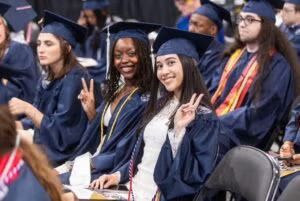
Last week, approximately 4,400 graduates from Georgia Southern University’s Statesboro, Armstrong, Liberty and Swainsboro campuses received associate, baccalaureate, masters, specialist and doctoral degrees in five Spring 2026 Commencement ceremonies. Georgia Southern President Kyle Marrero welcomed the graduates and their guests to the ceremonies, held at the Allen E. Paulson Stadium and Jack and Ruth Ann Hill Convocation Center in Statesboro, Enmarket Arena in Savannah and East Georgia Campus in Swainsboro on May 11, 13 and 14. “To our graduates, congratulations,” Marrero welcomed the crowds. “Today we recognize and honor your hard work, perseverance and personal growth throughout your academic journey. The road to this moment has not been without its challenges, and your presence here is a reflection of your dedication, resilience and strength. You have every reason to be proud. This commencement is a meaningful milestone not only for each of you personally, but for the entire Georgia Southern community.” The Commencement speakers included: Bob Somers (’83) Nick Westbrook (’20) Berry Aldridge (’15) Kim Hartsock (’20, ’21) Rep. Butch Parrish Somers opened the ceremonies at Paulson Stadium with words of encouragement for the new graduates. “While this day marks your formal education coming to a close, the truth is your education and life is just now beginning,” he said. “When I look out at you, I don’t look at graduates. I see future leaders. And our future is bright because of what you’re going to bring to this world. “Georgia Southern gave me structure, opportunity and people who believed in me. One of my proudest moments was graduating from this incredible institution. Find your north star. What kind of person are you? What are your values? Be genuine with yourself and others. If you’re authentic, people will trust you and they will follow you. Be comfortable being uncomfortable. Real leadership requires vulnerability.” Westbrook relayed the importance of service and character alongside leadership. “You will have the opportunity to influence people, organizations, companies and industries,” he said. “Use that influence for good. Your opportunity will not only be for a better job, more income or a higher position. The highest calling of your opportunity will be what you can do for the people who are affected by your influence. In a world that is becoming increasingly transactional, be the leader that goes the extra mile to make your world a little more relational, more kind, more human.” Aldridge enthusiastically challenged graduates to consistently recalibrate the way they think, and to consciously surround themselves with support. “Class of 2026, you’ve accomplished something incredible, but you’ve done it during a very strange and chaotic time in history,” he said. “I’m not breaking any news when I say that we are standing on the edge of a massive change to our jobs, our technology, our society. “I don’t know how AI is going to change the way we work or influence the job market. I challenge you to be skeptical even in your own most passionately held beliefs. That’s the only way to keep ourselves in check, and it’s the only way to keep ourselves growing. Nurture three types of relationships — one who lifts you up, another who tells you the truth, and one who will always show up — in order to succeed, he continued. And then be that person for others. Hartsock reflected on the generational impact of earning a degree. “For some of you, this is not just a personal achievement, it’s a historic one,” she shared. “You may be the first in your family to earn a college degree, and that accomplishment carries special significance. You are changing the trajectory of your family and setting an example for generations to come.” She asked them to be intentional about who they learn from. “Seek out people who can teach you things that books never will,” she said. “It’s important to look for leaders whose lives are marked not only by achievement, but also by joy and purpose. “Invest in this university. Join the alumni association. Help recruit future Eagles. Create a scholarship. Create opportunities for students to learn from you and work with you. Stay involved,” she said. “You never know, 25 years from now, you might be standing right here where I am. Congratulations, class of 2026 and Hail Southern!” In the closing ceremony in Swainsboro, Parrish encouraged graduates to continue learning. “Today is by no means an end,” he said. “It’s just the beginning. Your education has prepared you for what lies ahead. Your education allows you to create your own path forward. You have a unique opportunity to define your own path. You don’t have to follow anymore. Education is like insurance for whatever you’ll be facing in the future. “Education comes in many forms. There’s formal and informal, traditional, nontraditional and learned education, just to name a few. So, I encourage you to pursue a career in something that you really have a passion for and something that you really want to do. Whatever you decide to do is up to you, and your future is bright and it’s unlimited.” Video and Photo Links Spring 2026 Commencement ceremony 9 a.m. video on May 11 in Statesboro Spring 2026 Commencement ceremony 6 p.m. video on May 11 in Statesboro Spring 2026 Commencement ceremony video on May 13 in Savannah Spring 2026 Commencement ceremony video on May 14 in Statesboro Spring 2026 Commencement photos here Credit: Courtesy of Georgia Southern University Georgia Southern University, a public Carnegie Doctoral/R2 with a Carnegie Community Engagement classification, offers approximately 149 different degree programs serving nearly 31,600 students through 11 colleges on four campuses in Savannah, Hinesville, Statesboro, Swainsboro and online instruction. Founded in 1906, Georgia Southern is a leader in higher education in southeast Georgia with expert faculty and a focus on public impact research and engaging learning opportunities through knowledge and know-how that prepare our students to soar beyond and take ownership of their lives, careers and communities. Visit GeorgiaSouthern.edu.

Georgia Southern University names new dean of the Allen E. Paulson College of Engineering and Computing featured image

2 min

Georgia Southern University names new dean of the Allen E. Paulson College of Engineering and Computing

Abhijit Bhattacharyya, Ph.D., has been named the next dean of Georgia Southern University’s Allen E. Paulson College of Engineering and Computing. He will begin his role July 1. Bhattacharyya currently serves as the inaugural dean of the College of Engineering and Computer Science at Arkansas State University, where he has led a period of strategic growth focused on student success, workforce development and research expansion. During his tenure, the college launched new academic programs in high-demand fields, strengthened industry partnerships and advanced initiatives supporting student recruitment, retention and career readiness. “I have the honor and privilege to join Georgia Southern at an exciting time in its journey as it soars beyond its current very strong position in the state of Georgia,” said Bhattacharyya. “The energy on campus and within the college was palpable during my visit, and I look forward to working alongside my colleagues to build on that strong foundation and create a national brand.” Prior to his current role, Bhattacharyya held several leadership positions at the University of Arkansas at Little Rock, including interim vice provost for Research and dean of the graduate school, as well as associate dean of Engineering and Information Technology. He began his career as a faculty member committed to teaching, research and service, and remains an active scholar with externally funded research from federal agencies. Bhattacharyya earned his Ph.D. in mechanical and aerospace engineering from Rutgers University, along with a master’s degree in applied mechanics. He also holds a bachelor’s degree in mechanical engineering from the Indian Institute of Technology, Kharagpur. He is a fellow of the American Society of Mechanical Engineers and serves as an ABET program evaluator. Provost and Executive Vice President for Academic Affairs Avi Mukherjee, Ph.D., said Bhattacharyya’s experience and leadership align strongly with the University’s strategic priorities. “Dr. Bhattacharyya brings a proven record of growing engineering education, advancing academic programs, bolstering research, managing accreditation, strengthening industry partnerships and positioning engineering and computer science for long-term impact,” said Mukherjee. “His commitment to faculty excellence, student success and workforce development will be instrumental as we continue to expand opportunities for our students and elevate the national profile of the Allen E. Paulson College of Engineering and Computing.” Looking to connect with Abhijit Bhattacharyya?  Simply contact Georgia Southern's Director of Communications Jennifer Wise at jwise@georgiasouthern.edu to arrange an interview today.
View all posts