
Professors address students' climate anxiety

Jun 12, 2024

1 min


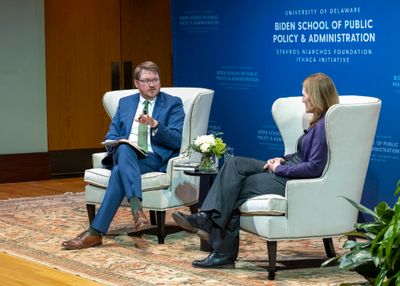
Professors at the University of Delaware preparing students for careers working on climate change are making sure to consider mental health issues as they send them out into the world.


UD's Climate Change Science and Policy Hub, led by director A.R. Siders, is starting a series of initiatives – on campus and in the region – to tackle the challenge of what is known as climate anxiety. This involves traditional trainings but also innovations with creativity, art, video games and play.


"Learning about and working on climate change causes climate anxiety, ecogrief, solastalgia – there’s a whole new set of terms being created just to describe the problem," said Siders, also an associate professor in UD's Disaster Research Center and Biden School of Public Policy and Administration. "This is a real mental health concern."


This new way of approaching climate education has become even more critical as universities expand climate education – such as new climate schools, degrees, courses and even embedding it in general education courses, Siders said. The U.S. government is supporting a growing climate workforce, and it is expected that more people will work in climate-related careers.


To reach Siders and set up an interview, visit her profile and click on the "contact" link. This will automatically send an email directly to her.


Powered by

You might also like...

Check out some other posts from University of Delaware

Structural Engineering Expert Available to Discuss High-Rise Building Stability, Structural Failures and Building Safety featured image

1 min

Structural Engineering Expert Available to Discuss High-Rise Building Stability, Structural Failures and Building Safety

University of Delaware structural engineering expert Michael Chajes is available to discuss the engineering challenges involved in assessing and stabilizing high-rise buildings following structural damage, structural failures and concerns about potential collapse. Chajes, a professor of civil and environmental engineering and a registered professional engineer, specializes in structural engineering, structural health monitoring and forensic engineering. He has provided expert commentary to national media outlets on major structural failures, including the Surfside condominium collapse and the Francis Scott Key Bridge collapse. His expertise is particularly relevant to the ongoing situation in New York involving a high-rise that is at-risk of partial collapse. He can discuss. • The conditions that can trigger structural instability during construction, renovation or changes in building use. • How engineers assess damaged structures and determine whether a building can be stabilized or safely repaired. • The engineering challenges involved in converting older office towers into residential buildings, including changes in structural loads, construction sequencing and temporary support systems. • How structural health monitoring and inspection technologies help engineers evaluate the safety of aging infrastructure and high-rise buildings. To arrange an interview with Chajes, visit his profile and click on the contact button. Interested reporters can also send an email to MediaRelations@udel.edu.

Post-earthquake crisis in Venezuela: University of Delaware experts available to discuss public health, infrastructure and relief featured image

1 min

Post-earthquake crisis in Venezuela: University of Delaware experts available to discuss public health, infrastructure and relief

Faculty from the University of Delaware’s renowned Disaster Research Center are available to comment on the back-to-back earthquakes in Venezuela. These experts can discuss critical infrastructure failures, public health threats, emergency logistics and community-led response efforts in the region. Available experts include: From what I’ve seen, it looks like the earthquake occurred on the boundary of the Caribbean and South American plate. A strike-slip fault similar to the San Andreas. There have been a lot of nonductile reinforced concrete frame building collapses. There may be an effect of soil given that a lot of the damage has been near the coast. Jennifer Horney (Professor of Epidemiology) Focus: Public health impacts, post-disaster waterborne/vector-borne disease outbreaks and the breakdown of healthcare delivery due to damaged roads and disrupted communication networks. Tricia Wachtendorf (Co-director, Disaster Research Center) Focus: Disaster response logistics, community improvisation, neighbors as first responders and how to donate effectively to maximize impact. Sarah DeYoung (Associate Professor, Sociology and Criminal Justice) Focus: Maternal and infant health/feeding in emergencies, pet and companion animal evacuations and community-level crisis decision-making. To contact these experts directly and arrange an interview, visit their ExpertFile page and click on the contact button. Interested reporters can also email MediaRelations@udel.edu.

From clay on the ground to construction on the moon featured image

2 min

From clay on the ground to construction on the moon

Building material samples from the University of Delaware spent six months mounted outside of the International Space Station, where the harsh conditions of low Earth orbit tested their limits. Some returned with higher measured strength than identical samples stored on Earth. The findings are a promising sign for the long-term goal of building infrastructure on the moon. There are no lunar supply yards, and transporting building materials from Earth would be prohibitively expensive. The solution may lie underfoot, in the form of lunar dust known as regolith. “Regolith is essentially a clay-like silicate material,” said Norman Wagner, Unidel Robert L. Pigford Chair in Chemical Engineering. “It is one of the most abundant materials on both Earth and the moon, which makes it interesting for construction.” Wagner's laboratory develops geopolymers, a cement alternative that binds clays into a strong solid through chemical reactions rather than high-temperature manufacturing. Their goal is to use regolith with minimal additives to produce construction materials without energy-intensive processing. The approach could contribute to more sustainable Earth-based construction, too. To evaluate how geopolymers hold up in space, the UD team sent thin plates made from commercially available simulated lunar and Martian regolith to the International Space Station as part of NASA's MISSE-20 mission. The findings, published in Advances in Space Research, showed the geopolymers did not deteriorate, and in some cases were stronger after their time in orbit. Lunar construction materials must not only survive space conditions, they also must be reliably manufactured on-site. In a separate study in Acta Astronautica, Wagner's team used artificial intelligence to tackle a practical challenge: not all lunar clays are the same. The researchers developed a machine learning model that can predict how strong a geopolymer will be based on the characteristics of the starting regolith and how it is processed. Complementary work from the Wagner lab offers insight into how geopolymers behave while being mixed, pumped and shaped before they harden. The researchers identified a key transition point, known as the critical gel point, at which the material shifts from a workable slurry into a solidifying structure. Mixing or shearing before that point did not affect how long the material took to harden or its final strength. This suggests that engineers may have flexibility in how they handle and process lunar construction materials, without compromising quality. That work appears in a special issue of the Journal of Rheology focused on materials behavior beyond Earth. To speak with Wagner about his space expertise, reach out to mediarelations@udel.edu.

View all posts