
Professors address students' climate anxiety

Jun 12, 2024

1 min


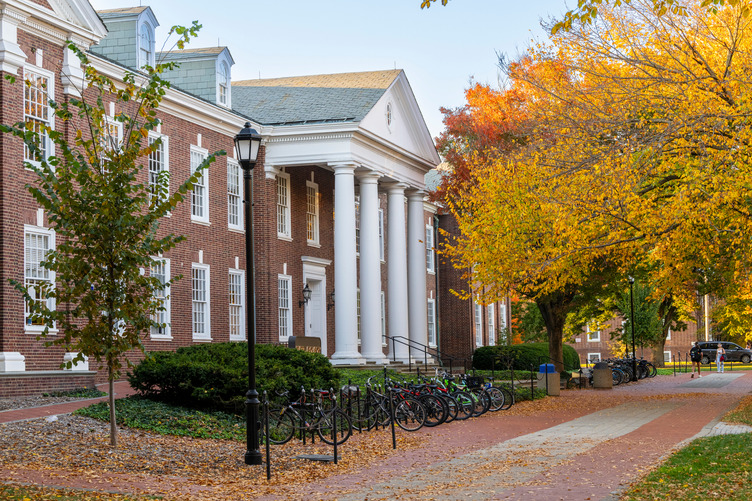
Professors at the University of Delaware preparing students for careers working on climate change are making sure to consider mental health issues as they send them out into the world.


UD's Climate Change Science and Policy Hub, led by director A.R. Siders, is starting a series of initiatives – on campus and in the region – to tackle the challenge of what is known as climate anxiety. This involves traditional trainings but also innovations with creativity, art, video games and play.


"Learning about and working on climate change causes climate anxiety, ecogrief, solastalgia – there’s a whole new set of terms being created just to describe the problem," said Siders, also an associate professor in UD's Disaster Research Center and Biden School of Public Policy and Administration. "This is a real mental health concern."


This new way of approaching climate education has become even more critical as universities expand climate education – such as new climate schools, degrees, courses and even embedding it in general education courses, Siders said. The U.S. government is supporting a growing climate workforce, and it is expected that more people will work in climate-related careers.


To reach Siders and set up an interview, visit her profile and click on the "contact" link. This will automatically send an email directly to her.


Powered by

You might also like...

Check out some other posts from University of Delaware

2 min

How AI can improve poor leadership writing and boost productivity

Poor written communication from leaders can create the kind of confusion it intended to avoid. University of Delaware career expert Jill Gugino Panté suggests using AI to sharpen emails, clarify expectations and reduce unnecessary calls. Getting through to employees with strong messaging can boost productivity by saving time and reducing unwanted meetings, she says. Panté, director of UD's Lerner Career Services Center, says that good leadership writing should be direct and outcome-driven, with no fluff, and offered the following advice for improvement. ✅ Don’t bury the lead. Start with what decision needs to be made, what action is required, and the deadline. If your writing doesn’t reduce ambiguity, it’s going to add to it. Vague communication can create interpretation gaps which, in turn, can create more meetings. When ownership isn’t defined, decisions aren’t documented, or outcomes aren’t clear, teams default to “Let’s hop on a call.” Meetings then become the fallback for unclear thinking. ✅ Generative AI can be a powerful clarity tool if it’s used intentionally. When used well, it can sharpen your ask and structure communication for action. The key is prompting it to refine your message, not just polish it. Leaders can use prompts like: • “Rewrite this message so the action, owner, deadline, and success metrics are explicitly stated" • “What assumptions or ambiguities exist in this message?” ✅ Good writing can replace unnecessary meetings. If communication is not direct, outcome-driven, and structured for action, it will cost you time somewhere else. Here are some practical actions that leaders can make in their writing: • Start with the Ask - Be explicit about what decision or action is needed. Don’t make people search for it. • Define Outcomes - Clarify deliverables, timelines, budgets and state what success looks like. • Clarify Ownership - Identify who is responsible for the request. • Document Decisions - Write down what has been decided and reiterate next steps, owners, and deadlines. To connect with Panté directly and arrange an interview, visit her profile and click on the "contact" button. Interested media can also send an email to MediaRelations@udel.edu.

1 min

Epidemiologist: Winter Olympics fortunate to dodge norovirus outbreak

Finland's Olympic women's hockey team overcame a norovirus scare last week, but they couldn't get past Team USA, who shut them out 5-0 Saturday in Milan. The University of Delaware's Jennifer Horney can discuss the difficult-to-contain virus, which also hit the Winter Games in 2018. - Horney, a professor of epidemiology at UD, said that the outbreak –  which forced Finland to cancel its first game after 13 players had either been infected or quarantined – is not surprising. Norovirus spreads rapidly in crowded environments through direct contact with surfaces or airborne droplets. - It is difficult to limit the spread of norovirus, as witnessed by the major outbreak that spread at the 2018 Winter Olympics in South Korea. - Consideration is often given for the potential of these types of outbreaks being intentional, which requires public health to work closely with law enforcement. To reach Horney directly and arrange an interview, visit her profile and click on the "contact" button. Interested journalists can also send an email to MediaRelations@udel.edu.

1 min

How ACL injury derailed Lindsey Vonn's heroic return to Olympic competition

An ACL rupture couldn't keep skiier Lindsey Vonn off the slopes to start this week's Olympics. But according to the University of Delaware's Dr. Karin Silbernagel, the injury likely contributed to her inability to land safely Sunday on the downhill course in Cortina d’Ampezzo, Italy. The crash ended her heroic return to competition Dr. Silbernagel, a professor of physical therapy, studies tendon injuries in the ankle and knee in elite athletes, especially Achilles ruptures and ankle function. She was quoted in an ESPN story about the rash of such injuries in the NBA and can specifically address the impact they could have on competition now and for the rest of an athlete's career. Her research shows that even after successful surgery, many athletes return to competition but not many among them return to peak explosiveness or durability. The impact a major injury would have on a fresh injury like Vonn's is obvious, she said. Dr. Silbernagel's research on ankle and knee injuries dates back to the early 2000s. She consults with professional sports teams relating to tendon injuries and is a consultant to the NFL's Musculoskeletal Committee. To connect directly with Dr. Silbernagel and arrange an interview, visit her profile and click the "contact" button. Interested members of the media can also send an email to MediaRelatons@udel.edu.

View all posts