Links
Social
Biography
Her research explores how political ideology shapes the behavior and attitudes of social actors, ultimately influencing organizational performance. In particular, she investigates how organizations operating in contested domains—such as those addressing social and environmental issues—navigate polarized sociopolitical landscapes. Her work examines how these organizations successfully innovate and secure resources by engaging key audiences, including employees and investors. Ludovica’s research spans multiple contexts, including entrepreneurial ventures on crowdfunding platforms and innovative public firms. She pays special attention to markets shaped by ideological divisions, such as Femtech—companies focused on women's health—and ESG-oriented mutual funds.
Ludovica graduated with a Bachelor and a Master of Science in Management Engineering from Sapienza University of Rome. During her graduate studies, she was a visiting student at the Universitat Politècnica de València. Ludovica began her professional journey as a process engineer intern at Procter & Gamble, then transitioned to Amazon as an operations area manager, and later joined Boston Consulting Group, where she worked on consulting projects across a range of industries.
Education
IESE Business School, University of Navarra
PhD
Strategic Management
Sapienza University
MS
Management Engineering
Sapienza University
BS
Management Engineering
Areas of Expertise
Publications
Striking a Political Balance? Political Polarization and Firm Innovation
Journal of ManagementLudovica Castiglia
2025-12-18
Affective polarization, a division marked by animosity between members of opposing political groups, has dramatically increased, particularly in the United States. This paper examines the extent to which affective polarization may spill over into organizations and influence strategic outcomes—specifically, corporate innovation. I theorize how politically balanced organizations, that is, those that lack a prevailing political ideology and have workforces that are more evenly divided between opposing political stances, are less innovative due to heightened animosity and reduced collaboration. Furthermore, I propose that the negative relationship between political balance and innovation intensifies at higher levels of partisan animosity in society and political engagement among organizational members. Conversely, I theorize that the relationship weakens when a firm is led by a CEO who does not overtly signal a clear political leaning. I test and find support for these predictions using a novel donation-based index of organizational political balance for 744 publicly traded U.S. companies from 2002 to 2015. This paper highlights the role of political balance as a potential conduit of intrafirm rivalry that hinders innovation. The findings advance our understanding of the mechanisms and conditions through which political polarization may influence organizations and their outcomes.
In the News
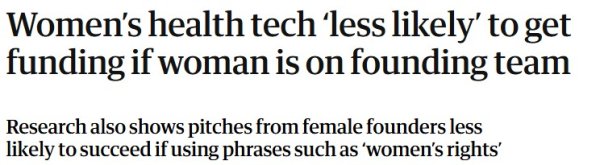
Women’s health tech ‘less likely’ to get funding if woman is on founding team
The Guardian online
2024-10-08
Healthcare technology designed to target a wide range of women’s issues is less likely to get funding if there is a woman on the founding team, according to research.