
Johnny Nhan
Associate Dean of Graduate Studies and Professor
- Fort Worth TX UNITED STATES
Nhan's research focuses primarily on technology and policing - cyber security, police culture and collaborative security networks.
Media
Social
Biography
Nhan's research has focused primarily on technology and policing, ranging from issues of cyber security to police culture and collaborative security networks. His first book, published in 2010, Policing Cyberspace: A Structural and Cultural Analysis, examined cyber policing task forces in California. His latest book, published in 2019, Issues and Controversies in Policing Today, looks at 21st century policing issues ranging from academy and field training to surveillance and LGBTQ officers.
Nhan has worked collaboratively and published research projects in the past several years, focusing primarily on cyber and high-tech crimes, applying theoretical models towards empirical data collected from sources ranging from policing organizations and security corporations to Internet vigilante groups. In 2015, Nhan with Laura Huey, Ph.D. at the University of Western Ontario and Ryan Broll, Ph.D. from the University of Geulph, were among the first researchers to publish on crowdsourcing criminology in their article, “Digilantism: An Analysis of Crowdsourcing and the Boston Marathon Bombings,” which examined the actions by online Internet communities and members of the general public during a critical incident. Another article published with Huey, “‘Uppity civilians’ and ‘cyber vigilantes’: The role of the general public in policing cyber crime,” analyzed Internet message board data to examine citizen efforts against sexual predators.
Future research will further examine the intersectionality of police and technology, including the impact of social media on policing. Nhan has a practical background in law enforcement. Nhan also is currently working with police and private security agencies in the Dallas-Fort Worth area to develop applicable leadership and policies for the future of policing.
Areas of Expertise
Education
University of California, Irvine
Ph.D.
Criminology, Law & Society
2008
University of California, Irvine
BA
Criminology, Law & Society
1999
University of California, Irvine
BA
Economics
1999
Links
Media Appearances
Texas law makes it easier to remove students from class. Experts question the impact
Fort Worth Report online
2026-11-05
A Texas law that took effect last year gives teachers more authority to remove disruptive students from their classrooms. Lawyers and professors are concerned about whether enough attention is being paid to helping resolve the underlying causes of those students’ behavior. “We’re starting to skip the helping the kids part,” said Johnny Nhan, a criminology professor at Texas Christian University. “We’re just going straight to the punishment part.” Nhan said his wife, a longtime Fort Worth ISD school psychologist, and her colleagues have described the challenges educators face as counselors contend with staffing shortages. Some teachers will ignore suggested interventions, attempting to have students removed from their classrooms instead, he said.
How a surveillance company pitched itself to Maine police and enlisted officers in the sales effort
Spectrum News online
2026-11-02
Nearly a year after Freeport, Maine, rejected funding for Flock cameras, the company offered cameras for free. Freeport did not ultimately accept the offer of free cameras, though the strategy has worked outside Maine. Texas Christian University criminology professor Johnny Nhan said users say Flock is “like Costco or drug dealers.” “They’ll give you a free sample, some free cameras, and then you get kind of hooked on it,” Nhan said. “Once they get that, then it’s contract time.”
Everything You Always Wanted To Know About ALPRs (But Didn’t Know Who To Ask)
KBOO radio
2026-11-02
What does research tell us about the effectiveness of ALPR systems—do they really help solve or prevent crimes? “That question is, in terms of research, a little bit of a mixed bag, because the data in the research is incomplete,” says Johnny Nhan, PhD, Associate Dean of Graduate Studies and Professor in the Department of Criminal Justice at Texas Christian University. “The data collection by Flock itself—and I was involved in a study they did—but then they wanted some advice on that. They were trying to draw a link between solving crime, reducing the crime rate, and the proliferation of Flock cameras. That was something I couldn’t do. I was like, ‘OK, I don’t know how this data was collected by different police departments, there’s no standardization in terms of how it’s collected.’”
Texas tightened school discipline rules under House Bill 6. Here's what to know
Fort Worth Star-Telegram online
2026-10-31
A panel of education and law experts met Wednesday in downtown Fort Worth to examine how a new Texas law is reshaping school discipline. They warned that House Bill 6 expands punishment options while leaving deeper classroom and community problems unaddressed. Johnny Nhan, a Texas Christian University professor, said schools are skipping “the helping the kids part” and moving straight to punishment while ignoring underlying poverty and social conditions that shape student behavior.
Mass surveillance or crime-fighting tool? Experts debate Flock cameras as Excelsior Springs removes system
KSHB online
2026-10-29
The Excelsior Springs City Council voted to remove Flock cameras from the city earlier this month, and the devices are now covered with trash bags as debate over the surveillance technology grows nationwide. Criminal justice researchers say the cameras are powerful, but the data on whether they reduce crime is unclear. They detailed their findings in an online forum. Other researchers caution that the evidence is limited. "The research is a little bit of a mixed bag because the data is incomplete," Johnny Nhan said. Nhan is a professor of criminology and criminal justice at Texas Christian University and a reserve officer at the Fort Worth Police Department. He warns about the technology's potential for misuse. "Police, as I mentioned, need to have access to information on these databases, this is criminal records to whatever information. Because police officers are trusted individuals, they have past background checks," Nhan said.
It’s easier for Tarrant students to be punished in school. What are the impacts?
Fort Worth Star-Telegram online
2026-10-28
A panel discussion with education and law experts on Wednesday outlined a complicated landscape of school discipline in Tarrant County and statewide, and how a newer state law makes it easier for students to receive punishment. Johnny Nhan, professor of criminology and criminal justice at Texas Christian University, said school behavior is a symptom of something bigger happening outside of school. Students in poverty, for example, are typically more concerned about meeting their basic needs rather than focusing in the classroom. “There’s two things that are happening. Number one: we are starting to skip the helping the kids part. We’re just going straight to the punishment part. And then on the second hand, we haven’t talked about these underlying social conditions, economic conditions, where if you’re in poverty, school is just secondary in terms of your concern,” Nhan said.
Automated License Plate Readers: Navigating the Adoption Challenges
Industrial Briefs online
2026-10-21
Municipalities across the United States are increasingly turning to automated license plate readers (ALPRs), like those offered by Flock Safety, as a tool for enhancing public safety. Experts like Kimberly Przeszlowski from Quinnipiac University highlight that ALPRs offer more than just plate reading; they create comprehensive vehicle profiles, akin to a 'vehicle fingerprint.' Johnny Nhan of Texas Christian University warns of a potential slippery slope as these technologies become intertwined with AI and real-time crime centers.
Got Flock cameras? 6 things to consider
Smart Cities Dive online
2026-10-20
Automated license plate readers are capable of tracking individuals’ patterns of activity, and they’re being integrated with other technologies like automatic drone deployment, AI and facial recognition through real-time crime centers, said Johnny Nhan, a criminology and criminal justice professor at Texas Christian University. “These things are not science fiction anymore,” Nhan said. “It creates a bit of a slippery slope.” And license plate reader companies are savvy, “and at the end of the day, it’s a huge commercial enterprise,” Nhan said. “Some of the Flock users I’ve talked to compare it to Costco or to drug dealers. They give you a free sample, some free cameras, and you get hooked because it’s effective at certain things. Then it’s contract time.”
Local license plate readers part of a nationwide debate
Park Rapids Enterprise online
2026-10-13
Automated license plate readers (ALPR) have been used in the area for roughly 13 months. Nationwide, their use has come under increasing scrutiny. Dr. Johnny Nhan of Texas Christian University in Fort Worth, Texas, noted that an ALPR can be “particularly effective” in locating stolen vehicles, but has its benefits in solving many other criminal cases.
As Central TX cuts ALPR ties, new research questions camera placement and crime prevention
CBS Austin online
2026-10-08
As more Central Texas communities cut ties with companies that operate automated license plate readers, new research is raising questions about where the cameras are placed, what they collect and whether they reduce crime. Research from Texas Christian University professor Johnny Nhan, a criminology and criminal justice expert, found mixed results when looking at the relationship between solving crimes, reducing crime rates and the spread of Flock cameras, leaving it unclear whether the technology lowers crime. He said he was involved in a study connected to Flock and was asked for advice, but said he could not draw that link because, “I don't know how this data is collected by the different police departments. There's no standardization in terms of how it's collected.”
Flock license plate readers and community surveillance
SciLine | American Association for the Advancement of Science (AAAS) online
2026-10-07
Automatic license plate reader (ALPR) systems, such as Flock and Axon, have rapidly expanded their reach as a surveillance tool for law enforcement and commercial use across the country. SciLine’s media briefing explored how ALPR technologies work, what data they collect, and what research tells us about disparities in deployment and the potential for misuse. Johnny Nhan participated in a moderated discussion, then took questions from reporters, all on the record.
TCU Criminology Professor on Flock/ALPRs cameras as Gov. Abbott defends pause on camera permits and funding
KWTX.com tv
2026-10-07
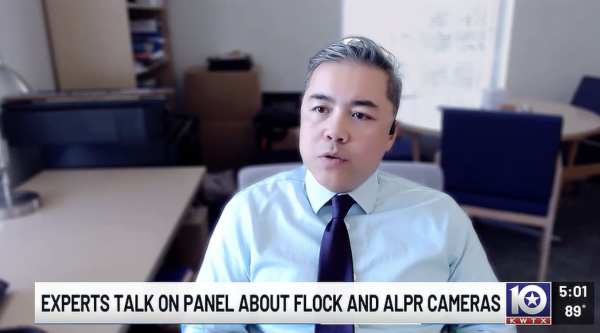
The controversy over Flock cameras continues, as more cases of misuse are popping up around the country. Texas Christian University criminology professor and reserve Fort Worth police officer Dr. Johnny Nhan says his research has shown how difficult it is to pinpoint how different departments across the country are tracking which cameras are used and when. “They just don’t have a universal standard of tracking… if Flock was used or not. For some departments it’s automatic, there’s something they check off if this was a flock-initiated ‘something’ or event. And other departments, they might write down on their report narrative, ‘hey, Flock was used for this element.’” Nhan says. “For a researcher to get the data, and I have access to most of the data, it’s virtually impossible to extract, because it’s like, ‘well, then we kind of have to automate the thousands and thousands of times Flock was mentioned or something like that. There’s no universal standard for collecting that data.”
Experts debate benefits and privacy concerns of license plate readers
WGNTV online
2026-10-07
Recent headlines over automated license plate reader (ALPR) technology are drawing widespread attention, and a group of panelists on Wednesday held a discussion over the technologies, what research is showing and potential for misuse. Automated license plate readers are intended to help investigators in missing persons cases, track stolen vehicles and generate investigative leads, which doesn’t include identifying a vehicle’s driver, but the technology is coming under scrutiny for misuse. In the meantime, Texas Christian University Professor Dr. Johnny Nhan says more detectives are using these in investigative work, finding success in cases like finding stolen vehicles, but Nhan also admits it’s difficult to draw a link in how effective it has been in bringing down crime rates based on the proliferation of the cameras. “There’s no universal standard in collecting that data,” he said.
Flock's CEO claims its tech "solved" 1 million crimes last year. The company's own methodology undercuts that claim
CBS News online
2026-09-30
"Last year we helped clear just over a million crimes in America," Flock CEO Garrett Langley said in a March 2026 podcast interview. "Flock technology is currently being used to solve approximately 2,000+ crimes per day, accounting for over 10% of all reported crime in the United States," the company said on the third page of a 2026 Company Fact Sheet that was, until recently, part of a media kit available on its website. The white paper says it was "created with the consultation" of two academics — Johnny Nhan of Texas Christian University and Richard Helfers of the University of Texas at Tyler.
Some Houston-area residents have growing concerns with the expansion of Flock cameras
Houston Public Media online
2026-08-10
Flock Safety says its cameras help solve crimes. But there have been cases of misuse by law enforcement. Johnny Nhan, a professor of criminology and criminal justice at Texas Christian University, said the rapid growth of these cameras – and a lack of individual consent over their use – has contributed to public frustration. "They didn’t sign anything saying that they allowed this. So it seems like the government, cities and police departments are just putting them up there," Nhan said. "It creates a ubiquitous big brother effect where, ‘Hey, everywhere I go, I’m being recorded.' "
Teachers packing heat: It's one thing to carry a gun. It's another to pull the trigger
Fort Worth Star Telegram online
2018-02-27
Antonio Orozco, an ordained minister of 30 years, is at peace preparing Texas teachers to carry out violence to stop violence.
"I have no qualms about using firearms to defend a life of a child or another person," the 67-year-old grandfather from Houston said. "It goes contradictory to what I'm doing, but the facts on the ground dictate to take action."
Cop charged in fatal shooting of man who tried to light himself on fire
New York Post online
2017-12-05
An Oklahoma City police officer was charged Tuesday with second-degree murder in the fatal shooting of a suicidal man who had doused himself in lighter fluid and was trying to set himself on fire.
Online Sleuths Are Outing Racists, But Should They?
Fast Company online
2017-08-19
Shortly after last Saturday’s white nationalist march through Charlottesville, outraged internet users took to social media to call out some of the participants in the march.
Daily News writer Shaun King tweeted photos of suspects in some violent attacks, including names and addresses shared by sources.
Criminal justice graduates first students from master’s program
tcu360 online
2016-05-09
An inaugural class of 14 students received a Master of Science in Criminal Justice and Criminology from TCU’s online criminal justice master’s program.
Johnny Nhan, director of the online master’s program, said members of the program typically already have real-world experience.
With identity crisis in police, more Fergusons inevitable
The Conversation online
2014-12-12
Recent social unrest across the country protesting the police shooting death of Michael Brown in Ferguson and the police chokehold death of Eric Garner in New York has reopened wounds and revealed deeply rooted tensions between citizens and police, especially in ethnic minority communities.
Articles
Cops and hotlists: Balancing security and privacy with ALPR technology
The Police Journal: Theory, Practice and PrinciplesJohnny Nhan and Richard C Helfers
2025-06-04
Automated License Plate Recognition (ALPR) technology is quickly becoming an essential tool in modern policing, offering efficiency and enhanced investigative capabilities. However, its rapid adoption has outpaced regulatory frameworks, leading to privacy concerns. This qualitative study examines the privacy implications of ALPR deployment through interviews with high-level law enforcement users and policymakers and representatives from Flock Safety, a leading ALPR company. The data highlights the gaps in standardization and oversight by agencies. Initial findings suggest that while ALPR systems are technologically accurate and provide undeniable law enforcement benefits, the absence of clear policies and operating standards has led to questions of potential misuse. The study underscores the need for comprehensive legal frameworks and transparent operational guidelines to balance public safety with civil liberties.
A Qualitative Study: An Examination of Police Officers’ Lived Experiences During the COVID-19 Pandemic
International Criminal Justice Review2021
In the spring of 2020, the COVID-19 pandemic spread across the globe prompting stay-at-home orders for all but the most essential workers in society. Policing was one of the professions that is essential for community safety, regardless of the circumstances. Officers were on the front-line of the COVID-19 public health crisis and their preparedness was crucial for officer and community health. During the onset of the pandemic little was known about how officers perceived the virus and how police agencies prepared officers to work in a highly contagious environment.
Stakeholder collaboration of a Texas Children’s Advocacy Center: An exploratory analysis of relations between law enforcement, Child Protective Services, and the children’s advocacy center
Children and Youth Services Review2021
The child advocacy center (CAC) model utilizes a multidisciplinary approach to handle crimes against children cases, with child protective services (CPS) and law enforcement agencies working closely with CACs. Though the CAC model surfaced in the 1980s, the main stakeholders’ collaborations are not well studied.
Digilantism: An Analysis of Crowdsourcing and the Boston Marathon Bombings
The British Journal of CriminologyJohnny Nhan, Laura Huey, Ryan Broll
2017
This paper explores the aftermath of the Boston Marathon bombing incident and how members of the general public, through the online community Reddit, attempted to provide assistance to law enforcement through conducting their own parallel investigations. As we document through an analysis of user posts, Reddit members shared information about the investigation, searched for information that would identify the perpetrators and, in some cases, drew on their own expert knowledge to uncover clues concerning key aspects of the attack. Although it is the case that the Reddit cyber-sleuths’ did not ultimately solve this case, or provide significant assistance to the police investigation, their actions suggest the potential role the public could play within security networks.
The reentry labyrinth: The anatomy of a reentry services network
Journal of Offender RehabilitationJohnny Nhan, Kendra Bowen & Katherine Polzer
2016
Difficulties of returning prisoners to society have been well documented in research the last few decades. This article looks at reentry programs and finds very few standardized programs and brought up many practical issues exoffenders face upon reentry. We examine a nonprofit regional reentry program in North Texas in order to better understand the number and nature of services available and the difficulties the organizations face and its potential impact on former inmates. We use Texas ReEntry Services (TXRS) data located in Fort Worth, Texas, as a starting point for mapping the reentry landscape, including client information in order to identify variables that affect obtaining resources, such as transportation. Finally, we discuss the potential impact of this networked arrangement on policy and recidivism.
‘Uppity civilians’ and ‘cyber-vigilantes’: The role of the general public in policing cyber-crime
Criminology & Criminal JusticeLaura Huey, Johnny Nhan, Ryan Broll
2012
The distributed nature of the Internet requires that security issues be addressed through collaborative efforts within and across various sets of public and private actors. Drawing on nodal governance theory, this article explores one aspect of the role that the general public can and does play in the field of cyber-security: civilian policing of the Internet. In particular, we examine the motives and actions of regular citizens, who use their computer skills to identify, track and collect information on the activities of suspected criminal offenders. Whereas some groups use such information to engage in vigilante acts, the groups that we study work cooperatively with police, collecting information to pass onto criminal justice agencies. We suggest that these collectives and their members are a potentially useful, if under-valued, component of cyber-security networks.