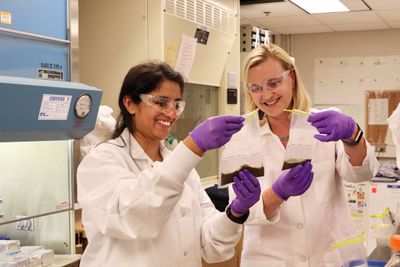
The University of Delaware’s Kalmia Kniel can discuss foodborne parasites and food safety risks, including the ongoing cyclosporiasis outbreak spreading across the United States.
Kniel, a professor of microbial food safety, can explain how foodborne parasites spread, why outbreaks (particularly those involving the Cyclospora parasite) can be challenging to investigate and what consumers should know about reducing their risk of illness.
She co-authored a study published in December 2025 that examined challenges researchers face in detecting, studying and controlling Cyclospora cayetanensis, including gaps in understanding the parasite and improving prevention strategies.
Kniel can also discuss why fresh produce and water are often a focus during investigations and the steps consumers can take to improve food safety.
Kniel’s expertise includes: Foodborne parasites and illness outbreaks
Produce and microbial food safety
Food contamination and prevention
Food safety research
Kniel discussed the biology of this specific pathogen in detail at a recent presentation on cyclospora.
To arrange an interview with Kniel, visit her profile page and click the contact button. Interested journalists can else email MediaRelations@udel.edu.
·
6 min
More than half of U.S. states allow the sale of raw milk directly from farms to consumers, a number that would likely increase if Robert F. Kennedy Jr. – a raw milk advocate – is confirmed to lead the Department of Health and Human Services (DHHS). Kali Kniel, a professor of microbial food safety at the University of Delaware, can discuss the dangers and potential benefits of drinking raw milk.
Some have celebrated the legalization of raw milk around the country, claiming it tastes better and has some nutritional benefits. Meanwhile, the U.S. Food and Drug Administration, one of the DHHS agencies Kennedy would lead, cautions against drinking raw milk, which comes directly from cows, sheep or goats and has been banned from being sold across state lines since the 1980s.
Concerns regarding raw milk have been elevated as a deadly strain of bird flu is infecting dairy farms around the country.
In the following Q&A, Kniel talks about the pathogens that may be present in raw milk, ways to communicate food safety to the public and other topics.
Milk and other dairy products that sit on shelves at the grocery store are pasteurized. What does this process involve and why is it important for dairy products? Pasteurization of milk is a process of heating milk and passing it between heated stainless steel plates until it reaches 161 degrees Fahrenheit. It is held at that temperature for around 15 seconds before it is quickly cooled to 39 degrees Fahrenheit. This process is intended to kill the pathogenic bacteria that could make a person sick.
How does this process affect milk’s quality and nutritional value? Scientific studies have shown that pasteurization does not significantly change the nutritional value of milk. Unpasteurized milk may have more vitamin C, which does not survive the pasteurization process, but milk is not considered a good source of vitamin C, as it contains less than 10% of the Recommended Dietary Allowance (RDA), the average amount of nutrients it takes to meet a healthy person’s needs.
There are no beneficial bacteria in raw milk. Milk (pasteurized or raw) is not a good source of probiotic or potentially beneficial bacteria, so for that consumers should choose yogurt and other fermented dairy products as well as other fermented products.
Scientific studies using animal models have shown no difference in how calcium in raw milk and pasteurized milk is absorbed by the human body.
Popularity in drinking raw milk is increasing, despite the U.S. Food and Drug Administration advising that it’s not safe to drink. What are the health risks that come with drinking raw milk? Raw milk may contain pathogenic bacteria, including Campylobacter, Salmonella, pathogenic types of E. coli, Listeria and Brucella, as well as the protozoan parasite Cryptosporidium. These are all zoonotic microbes, which means they can be transmitted from animals to humans. Often the animal does not appear ill, so it is not possible to determine if an ill animal is shedding these pathogens in its feces that can contaminate milk.
Microbial testing of the finished product and environmental monitoring programs may be helpful, but do not guarantee that the raw milk is absent of these pathogens. Milk can be contaminated with these pathogens from direct contamination with feces or from environmental conditions. Cross-contamination from dairy workers can also happen, even when people are trying their best to reduce the risk of cross-contamination.
The likelihood of a disease outbreak occurring associated with a person consuming raw milk is relatively high given that others may also be exposed. Unpasteurized milk will have a relatively short shelf life and may not be available for testing. Following good hygiene practices on the farm and during milking such as biosecurity around the farm, appropriately sanitizing equipment and monitoring the health of animals can reduce the chance of milk contamination, but not eliminate it.
There have been numerous outbreaks of illness associated with raw milk as well as cheese made from raw milk. Persons most at risk of illness associated with drinking raw milk include children, in particular 5 years of age and under, individuals aged 65 and over, pregnant women and immunocompromised individuals. It should be noted that all outbreaks of illness associated with raw milk have included individuals under 19 years of age. Children may be most vulnerable, as they cannot voice an opinion on consumption and risk of raw milk if it is in their household.
The Center for Disease Control and Prevention (CDC) collects data on foodborne disease outbreaks voluntarily reported by state, local or territorial health departments. According to the CDC from 2013 to 2018 there were 75 outbreaks of illness linked to raw milk consumption. These outbreaks include 675 illnesses and 98 hospitalizations. Most of these illnesses were caused by Campylobacter, shiga-toxigenic E. coli, or Salmonella.
An increase in outbreaks has been correlated with changes in the availability of raw milk. For example, between 2009 and 2023, there were 25 documented outbreaks in the state of Utah, which has 16 raw milk retailers licensed by the Utah Department of Agriculture and Food. In all of these outbreaks, the raw milk was contaminated with the bacteria Campylobacter, which typically causes gastroenteritis symptoms like diarrhea and nausea, but may also cause chronic illness, including Guillain-Barré syndrome which can cause paralysis.
How likely are these illnesses to happen from drinking raw milk? It is difficult to say. Foodborne illness is often underreported, depending on how severe people’s symptoms are.
According to one study, only about 3.2% of the U.S. population drinks raw milk, while about 1.6% eats cheese made from raw milk. But compared with consumers of pasteurized dairy products, they are 840 times more likely to experience an illness and 45 times more likely to be hospitalized. The authors of this work used the CDC’s national reporting system to analyze data from 2009 to 2014.
Despite health risks, why do some people still drink raw milk? Some people feel a nostalgic connection to raw milk, and others may feel that foods that are not treated with heat retain certain nutrients and enzymatic activity. I am not aware of any peer-reviewed rigorous scientific studies that indicate the nutritional benefits of consuming raw milk over time, given the risks of potential for illness, combined with a well balanced diet full of healthful food choices.
It remains that raw milk is particularly risky for children to consume, as children can get sick from consuming fewer bacterial cells compared to adults.
More than 900 cases of highly pathogenic avian influenza — the disease commonly known as bird flu — have been detected in dairy cattle across 16 states, and at least 40 people have been infected with the disease from close contact with dairy cows. Raw milk is being tested for the virus. With raw milk gaining interest among consumers, what are the possible consequences? Does it elevate the risk of bird flu spreading further to people? There remain clear risks of transmission of pathogenic bacteria through consumption of raw milk, and now with the potential for contamination of raw milk with avian influenza, it is even more important that consumers protect themselves by drinking pasteurized milk.
The people most at risk right now are those involved with the milking process and in the handling of dairy cattle. So it is important that those individuals be aware of the risks and take appropriate precautions, including hand washing and wearing appropriate personal protective equipment like protective clothing, gloves, face shields and eye protection.
As of December, the U.S. Department of Agriculture is requiring 13 states to share raw milk samples so the agency can test for bird flu viruses. How could this testing better help us understand the virus? I think it is very smart that USDA is leading the National Milk Testing Strategy, which will help us understand the extent of infected herds. Surveillance of microorganisms is an important way to assess risk so we can develop appropriate strategies to reduce and control these risks.
·
3 min
University of Delaware researchers grew lettuce under conditions that imitated the weightless environment aboard the International Space Station and found those plants were actually more prone to infections from Salmonella.
It’s been more than three years since the National Aeronautics and Space Administration made space-grown lettuce an item on the menu for astronauts aboard the International Space Station. Alongside their space diet staples of flour tortillas and powdered coffee, astronauts can munch on a salad, grown from control chambers aboard the ISS that account for the ideal temperature, amount of water and light that plants need to mature.
But as the UD researchers discovered, there is a problem. The International Space Station has a lot of pathogenic bacteria and fungi. Many of these disease-causing microbes at the ISS are very aggressive and can easily colonize the tissue of lettuce and other plants. Once people eat lettuce that’s been overrun by E. coli or Salmonella, they can get sick.
With billions of dollars poured into space exploration each year by NASA and private companies like SpaceX, some researchers are concerned that a foodborne illness outbreak aboard the International Space Station could derail a mission.
In the new study by UD's team, published in Scientific Reports and in npj Microgravity, researchers grew lettuce in a weightless environment similar to that found at the International Space Station. Plants are masters of sensing gravity, and they use roots to find it. The plants grown at UD were exposed to simulated microgravity by rotation. The researchers found those plants under the manufactured microgravity were actually more prone to infections from Salmonella, a human pathogen.
Stomata, the tiny pores in leaves and stems that plants use to breathe, normally close to defend a plant when it senses a stressor, like bacteria, nearby, said Noah Totsline, an alumnus of UD’s Department of Plant and Soil Sciences who finished his graduate program in December. When the researchers added bacteria to lettuce under their microgravity simulation, they found the leafy greens opened their stomata wide instead of closing them.
“The fact that they were remaining open when we were presenting them with what would appear to be a stress was really unexpected,” Totsline said.
Totsline, the lead author of both papers, worked with plant biology professor Harsh Bais as well as microbial food safety professor Kali Kniel and Chandran Sabanayagam of the Delaware Biotechnology Institute. The research team used a device called a clinostat to rotate plants at the speed of a rotisserie chicken on a spinner.
“In effect, the plant would not know which way was up or down,” Totsline said. “We were kind of confusing their response to gravity.”
Additionally, Bais and other UD researchers have shown the usage of a helper bacteria called B. subtilis UD1022 in promoting plant growth and fitness against pathogens or other stressors such as drought.
They added the UD1022 to the microgravity simulation that on Earth can protect plants against Salmonella, thinking it might help the plants fend off Salmonella in microgravity.
Instead, they found the bacterium actually failed to protect plants in space-like conditions, which could stem from the bacteria’s inability to trigger a biochemical response that would force a plant to close its stomata.
“The failure of UD1022 to close stomata under simulated microgravity is both surprising and interesting and opens another can of worms,” Bais said. “I suspect the ability of UD1022 to negate the stomata closure under microgravity simulation may overwhelm the plant and make the plant and UD1022 unable to communicate with each other, helping Salmonella invade a plant.”
To contact researchers from the team, visit the profiles for Bais or Kniel and click on the contact button.
Media
Social
Biography
Dr. Kniel’s laboratory explores issues of food safety and public health that involve transmission of viruses, protozoa, and pathogenic bacteria. Few laboratories work with this extent of different microorganisms. Specific projects may address survival or transmission routes through various complex food systems. In light of needs related to the FDA FSMA Produce Safety Rule, research includes assessing risks associated with pre-harvest contamination of raw agricultural commodities through water and soil amendments. Research projects focus on survival and persistence in water and poultry litter and subsequent transfer onto the edible portion of the crop. Investigations into novel detection methods as well as biocontrol are also ongoing. Efforts are made to correlate behaviors of different microorganisms, including viral surrogates, with climate or other environmental metadata in our assessments. We also work with nearby government agencies and connect our research to the needs of policy makers. We have contributed data critical to addressing contemporary food safety questions; specifically, prevalence of pathogens in manure and time needed between application of manure and time to harvest. Students on all levels assist with this research.
Exploratory studies surrounding issues of food safety education is part of Dr. Kniel’s passion for research. Issues of food microbiology and food safety can be integrated across the K-16 curriculum in a novel way of connecting science to other topics. One Health is a holistic way of thinking about how the health of our environment is intertwined with human health and animal health. Food Safety is an outstanding example of a topic with a One Health focus. More information and examples are available on the Foodborne Illness Outbreak Investigation website.
Industry Expertise
Research
Education/Learning
Areas of Expertise
Microbial Food Safety
Foodborne parasites
Produce Safety
Cyclospora
Food Systems
Pathogenic Bacteria
Food Safety
Public Health
Microorganisms
Media Appearances
USDA cyclospora research projects shelved amid funding cuts and relocations
Politico online
2026-08-30
Article quotes Kali Kniel, professor of microbial food safety. “We know so little, and I think that that’s been very frustrating to consumers," she said.
Is Lettuce Still Unsafe? Experts Weigh In After Cyclospora Warning Update
Newsweek online
2026-08-28
Newsweek interviewed Kali Kniel, professor of microbial food safety, who said that the Food and Drug Administration's latest announcement has caused confusion. "There is no known or documented reason now for consumers to avoid lettuce at this time," she said.
Alfalfa Sprouts Were Linked to E. Coli and Salmonella at the Same Time — Here’s How That’s Possible
Food & Wine online
2026-08-25
Kali Kniel, professor of microbial food safety, was quoted extensively in the story. She discussed the risk of consuming the sprouts and the science behind the double threat.
How Cyclospora Evaded the U.S. Food Safety System to Sicken Thousands
The New York Times
2026-08-15
Cyclospora does not grow in laboratory culture. Scientists often use culture as a tool to amplify tiny bits of bacteria, like salmonella or E. coli, to detectable levels. The same cannot be done for cyclospora, said Kalmia Kniel, a microbiologist at the University of Delaware who researches the parasite.
Trump blamed for explosive diarrhoea outbreak sweeping US
The Telegraph online
2026-07-16
Professor Kalmia Kniel told the British news outlet that although the Trump administration could not directly be blamed for the spread of the outbreak, "there are clear ramifications of the lack of active surveillance."
Amid Cyclosporiasis Outbreak, University Researchers Lend Their Expertise
Inside Higher Ed online
2026-07-15
“There are several of us that work in this field that are getting the questions about, ‘How does an outbreak investigation go? What is it about cyclospora that makes it more unique, and how can it survive in the environment?’” University of Delaware professor Kalmia Kniel said. “I take the angle that I really want the right information to get out there, however I can share that as a scientist and as an educator.
What makes this cyclospora outbreak different — and why it might not end until August
MarketWatch online
2026-07-15
“This outbreak is very unique,” said Kalmia Kniel, professor of microbial food safety at the University of Delaware. “The way the numbers are growing and the way we have geographical clustering, there’s probably many outbreaks.”
How Long Does Cyclospora Incubate? Symptoms to Watch For, How to Treat It
Newsweek online
2026-07-14
"It is important to note that Cyclospora oocysts can attach to the hairlike projections on raspberries and cilantro," University of Delaware professor Kalmia Kniel told Newsweek.
It's not just produce. Where else can 'explosive diarrhea' bug hide?
USA Today online
2026-07-11
Kalmia Kniel, professor of microbial food safety, said the CDC's decision to scale back monitoring of foodborne illnesses could hinder health officials’ ability to track cases across the country.
This Parasite Could Be on Your Raspberries — and It Causes ‘Explosive’ Diarrhea
Food & Wine online
2026-07-11
“As happens often with foodborne disease, we do not yet know the exact cause of these illnesses,” says Kalmia E. Kniel, PhD, professor, and chair of microbial food safety at the University of Delaware. “That is concerning and frustrating to consumers.”
The internet is freaking out about reheated rice. Should you be worried?
Mashable online
2024-02-03
"Heat-resistant endospores of this bacteria are more likely to survive cooking and start growing again (germinate) when the food is cooled gradually over an extended period of time," Kalmia Kniel, professor of animal and food sciences, told Mashable.
UD’s CEWER takes on analyzing wastewater to track COVID-19
Delaware Public Media online
2021-02-05
New Castle County started analyzing its sewer water for COVID-19 last spring. Late last year, it moved that analysis to the University of Delaware’s Center for Environmental and Wastewater-based Epidemiological Research (CEWER). Delaware Public Media’s Sophia Schmidt talks with CEWER director Kali Kniel about this work.
Opportunistic bacteria — salmonella, listeria and E.coli, for example — often piggyback on raw vegetables, poultry, beef and other foods to gain entry into a human host, causing millions of foodborne illnesses each year. But University of Delaware researchers Harsh Bais and Kali Kniel and their collaborators now have found that wild strains of salmonella can circumvent a plant’s immune defense system, getting into the leaves of lettuce by opening up the plant’s tiny breathing pores called stomates.
Many experts come from a variety of professions that historically do not consistently interact — public health professionals, food scientists, economists, educators, engineers, entomologists, epidemiologists, hydrologists, microbiologists, nutritionists, physicians, molecular biologists and veterinarians. UD has strong expertise in the great majority of these areas, so Arsenault and Kali Kniel are leading the charge to bring a critical mass of UD researchers together around the topic.
“Large distribution chains do allow for more chances of contamination, but we have to balance that with feeding the world,” said Kali Kniel, an animal and food science professor at the University of Delaware. “Unfortunately, it’s a complex problem with no easy answers.”
Ranking Produce Safety Priorities of Fresh Produce Industry Stakeholders in the United States
IAFP 2022
2022
A comprehensive understanding of stakeholder food safety priorities around fresh produce does not currently exist. Such information is essential to improve food safety knowledge and practices effectively and efficiently throughout the fresh produce industry.
Variations in Bacterial Communities and Antibiotic Resistance Genes Across Diverse Recycled and Surface Water Irrigation Sources in the Mid-Atlantic and Southwest United States
Environmental Science & Technology
2022
Reduced availability of agricultural water has spurred increased interest in using recycled irrigation water for U.S. food crop production. However, there are significant knowledge gaps concerning the microbiological quality of these water sources. To address these gaps, we used 16S rRNA gene and metagenomic sequencing to characterize taxonomic and functional variations (e.g., antimicrobial resistance) in bacterial communities across diverse recycled and surface water irrigation sources. We collected 1 L water samples (n = 410) between 2016 and 2018 from the Mid-Atlantic (12 sites) and Southwest (10 sites) U.S. Samples were filtered, and DNA was extracted.
Human Norovirus Surrogates Persist in Nontraditional Sources of Irrigation Water in Excess of 100 Days
Journal of Food Protection
2023
Human norovirus (HuNoV) has been implicated as the leading cause of foodborne illness worldwide. The ability of HuNoV to persist in water can significantly impact food safety as agriculture and processing water could serve as vehicles of virus transmission. This study focused on the persistence and infectivity of the HuNoV surrogate viruses, murine norovirus (MNV), and Tulane virus (TV), after prolonged storage in diverse environmental water types currently used for agricultural irrigation.
Temporal Stability of Salmonella enterica and Listeria monocytogenes in Surface Waters Used for Irrigation in the Mid-Atlantic United States
Journal of Food Protection
2023
Enteric bacterial pathogen levels can influence the suitability of irrigation water sources for fruits and vegetables. We hypothesize that stable spatial patterns of Salmonella enterica and Listeria monocytogenes levels may exist across surface water sources in the Mid-Atlantic U.S. Water samples were collected at four streams and two pond sites in the mid-Atlantic U.S. over 2 years, biweekly during the fruit and vegetable growing seasons, and once a month during nongrowing seasons.
Deep ultraviolet fluorescence sensing with multispectral imaging to detect and monitor food-borne pathogens on the leafy green phyllosphere
Journal of Food Safety
2023
Demand for sustainable and safe raw agricultural commodities is growing rapidly worldwide. Reducing the risk of foodborne illnesses associated with fresh produce is a task which the industry and academic researchers have been struggling with for many years. There is an immediate need to devise a non-invasive optical detection system to monitor the food-borne pathogens on the leaf surface.
Survival of enteric viruses on salad greens, green onions and strawberries after treatment with ultraviolet light
CANR Seed Grant
5/04-5/06
Fate of viral and bacterial pathogens during the growth of leafy greens
ISEQ and ABC Graduate Fellowship
06/01/07-05/31/09
Inactivation of viruses by pressure in ready to eat food products
USDA-CSREES-Integrated Food Safety Program
9/01/04-8/31/07
Accomplishments
Outstanding Advisor Certificate of Appreciation
2017
Department of Animal and Food Sciences
2018 John N. Sofos Most-cited JFP Research Publication Award
2018
for paper entitled, “Comparing Human Norovirus Surrogates: Murine Norovirus and Tulane Virus” by K.A. Hirneisen and K.E. Kniel
Excellence in Research Award
2020
University of Delaware College of Agriculture and Natural Resources
Education
United States Agricultural Research Service, Animal Parasitic Diseases Laboratory
Postdoctoral
Microbiologist
Virginia Polytechnic Institute and State University
PhD
Food Science
2002
Virginia Polytechnic Institute and State University
MS
Molecular Cell Biology
1998
Virginia Polytechnic Institute and State University
BS
Biology
1996
Affiliations
International Association for Food Protection (IAFP) : Current Past President (2020-2021), President (2019-2020), Executive Board Member (2016-2021), and Member
Capital Area Association for Food Protection : Member
Web-based Game Engages Post-secondary Students in Food Safety and Shifts Perceptions
International Association of Food Protection, A Virtual Annual Meeting Virtual
Role of Edaphic Soil Factors and Climatic Conditions in Pathogen Survival on the Farm
International Association of Food Protection, A Virtual Annual Meeting Virtual
Evaluation of Zero-valent Iron Filtration in the Removal and Persistence of Escherichia coli in Non-traditional Irrigation Water Sources: A Conserve Study
International Association of Food Protection, A Virtual Annual Meeting Virtual