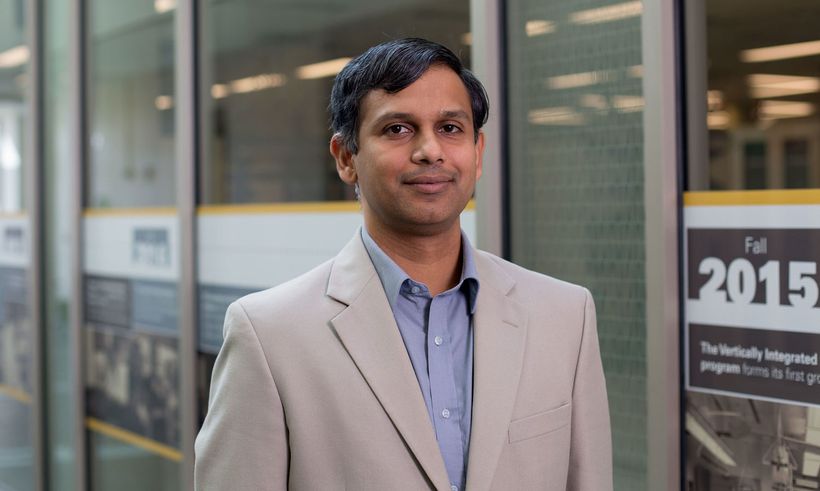
Jayasimha Atulasimha, Ph.D. profile photo

Jayasimha Atulasimha, Ph.D.

Engineering Foundation Professor, Department of Mechanical and Nuclear Engineering

  • Richmond VA UNITED STATES

Professor Atulasimha researches nanomagnetic/spintronic memory and neuromorphic computing devices.

Contact

Spotlight

5 min

The National Academy of Inventors (NAI) recently inducted five Virginia Commonwealth University (VCU) College of Engineering researchers as senior members. Chosen for their innovative engineering contributions, the honorees are recognized as visionary inventors whose groundbreaking research and patented technologies are driving meaningful societal and economic advancements across the national innovation landscape. “Invention represents the practical application of knowledge and stands as one of the many ways engineers can make a positive impact on their communities and the world,” said Azim Eskandarian, D.Sc, the Alice T. and William H. Goodwin Jr. Dean of the VCU College of Engineering. “This year’s honorees exemplify the interdisciplinary nature of our field, leveraging advanced concepts from mechanical, biomedical, chemical and pharmaceutical engineering to address today’s most pressing challenges. We are immensely proud that our dedicated researchers have earned recognition as members of the esteemed National Academy of Inventors.” The VCU College of Engineering NAI inductees are: Jayasimha Atulasimha, Ph.D. Engineering Foundation Professor Department of Mechanical & Nuclear Engineering An internationally recognized pioneer of straintronics, an approach to electrically control magnetism for ultra-low-energy computing, Atulasimha has made significant research contributions to next-generation memory, neuromorphic hardware and emerging quantum computing technologies. He holds four U.S. patents spanning energy-efficient magnetic memory, nanoscale computing architectures and medical tools. Atulasimha’s commercially viable inventions are funded by organizations like the Virginia Innovation Partnership Corporation and he leads multi-institutional collaborations that drive innovation in computing hardware, AI and quantum technologies with more than $10 million in funded research. Casey Grey, Ph.D. Postdoctoral Research Associate Department of Mechanical & Nuclear Engineering Bridging engineering and medicine, Grey’s work spans life‑saving stroke technologies, breakthrough respiratory and neurological care, and sustainable packaging. As a lead R&D scientist at WestRock, he helped create and commercialize the CanCollar® portfolio, a recyclable paperboard replacement for plastic beverage rings now used on five continents, eliminating thousands of tons of single‑use plastic annually. In medical device innovation, Grey’s patent and development work on a novel cyclic aspiration thrombectomy platform, currently in clinical trials, is advancing stroke treatment by enhancing clot removal efficiency and reducing long‑term disability. At the VCU College of engineering, Grey built a research and commercialization pipeline around neurological and respiratory technologies, securing eight provisional patents and leading multidisciplinary teams in neurology, neurosurgery, surgery, pharmacology and toxicology, internal medicine, and respiratory medicine. His work includes developing dry powder inhaler strategies for delivering life‑saving drugs to patients with acute respiratory distress syndrome (ARDS), a pediatric bubble CPAP system designed to protect brain development in premature infants, and non‑invasive, non‑pharmacological 40 Hz neuromodulation therapies to treat neurodegeneration and conditions with significant central nervous system complications, like sickle cell disease. In collaborations with the VCU Children’s Hospital and VCU Critical Care Hospital, Grey is leading two clinical studies that are translating these innovations to improve patient care. Ravi Hadimani, Ph.D. Associate Professor and Director of Biomagnetics Laboratory Department of Mechanical & Nuclear Engineering Hadimani founded RAM Phantoms LLC, a VCU startup company, commercializing anatomically accurate, MRI-derived brain phantoms for neuromodulation and neuroimaging applications. These brain phantoms help test and tune transcranial magnetic and deep brain stimulation technologies, improving clinical safety and enabling personalized therapy for patients. RAM Phantoms is also developing a highly-skilled workforce for employment in Virginia’s growing biomedical device industry. Beyond commercialization, Hadimani maintains a productive research program with more than $4.5 million in funding resulting in 125 original peer-reviewed publications, 17 current and pending patents, a book, and several book chapters. His biomagnetics lab serves as a training ground for undergraduate, graduate and Ph.D. students to hone their skills in innovation management, intellectual property strategy and startup development. Several students from Hadimani’s lab have engaged in translational research, patent co-authorship and start-up formation, cultivating a new generation of engineer-entrepreneurs equipped to drive future technological advances. Before joining VCU, Hadimani led the development of hybrid piezoelectric–photovoltaic materials that established FiberLec Inc., which commercialized multifunctional energy-harvesting fibers capable of converting solar, wind and vibrational energy into usable electricity. Worth Longest, Ph.D. Alice T. and William H. Goodwin, Jr. Distinguished Chair Department of Mechanical & Nuclear Engineering Uniting aerosol science, biomedical engineering and computational modeling, Longest is revolutionizing inhaled drug delivery. Working with collaborators, his lab has developed novel devices, formulations and delivery platforms that precisely target medications to the lungs, addressing conditions like cystic fibrosis, pneumonia, acute respiratory distress syndrome and neonatal respiratory distress syndrome. These innovations have resulted in multiple patents. Some of them have been licensed through commercial partnerships like Quench Medical, an organization advancing inhaled therapies for applications like lung cancer. Collaborating with the Gates Foundation and the lab of Michael Hindle, Ph.D., from the VCU Department of Pharmaceutics, Longest’s team developed a low-cost, high-efficacy aerosol surfactant therapy for pre-term infants based entirely on technology developed at VCU. The invention eliminates intubation, reduces dosage by a factor of 10, and cuts treatment costs. Over 9 million infant lives are projected to be saved by this technology between 2030 and 2050. Through a long-term collaboration with the U.S. Food and Drug Administration, Longest’s in vitro and computational methods provide federal regulatory guidance for generic inhaled medications. The VCU mouth-throat airway models developed under his leadership are used globally across the pharmaceutical industry and in government laboratories. Hong Zhao, Ph.D. Associate Professor Department of Mechanical & Nuclear Engineering Zhao holds 40 patents with innovations spanning additive manufacturing, stretchable electronics, inkjet printing technologies and superoleophobic materials that repel oils, greases, and low-surface-tension liquids. Her research has applications across health care, sustainable energy and advanced manufacturing. Prior to joining the College of Engineering, Zhao served as a senior research scientist and project leader at the Xerox Research Center, where she developed high-performance materials and printing technologies for commercial deployment. Her industry experience makes Zhao’s lab a hub for innovation and mentorship, with students engaging in innovative research and co-authoring publications. Zhao is an invited reviewer for more than 50 premier journals and grant agencies. “Working with distinguished researchers and innovators like those inducted into the National Academy of Inventors is a great honor for me,” said Arvind Agarwal, Ph.D., chair of the Department of Mechanical & Nuclear Engineering and NAI fellow. “They are an inspiration and showcase the kind of impact engineers can make. Having all five of these innovators as part of our department amplifies the scientific richness of our college and its societal impact. They advance the college’s mission of Engineering for Humanity, with research that brings a positive change to our world.” The 2026 NAI class of senior members, composed of 231 emerging inventors from NAI’s member institutions, is the largest to date. Hailing from 82 NAI member institutions across the globe, they hold over 2,000 U.S. patents.

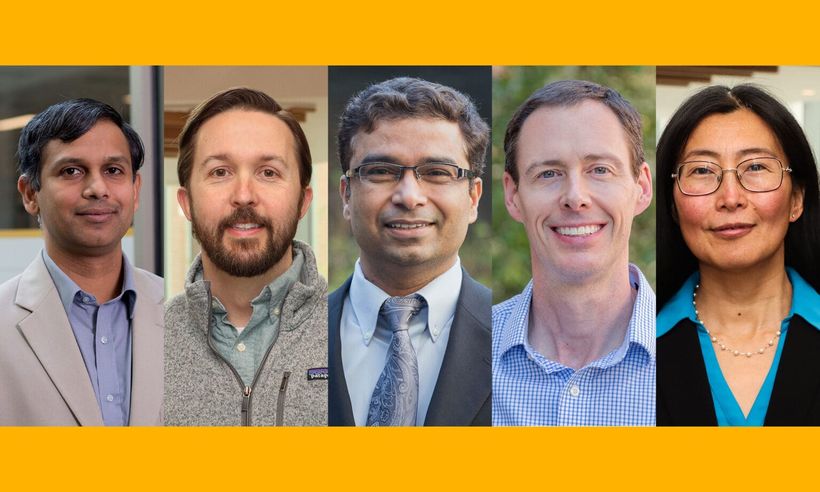
Jayasimha Atulasimha, Ph.D.Ravi HadimaniWorth Longest, Ph.D.Hong Zhao, Ph.D.

4 min

Artificial intelligence is a resource-intensive technology. A paper recently published in Nano Letters by collaborators at the Virginia Commonwealth University (VCU) College of Engineering and Georgetown University hopes to improve AI’s ability to parse the vast amounts of information it creates by applying magneto-ionics to the established concept of physical reservoir computing (PRC). “Demonstrating we can make solid-state devices with magneto-ionic materials is an important step into further energy-efficient computing research, and this Nano Letters publication reinforces that,” said Muhammad (Md.) Mahadi Rajib, Ph.D., a postdoc with Jayasimha Atulasimha, Ph.D., Engineering Foundation Professor in the Department of Mechanical & Nuclear Engineering. What makes a decision? Our brains make countless complex decisions everyday. Input comes in, we weigh options and decide what to do. Within that simple path are countless identical loops of input, consideration and output as neurons fire in a chain that takes you from cause to effect. For artificial intelligence, nodes within a neural network receive inputs and provide output, much like the neurons in our brains. These outputs can be sent to other nodes for continued processing, but those outputs need weight to have value. For AI, weight signifies one input or connection is more important than another. Traditional neural networks have multiple layers consisting of countless nodes like this. Each node requires training in order to weigh things properly. Training consumes processing power, and processing power takes time and energy. Making tasks like analysis and prediction more efficient is how to continuously improve AI technology. Less training, more efficiency. Physical reservoir computing reduces the number of nodes an AI needs to train. Only the final output layer needs training in PRC, using a simple method for classification or prediction tasks. A physical “black box” replaces neural network nodes and synapses, like the ones used for AI inference, in PRC and processes inputs by implementing a nonlinear mathematical function with temporal memory. To explain the inner workings of the black box, imagine two stones thrown into still water. One stone is thrown with high force and the other with low force, creating big and small ripples respectively. If the stones are thrown so the second stone lands before the previous ripples have dissipated, the new ripple is affected by the earlier one. This illustrates the concept of temporal memory. In this analogy, if multiple stones are thrown one after another into still water according to some complex trend, observing the ripples over time allows you to understand the trend and train a simple set of weights to predict the force of the next stone throw from the ripple pattern. Repeatedly performing this cycle of input, interaction and observation is PRC. It reveals patterns over time that can predict chaotic systems, like market trends or the weather, using techniques like linear regression modeling to plot each output as a single point. The magneto-ionic approach. Using this same example above, the “water” in a magneto-ionic PRC is represented by a positive and negative electrode with solid-state electrolyte between them through which ions move when voltage is applied. The application of voltage is equivalent to throwing a stone and the ripple effect is comparable to the movement of oxygen ions in the system. “In addition to its energy efficiency, a useful feature of the magnetoionic system is that time scales for ion diffusion can be controlled from microseconds to minutes,” Atulasimha said. “This leads to simple experimental demonstration, as no megahertz and gigahertz measurements are needed. One can work at the natural time scales of the target application in practical systems and remove the need for complex frequency conversion, which takes both energy and space due to complex electronics.” Atulasimha imagines these energy-efficient reservoir systems have applications in edge computing devices like drones, automated vehicles and surveillance cameras. Tasks such as household energy load forecasting, weather prediction or processing hourly readings from wearable devices, which operate on hour-scale data, can also be performed using magneto-ionic PRC without additional preprocessing. “We showed that the magneto-ionic physical reservoir has both memory and nonlinear behavior, two important properties necessary for using it as a reservoir block,” Rajib said. “Our system stands out because voltage-controlled ion migration is a highly energy efficient method of manipulating magnetization. We demonstrated the required reservoir properties in a physical system and did so using a very energy efficient approach.” Two labs came together in order to pursue this research. Virginia Commonwealth University collaborators included Atulasimha, Rajib, and VCU Ph.D. students Fahim Chowdhury and Shouvik Sarker. The Georgetown University team included Kai Liu, Ph.D., Professor and McDevitt Chair in Physics, Dhritiman Bhattacharya, Ph.D., Christopher Jensen, Ph.D. and Gong Chen, Ph.D. Atulasimha’s group illustrated physical reservoir computing using numerical models of spintronic devices and sought a material system to experimentally demonstrate PRC. Liu’s team worked with magneto-ionic materials and was intrigued by the possibility of using them for computing applications.

Jayasimha Atulasimha, Ph.D.

Media

Biography

Jayasimha Atulasimha is a Qimonda Professor of Mechanical and Nuclear
Engineering with a courtesy appointment in Electrical and Computer Engineering at the Virginia
Commonwealth University. He has authored or coauthored ~80 journal publications on
magnetostrictive materials, magnetization dynamics, spintronics and nanomagnetic computing.
His current research interests include nanomagnetism, spintronics, multiferroics, nanomagnetic
memory and neuromorphic computing devices. He is a fellow of the ASME, an IEEE Senior
Member and current chair for the TC on Spintronics, IEEE Nanotechnology Council.

Industry Expertise

Research
Education/Learning

Areas of Expertise

Spintronics and Nanomagnetism
Exploratory neuromorphic devices
Straintronics: Strian mediated electric field control of magnetism
Electric field (VCMA) control of skyrmions
Magnetic and multiferroic materials

Accomplishments

Fellow of ASME

American Society of Mechanical Engineers

Senior Member of IEEE

Institute of Electrical and Electronics Engineers

NSF CAREER Award

National Science Foundation

Education

University of Maryland

Ph.D.

Aerospace Engineering

2006

University of Maryland

M.S.

Aerospace Engineering

2003

Indian Institute of Technology - Madras

B.S.

Mechanical Engineering

2001

Media Appearances

Study reveals magnetic process that can lead to more energy-efficient memory in computers

Science Daily from original material published by VCU  online

2020-06-30

Press for our article published in Nature Electronics, 2020

View More

Engineering researchers develop a process that could make big data and cloud storage more energy efficient Read more at: https://phys.org/news/2016-11-big-cloud-storage-energy-efficient.html#jCp

Phys.org  online

2016-11-30

"When you look at the energy reduction that this affords, it's a major change," said Jayasimha Atulasimha, Ph.D., Qimonda associate professor in the Department of Mechanical and Nuclear Engineering. "This has the potential to significantly reduce the energy consumption in switching non-volatile magnetic memory devices."

Read more at: https://phys.org/news/2016-11-big-cloud-storage-energy-efficient.html#jCp

View More

'Straintronic spin neuron' may greatly improve neural computing

Phys.org  

2015-07-08

"Researchers have proposed a new type of artificial neuron called a 'straintronic spin neuron' that could serve as the basic unit of artificial neural networks—systems modeled on human brains that have the ability to compute, learn, and adapt. Compared to previous designs, the new artificial neuron is potentially orders of magnitude more energy-efficient, more robust against thermal degradation, and fires at a faster rate.

The researchers, Ayan K. Biswas, Professor Jayasimha Atulasimha, and Professor Supriyo Bandyopadhyay at Virginia Commonwealth University in Richmond, have published a paper on the straintronic spin neuron in a recent issue of Nanotechnology..."

View More

Selected Articles

Acoustic-Wave-Induced Magnetization Switching of Magnetostrictive Nanomagnets from Single-Domain to Nonvolatile Vortex States

Nano Letters

Vimal Sampath, Noel D'Souza, Dhritiman Bhattacharya, Gary M. Atkinson, Supriyo Bandyopadhyay & Jayasimha Atulasimha

2016-08-26

We report experimental manipulation of the magnetic states of elliptical cobalt magnetostrictive nanomagnets (with nominal dimensions of ∼340 nm × 270 nm × 12 nm) delineated on bulk 128° Y-cut lithium niobate with acoustic waves (AWs) launched from interdigitated electrodes. Isolated nanomagnets (no dipole interaction with any other nanomagnet) that are initially magnetized with a magnetic field to a single-domain state with the magnetization aligned along the major axis of the ellipse are driven into a vortex state by acoustic waves that modulate the stress anisotropy of these nanomagnets. The nanomagnets remain in the vortex state until they are reset by a strong magnetic field to the initial single-domain state, making the vortex state nonvolatile. This phenomenon is modeled and explained using a micromagnetic framework and could lead to the development of extremely energy efficient magnetization switching methodologies for low-power computing applications.

View more

Experimental Clocking of Nanomagnets with Strain for Ultralow Power Boolean Logic

Nano Letters

Noel D'Souza, Mohammad Salehi Fashami, Supriyo Bandyopadhyay, Jayasimha Atulasimha

2016-01-08

Nanomagnetic implementations of Boolean logic have attracted attention because of their nonvolatility and the potential for unprecedented overall energy-efficiency. Unfortunately, the large dissipative losses that occur when nanomagnets are switched with a magnetic field or spin-transfer-torque severely compromise the energy-efficiency. Recently, there have been experimental reports of utilizing the Spin Hall effect for switching magnets, and theoretical proposals for strain induced switching of single-domain magnetostrictive nanomagnets, that might reduce the dissipative losses significantly. Here, we experimentally demonstrate, for the first time that strain-induced switching of single-domain magnetostrictive nanomagnets of lateral dimensions ∼200 nm fabricated on a piezoelectric substrate can implement a nanomagnetic Boolean NOT gate and steer bit information unidirectionally in dipole-coupled nanomagnet chains. On the basis of the experimental results with bulk PMN–PT substrates, we estimate that the energy dissipation for logic operations in a reasonably scaled system using thin films will be a mere ∼1 aJ/bit.

View more

Skyrmion-Mediated Voltage-Controlled Switching of Ferromagnets for Reliable and Energy-Efficient Two-Terminal Memory

ACS Appl. Mater. Interfaces

Dhritiman Bhattacharya and Jayasimha Atulasimha

2018-04-27

We propose a two-terminal nanomagnetic memory element based on magnetization reversal of a perpendicularly magnetized nanomagnet employing a unipolar voltage pulse that modifies the perpendicular anisotropy of the system. Our work demonstrates that the presence of Dzyaloshinskii–Moriya interaction can create an alternative route for magnetization reversal that obviates the need for utilizing precessional magnetization dynamics as well as a bias magnetic field that are employed in traditional voltage control of magnetic anisotropy (VCMA)-based switching of perpendicular magnetization. We show with extensive micromagnetic simulation, in the presence of thermal noise, that the proposed skyrmion-mediated VCMA switching mechanism is robust at room temperature leading to extremely low error switching while also being potentially 1–2 orders of magnitude more energy efficient than state-of-the-art spin transfer torque-based switching.

View more