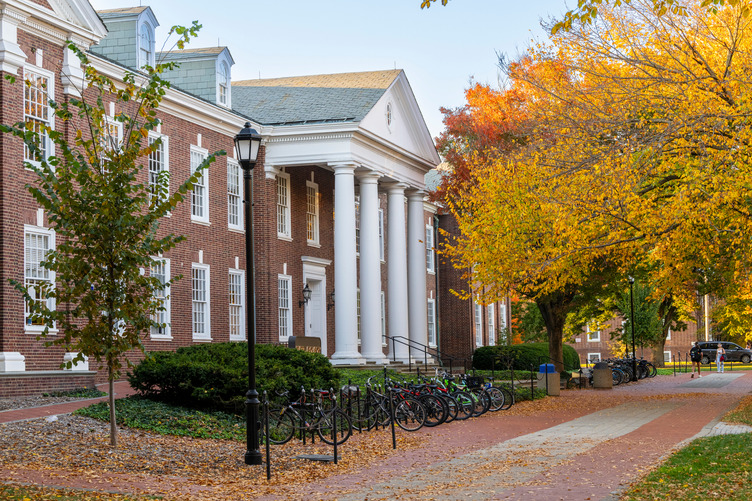

Kyle Davis wins NSF CAREER Award for pioneering research on climate-resilient food systems

Jun 24, 2025

2 min

Kyle Davis

University of Delaware assistant professor Kyle Davis has received a National Science Foundation (NSF) CAREER Award—one of the most competitive and prestigious honors for early-career faculty—for his work advancing the climate resilience of global food systems.


Davis, who holds joint appointments in the College of Earth, Ocean and Environment and the College of Agriculture and Natural Resources, leads cutting-edge research at the intersection of agriculture, sustainability and global environmental change. His focus? Making food production more efficient, climate-smart and socially equitable—especially in regions grappling with limited water resources.


With a growing global population and increasing pressure on land and water, Davis’s research is helping to answer one of the most critical questions of our time: How can we feed the world without destroying the planet?


His lab’s work recently led to the development of MIRCA-OS, a groundbreaking open-source dataset that offers high-resolution global data on irrigated and rain-fed croplands across 23 crop types. The tool, co-created with UD doctoral student Endalkachew Kebede and published in Nature Scientific Data, allows researchers, farmers and policymakers to assess how crop choices, rainfall and irrigation interact with water systems and food security.


Some of the thirstiest crops are grown in the most water-stressed areas Davis said. Shifting crop mixes to crops that require less water but still ensure farmer profits is a promising way to reduce the amount of water needed to irrigate crops and to avoid conditions of water scarcity.


Davis’s research spans continents, with active projects in the United States, India, China and Nigeria, where his team is exploring solutions to water scarcity, crop nutrition and agricultural sustainability. His work has appeared in Earth.com, Phys.org and major scientific journals. In 2023, he was recognized with the American Geophysical Union’s Global Environmental Change Early Career Award.


In addition to research, Davis is a dedicated mentor, guiding graduate students from around the world. “So much of my research is the result of their passion, abilities, drive and creativity,” Davis said.


Davis is available for interviews on topics including sustainable agriculture, water use, climate adaptation, food systems and the power of data science in global development. He can be contacted by clicking the "View Profile" button.

Connect with:
Kyle Davis

Kyle Davis

Assistant Professor, Geography and Spacial Sciences

Prof. Davis' work focuses on food systems, water sustainability, and global environmental change.

Human MigrationNutritionGlobal Environmental ChangeFood SystemsSustainability
Powered by

You might also like...

Check out some other posts from University of Delaware

Cultivating justice and joy through critical AI use in the K-12 Classroom featured image

3 min

Cultivating justice and joy through critical AI use in the K-12 Classroom

Inspired by her middle school social studies teacher, University of Delaware Associate Professor Stephanie Smith Budhai has always believed that a classroom should be a space where students feel valued and nurtured. As a seasoned educator, she has helped teachers create spaces using technology to assist students to meet learning outcomes, develop their skills and grow their confidence. Now, Budhai is mentoring overwhelmed teachers to reclaim the classroom as a nurturing environment for all students. Her book, "Critical AI in K-12 Classrooms: A Practical Guide for Cultivating Justice and Joy" with co-author Marie Heath of Loyola University Maryland, supports teachers and students as they navigate the complicated interactions of AI, education and justice. Budhai answered pressing questions about the already popular book. How would you describe the central message or takeaway of this book? "I believe that classrooms should be joyous spaces where all students feel heard, valued, seen and loved. Dealing with powerful technologies that exacerbates the biases and harms of society such as AI can impact teachers’ ability to nurture such spaces. Thus, this book was written to provide a practical guide for teachers and students as they navigate the complicated interactions of AI, education and justice. It is our duty as educators not to dismiss the technology altogether, but to help teachers take a critical lens, as they use AI for teaching and learning." What inspired you to pursue this line of research? "Before writing this book, I had already published 8 books and over 80 practitioner articles around technology, equity, teacher education and leadership. There had been other books that were quickly published about AI, but none focused on the harms of AI, how teachers could come to understand how AI really works and use it in ways that do not harm students." What are some of the key ways that K-12 teachers can cultivate justice and joy through AI? "In the book, we have many examples of how to cultivate justice and joy. For example, in chapter 3, we provide strategies for teachers to build an equity-mindset while supporting students in developing a critical consciousness around AI technologies, which are inherently biased. In chapters 4 and 5, we provide framing for using culturally-sustaining, abolitionist and fugitive pedagogies in designing curricula and learning activities that include the just use of AI technologies. And, in chapter 6, we provide teachers with myriad personal, professional, pedagogical and participatory actions they can take when using AI for teaching and learning." How could this work impact schools, teacher education programs and the broader public? "This work was created to support K-12 teachers, and many teachers have already shared how it has impacted them. K-12 teachers can immediately put the strategies and learning activities that we suggest in the book to use. We also situate AI in longer histories of technology injustice and provide accessible content on understanding how AI works through a critical algorithmic literacy perspective. Teacher education programs can use this work as they prepare teachers to navigate the complicated intersections of teaching, AI and justice. For the broader public, we also include content on justice-centered community activities and projects that are focused on critical AI." About Stephanie Smith Budhai Stephanie Smith Budhai is an associate professor in UD’s College of Education and Human Development, specializing in educational technology. Her interdisciplinary research and practice lies at the intersections of technology, equity and civic engagement, across myriad K-16 settings. She has published 10 books on teaching and digital technologies. Among other professional appointments, she serves as the Chair of the Information Technology Council for the Society for Information Technology and Teacher Education and is on the Board of Directors for the Civics of Technology. To speak with Smith further about AI in K-12 education, reach out to MediaRelations@udel.edu.

Energy expert: Venezuela’s oil, U.S. energy security and the future of the Caribbean featured image

2 min

Energy expert: Venezuela’s oil, U.S. energy security and the future of the Caribbean

Venezuela’s enormous oil reserves have long been central to its economic development and geopolitical importance in the Western Hemisphere and globally. Efforts by the United States to gain greater access to Venezuelan oil supply could have major consequences for both countries, says the University of Delaware’s Kalim Shah. Shah, associate professor of energy and environmental policy, studies energy security, energy policy and governance, with a particular focus on the Caribbean and other energy-producing regions. Venezuela has some of the world’s largest oil reserves, but years of political interference, underinvestment deteriorating infrastructure and expropriation of foreign assets under the Chavez-Maduro socialist model have severely reduced its production capacity, Shah says. Rebuilding the industry will require substantial investment from U.S. and other international energy companies. Shah can discuss: • U.S. energy security: How greater access to Venezuelan oil could provide an additional source of supply during future global disruptions and serve as an “energy shock absorber.” • Gas prices: Why increased Venezuelan production is unlikely to produce an immediate, dramatic reduction in U.S. gasoline prices. • Caribbean geopolitics: How energy resources can shape U.S. influence and relationships throughout the Caribbean and Western Hemisphere. • Venezuela’s recovery: How rebuilding the country’s oil industry can generate jobs, government revenue, infrastructure investment and broader economic recovery. • Energy governance: The importance of transparent contracts, regulation and revenue management in ensuring that energy development benefits Venezuela while protecting international investors. • The energy transition: The long-term risks and opportunities of investing in major oil resources as global energy systems increasingly move toward lower-carbon sources. • U.S. companies: The role American energy companies can play in rebuilding Venezuela’s oil industry, and the opportunities and risks that could come with greater U.S. investment. To reach Shah directly and arrange an interview, visit his profile page and click on the "connect" button. Interested reporters can also send an email to MediaRelations@udel.edu.

Why Dolly Parton’s intersectional philanthropy keeps making headlines featured image

1 min

Why Dolly Parton’s intersectional philanthropy keeps making headlines

Dolly Parton’s generosity keeps showing up in the news because it feels both big and deeply personal. Her charitable work, especially around literacy, education and community support, connects to real-life needs that people understand right away, all while being a big part of her own intersectional identity. That makes her philanthropy easy to notice and even easier to care about. Jennifer Naccarelli is chair of the Department of Women & Gender Studies here at the University of Delaware and the founding director of the Center for Study & Prevention of Gender Based Violence. On Dolly Parton's passing she said: "In practice, Dolly Parton's life is a case study in intersectionality: the various social identities that she encompassed and her interactions with various social structures led to her unique perspectives, lifelong commitments and magnificent catalog. While not an political activist, and hesitant to call herself a feminist, her work and religious identity informed her contributions to so many communities. She was an ally before that term entered the vernacular. It is truly a loss of a model human and great talent." To speak with Naccarelli about Parton and other feminist icons, email mediarelations@udel.edu.

View all posts