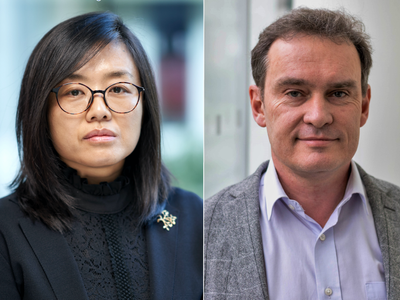

From circular supply chains to global sustainability leadership: How Dr Luciano Batista is shaping the future of the circular economy

Nov 27, 2025

2 min

Dr Luciano Batista

When it comes to transforming how organisations produce, consume, and reuse resources, Dr Luciano Batista, professor of operations management at Aston University, is a global pioneer. His research sits at the crossroads of innovation, digital transformation, and sustainability, tackling one of humanity’s most pressing challenges: our overconsumption of the planet’s resources.


Reimagining the economy around renewal


Dr Batista’s work focuses on circular supply chains —a model he helped establish at a time when 'closed-loop' systems dominated sustainability thinking. His early research laid the foundation for how businesses could move beyond recycling and linear take-make-dispose models, instead designing systems that reuse, restore, and regenerate. 


View his profile here


From theoretical frameworks to real-world applications, his studies—such as comparative analyses of circular systems implemented by Tetra Pak in China and Brazil—demonstrate the measurable economic and environmental benefits of circularity in action.


His 2022 Emerald Literati Award-winning paper introduced a methodology for mapping sustainable alternatives in food supply chains, earning international recognition for its real-world impact.


A global voice for industrial symbiosis and circular innovation


The influence of Dr Batista’s work reaches far beyond academia. He has advised the European Commission’s Circular Cities and Regions Initiative (CCRI) and contributed insights to policymakers through the UK All-Party Parliamentary Manufacturing Group. His expertise continues to inform national and regional strategies for sustainable production and industrial symbiosis —where one company’s waste becomes another’s resource.


Today, he extends that impact globally as a visiting professor at the Massachusetts Institute of Technology (MIT), conducting research at the MIT Center for Transportation & Logistics on circular supply chain innovations, supported by Aston University’s study-leave programme. He also mentors future leaders in sustainability as part of Cambridge University’s Institute for Sustainability Leadership (CISL).


Driving the next wave of sustainable transformation


Looking ahead, Dr Batista is spearheading collaborations through Aston’s Centre for Circular Economy & Advanced Sustainability (CEAS), working with the Energy & Bioproducts Research Institute (EBRI) and West Midlands Combined Authority (WMCA) on projects developing biochar-based clean energy systems for urban districts.


He is also advancing the social dimension of the circular economy—ensuring that the move toward sustainable production is inclusive and equitable. His Symposium on the Socially Inclusive Circular Economy, held at the 2025 Academy of Management Conference, has sparked new international research partnerships with Monash University (Australia) and the Vienna University of Economics and Business.


A vision for a regenerative future


At the heart of Dr Batista’s work is a simple but urgent truth: humanity is consuming resources at a rate our planet cannot sustain. Through his research and global collaborations, he is helping organisations, policymakers, and communities move toward a future where growth and sustainability coexist.


“The transition to a circular economy is not optional—it is essential,” says Dr Batista. “Our goal must be to redesign systems that allow people, businesses, and ecosystems to thrive together.”
Connect with:
Dr Luciano Batista

Dr Luciano Batista

Reader (Associate Professor), Sustainable Operations & Supply Chain Management

Dr Batista specializes in circular economy approaches, technologies and business innovations across industrial sectors, regions and nations.

Circular Economy Strategies and ApproachesCircular Business Model InnovationsCircular Supply Chain DesignIndustrial SymbiosisSustainable Operations Management
Powered by

You might also like...

Check out some other posts from Aston University

Why disaster recovery in the Himalayas needs a rethink featured image

3 min

Why disaster recovery in the Himalayas needs a rethink

After five weeks of fieldwork across Nepal, Bhutan and Northwest India, Aston University researcher Dr Komal Raj Aryal is calling for a more locally grounded approach to resilience and post-disaster recovery in one of the world’s most hazard-prone regions. What happens after the headlines fade from a disaster? That question sits at the heart of new field research led by Dr Komal Raj Aryal, Lecturer in Crisis and Disaster Management at Aston Business School. After returning from a five-week research visit across Nepal, Bhutan and Northwest India, Dr Aryal says the evidence points to a troubling reality: many communities remain highly vulnerable long after major recovery programmes are supposed to have helped them rebuild. The trip brought together field visits, stakeholder consultations and community observations linked to ongoing UKRI, NERC and ISPF-supported research on earthquake risk, disaster governance, resilience and post-disaster recovery in the Himalayan region. The aim was not only to understand current conditions, but to ask why repeated losses continue despite years of international development assistance, scientific research and investment. Across the region, the research found that resilience is being undermined by a combination of persistent governance challenges, fragmented institutions, weak local preparedness systems, livelihood insecurity and mounting environmental pressures. In other words, recovery is not simply about rebuilding infrastructure; it is about whether communities are genuinely better equipped to cope with the next shock. This challenge is especially striking in places still living with the legacy of the 2015 Nepal earthquakes, where long-term vulnerabilities remain visible despite the scale of international support directed towards recovery and reconstruction. Reflecting on his findings, Dr Aryal said: “One of the most striking observations from the field is that many communities affected by the 2015 Nepal Earthquakes continue to face similar vulnerabilities today, despite significant international support allocated for recovery and reconstruction. This raises important questions about how disaster recovery is planned, implemented, and sustained over time.” The fieldwork also highlighted the growing complexity of future disaster risks in the Himalayas. Large-scale earthquakes do not exist in isolation; they interact with environmental degradation, cascading hazards, climate-related stresses and rapid urbanisation in fragile mountain settings. He added: “The Himalayan region is entering a period of growing uncertainty where environmental change, socio-economic inequality, weak governance systems, and seismic risks are becoming increasingly interconnected. There is an urgent need to rethink conventional development approaches and invest more seriously in locally grounded, community-centred resilience strategies.” For Aston University, this work reflects a broader commitment to international research on disaster risk reduction, resilience governance and humanitarian response across South Asia. Aston researchers are working with government agencies, local authorities, universities, emergency responders and humanitarian organisations to strengthen evidence-based approaches to preparedness and recovery. The findings feed into wider international debates about sustainable development, climate resilience, risk communication and the future of disaster governance in vulnerable mountain regions. They also underline the importance of moving beyond short-term recovery models towards approaches that are participatory, practical and rooted in local knowledge. Dr Aryal’s research emphasises the value of integrating community knowledge, participatory governance, youth engagement and long-term livelihood security into resilience planning. As future collaborations and policy discussions develop, these themes are likely to be central to how the region prepares for the risks ahead. The recent fieldwork is expected to inform future international research partnerships, policy dialogue and resilience-focused initiatives between the UK and South Asian partners.


Aston University economists say Prime Minister can reduce UK trade vulnerability with China visit featured image

2 min

Aston University economists say Prime Minister can reduce UK trade vulnerability with China visit

Greenland episode exposed UK’s lack of effective response to economic coercion from allies Research shows tariff retaliation would have cost the average UK household up to £324 per year Economists say China visit is “portfolio risk management” – diversification reduces vulnerability. The Prime Minister’s visit to China – the first by a British PM since 2018 – is an opportunity to reduce the UK’s vulnerability to economic coercion, according to new research from Aston University. A policy paper from Aston Business School’s Centre for Business Prosperity analyses the January 2026 Greenland tariff episode, when President Trump threatened and then withdrew tariffs on eight European countries. The researchers found that the UK had no good options: retaliation would have made Britain worse off, while absorbing the tariffs left Europe without credible deterrence. Director of the centre for business prosperity, Professor Jun Du, said: “The Greenland episode was a wake-up call. When your principal security ally threatens economic coercion, the old assumptions about who is safe and who is dangerous no longer hold. “The PM’s China visit should be framed as portfolio risk management – building diversified trading relationships that reduce the UK’s exposure to any single partner. Just as investors don’t put all their money in one stock, countries shouldn’t put all their trade into one basket. A UK with multiple strong partnerships is harder to pressure, whether the pressure comes from Washington or Beijing.” The research found that coordinated UK–EU tariff retaliation would have cost British households up to £324 per year – the worst outcome modelled. But the authors argue that Europe has untapped leverage elsewhere: the US runs a €148 billion annual services surplus with the EU, and mutual investment exceeds €5.3 trillion. Associate professor of economics and co-author, Dr Oleksandr Shepotylo, said: “Tariff retaliation fails because it hurts consumers and distorts the economy – the retaliator suffers similarly to the target. But Europe has cards it isn’t playing. Services, investment screening, and regulatory access are pressure points where Europe can respond effectively.” UK exports to China fell by 10.4% in the year to Q2 2025, with goods exports down 23.1% – the sharpest decline among major trading partners. The researchers argue that this closes off the UK’s largest alternative market at precisely the moment US reliability is in question. The paper identifies three priorities for UK policy: Recognise the permanent incentives behind US tariffs. US tariff revenue hit $264 billion in 2025. Trade negotiations alone cannot resolve revenue-driven policy. Build UK–EU coordination on non-tariff instruments. Services, investment, procurement, and regulation offer leverage that tariffs do not. Treat China engagement as portfolio risk management. Concentration in any single market creates vulnerability. Diversification is not about picking sides – it’s about resilience. Professor Du added: “The question for the Prime Minister is whether to use this breathing space to build resilience – or wait for the next Greenland.” To read the policy paper in full, click on this link:

Medication adherence: Why it matters and how we can improve it – public lecture by Professor Ian Maidment featured image

2 min

Medication adherence: Why it matters and how we can improve it – public lecture by Professor Ian Maidment

Professor Ian Maidment is a professor in clinical pharmacy at Aston Pharmacy School His inaugural lecture will explain why patients struggle with taking medication and present possible solutions to the problem Professor Maidment is a former practising pharmacist and an expert in medication optimisation and management in mental health and dementia. Professor Ian Maidment, professor in clinical pharmacy at Aston Pharmacy School, will give a public lecture about his life’s work on 5 February 2025. In his inaugural lecture, Professor Maidment will reflect on his journey from a childhood in Kent to becoming a leading researcher in clinical pharmacy. After more than two decades working in the NHS, in community pharmacy, mental health, dementia care, and leadership roles, he joined Aston University in 2012. His research focuses on the real-world challenges of medication optimisation for patients, carers, and healthcare professionals. The title of Professor Maidment’s lecture is ‘Medication adherence: Why it matters and how we can improve it’. Every year, the UK spends nearly £21 billion on medicines. Yet up to half of people with long-term conditions do not take their medication as prescribed—a problem known as non-adherence. This has profound clinical consequences and significant financial implications for the NHS. Professor Maidment will draw on his experience to explore how factors such as medication burden and side-effects influence adherence, the challenges posed by conditions such as dementia and severe mental illness, the role of pharmacy in supporting adherence and why tackling non-adherence requires a system-wide approach. He will also offer practical solutions to one of healthcare’s most persistent problems. Professor Maidment said: “We need to understand why patients struggle to take their medication and then develop and test solutions that work well.” The lecture on Thursday 5 February 2026 will take place at Aston Business School. In-person tickets are available from Eventbrite. The public lecture will begin at 18:00 GMT with refreshments served from 17:30 GMT. It is free of charge and will be followed by a drinks reception. The lecture will also be streamed online.

View all posts