Personality matters: the tie between language and how well your video content performs

Mar 8, 2021

2 min

Rajiv Garg

Why does one piece of online video content perform better than another? Does it come down to its relevance, production values, and posting and sharing strategies? Or are other dynamics at play?


There are plenty of theories about what, when and how to post if you want to drive the performance of your video. But new research by Goizueta’s Rajiv Garg, associate professor of information systems and operations management, sheds empirical and highly nuanced new light on the type of language to inject in a content if you really want to accelerate consumption. And it turns out that a lot of it depends on personality.


Together with Haris Krijestorac of HEC Paris and McCombs’ Maytal Saar-Tsechansky, Garg has run a large-scale study, analyzing the words spoken and used in speech-heavy videos posted to YouTube, and then organizing those words by personality – how they “score” in terms of the so-called Big Five personality traits.

“The Big Five is a system or taxonomy that has been used by psychologists and others since the 1980s to organize different types of personality traits. These traits are extroversion, agreeableness, openness, conscientiousness, and neuroticism,” says Garg.


“In previous research into video content performance, we’ve looked into mechanisms such as posting and re-posting on different channels and how they impact the virality of one video over another. But we were intrigued by the role of language and how different words map to these personality traits, which in turn might have an impact on user emotion or response.”


Emory has this entire comprehensive article that includes more details on the Big Five and it is available for reading here:


If you are a journalist looking to cover this topic – then let our experts help with your story. Rajiv Garg from Emory’s Goizueta Business School is available to speak with media – simply click on his icon now to arrange an interview today.


Connect with:
Rajiv Garg

Rajiv Garg

Associate Professor of Information Systems & Operations Management

Expert on AI, Digital Strategy, and the Economics of Human–Machine Interaction

Artificial Intelligence (AI) for HumanitiesEconomics of InformationSocial MediaDigital MarketingMobile Economy
Powered by

You might also like...

Check out some other posts from Emory University, Goizueta Business School

Why Negative Political Ads Work -  And When They Backfire featured image

2 min

Why Negative Political Ads Work - And When They Backfire

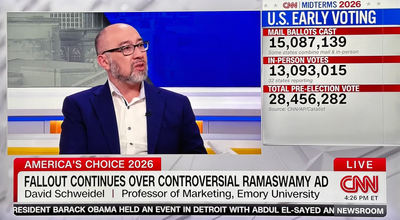
With the U.S. midterm elections approaching, political campaigns are increasingly turning to negative advertising, emotional appeals and artificial intelligence to influence voters. But how effective are these tactics, and when might they do more harm than good? David Schweidel, Professor of Marketing and Roberto C. Goizueta Professor in Business Technology at Emory University's Goizueta Business School, joined CNN Newsroom anchor Fredricka Whitfield on October 25 to examine the psychology behind political attack ads and the growing influence of AI-generated campaign content. View his profile Schweidel, whose research includes political marketing, consumer behaviour and digital advertising, explained why negative messages often have a greater impact on voters than positive campaign advertising. The Power of Negative Advertising Research suggests that advertisements designed to provoke fear or anger can be particularly effective at capturing attention, influencing voter preferences and motivating people to cast their ballots. As Schweidel explained during the CNN interview: "That's what the research has shown, that negative ads tend to stick with people longer than positive ads, getting them more likely to show up at the polls. So increasing voter turnout and moving the needle when it comes to share of the vote." However, the effectiveness of negative advertising comes with risks. Campaigns that push emotional messaging too far may alienate the very voters they hope to persuade. Schweidel noted that economic frustrations, including rising costs for groceries, health care and gasoline, have created an environment in which political campaigns are eager to capitalize on voter anger. AI Adds a New Dimension The conversation also explored the increasing use of artificial intelligence in political advertising, particularly the ability to create realistic images and messages that may mislead audiences. Schweidel warned that voters who encounter these advertisements casually may not take the time to verify their accuracy. Even brief exposure to misleading content can leave a lasting impression, particularly when subsequent advertisements reinforce the same message. The emergence of AI-generated political advertising raises important questions about transparency, authenticity and the ability of voters to distinguish legitimate campaign messages from manipulated content. An Expert Perspective for Election Coverage As campaigns intensify ahead of Election Day, Schweidel's research offers valuable insight into why political advertisements resonate with voters, how emotional appeals influence political behaviour and the implications of AI for election communications. His expertise spans political marketing, artificial intelligence, social media analytics and consumer behaviour, making him a valuable resource for journalists examining the changing landscape of political advertising. David Schweidel is available to speak with media about negative political advertising, voter psychology, AI-generated campaign content and the effectiveness of political messaging. To arrange an interview or connect with David Schweidel, click on his profile below.


Why Negative Campaign Ads Work: David Schweidel on the Psychology Driving This Election Cycle featured image

2 min

Why Negative Campaign Ads Work: David Schweidel on the Psychology Driving This Election Cycle

As the 2026 Senate races heat up, negative campaign ads are once again dominating the airwaves. David Schweidel, Professor of Marketing and the Roberto C. Goizueta Professor in Business Technology at Emory's Goizueta Business School, has researched political advertising for years and is currently tracking the 2026 Senate races. Asked why negative campaigns tend to outperform positive ones, Schweidel points to what sticks with voters: "It's those negative messages. It's those attack messages," often fear- or anger-based, that he says are "more arousing to us" and "tends to move the needle more so than positive advertising." Where an ad comes from matters too. Schweidel's research looks at whether messaging originates from the candidate directly or from third parties like PACs or political parties, and he's found that candidate-sourced messaging tends to be more believable, "coming from a human brand," in his words, rather than an unfamiliar political organization. His current research pushes this further, into how political advertising shapes what AI chatbots tell voters. Schweidel notes that where news coverage and social media once drove poll movement, more voters are now turning to AI chatbots for candidate information. Using Maine Senate candidate Graham Platner as an example, he explains that recent news coverage and online conversation about a candidate gets absorbed by these chatbots, ultimately shaping what's presented to a voter asking about that candidate. For campaigns and advertisers, Schweidel frames this as a new channel to understand, similar to how companies already monitor social media conversation, and predicts political campaigns will start actively tracking how their candidates are portrayed in AI responses, the same way many companies now treat AI presence the way they once treated search engine optimization: "What a lot of companies are trying to come up with now is what is the playbook to do the same thing for AI." Dr. Schweidel is an expert in marketing technology, AI, social media, political marketing, and customer analytics. He holds a PhD in Marketing from the Wharton School of the University of Pennsylvania and is the author of Social Media Intelligence and Profiting from the Data Economy. His research has appeared in the Journal of Marketing, Journal of Marketing Research, Marketing Science, and Management Science, and he has been recognized as a Marketing Science Institute Young Scholar and named to Poets & Quants' "Top 40 Under 40." Dr. Schweidel is available to discuss: Why are negative campaign ads more effective than positive ads? Why do negative emotions drive people to vote, donate, and campaign, more than positive emotions? The connection between AI and campaign ads How organizations make explicit decisions to exploit these trends Click on the connect button in his profile below. 

World Cup 2026: The Business Behind the Game featured image

1 min

World Cup 2026: The Business Behind the Game

As the 2026 FIFA World Cup unfolds across North America, Emory University’s Goizueta Business School experts are available to help media explore the business stories behind the world’s biggest sporting event, from the economics of hosting and ticket pricing to global sponsorship, player brands and the psychology of fandom. Goizueta’s World Cup 2026 Business Hub brings together faculty who can provide timely, research-backed commentary on the commercial, cultural and consumer forces shaping the tournament as it moves from match to match, city to city and story to story. Featured Topics The Economics of Hosting Infrastructure investment, tourism revenue, real estate, local labor markets and the broader financial impact of hosting World Cup matches. The Science of Fandom What drives global fan devotion, audience loyalty and engagement across stadiums, broadcasts and digital platforms. Ticket Pricing and Demand Dynamic pricing, hospitality packages, travel costs and how extraordinary demand shapes the fan experience at major global events. Brand Strategy and Global Sponsorship How companies evaluate World Cup sponsorships, build global campaigns and measure the return on major sports partnerships. The Rise of the Player Brand How star footballers build, extend and monetize personal brands that reach far beyond the pitch. Media can visit Goizueta’s World Cup 2026 Business Hub to explore available experts and connect directly with the right source for their story.

+1
View all posts