Expert Insight: The Voice of Alexa: How Speech Characteristics Impact Consumer Decisions

May 28, 2023

5 min

Rajiv Garg

In the 2020 film “Superintelligence,” an all-powerful artificial intelligence attempts to take over the world, and it studies an average person, played by Melissa McCarthy, to decide if humanity is worth saving. The AI is voiced by James Corden—a voice it chooses because it knows it’s one McCarthy’s character will engage with.


Rajiv Garg, associate professor of Information Systems & Operations Management at Emory’s Goizueta Business School, shows the “Superintelligence” trailer before his research presentations to set the tone. Garg conducts research that explores the impact of artificial intelligence voices on consumer behavior and purchase intent, along with Haris Krijestorac, a professor at HEC Paris, and Vijay Mahajan, a professor from The University of Texas at Austin.


Garg’s research began when Amazon launched celebrity voices for its Alexa device in 2019. From Samuel L. Jackson to Shaquille O’Neal, users can now get their news and entertainment, while interacting with their favorite superstars.


“I questioned if certain voices could get more engagement or more purchases from consumers,” Garg says.


If Alexa starts talking to you in Samuel L. Jackson’s voice, will you continue the conversation? What could Samuel L. Jackson’s voice sell you that you would buy?  

Garg and his team began their research by collecting more than 300 celebrity voice samples, which they analyzed based on their sound characteristics, such as amplitude, frequency, and entropy. They looked at 20 sound characteristics and identified that all the voices could be segmented into six clusters: ostentatious, colloquial, friendly, authoritative, seductive, and suave.


The team then created advertisements for select products using computer generated voices for each of the six clusters, opting for artificial intelligence-created speech instead of celebrity deep fakes due to permission legalities.


They chose a shoe and an office chair as their products, and created two different advertisements for each product. One ad was simple, denoting the shoe as comfortable for all-day wear and the office chair as comfortable for sitting in for extended time periods. The other ad was hedonic, denoting the shoe as crafted with Italian leather and the office chair equipped with several massage features. They recorded the four advertisements using both a female and male voice for all six voice clusters.


Study participants listened to each of the four advertisements in one of the 12 voices, which was randomly selected. After the advertisement was played, participants were asked if they wanted more information, and later, if they wanted to buy the product (omitting the price as to not add another factor to their decision making).


Influencing Consumer Behavior


For simple, utilitarian products, they found no significant effect of voice on information seeking behavior. Garg says once participants hear this type of advertisement, they simply decide to purchase or move on.


Participants do, however, engage more in information seeking behavior for hedonic products when the voice is ostentatious, seductive, or authoritative. The team also found men were more likely than women to engage with ostentatious or seductive voices, and women were more likely to engage with friendly or colloquial voices.


Overall, they found participants did not seek information with male voices.


For information seeking, men and women only engage if the voices are female, which is somewhat intuitive. The industry is doing this—Alexa, Google, and Siri all have a female voice.


In terms of purchase intention, they found ostentatious voices have higher yields for utilitarian products. Men, especially, were more likely than women to purchase a utilitarian product advertised in an ostentatious voice.


Think about advertising a stapler. It’s a stapler—it staples paper—but you advertise it in a French accent to make it sound interesting.


Conversely, for hedonic products, an ostentatious voice has a negative effect on purchase intent because Garg says it can make the product sound gimmicky. Their research shows colloquial voices do the best here because people focus more on the advertisement’s content.


Across the board, they found seductive voices have a negative effect on purchase intent, but more so on utilitarian products compared to hedonic ones. Men were more likely than women to respond positively to seductive and suave voices.


Applying the results


Voices are another way smart device companies can personalize their customers’ experiences. Garg says these companies should be aware that there may be a certain voice that will garner the best engagement.


Their findings are not isolated to business, but may apply to other industries, such as the media. Garg says, for example, if publications intend to increase reader curiosity and engagement, they should use a female colloquial voice on “click to listen” features.


Although not yet tested, Garg says he wouldn’t be surprised if their results extend to real-world settings with real human voices as well.


During their research, Garg’s team asked participants if they had heard the advertisement voices before, and about 15 percent of respondents says they had.


"These were voices we’d created for the first time,” Garg says. “If they say they’ve heard the voice before, that means they were thinking of them as human voices. Although we didn’t study it that way, I do believe what we’re seeing will be relevant for actual human being’s voices and interactions.”


Having researched this for years, Garg says every time he listens to a voice, whether a customer service representative or podcast host, he questions whether or not it is impacting his behavior.


A lot of times when I’m making a decision, I know that I’m making that decision passively because of the voice.


“I’m acting 50 percent based on the rational information in the voice, but the other 50 percent I just want to listen more. There is an inherent desire for a certain voice.”


Garg says his favorite part of the research are those “aha moments,” whether they be the influence of voice in his own life or in the industry—such as large companies using female voices in their products to draw engagement.


He says he hopes to continue doing this kind of research to help startups and other companies perform better, as AI-powered voices continue to change the way people interact with technology and consume information.


“We’re finding these interesting phenomena that can help create new products that are more effective,” Garg says. “I am trying to increase the economic surplus, in some ways to improve society, and this technology presents numerous opportunities.”


Looking to know more?  Rajiv Garg from Emory’s Goizueta Business School is available to speak with media – simply click on his icon now to arrange an interview today.




Connect with:
Rajiv Garg

Rajiv Garg

Associate Professor of Information Systems & Operations Management

Expert on AI, Digital Strategy, and the Economics of Human–Machine Interaction

Artificial Intelligence (AI) for HumanitiesEconomics of InformationSocial MediaDigital MarketingMobile Economy
Powered by

You might also like...

Check out some other posts from Emory University, Goizueta Business School

GTA VI Isn't Just a Video Game. It's a Cultural and Economic Juggernaut. featured image

2 min

GTA VI Isn't Just a Video Game. It's a Cultural and Economic Juggernaut.

After more than a decade of anticipation, Grand Theft Auto VI has finally arrived, and gamers around the world are celebrating one of the biggest entertainment launches in history. As media across the planet are reporting, fans across the globe are diving into the latest installment of the enormously popular franchise, turning its release into an international cultural event. But the real story may be much bigger than the game itself. Michael Lewis, Professor of Marketing at Emory University's Goizueta Business School, studies fandom, consumer behaviour and the economics of entertainment. He believes the GTA VI launch offers a remarkable illustration of how video games are transforming both the entertainment business and the cultural experiences that connect generations. View his profile Covering? We can help. Lewis offers several compelling perspectives for journalists covering the launch: A multibillion-dollar opening act: Estimates for GTA VI's first-week revenue range from approximately $3 billion to more than $5 billion, placing the launch among the most significant commercial events in entertainment history. Rivaling the world's biggest entertainment properties: Projections of approximately $15 billion in lifetime revenue put GTA VI in extraordinary company. Lewis compares that potential with estimated revenues of $9 billion to $11 billion associated with the 2026 FIFA World Cup, illustrating the enormous commercial scale gaming has achieved. The changing face of fandom: Sports, movies and music have traditionally dominated popular culture. Gaming is increasingly competing for that same attention, loyalty and emotional investment, particularly among younger generations. A new cultural language for Gen Z: Understanding today's youth culture may require greater familiarity with Minecraft and Fortnite than with the latest Hollywood blockbuster. Gaming experiences are becoming central to how younger audiences connect, communicate and identify with popular culture. When entertainment worlds transcend categories: Lewis sees the rise of shared narrative universes, where characters and fictional settings move between video games, scripted entertainment and consumer products. In this evolving cultural landscape, GTA characters Lucia Caminos and Jason Duval could become recognizable reference points alongside Spider-Man, Darth Vader, Indiana Jones and Taylor Swift. The bigger question is no longer whether video games can compete with Hollywood or professional sports. It's whether gaming is becoming one of the defining cultural forces of a generation. For journalists exploring GTA VI's economic impact, the changing nature of fandom, Gen Z consumer behavior or the future of entertainment, Lewis offers a research-driven perspective on a story that extends well beyond the gaming industry. To arrange an interview or connect with Michael Lewis, see his ExpertFile profile below.

Inside the Holiday Season: Goizueta Experts on Spending, AI and Scams featured image

1 min

Inside the Holiday Season: Goizueta Experts on Spending, AI and Scams

As the holiday season ramps up, Emory University’s Goizueta Business School experts are available to help media unpack the stories behind the shopping, from tariffs and Black Friday pricing to AI gift guides and the psychology of giving. Goizueta’s Holiday Experts Hub brings together economists, marketers and consumer psychology researchers who can provide timely insight into the economic, behavioral and technological forces shaping how consumers spend and how retailers respond. Featured Topics The Holiday Economy: Spending, Prices and Retail Expectations How tariffs, affordability and consumer confidence are shaping holiday budgets, Black Friday deals and retailers’ fourth-quarter expectations. The Psychology of Holiday Shopping: Gifts, Pressure and Purpose Why we spend more than we intend, what makes a gift meaningful, and how stress, scarcity and promotional pressure shape what ends up in the cart. AI and the Future of Holiday Shopping How AI shopping assistants and gift guides are changing the way consumers find products and retailers personalize the experience, and how much those recommendations can be trusted. The Hidden Risks and Costs of Holiday Shopping Why AI-powered scams are getting harder to spot, and how the surge in online returns is creating costly challenges for retailers. Media can visit Goizueta’s Holiday Experts Hub to explore available experts and connect directly with the right source for their story.

Why Negative Political Ads Work -  And When They Backfire featured image

2 min

Why Negative Political Ads Work - And When They Backfire

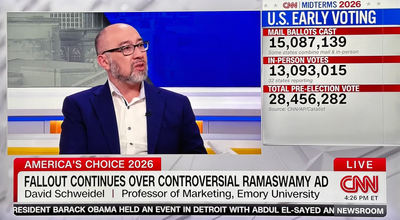
With the U.S. midterm elections approaching, political campaigns are increasingly turning to negative advertising, emotional appeals and artificial intelligence to influence voters. But how effective are these tactics, and when might they do more harm than good? David Schweidel, Professor of Marketing and Roberto C. Goizueta Professor in Business Technology at Emory University's Goizueta Business School, joined CNN Newsroom anchor Fredricka Whitfield on October 25 to examine the psychology behind political attack ads and the growing influence of AI-generated campaign content. View his profile Schweidel, whose research includes political marketing, consumer behaviour and digital advertising, explained why negative messages often have a greater impact on voters than positive campaign advertising. The Power of Negative Advertising Research suggests that advertisements designed to provoke fear or anger can be particularly effective at capturing attention, influencing voter preferences and motivating people to cast their ballots. As Schweidel explained during the CNN interview: "That's what the research has shown, that negative ads tend to stick with people longer than positive ads, getting them more likely to show up at the polls. So increasing voter turnout and moving the needle when it comes to share of the vote." However, the effectiveness of negative advertising comes with risks. Campaigns that push emotional messaging too far may alienate the very voters they hope to persuade. Schweidel noted that economic frustrations, including rising costs for groceries, health care and gasoline, have created an environment in which political campaigns are eager to capitalize on voter anger. AI Adds a New Dimension The conversation also explored the increasing use of artificial intelligence in political advertising, particularly the ability to create realistic images and messages that may mislead audiences. Schweidel warned that voters who encounter these advertisements casually may not take the time to verify their accuracy. Even brief exposure to misleading content can leave a lasting impression, particularly when subsequent advertisements reinforce the same message. The emergence of AI-generated political advertising raises important questions about transparency, authenticity and the ability of voters to distinguish legitimate campaign messages from manipulated content. An Expert Perspective for Election Coverage As campaigns intensify ahead of Election Day, Schweidel's research offers valuable insight into why political advertisements resonate with voters, how emotional appeals influence political behaviour and the implications of AI for election communications. His expertise spans political marketing, artificial intelligence, social media analytics and consumer behaviour, making him a valuable resource for journalists examining the changing landscape of political advertising. David Schweidel is available to speak with media about negative political advertising, voter psychology, AI-generated campaign content and the effectiveness of political messaging. To arrange an interview or connect with David Schweidel, click on his profile below.

View all posts