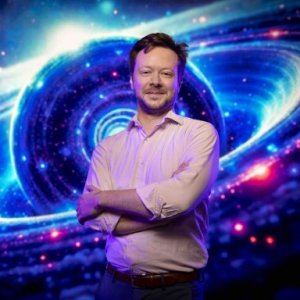
Dr Burns focuses on cosmic explosions - supernova, gamma-ray bursts, neutron star mergers, and magnetar giant flares. He utilizes data from NASA's satellite fleet in concert with Earth-based facilities including LIGO in order to probe fundamental questions of the universe. These include the first precise measurement of the speed of gravity, understanding where the heaviest elements like gold come from, and trying to break foundational theories in physics. He is currently one of a dozen scientists tasked with maturing NASA's Habitable Worlds Observatory concept towards a future launch, which will answer the question: are we alone?
Research Focus
High-Energy Transients & Gamma-Ray Bursts
Dr. Burns’s research focuses on high-energy transient astrophysical events—gamma-ray bursts, neutron-star mergers, and other multi-messenger phenomena that forge heavy elements like gold. He analyzes space-borne gamma-ray observations and multi-messenger datasets to uncover explosion mechanisms and trace the cosmic origins of the universe’s heaviest matter.
Spotlight
·
1 min
Dr. Eric Burns is a leading researcher in high-energy astrophysics, he studies neutron star mergers and gamma-ray bursts and helped lead the first multimessenger discovery of a binary neutron star merger.
"Given the vast size of the universe, most scientists think life beyond Earth likely exists, and we are actively searching for it. However, there is no credible evidence that extraterrestrials have visited Earth or made contact with humanity. Previous government reviews of UFO reports have not produced convincing proof of alien technology. Astronomers are terrible at keeping secrets — if even one of us had solid evidence of aliens, the entire world would know by lunchtime. I strongly support transparency and look forward to the release of additional information, but extraordinary claims require extraordinary evidence."
·
3 min
Black Hole Eats Star: NASA Missions Discover Record-Setting Blast Dr. Eric Burns, associate professor of Physics & Astronomy in LSU’s College of Science, leads a consortium that studies gamma-ray bursts (GRBs), including the July event that, because of its long duration, stands in a class by itself. Because opportunities to study such events are so rare, and because they may reveal new ways to create GRBs, astronomers are particularly excited about the July burst.
Burns discussed the discovery and the significance of this area of research.
Can you explain your interest in gamma-ray bursts, why they matter, and how they play into these new discoveries? "I run a consortium that studies gamma-ray bursts. These are the most luminous explosions in the universe, other than the Big Bang itself.
The consortium's been operating for almost 50 years. We've seen 15,000 gamma-ray bursts. We've used these sightings to understand the speed of gravity, where gold is created, and fundamental properties in the universe.
In July, we detected a gamma-ray burst that was longer than we've ever seen before. They're normally like 30 seconds long. This one was 8 hours. It was so long that we didn't believe it was a gamma-ray burst for a while."
What was your role in investigating this phenomenon? "The consortium I run helped find it and helped figure out where it was coming from. We put a bunch of telescopes on it to try and figure out what was happening and to understand what caused this event.
Normal gamma-ray bursts come from a massive star near the end of its life. The interior of the star collapses, and it forms a black hole. That black hole eats it from the inside out, and it launches this matter that's moving at basically the speed of light, and that produces your gamma-ray burst.
By chance, a colleague and I had written a paper earlier this year on what is the longest gamma-ray burst you could produce with this scenario. And the answer is 1,000 seconds. So we're pretty sure that what happened here was this: You have that massive star, but instead of its core becoming the black hole, instead you have a black hole that falls into it. Or they sort of fall into each other."
How was this long gamma-ray burst discovered? And what led to your involvement in studying it? "We have what’s called gamma-ray burst monitors. They're a version of a telescope, but they're not like a long tube that you use to see visible light with your eyes. They're actually crystals that detect when they are hit by a gamma ray by fluorescing and sending out light. And so we could detect them that way.
In the consortium I run, there are about a dozen of these gamma ray detectors. They're all on different satellites. Most of them are around Earth, but some of them are much further out in our solar system.
We've automated most of our processes. The spacecraft itself will detect this event and report it to the community. All of that happens in like 30 seconds. In this case, our satellite had four different triggers spread over eight hours, and a member of the community pointed out that these events were coming from the same general area in the sky.
So, even before the last trigger, within a couple hours, we realized, oh, there's something really long happening here that we haven't really seen before."
Full story available here.
·
5 min
BATON ROUGE – Since the Big Bang, the early universe had hydrogen, helium, and a scant amount of lithium. Later, some heavier elements, including iron, were forged in stars. But one of the biggest mysteries in astrophysics is: How did the first elements heavier than iron, such as gold, get created and distributed throughout the universe? A new answer has come from an unexpected place – magnetars.
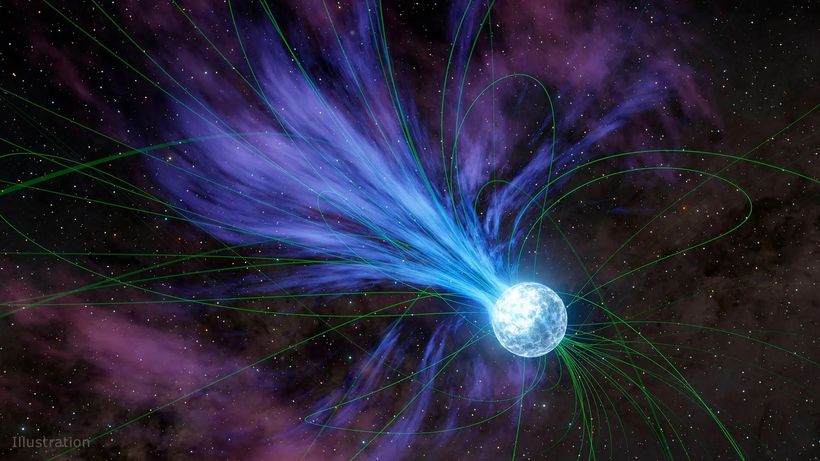
Neutron stars are the collapsed cores of stars that have exploded. They are so dense that one teaspoon of neutron star material, on Earth, would weigh as much as a billion tons. A magnetar is a neutron star with an extremely powerful magnetic field.
On rare occasions, magnetars release an enormous amount of high-energy radiation when they undergo “starquakes,” which, like earthquakes, fracture the neutron star’s crust. Starquakes may also be associated with powerful bursts of radiation called magnetar giant flares, which can even affect Earth’s atmosphere. Only three magnetar giant flares have been observed in the Milky Way and the nearby Large Magellanic Cloud, and seven from other nearby galaxies.
Astrophysicist Eric Burns and his team of researchers at Louisiana State University in Baton Rouge study magnetars extensively through the observation of gamma-rays. These are the most energetic photons, most famous for turning Bruce Banner into the Incredible Hulk.
Burns joined with researchers at Columbia University and other institutions to see if we could use gamma-rays to understand if magnetar giant flares forge the heaviest elements, and unexpectedly found the smoking-gun signature in decades-old data. The study, led by Anirudh Patel, a doctoral student at Columbia University in New York, is published in The Astrophysical Journal Letters.
“It’s answering one of the questions of the century and solving a mystery using archival data that people had just forgotten about, demonstrating something that occurred when the Universe was younger,” said Burns. “Giant flares should occur just after the first stars died, meaning we have identified what could be the origin of the first gold in the universe.”
How could gold be made at a magnetar? Patel and colleagues, including his advisor Brian Metzger, Professor at Columbia University and senior research scientist at the Flatiron Institute in New York, have been thinking about how radiation from giant flares could correspond to heavy elements forming there. This would happen through a “rapid process” of neutrons forging lighter atomic nuclei into heavier ones.
Protons define the element’s identity on the periodic table: hydrogen has 1 proton, helium has 2, lithium has 3, and so on. Atoms also have neutrons which do not affect identity, but do add mass. Sometimes when an atom captures an extra neutron the atom becomes unstable and a nuclear decay process happens that converts a neutron into a proton, moving the atom forward on the periodic table. This is how, for example, a gold atom could take on an extra neutron and then transform into mercury.
In the unique environment of a disrupted neutron star, in which the density of neutrons is extremely high, something even stranger happens: single atoms can rapidly capture so many neutrons that they undergo multiple decays, leading to the creation of a much heavier element like uranium.
When astronomers observed the collision of two neutron stars in 2017 using NASA telescopes and the gravitational wave observatory LIGO, they confirmed that this event could have created gold, platinum, and other heavy elements. “LIGO tells us there was a merger of compact objects, and Fermi tells us there was a short gamma-ray burst. Together, we know that what we observed was the merging of two neutron stars, dramatically confirming the relationship,” said Burns. But neutron star mergers happen too late in the universe’s history to explain the earliest gold and other heavy elements.
Finding secrets in old data At first, Metzger and colleagues thought that the easiest signature to study from the creation and distribution of heavy elements at a magnetar would appear in the visible and ultraviolet light, and published their predictions. But Burns in Louisiana wondered if there could be a gamma ray signal bright enough to be detected, too. He asked Metzger and Patel to work out what that signal could look like.
Burns looked up the gamma ray data from the last giant flare that was observed, which was in December 2004. He realized that while scientists had explained the beginning of the outburst, they had also identified a smaller signal from the magnetar, in data from ESA (European Space Agency)’s INTEGRAL, a retired mission with NASA contributions. “It was noted at the time, but nobody had any conception of what it could be,” Burns said.
Metzger remembers that Burns thought he and Patel were “pulling his leg” because the prediction from their team’s model so closely matched the mystery signal in the 2004 data. In other words, the gamma ray signal detected over 20 years ago corresponded to what thought it should look like when heavy elements are created and then distributed in a magnetar giant flare.
"This is my favorite discovery I've contributed to,” said Burns. “My colleagues found this signal in the past, but nobody knew what it could be at the time. Once these models were ready, everything fit like a perfect puzzle, which is extremely rare in science."
Researchers supported their conclusion using data from two NASA heliophysics missions: the retired RHESSI (Reuven Ramaty High Energy Solar Spectroscopic Imager) and the ongoing NASA Wind satellite, which had also observed the magnetar giant flare. Other collaborators on the new study included Jared Goldberg at the Flatiron Institute.
Next steps in the magnetar gold rush Patel’s study estimates that magnetar giant flares could contribute about 10% of the total abundance of elements heavier than iron in the galaxy. Since magnetars existed relatively early in the history of the universe, the first gold could have been created this way.
LSU PhD candidate Aaron Trigg, a NASA FINESST (Future Investigators in NASA Earth and Space Science and Technology) fellow, who works with Burns, is responsible for finding more magnetar giant flares to study. “These are gargantuan outbursts of energy from the strongest magnets in the Universe, which are powerful enough to affect Earth’s atmosphere,” said Burns. Trigg’s work will help us better understand these sources.”
NASA’s forthcoming COSI (Compton Spectrometer and Imager) mission can follow up on these results. COSI, a wide-field gamma ray telescope, is expected to launch in 2027 and will study energetic phenomena in the cosmos, such as magnetar giant flares. COSI will be able to identify individual elements created in these events, providing a new advancement in understanding the origin of the elements.
LSU is one of the lead science institutes for COSI. Burns and LSU Assistant Professor Michela Negro have key responsibilities in the mission, and Trigg is working through how best to study giant flares with COSI. These LSU astrophysicists will be growing their research group as they approach launch in 2027.
“I have so many questions about the cosmos and our place in it,” said Trigg. “This research allows me to explore those questions and share the answers with the world.”
Answers
One of the most critical things we're learning from Artemis II is how the human body responds to deep space radiation. In low Earth orbit, we're still partially shielded by Earth's magnetic field. Beyond that, astronauts are exposed to galactic cosmic rays and solar particle events that we can't fully simulate on the ground. The mission is actually carrying organ-on-a-chip devices — tiny engineered tissues — to study in real time how radiation and microgravity affect human health at the cellular level. That's cutting-edge biology happening a quarter million miles from Earth.
One of the grandest questions is whether or not we are alone in the universe. The ingredients for life appear to be ubiquitous, but how often that ultimately leads to life is unknown. Mars is one of the likeliest places for life to have existed, being the closest planet which was once habitable, including liquid water in the distant past. Further, if life existed then, its possible it still exists on Mars under the surface. Observations with past and current scientific experiments have hinted that life has or does exist on Mars. If the US decides to proceed with the Mars Sample Return mission, which will gather dust and rocks from Mars and bring them back to Earth for detailed study, we could prove life on Mars as early as 2040. I am one of a dozen or so scientists external to NASA brought in to consult on the design of the Habitable Worlds Observatory. This successor to Hubble is designed to seek signatures of life beyond our own, with a planned launch around 2040. Thus, NASA is seeking to answer the grand question "are we alone?" with every viable avenue.
NASA has begun designing a new mission to understand whether we are alone in the universe, called the Habitable Worlds Observatory. It is focusing on searching for life-like us, on Earth-like planets, around Sun-like stars, because this is the only example of life we have. One key part of Earth-like planets is holding an atmosphere around a small, rocky planet. For Earth, our magnetic field has protected our atmosphere from the immense energy output by our Sun for billions of years. We have our magnetic field because the radioactive decay of Uranium and Thorium deep in Earth's core continues to heat it, allowing it to be molten. We know Mars used to have an atmosphere, but it eroded once its core cooled and froze. Further, we know life like us requires Iodine as it helps regulate our metabolism and body temperature. Iodine, Uranium, and Thorium are among the heaviest elements known. We do not know when these elements first formed abundantly in the Universe. Its possible it was only recently, and thus we are among the first life in the universe. Alternatively, these elements may have been available for a long time. We answer this question by looking deep into the past, which requires pointing our most powerful telescopes at distant galaxies, to understand what processes generate these heavy elements.
Education
University of Alabama in Huntsville
Ph.D.
2017
Accomplishments
Habitable Worlds Observatory Community Science & Instrument Team
2025-Present
Lead of the InterPlanetary Network
2022-Present
NASA Early Career Public Achievement Medal
2020
Media Appearances
We figured out where gold comes from. The answer is explosive.
The Washington Post online
2025-05-04
“If you disrupt the neutron star, you have now freed the densest matter in the universe that’s mostly comprised of neutrons,” said Eric Burns, a co-author on the study and astrophysicist at Louisiana State University
The Universe’s Gold May Come From a Totally Unexpected Kind of Star
Gizmodo online
2025-05-01
“It’s answering one of the questions of the century and solving a mystery using archival data that had been nearly forgotten,” said Eric Burns, an astrophysicist at LSU and co-author of the paper, in a NASA release.
Explosion 1 million times brighter than the Milky Way creates rare elements
CNN online
2023-10-27
“This burst is way into the long category. It’s not near the border. But it seems to be coming from a merging neutron star,” said study coauthor Eric Burns, assistant professor of physics and astronomy at Louisiana State University, in a statement.
The brightest blast ever seen in space continues to surprise scientists
National Geographic online
2023-08-16
“It's the brightest one ever seen, almost by a factor of 70,” says Burns. This extreme brightness is due to the fact that the GRB was relatively nearby, at some two billion light-years distant, and it also just happened to be an intrinsically bright explosion.
Editorial: LSU scientists contribute to mankind's understanding of the universe
NOLA online
2023-04-20
''GRB 221009A was likely the brightest burst at X-ray and gamma-ray energies to occur since human civilization began,’' Burns said. Earning the title of BOAT, or “brightest of all time,” the event prompted Burns and colleagues to mobilize the James Webb Space Telescope and other telescopes' instruments to better observe the gamma-ray burst.
Satellites Threaten Astronomy, but a Few Scientists See an Opportunity
The New York Times online
2023-04-17
“It’s a hot topic,” said Eric Burns, an astronomer at Louisiana State University. “We’re dealing with numbers of satellites so great that they are limiting the sensitivity of ground-based telescopes.”
‘Quite Unexpected’: LSU Astrophysicist Helps Trace the Origin of the First Gold in the Universe
Louisiana State University online
2025-04-29
Nearly everyone has looked up at the night sky and wondered about the mysteries of the universe. LSU astrophysicist Eric Burns says he and his fellow experts are doing that very thing from a scientific perspective, and they recently struck gold.
Brightest gamma-ray burst ever seen a 1-in-10,000-years event that's 'absolutely monstrous,' scientists say
Space online
2023-03-28
"It is just an absolutely monstrous burst. It is extremely extraordinary; we've never seen anything remotely close to it," Eric Burns, an assistant professor of physics and astronomy at Louisiana State University, said Tuesday (March 28) during a press conference at the 20th meeting of the American Astronomical Society's High Energy Astrophysics Division in Hawaii.
Astrophysicists break down the impact of newly released NASA images
Phys.org online
2022-07-15
"These images are the first scientific results from Webb, a successor to Hubble, representing the product of two decades of work from scientists at NASA, ESA, and CSA. Each of the five in the initial release come from only the first week of observations. Not only are they breathtaking, they are harbingers for the results Webb will enable over the next decade," says LSU Astrophysicist Eric Burns.
Astronomers unmask cosmic eruptions in nearby galaxies
Phys.org
2021-01-22
"Discovering the existence of a population of extragalactic magnetar flares will provide future research opportunities for LIGO and nuclear physicists to delve into core questions of the universe," said LSU Department of Physics & Astronomy Assistant Professor Eric Burns, who is part of this international discovery.
Direct Evidence for r-process Nucleosynthesis in Delayed MeV Emission from the SGR 1806–20 Magnetar Giant Flare
The Astrophysical Journal Letters
2025
The origin of heavy elements synthesized through the rapid neutron capture process (r-process) has been an enduring mystery for over half a century. J. Cehula et al. recently showed that magnetar giant flares, among the brightest transients ever observed, can shock heat and eject neutron star crustal material at high velocity, achieving the requisite conditions for an r-process. A. Patel et al. confirmed an r-process in these ejecta using detailed nucleosynthesis calculations. Radioactive decay of the freshly synthesized nuclei releases a forest of gamma-ray lines, Doppler broadened by the high ejecta velocities v ≳ 0.1c into a quasi-continuous spectrum peaking around 1 MeV. Here, we show that the predicted emission properties (light curve, fluence, and spectrum) match a previously unexplained hard gamma-ray signal seen in the aftermath of the famous 2004 December giant flare from the magnetar SGR 1806–20.
Prompt Gamma-Ray Burst Recognition through Waterfalls and Deep Learning
The Astrophysical Journal
2025
Gamma-ray bursts (GRBs) are one of the most energetic phenomena in the cosmos, whose study can probe physics extremes beyond the reach of laboratories on Earth. Our quest to unravel the origin of these events and understand their underlying physics is far from complete. Central to this pursuit is the rapid classification of GRBs to guide follow-up observations and analysis across the electromagnetic spectrum and beyond. Here, we introduce a compelling approach that can set a milestone toward a new and robust GRB prompt classification method. Leveraging self-supervised deep learning, we pioneer a previously unexplored data product to approach this task: GRB waterfalls.
Heavy-element production in a compact object merger observed by JWST
Nature
2023
The mergers of binary compact objects such as neutron stars and black holes are of central interest to several areas of astrophysics, including as the progenitors of gamma-ray bursts (GRBs)1, sources of high-frequency gravitational waves (GWs)2 and likely production sites for heavy-element nucleosynthesis by means of rapid neutron capture (the r-process)3. Here we present observations of the exceptionally bright GRB 230307A. We show that GRB 230307A belongs to the class of long-duration GRBs associated with compact object mergers4,5,6 and contains a kilonova similar to AT2017gfo, associated with the GW merger GW170817 (refs. 7,8,9,10,11,12). We obtained James Webb Space Telescope (JWST) mid-infrared imaging and spectroscopy 29 and 61 days after the burst. The spectroscopy shows an emission line at 2.15 microns, which we interpret as tellurium (atomic mass A = 130) and a very red source, emitting most of its light in the mid-infrared owing to the production of lanthanides. These observations demonstrate that nucleosynthesis in GRBs can create r-process elements across a broad atomic mass range and play a central role in heavy-element nucleosynthesis across the Universe.
GRB 221009A has been referred to as the brightest of all time (BOAT). We investigate the veracity of this statement by comparing it with a half century of prompt gamma-ray burst observations. This burst is the brightest ever detected by the measures of peak flux and fluence. Unexpectedly, GRB 221009A has the highest isotropic-equivalent total energy ever identified, while the peak luminosity is at the ∼99th percentile of the known distribution. We explore how such a burst can be powered and discuss potential implications for ultralong and high-redshift gamma-ray bursts. By geometric extrapolation of the total fluence and peak flux distributions, GRB 221009A appears to be a once-in-10,000-year event. Thus, it is almost certainly not the BOAT over all of cosmic history; it may be the brightest gamma-ray burst since human civilization began.
Identification of a Local Sample of Gamma-Ray Bursts Consistent with a Magnetar Giant Flare Origin
The Astrophysical Journal Letters
2021
Cosmological gamma-ray bursts (GRBs) are known to arise from distinct progenitor channels: short GRBs mostly from neutron star mergers and long GRBs from a rare type of core-collapse supernova (CCSN) called collapsars. Highly magnetized neutron stars called magnetars also generate energetic, short-duration gamma-ray transients called magnetar giant flares (MGFs). Three have been observed from the Milky Way and its satellite galaxies, and they have long been suspected to constitute a third class of extragalactic GRBs. We report the unambiguous identification of a distinct population of four local (99.9% confidence. These
Neutron star mergers are the canonical multimessenger events: they have been observed through photons for half a century, gravitational waves since 2017, and are likely to be sources of neutrinos and cosmic rays. Studies of these events enable unique insights into astrophysics, particles in the ultrarelativistic regime, the heavy element enrichment history through cosmic time, cosmology, dense matter, and fundamental physics. Uncovering this science requires vast observational resources, unparalleled coordination, and advancements in theory and simulation, which are constrained by our current understanding of nuclear, atomic, and astroparticle physics. This review begins with a summary of our current knowledge of these events, the expected observational signatures, and estimated detection rates for the next decade. I then present the key observations necessary to advance our understanding of these sources, followed by the broad science this enables. I close with a discussion on the necessary future capabilities to fully utilize these enigmatic sources to understand our universe.
Gravitational Waves and Gamma-Rays from a Binary Neutron Star Merger: GW170817 and GRB 170817A
The Astrophysical Journal Letters
2017
On 2017 August 17, the gravitational-wave event GW170817 was observed by the Advanced LIGO and Virgo detectors, and the gamma-ray burst (GRB) GRB 170817A was observed independently by the Fermi Gamma-ray Burst Monitor, and the Anti-Coincidence Shield for the Spectrometer for the International Gamma-Ray Astrophysics Laboratory. The probability of the near-simultaneous temporal and spatial observation of GRB 170817A and GW170817 occurring by chance is . We therefore confirm binary neutron star mergers as a progenitor of short GRBs. The association of GW170817 and GRB 170817A provides new insight into fundamental physics and the origin of short GRBs.
Collaborative Research: New Windows on the Dynamic Universe with the Vera C. Rubin Observatory, the InterPlanetary Network, and the International Gravitational Wave Network