Severe Weather Events Mean Officials Must Be Ready for the Unexpected

Sep 2, 2025

1 min

Jase Bernhardt

Dr. Jase Bernhardt, associate professor in Hofstra’s Department of Geology, Environment, and Sustainability, was interviewed by Newsday for the article “Long Island storm prep increasingly means expect the unexpected.”


Supervisors in Suffolk and Nassau Counties must have response plans for extreme and sudden weather events, which have been occurring with more frequency due to climate change and inadequate drainage systems.


Though meteorologists have the ability to issue a flood watch alert between 12 to 24 hours in advance of an approaching storm, the more actionable and localized alerts people want arrive much later.


“It’s great to have that notice … but you still can’t always pinpoint that exact locality, which is always frustrating to people,” Dr. Bernhardt said. “To pinpoint at that level, like what county or what town, unfortunately might only come very close to when the flooding actually happens.”
Connect with:
Jase Bernhardt

Jase Bernhardt

Associate Professor of Geology, Environment, and Sustainability

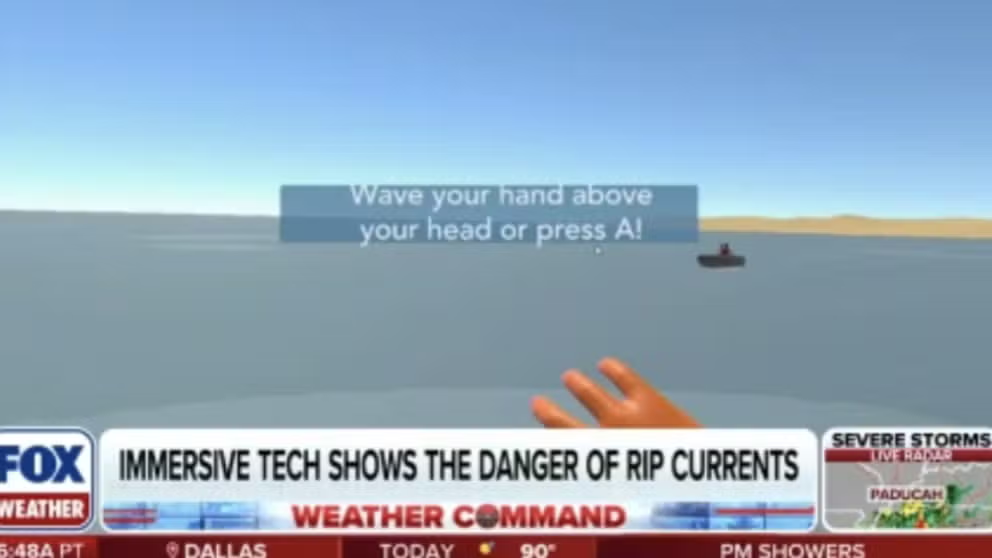
Dr. Bernhardt's current research is focused on using VR technology to teach about dangerous weather conditions.

Rip Tide safetyHurricanesClimatologyClimate ChangeWeather
Powered by

You might also like...

Check out some other posts from Hofstra University

1 min

U.S. Has a “Checkered History” of Toppling Authoritarian Regimes

In a Newsday article about Long Island Iranian-Americans’ reactions to recent developments involving Iran’s leadership, Dr. Paul Fritz, associate professor and chair of Hofstra’s Department of Political Science, discussed the history of the United States toppling authoritarian regimes, which, he said, rarely leads to new democracies or stable leadership without extensive American support. “The Trump administration is banking on the people rising up and demanding some change to the regime,” Dr. Fritz said. “Foreign imposed regime change doesn’t work very often.”

1 min

Housing Shortage Could Cost NY Politically

Lawrence Levy, associate vice president and executive dean of the National Center for Suburban Studies, was interviewed by the Investigative Post for the article: “Housing shortage could cost New York politically.” New York’s persistent housing shortage, driven in part by restrictive local zoning and slow homebuilding, is contributing to population loss that could cost the state two U.S. House seats after the 2030 Census as people relocate to more affordable areas. Levy said that because housing policy is handled town by town, many communities “become villages of no,” resisting new housing and exacerbating the problem.

1 min

Blizzard of ’26 – One for the History Books

“The blizzard of ‘26 will be remembered in meteorology circles,” Dr. Jase Bernhardt told Newsday about the historic storm this week that dropped approximately 30 inches of snow on parts of Long Island. The Hofstra University associate professor of geology, environment, and sustainability and director of meteorology explained the blizzard hit what’s known as the “70/40 benchmark." That’s 40 degrees north latitude and 70 degrees west longitude, geographic coordinates for a spot over the Atlantic Ocean: “That’s the sweet spot,” said Dr. Bernhardt. “Say it tracks 50 miles south and east, that means the heaviest snow shifts farther away. If it tracks closer, oftentimes, it’s bringing in warm air closer to the center [of the storm], and if it tracks too close, it might yield heavy precipitation, but it’s going to be too warm for all snow.”

View all posts