Pope Leo XIV Releases First Encyclical, "Magnifica Humanitas"

May 28, 2026

8 min

Tia Noelle Pratt, PhDJaisy A. Joseph, PhDPatrick McKinley Brennan, JDSally Scholz, PhDIlia Delio, OSF, PhDTerence Sweeney, PhD


On May 25, 2026, Pope Leo XIV released his first papal encyclical, “Magnifica Humanitas: On Safeguarding the Human Person in the Time of Artificial Intelligence.” The letter—true to its title’s meaning of “magnificent humanity”—addresses how society, collectively, must preserve human virtues in a time of rapid technological advancement.


The 42,000-word document features five distinct chapters, exploring various elements of the broader issue at hand and serving as a guidepost for moral and ethical use of technology, through the lens of Church teachings. It covers everything from the development and principles of Church social doctrine to technological responsibility, the culture of power, building civilization through love and preserving humanity through truth, work and freedom.


“In recent years, it has become increasingly evident how rapidly and profoundly digitalization, artificial intelligence (AI) and robotics are transforming our world,” wrote Pope Leo in the encyclical’s introduction. “Technology should not be considered, in itself, as a force antagonistic to humanity. On the contrary…


“Over the centuries, technological development has significantly improved the living conditions of humanity. At the same time, each phase of progress has also revealed the ambiguity of tools that can cause harm when not oriented toward the good… The power and prevalence of emerging technologies are interwoven into the fabric of daily life, shaping decision-making processes and deeply affecting the collective imagination: ‘Never has humanity had such power over itself.’


“[Most] people are watching and waiting, observing from afar and merely hoping for the best. For this very reason, crucial questions impose themselves on our conscience and can no longer be avoided: Where are we going? Toward what goal do we wish to orient ourselves? What direction should we choose as a people and as a human community?”


What Is a Papal Encyclical?


Popes have written more than 300 encyclicals—or “circulating letters”—since the mid-18th century. They were initially used to clearly communicate doctrine and guidance to priests throughout the world who were facing religious, political or social issues, which was especially useful as the world grew more interconnected and the Church grew larger.


Beginning with Pope Leo XIII’s Rerum Novarum and continuing today, some papal encyclicals have been referred to as “social encyclicals” because they address a pervasive social issue through the lens of Catholic Social Teaching and are written not only for those within the Church, but laypeople as well.


Some examples of those included Pope Saint John Paul’s 1987 Sollicitudo Rei Socialis on international inequality, and Pope Francis’ 2015 Laudato Si’ on environmental care and social justice.


“[Pope Leo XIII and his successors] were developing a new way of teaching the world how to order itself according to Catholic principles, now translated into a vocabulary that would be intelligible to the larger world,” said Patrick Brennan, JD, the John F. Scarpa Chair of Catholic Legal Studies at Villanova University Charles Widger School of Law, on LiveNow From Fox. “They try to address important social questions in ways that any person of goodwill can read and understand.”


“Encyclicals contribute to our collective wisdom for how to live as community,” wrote Sally Scholz, PhD, professor of Philosophy at Villanova, in her recent contribution to Church Life Journal titled “What to Look For in Pope Leo XIV's First Social Encyclical.” “The principles and various themes they discuss offer guidance for day-to-day interpersonal interactions as well as for how to participate as a Catholic and as a “person of good will” at every level of social existence: in our families, our communities, our institutions, our states and in our ‘one human family.’”


Observations From Magnifica Humanitas


A New Twist on a Longstanding Issue


While the types of technology being discussed in the letter—particularly artificial intelligence—are unique to our modern times, encyclicals addressing how to interact with contemporary technology are far from it.


“Discussion of the relationship between humans and technology appears in many of the previous social encyclicals,” wrote Dr. Scholz in Church Life Journal. “It is a social phenomenon with so much promise but inspires so much fear for how it will change work and the workplace, communication, global trade, war and the family.”


“Technology is integral to evolution. Understanding technology's relationship to human welfare means grasping its role within the flow of biological and human life,” wrote Sister Ilia Delio, OSF, PhD, the Josephine C. Connelly Endowed Chair in Christian Theology in the 2025 Global Sisters Report.


What Pope Leo argues in his lengthy letter, boiled down to a few sentences, is that while technological advancements, and AI in particular, can be beneficial to society, they must never supersede human dignity, moral responsibility and the common good. A society that allows systems to replace human judgment, concentrate power or exploit workers risks dehumanization.


For Jaisy Joseph, PhD, assistant professor of Theology and Religious Studies at Villanova University, particularly striking was something not written in the document itself, but rather spoken at the official promulgation of the letter in Rome. There, Pope Leo was joined in powerful reflection by Anthropic co-founder Christopher Olah. Olah analogized the current reality with bringing a fictional character to life, citing that while technical fields build the machinery of AI, “what character we choose, how it interacts with the world, how it ought to interact with the world— these are more clearly questions for the humanities, for religion, for philosophy, for society at large.”


On that front, he then enlisted the help of the Church in addressing three pressing concerns related to AI and human flourishing, before ending with a request for the Church to continue to be an unyieldingly moral voice and informed critic.


“The dynamic dialogue and discernment between Leo and Olah reflect a significant continuity with the Francis papacy,” Dr. Joseph said, referencing the late pontiff’s encouragement of “theology to adopt a transdisciplinary method that recognized how this discipline is part of a web of relationships among disciplines.”


Technology Through the Lens of Augustinian Theology


Throughout Magnifica Humanitas, Pope Leo’s ubiquitous thoughts and guidance on safeguarding humanity—particularly in the context of modern technology—are infused with references to the teachings of St. Augustine.


“[Augustine’s teachings say] we need standards to guide our judgements and actions,” said Terence Sweeney, PhD, assistant teaching professor of Humanities at Villanova. “Pope Leo XIV, ‘a son of St. Augustine,’ offers us standards for how we judge our world in the age of AI.


“One surprising standard in a document on Big Tech is that ‘a litmus test for social justice today is the treatment of migrants, refugees and those forced to move.’ Why this litmus test? Leo is shaped by Augustine’s rejection of communities of perfection where only the pure, powerful and perfect are welcome.”


“Pope Leo beautifully aligns himself with traditional Catholic Social Teaching while grounding his vision in the theology of St. Augustine,” Dr. Joseph added. “The result is a groundbreaking defense of the human person in our new age of artificial intelligence.”


Pope Leo, through a scriptural metaphor of the Tower of Babel, “resurrects Augustine’s famous warning that human history is a constant struggle between two loves fighting for our hearts,” Dr. Joseph said.


He references how the builders of the tower tried to create “a single language, a single technology, a single direction” without reference to God.


“The concluding paragraphs of chapter three highlight Pope Leo XIV’s distinctively Augustinian approach to evaluating the place of technology and scientific progress in the world,” said Emma Kennedy, PhD, assistant professor of Christian Ethics at Villanova University. “What we love, ‘both as individuals and as a society,’ will guide us to participate in ‘the rebuilding of Jerusalem’ or ‘the construction of Babel’––a contrast that hearkens back to Augustine’s ‘two cities.’”


“Pope Leo [also] draws on an Augustinian spirituality that highlights fundamental desiring in the shared search for truth,” added Tim Hanchin, PhD, associate professor of Practical Theology at Villanova. “Our desire for truth, or wonder, reflects humanity’s transcendent origin and end. That we are created in the image and likeness of the Triune God (Genesis 1:26-27) distinguishes human knowing from mere data processing.”


A Discussion on Slavery, Past and Present


Intermixed with Pope Leo’s chapter four thoughts on modern slavery—such as various forms of human trafficking that he says are “directly linked to the digital economy”—he made an historic recognition and apology for the Church’s role in the transatlantic slave trade centuries ago.


Tia Noelle Pratt, PhD, special assistant to the Vice President of Mission and Ministry at Villanova University, assistant professor of Sociology, and editor of the Journal of Catholic Social Thought, said that what makes this acknowledgement so important is how it differs from the way previous popes have addressed the issue, which have condemned slavery but remained at the individual level.


“They spoke of their papal predecessors and those popes’ actions, but stopped short of invoking the institution itself and the institution's role in the promulgation of slavery,” Dr. Pratt said.


Tying it back to current affronts on human dignity fueled by the digital age, Pope Leo penned his own papal version of the famous saying that “Those who cannot remember the past are condemned to repeat it.”


“If we want to avoid the need to ask for pardon again in the future for having failed to respect the treasure of human dignity that is required by our faith, it falls to us today to denounce, clearly and firmly, trafficking in its many forms,” he wrote.


“Pope Leo is telling us today that we cannot have detachment between the past and the present,” Dr. Pratt said. “We must see how these things are connected.”


Inspired by Rerum Novarum, but Far From a Repeat


Pope Leo XIV signed Magnifica Humanitas on May 15—the 135th anniversary of the release of Pope Leo XIII’s Rerum Novarum. That was the most famous social encyclical issued by the long-reigning pontiff and is considered to be a foundational text of modern Catholic Social Thought. It addressed numerous issues facing the working class during the time of the Industrial Revolution.


On May 10, 2025—just two days after his election—Pope Leo referenced his namesake’s 1891 encyclical in an address to the College of Cardinals, foreshadowing the attention he intended to pay to the modern version of the same issue.


“Pope Leo XIII in his historic encyclical Rerum Novarum addressed the social question in the context of the first great industrial revolution,” Pope Leo said in that address. “In our own day, the Church offers to everyone the treasury of her social teaching in response to another industrial revolution and to developments in the field of artificial intelligence that pose new challenges for the defense of human dignity, justice and labor.”


Yet, while he was explicitly inspired by the 19th-century pontiff and his text, Pope Leo makes it clear early in Magnifica Humanitas that “While Leo XIII spoke in his time of ‘new things’ (rerum novarum), today we cannot limit ourselves simply to repeating his insightful teachings.


“Instead, we must ask God for the wisdom to interpret the great trends of our time, particularly technological advances.”


Connect with:
Tia Noelle Pratt, PhD

Tia Noelle Pratt, PhD

Special Assistant to the Vice President and Director of Mission Engagement and Strategic Initiatives; Assistant Professor of Sociology

Tia Noelle Pratt, PhD, researches Catholicism in the U.S. with emphasis on systemic racism and African American Catholics.

African American CatholicsSystemic RacismCatholic Social TeachingU.S. Catholic Church
Jaisy A. Joseph, PhD

Jaisy A. Joseph, PhD

Assistant Professor of Theology and Religious Studies | College of Liberal Arts and Sciences

Jaisy A. Joseph, PhD, is an expert in the study of unity and difference in the global Church, synodality and the Eastern Catholic Churches.

Pope Leo XIVPope FrancisSynodalityEcclesiologyTheological Anthropology
Patrick McKinley Brennan, JD

Patrick McKinley Brennan, JD

Professor of Law; John F. Scarpa Chair in Catholic Legal Studies | Charles Widger School of Law

Patrick McKinley Brennan, JD, is an expert in Christian legal thought, constitutional law and religion and the law.

Catholic ChurchCommon-Good ConstitutionalismCatholic Legal StudiesPolitical FriendshipConstitutional Law
Sally Scholz, PhD

Sally Scholz, PhD

Professor of Philosophy | College of Liberal Arts and Sciences

Sally Scholz, PhD, is an expert on solidarity, feminism, just war theory and Catholic Social Teaching.

FeminismEthicsSocial MovementsCatholic Social TeachingViolence Against Women
Ilia Delio, OSF, PhD

Ilia Delio, OSF, PhD

Josephine C. Connelly Endowed Chair in Theology | College of Liberal Arts and Sciences

Sister Ilia Delio, OSF, PhD, works to find a new unity and synthesis in science and religion.

TheologyNeuroscienceArtificial Intelligence and BecomingCulture and ReligionCatholicity
Terence Sweeney, PhD

Terence Sweeney, PhD

Assistant Teaching Professor in Humanities and Honors | College of Liberal Arts and Sciences

Terence Sweeney, PhD, is a philosopher who specializes in the Augustinian tradition and Catholic Social Thought.

St. AugustineCatholic Social ThoughtCatholicism and PoliticsImmigrationPope Leo XIV
Powered by

You might also like...

Check out some other posts from Villanova University

Ahead of America250, Villanova Historian Reveals How Independence Hall Almost Didn't Survive featured image

4 min

Ahead of America250, Villanova Historian Reveals How Independence Hall Almost Didn't Survive

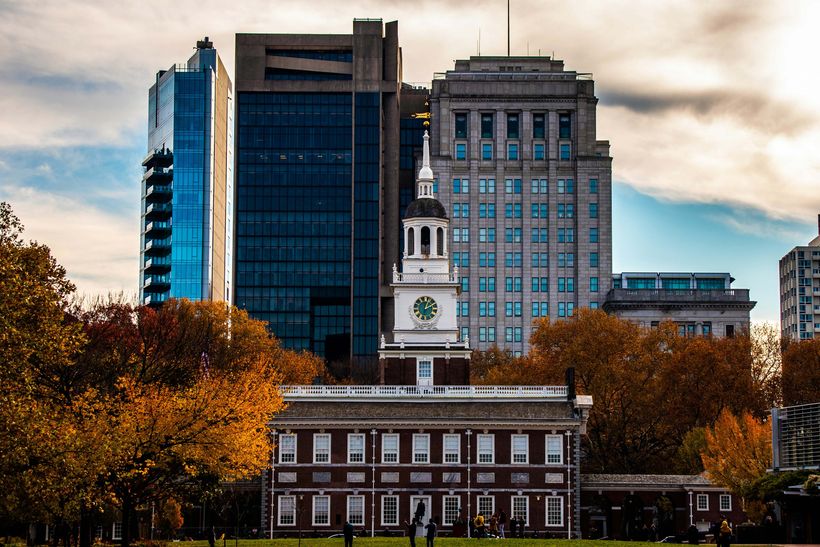
Philadelphia’s Independence Hall has long occupied an outsized place in the American imagination. The space where the Continental Army was established, the Declaration of Independence adopted and the United States Constitution ratified, the site was once described by President Abraham Lincoln as the source “where were collected together the wisdom, the patriotism, the devotion to principle, from which sprang the institutions under which we live.” In July, these hallowed grounds will yet again take center stage, as the country observes its semiquincentennial, or America250, celebration. In due course, House lawmakers will gather at the landmark for a special commemorative event, mayors from across the U.S. will march to the gates in a show of civic pride and solidarity, and thousands of visitors will flock to the site daily in appreciation for its significance to the cause of “Life, Liberty and the pursuit of Happiness.” However, while Independence Hall’s role in the national saga will go widely remarked and recognized, the building itself has a story that remains largely unknown. According to Whitney Martinko, PhD, associate professor of History and director of the Albert Lepage Center for History in the Public Interest at Villanova University, the “cradle of American democracy” almost never survived the country’s infancy. “Early on, the challenge was about two things,” says Dr. Martinko, who specializes in public history, historic preservation and the early U.S. “One was about ownership of what was called the ‘Old State House,’ because it was the former statehouse in the colony of Pennsylvania. And the second was about the development of the city around it.” As Dr. Martinko explains, in the early 19th century, Independence Hall—then the Old State House—was under the control of the Commonwealth of Pennsylvania, which had shifted its governmental seat from Philadelphia to Harrisburg by 1812. To fund the construction of a new capitol building in the wake of the move, Pennsylvania legislators seriously contemplated selling the site to private enterprise, with the surrounding area undergoing a development boom. “Today’s Independence Mall was built up entirely,” says Dr. Martinko. “In the 18th century, it was full of buildings, shops and houses, and by the 19th century, it had become a huge furniture district and a heart of commerce in many ways.” As plans were drawn up to deliver the hall to the highest bidder, local resistance quickly emerged. Opposed to the landmark’s loss, citizens of Philadelphia and municipal leaders rushed to the defense of the building and its lawn, arguing that their preservation entailed a necessary public good. “Everyone looked to this site as the heart of the new nation. It’s a historic site. It’s an important building. People thought of it as one of the great pieces of Georgian architecture at the time,” says Dr. Martinko. “It was also seen as a civic space, as people gathered there on Election Day. And its lawn was highly valued, with green, open space considered important even then, for air circulation. So, it was really seen as a political space, a civic space and a green space that was important for the well-being of Philadelphians and the health of Philadelphia.” Deliberations over the fate of Independence Hall would continue for a period of five years, up until 1818. After a spirited public campaign, a settlement was finally reached when the City of Philadelphia purchased the plot from the Commonwealth of Pennsylvania for $70,000 (roughly $1.85 million in today’s currency). In essence, the deal would forevermore secure Independence Hall’s place within the pantheon of great American shrines, parks and monuments. However, in a terrific irony, it would also eventually lead to the loss of a different piece of history: Between 1950 and 1967, the 19th-century development projects that once threatened Independence Hall became a casualty of the city’s efforts to make the “birthplace of America” an urban focal point, with the creation of Independence Mall. “Those buildings were all torn down in the mid-20th century, when Ed Bacon and the City Planning Commission decided to make Independence Hall a major attraction,” says Dr. Martinko. “There were debates surrounding this issue as well. The Jayne Building was one of the 19th-century buildings that was demolished and that is most well-known. So, there’s this sense of preserving 18th-century history through the demolition of 19th-century architecture.” As the nation approaches its 250th anniversary, the near loss of Independence Hall and the removal of its 19th-century neighbors stand as striking examples of the ways in which what we value, and how much we value it, evolves over time. What’s more, the historic threats to Philadelphia’s most famous site serve as a poignant reminder of the delicate nature of public memory and preservation—and the fact that the places we treasure today may not always be with us tomorrow. “Even though it seems absurd to us now, we’re still seeing debates over the line between redevelopment and connection with the past,” concludes Dr. Martinko. “It’s not that no one saw the value of Independence Hall, or that they didn’t see it as historic. It was just this debate that a lot of very reasonable people continue to have today: Is this what really needs to be preserved? And how should it be preserved?”

100 Years After the "Launch" of Aerospace Industry, Villanova Faculty Continue to Innovate the Sector featured image

4 min

100 Years After the "Launch" of Aerospace Industry, Villanova Faculty Continue to Innovate the Sector

In 1926, Robert H. Goddard launched the world’s first liquid-fueled rocket in Auburn, Mass. Goddard’s 10-foot-tall rocket was airborne for just 2.5 seconds, reaching speeds of 60 miles per hour before landing 184 feet away from the launch site. A century later, the aerospace industry is booming, with new technology and missions making headlines every day—some with incredible success, and others encountering challenges that send scientists back to the drawing board. In February 2026, NASA delayed the launch of Artemis II—its next mission to the moon—citing issues with helium flow in the rocket’s systems. By April, the mission was on track again, and Artemis II completed the first crewed flight to the moon in more than half a century. Crew members for the upcoming Artemis III mission were also recently announced, as well as a timeline and overview for Artemis IV, the first planned crewed mission to the lunar South Pole in 2028. Amid these successes and setbacks, researchers continue to innovate the field and develop new technologies designed to help expand our knowledge of the vast universe. That innovation comes from diverse and unique places, including Villanova University. Research in Flight Student interest in aerospace led to the creation of a Master of Science in Aerospace Engineering (MSAE) program at Villanova University, which began in the Fall 2025 semester. Sergey Nersesov, PhD, associate professor of Mechanical Engineering, was instrumental in the inception of the MSAE program and helped develop courses in space flight mechanics, applied aerodynamics, aerospace structures analysis and advanced flight dynamics and control, among others. The idea for the graduate program was inspired by the growing popularity of the College of Engineering’s Minor in Aerospace Engineering. The minor attracts students from across the university, drawing from other majors and colleges at Villanova. For example, Dr. Nersesov recently collaborated on a research project focused on spacecraft and satellite control systems with Aedan Disanto ‘26 CLAS, an astrophysics and planetary sciences major and aerospace engineering minor. “If you look up at the sky, sometimes you see satellites chasing each other,” said Dr. Nersesov. “Dynamics and control researchers develop algorithms to ensure proper spacing between the satellites so they can function correctly.” The spacing between satellites is crucial to avoid collision, which is also a potential issue when a spacecraft approaches a space station to dock. In this situation the velocities, rotation and orientation of both vehicles are carefully controlled so that docking mechanisms align correctly, which requires up to 12 variables to be coordinated simultaneously. Dr. Nersesov and Disanto analyzed the algorithms needed to guarantee perfect satellite function and built upon them, discovering more efficient ways to operate vehicles in space. This summer, Dr. Nersesov and his students will also begin designing a prototype for a new kind of drone. Typical drones use ample amounts of energy to become airborne and capture photos or video content because they rely entirely on thrust to hold themselves up. To improve effectiveness, Dr. Nersesov and his students aim to create a drone in the style of an airplane, with vertical takeoff and landing (VTOL) capability. The drone will take off vertically, like a helicopter, but then transition to flying horizontally like an airplane, allowing lift from the wings to reduce the energy needed to stay airborne. As a result, it could stay in the air up to ten times longer than a hovering drone. While the project focuses on a single aircraft design, it represents the type of forward-thinking research driving the aerospace field today. Aerospace Engineering with Biology Elsewhere, Qianhong Wu, PhD, chair of Mechanical Engineering in the College of Engineering, is exploring a concept called super-lubrication, inspired by the way red blood cells move through the human body. Blood cells travel through capillaries narrower than their own diameter without damaging themselves or the vessel walls. A soft, porous layer called the endothelial glycocalyx within the vessels allows cells to glide through, reducing friction. In studying this biological process, an idea emerged that could potentially be translated to the aerospace field. Dr. Wu’s team is currently applying their deep understanding of biomechanical processes to applications that might reduce aerodynamic friction on aircraft surfaces by more than 90 percent. This lower friction may also improve fuel efficiency and extend flight endurance for drones or other aircraft. “Our work is an example of how thinking outside your traditional field can lead to innovation,” said Dr. Wu. “Sometimes the solution comes from a completely different subject, like biology.” A Century of Momentum One hundred years after Goddard’s brief but groundbreaking flight, aerospace innovation has expanded far beyond its earliest experiments. Today, progress in the field depends not only on major missions and milestones, but also on the steady work of researchers refining systems and exploring new ideas. At Villanova, that work is taking shape across disciplines—from spacecraft control systems to biologically inspired materials. Together, these efforts reflect how the field continues to evolve through collaboration and creativity.

Villanova Researcher Authors Comprehensive Look at Large Outdoor Gatherings and Severe Weather Risk featured image

5 min

Villanova Researcher Authors Comprehensive Look at Large Outdoor Gatherings and Severe Weather Risk

If Benjamin Franklin had modern climatological data to consult, he may have scheduled his famous kite and key experiment for July of 1753 in Philadelphia, instead of a month sooner. July, after all, is Philadelphia’s most active month for lightning strikes, noted Stephen Strader, PhD, associate professor of Geography and the Environment and severe weather geographer at Villanova University. Lightning has been on Dr. Strader’s mind recently. In Spring 2025, he and a colleague published a study in Weather, Climate, and Society where they developed a metric to comprehensively rank more than 475 “large outdoor gatherings” in the U.S. in terms of greatest lightning risk, weak (EF0+) tornadoes and strong or significant (EF2+) tornadoes. The rankings factored in time of year, frequency of events, attendance and capacity, which was then compared to tornado/lightning climatology data for the venue location. With major outdoor events scheduled throughout the summer in Philadelphia, Dr. Strader recently reanalyzed his data to include gatherings like the FIFA World Cup, MLB All-Star Game and America 250 celebrations in the city. What he found was that many of these gatherings—when compared to other large outdoor gatherings across the country—are among the most likely to experience certain severe weather events. “While it is too soon to predict what the weather will be like for each of these events, the climatology does suggest that if severe inclement weather threatens them, many people could be exposed to deadly hazards such as lightning and tornadoes,” he said. “The key is for venue organizers, first responders and event attendees to be informed, not alarmed.” Preparedness Lessens Impact Every year, thousands of sports games, concerts, fairs, parades and days at amusement parks occur without weather-related safety incidents. But every now and again one does, sometimes with tragic results. In 2011, a spectator at Pocono Raceway was struck and killed by lightning in the parking lot after the race was halted due to weather. One year later, a sudden strong wind from an approaching storm collapsed a grandstand at the Indiana State Fair, causing seven fatalities and dozens of injuries. The objective of Dr. Strader’s research was to find what venues are most likely, comparatively, to experience these extremely rare worst-case scenario exposures. By doing so, he hopes that it will help venues and organizers to understand how they can plan, execute or update their preparedness and protocol, so that their impacts are less deadly when they do occur. “The idea isn’t to scare people,” he said. “Most of these venues and entities know that they're at risk for inclement weather. My hope is that those who do have a plan in place re-evaluate them, and think, based on the climatology, how they can adapt. For those who don’t, the goal is to make them aware of their risk so they can begin to plan. “There's a mental side to this too. Every year that goes by where there's not an issue or incident, people get increasingly relaxed. It’s a reminder to stay vigilant.” Many of the large outdoor gatherings that appear high in the research rankings do have robust protocols and infrastructure. For example, amusement parks score very high for lightning risk because they are open almost every day of the year to huge crowds, and many are located in states that experience frequent severe weather, like Florida and Texas. “But places like Disney World have comprehensive preparedness plans—they have people hired to understand and be aware of these threats,” Dr. Strader said. “Attendees have ample places to seek shelter.” The same is true, to varying extents with sporting venues, especially major professional sports stadiums. Even though gatherings held there may rank higher for these weather events, the chances of a catastrophe are lessened because of preparedness, protocol and infrastructure. Where Dr. Strader is more concerned is with gatherings like parades and fairs, especially when they last for multiple days and/or draw large crowds. “A state fair tends to be more ‘mom and pop’ at times, and they lack permanent infrastructure,” he said. “Vendors set up in temporary structures and a lot of times there are no places for attendees to seek shelter when thunderstorms threaten. You're also dealing with a transient population—people who don't know the area, and don’t know where to go when severe weather hits. “Parades are kind of a free for all in that you can come and go as you please. This is one of the reasons venues take tickets—so they understand their capacity to deal with an emergency. But if you have a place that doesn't do that, it can be tricky.” How Philadelphia’s 2026 Events Rank So, what exactly did Dr. Strader find when factoring in this summer’s events in and near the City of Brotherly Love, and what does it mean? In terms of lightning risk, several events and venues rank in the 80th percentile and greater for potential exposure compared to all other documented U.S. large outdoor gatherings. Citizens Bank Park, the host of the MLB All-Star Game in July, ranks in the 95th percentile. America 250 celebrations on July 4 rank in the 94th percentile, while FIFA World Cup events at Lincoln Financial Field rank 87th in June and 94th in July. For tornado threats to all nationwide events, Citizens Bank Park tops all local functions in July at the 96th percentile. The America 250 celebration ranks in the 95th, FIFA World Cup the 94th and MLB All-Star Game the 78th percentile for tornado exposure in that same month. According to Dr. Strader, lightning is often the bigger concern because it is far less predictable than tornadoes. While events are frequently canceled ahead of a credible tornado threat, they are less likely to be canceled due to the possibility of lightning. “Although lightning [strikes] and tornadoes are not very common in southeastern Pennsylvania, the large number of people gathered for these events sets up a ‘what if’ situation where tens of thousands of individuals could be threatened by severe weather,” he said. “Based on these findings, venue operators and governing bodies should continue to develop risk reduction strategies aimed at improving lightning and tornado safety, especially as lightning and tornado hazard threats evolve over time and across geographic space.” It is not only operators and organizers who should be prepared. Patrons, he says, can also devise and enact their own personal preparedness plan in the event of sudden severe weather. Teaching children simple sayings such as “when thunder roars go indoors” and scoping out potential places for shelter can go a long way in the event of severe weather—especially at come-and-go, transient events like America 250 festivities. “And if you see approaching clouds on July 4, maybe find another way to pay homage to Ben Franklin, and pull down your kite.”

View all posts