Experts Matter. Find Yours.
Connect for media, speaking, professional opportunities & more.

More Than a Long Weekend: Why Labor Day Still Matters in America
For millions of Americans, Labor Day means the unofficial end of summer , a final long weekend before schools are back in full swing and the fall routine takes over. But behind the barbecues, travel and end-of-summer sales is a holiday rooted in the history of American workers and the transformation of the workplace. Observed on the first Monday in September, Labor Day recognizes the social and economic achievements of American workers. Its origins date to the labor movement of the late 19th century, with the first Labor Day celebration held in New York City on September 5, 1882. In 1894, it became a federal holiday. More than 130 years later, Labor Day remains an opportunity to look at the role work plays in American life, particularly at a time when the workplace itself is undergoing enormous change. Artificial intelligence and automation are reshaping jobs and industries. Remote and hybrid work have changed where and how millions of people work. Employers continue to navigate workforce shortages, recruitment and retention, while workers are reconsidering expectations around compensation, flexibility, benefits and work-life balance. Labor Day can also open the door to broader conversations about the American labor movement, organized labor, workplace protections, wages and the economic contribution of workers. For journalists, that makes the holiday much more than a date on the calendar. It's a timely opportunity to explore both how work in America has changed and where it is heading next. Experts across economics, business, labor relations, history, human resources, public policy and emerging technology can provide valuable perspective on Labor Day and the changing American workplace. Journalists covering Labor Day and looking for expert perspective on the history of the holiday, labor and employment, workplace trends, organized labor, artificial intelligence and the future of work can connect with experts directly through ExpertFile profiles below:


Vanderbilt Index Finds Sustainability Remains a Mainstream Consumer Priority
As companies reconsider environmental commitments and sustainability receives less attention in corporate America, American consumers appear to be holding their ground. The inaugural Vanderbilt Consumer Sustainability Index (VCSI), released today by Vanderbilt University and consumer research company Switch 5, finds broad and consistent commitment to sustainability across the country. The national survey of 2,528 American adults found that 83% score above the midpoint on the new index, with surprisingly small differences across regions, gender and urban and rural communities. The findings establish the first baseline for the VCSI, a new quarterly measure designed to track how Americans’ attitudes toward sustainability change over time. Unlike existing measures focused primarily on climate policy or political attitudes, the VCSI looks at Americans as consumers — what they believe, what they expect from businesses and other institutions, and what they say they are willing to do themselves. The inaugural July 2026 reading places the VCSI at 69.2 out of 100, indicating a moderate-to-strong sustainability orientation among American consumers. The VCSI builds on more than two years of consumer research by Switch 5, which studies the attitudes and behaviors shaping consumer adoption of clean energy and sustainable products. That research has included more than 16 national surveys involving more than 50,000 Americans. The partnership with Vanderbilt brings that work into a recurring academic index designed to provide researchers, journalists, and businesses with a consistent measure of how consumer sustainability sentiment is changing over time. “Sustainability is often discussed through the lens of politics or corporate commitments, but consumer preferences are a critical part of the picture,” said Eric VanEpps, Associate Professor of Marketing at Vanderbilt Owen Graduate School of Management and coauthor of the study. “We created the VCSI to establish a consistent measure of what Americans believe and expect when it comes to sustainability, and to track how those attitudes change over time.” Key Findings from the Inaugural Wave 1. Consumer sustainability orientation is stronger than commonly recognized. 83% of Americans score above the midpoint of 50 on the index, suggesting broad popularity of sustainability. “People might read media coverage about how both public and private investments in sustainability initiatives have been reduced, and how large corporations have pulled back from the climate goals they set a few years ago. But the American public still cares about the environment, and these initial results create a baseline from which we can now measure trends in general sentiment,” said VanEpps. 2. Americans want businesses to lead on sustainability. Nearly nine in ten Americans (87%) want companies to help them be more environmentally friendly, and 85% say corporations bear responsibility for addressing climate change. Support for federal government action to address climate change is similarly high, at 84%, indicating broad public expectation that institutions — both public and private — should be part of the solution. “One thing to note is that most Americans work for either large corporations or the government. So when survey respondents say they want these organizations to address climate change, that is also a likely signal of how they want their employers to act,” said Vanderbilt Law School professor and study coauthor Michael Vandenbergh. 3. Concerns about future generations are widespread. More than four in five Americans (81%) believe climate change will harm future generations, including nearly half (47%) who say it will do a great deal of harm. Parents score meaningfully higher on the overall index than non-parents (72.9 vs. 67.3), suggesting the intergenerational frame is a significant motivator of sustainability commitment. 4. Americans say they are willing to act — including at some personal cost. Nearly three-quarters (74%) of Americans say they are willing to pay a little more for products that are better for the environment, and 72% say they are willing to sacrifice convenience to make environmentally friendly choices. These findings suggest meaningful room for consumer-facing sustainability initiatives that go beyond attitude measurement into behavioral change. 5. Sustainability commitment cuts across demographic lines. Perhaps the most noteworthy finding of the inaugural wave is how narrow the differences are across groups typically assumed to hold divergent views on the environment. Regional differences are minimal, with less than 2 points separating the highest and lowest of the four census regions. The gender gap is 1.5 points, and the urban-rural gap is 3 points. 6. Younger Americans lead, but sustainability commitment is broad across generations. Americans aged 18-34 score 72.2 on the index, compared to 65.1 among those 65 and older — a 7-point generational gap that reflects growing sustainability orientation among younger cohorts. Even the oldest segment sits well above the midpoint of the scale, however, indicating sustainability commitment has broad support across generations. Methodology The inaugural wave of the VCSI was fielded to a nationally representative sample of 2,528 American adults in July 2026, with data collection and analysis conducted by Switch 5 using PureSpectrum and Beacon Research. The 10-item composite index demonstrates strong internal reliability (Cronbach’s α = 0.87). Two sub-indices — Consumer Commitment (5 items) and Climate Concern & Responsibility (5 items) — correlate at r = 0.52, indicating that the two dimensions are meaningfully related but distinct. Full methodology and item-level results are available upon request, with a website currently in development. The next wave of the VCSI is expected to be fielded in October 2026 and released in late fall. Subsequent waves will report the current index level along with wave-over-wave and year-over-year changes.


Absence and Opportunity: New Academy Report on Working Class Candidates
A new report released by the American Academy of Arts & Sciences aims to explain the near-absence of elected politicians from working-class occupations at all levels of government in the in the U.S., despite making up more than half of the U.S. labor force, and highlights strategies that can give working-class Americans a seat at the table in our elected institutions. In How to Elect More Working-Class Americans and Why It Matters, authors Noam Lupu (Vanderbilt University) and Nicholas Carnes (Duke University) describe how the shortage of politicians from the working class harms trust in government, runs contrary to our national ideals, and makes it difficult for our political institutions to understand and respond to the needs of working people in a fast-changing economy. Carnes and Lupu sought input from the working group that convened to support a recommendation of the Academy’s Commission on Reimagining Our Economy to increase working-class candidates. A main focus of the report is understanding and addressing the barriers that keep working-class Americans from running for office. How to Elect More Working-Class Americans and Why It Matters includes detailed descriptions of how parties, unions, interest groups, funders, and policymakers can increase the number of working-class candidates and officeholders. “Our democracy and our economy will grow stronger when more Americans feel included and invested,” said Laurie Patton, president of the Academy. “To address declining trust and engagement in our government, we need workable evidence-backed solutions that are driven by good ideas and good will. Nick Carnes and Noam Lupu provide a blueprint for how a policymakers, leaders and citizens across the country can increase the number of working-class candidates and benefit all who care about strengthening America.” The report represents the culmination of a decade-and-a-half of research. “Working-class people almost never go on to hold elected office in the U.S.,” said Nick Carnes, Z. Smith Reynolds Distinguished Professor of Public Policy Studies at Duke’s Sanford School of Public Policy. “In this report, we look to the available research to dispel myths about the working class and highlight the real obstacles that prevent working-class Americans from holding office.” “At a time when both major parties are seeking to win over working-class Americans, we hope this document will provide clear and actionable advice for anyone hoping to support working-class people serving their communities as elected officeholders,” said Noam Lupu, Gertrude Conaway Vanderbilt Professor of Political Science at Vanderbilt University. The challenge is not that workers are unqualified or uninterested in public service; it’s that running for office in our nation is burdensome. Candidates have to spend an enormous amount of time, money, and personal resources to run for office, making it difficult for working-class Americans to take time away from work and devote the resources necessary to mount a successful campaign. The report builds on the Academy’s enduring commitment to strengthening democracy, beginning with the organization’s founding in 1780 and embodied most recently with the Our Common Purpose initiative, and the Commission on Reimagining Our Economy, which recognized the inextricable link between democracy and economy. Adam Bonica, Stanford University; Andrea Louise Campbell, Massachusetts Institute of Technology; Katherine J. Cramer, University of Wisconsin–Madison; Jake M. Grumbach, University of California, Berkeley; Alexandra Killewald, University of Michigan; Jane Mansbridge, Harvard University; Tali Mendelberg, Princeton University; Lara Putnam, University of Pittsburgh; and Kay Lehman Schlozman, Boston College served on the advisory group with Carnes and Lupu on this project.

Ten years ago, Colin Kaepernick transformed a moment before an NFL game into one of the most consequential acts of athlete protest in modern American sports. What began in 2016 as a protest against racial injustice and police brutality quickly moved far beyond football. Kaepernick became a national flashpoint in debates about race, patriotism, free expression and the role professional athletes should play in challenging social and political institutions. A decade later, the impact of that decision, and the questions it raised, remain. The Associated Press recently revisited Kaepernick’s protest and its legacy, including the fact that many people who played or coached alongside him in 2016 remain reluctant to discuss what happened and its aftermath. Kaepernick never played another NFL game after that season, despite having previously led the San Francisco 49ers to a Super Bowl. For Frederick Gooding Jr., Ph.D., Professor of African American Studies and the Dr. Ronald E. Moore Professor in Humanities at Texas Christian University, that continuing reluctance is itself significant. View his profile “I think that this reluctance to even talk about it now is indicative of to what degree did the NFL substantively address it.” — Frederick Gooding Jr., speaking to The Associated Press Gooding told the AP that people should now be more willing to discuss the episode openly, and said Kaepernick “forced people to get uncomfortable.” He also pointed to the power dynamics involved when the NFL later acknowledged that it should have listened more closely to players speaking out about social inequality — after Kaepernick's playing career had effectively ended. Why This Story Still Matters The Kaepernick story provides an opportunity to look beyond whether taking a knee was right or wrong and examine what happened afterward. How much has professional sports actually changed in the decade since Kaepernick's protest? What happens when athletes use their platforms to challenge powerful institutions? Why can some forms of athlete activism become accepted over time while others remain deeply polarizing? And what does the continuing discomfort around Kaepernick tell us about the intersection of race, sports, media and American culture? Those questions extend well beyond one quarterback or one football league. For journalists covering the 10th anniversary of Kaepernick's protest, or future stories involving athletes, race, activism and the role of sports organizations in social debates, Gooding can provide perspective on questions including: How Kaepernick changed the relationship between professional athletes, activism and their employers. Why the reaction to athlete protest often reveals broader attitudes about race and power. How media coverage influences public perceptions of athletes who engage in activism. Whether sports organizations have substantively changed since the protests of 2016 and 2020. How Kaepernick fits within the longer history of Black athletes using sports as a platform for social change. Why the intersection of race, sports and popular culture continues to produce some of America's most contentious public debates. Frederick Gooding Jr. is available to speak with media about Colin Kaepernick's legacy, race and sports, athlete activism, representation, popular culture and the intersection of race and mainstream media. Simply click on his profile now to arrange an interview today.



Cornea specialist, educator named chair of MCG Ophthalmology
Amy Estes, MD, a cornea specialist, educator and long‑time faculty leader, has been named chair of the Department of Ophthalmology at the Medical College of Georgia at Augusta University, effective July 1. Pending approval of the University System of Georgia Board of Regents, she will also hold the Knights Templar Educational Foundation of Georgia/Fleetwood Maddox Chair in Ophthalmology. Estes joined MCG in 2013 and currently serves as director of the Cornea Service. She is a highly respected clinician who cares for patients from across Georgia who require advanced medical and surgical management of complex corneal disease. A dedicated educator, Estes has played a central role in training the next generation. She has advised numerous medical students pursuing careers in ophthalmology, served on multiple PhD committees and contributed extensively to resident education. She previously served as associate director of the Ophthalmology Residency Program and has led the residency program as director since 2020. Her leadership has strengthened the visibility and reputation of the department’s educational programs across the state. She also brings significant leadership experience at both the state and national levels. She has served on the council of the Georgia Society of Ophthalmology, ultimately becoming its president, and as the Georgia representative at the American Academy of Ophthalmology. Her research collaborations with the James and Jean Culver Vision Discovery Institute have contributed to six R01 grants and 19 peer-reviewed publications, advancing both basic science and translational vision research at MCG. “Dr. Estes has demonstrated exceptional commitment to patient care, education, and research throughout her career at MCG,” said MCG Dean David C. Hess, MD. “Her vision for the department, combined with her deep understanding of our institution and the needs of patients across Georgia, makes her an outstanding choice to lead the department into its next chapter. “I also want to express my sincere appreciation to Steve Brooks, MD, who has served as chair of the department since 2020 and will return to his faculty role as a pediatric ophthalmologist. Dr. Brooks has guided the department through significant transitions with steadiness, compassion, and a deep commitment to learners and patients. I’m thankful that he will continue to share his expertise with our students, residents, and the children and families he serves, and that he will continue his important work in patient care, research, and education.” As chair, Estes plans to prioritize faculty recruitment and retention, support continued growth in research and education, and pursue opportunities to expand clinical services, including exploring satellite locations to improve patient access and accommodate increasing demand for eye care across the state. She completed her undergraduate education at Davidson College before earning her medical degree from The Ohio State University College of Medicine. She completed both her ophthalmology residency and a fellowship in cornea and refractive surgery at Wake Forest Baptist Medical Center. See more experts at Augusta University → Click here

AU Hosts Congressional Hearing on 'Building an AI-Ready America'
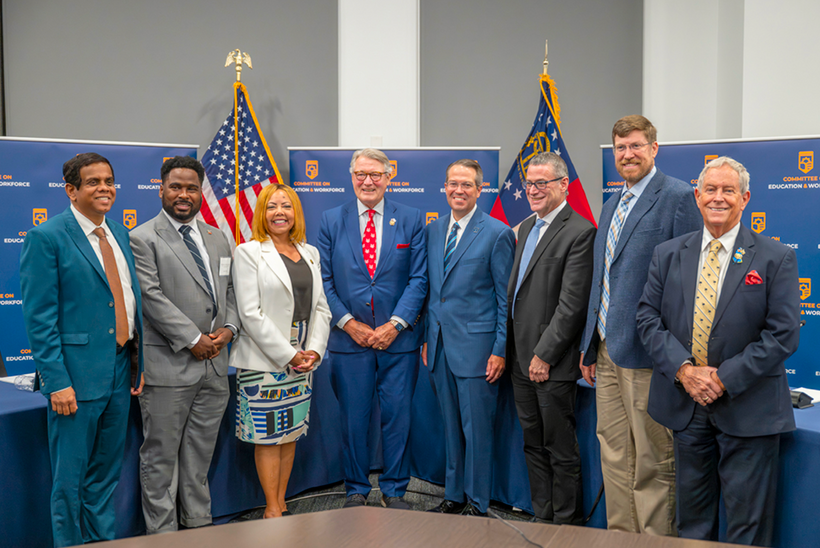
The U.S. House Committee on Education and Workforce held its first artificial intelligence field hearing of the year, titled "Building an AI-Ready America: How AI Is Creating Opportunities Across America's Workforce," at the Georgia Cyber Center at Augusta University on July 24. U.S. Rep. Rick W. Allen, who represents Georgia's 12th District and chairs the committee's Subcommittee on Health, Employment, Labor, and Pensions, chaired the hearing. He was joined by U.S. Rep. Joe Wilson of South Carolina and U.S. Rep. Lucy McBath of Georgia. Jeffery Talbert, PhD, chair of Augusta University's Department of Artificial Intelligence and Health at the Medical College of Georgia and a Georgia Research Alliance Eminent Scholar, served as one of four witnesses at the hearing. "Today, we examine how artificial intelligence, AI, is creating economic opportunities for American workers, job creators and our communities," Allen told the committee. "There's no better place to hold this hearing than right here in Augusta." Allen said the combination of the Georgia Cyber Center and Fort Gordon provides the expertise needed to discuss AI. "Fort Gordon is just a short 30-minute drive from where we currently sit," he said. "It hosts the Army Cyber Center of Excellence and is home to Army Cyber School, which trains, educates and develops the Army's Cyberspace and Electronic Warfare workforce. Every year, thousands of people leave Fort Gordon looking for work." He added that the Georgia Cyber Center "was created to meet this growing demand and drive collaboration between academia, government and industry stakeholders to equip a superior cybersecurity workforce with the skills they need." Augusta University President Russell T. Keen told the committee it was an honor for AU's Georgia Cyber Center to host the hearing. "Congressman Allen has long recognized the important role that education, innovation and workforce development play in strengthening our state and our nation," Keen said. He added that AI "will continue to change how we live, how we learn, how we work and how we solve problems," and that Augusta University "intends to lead in that transformation in ways that strengthen our workforce, advance discovery, improve lives, change lives and save lives." Talbert, who has more than 30 years of experience in biomedical informatics, has published approximately 260 times and has led more than 100 funded research projects totaling more than $130 million. He told the committee that in health care, AI is demonstrating its greatest value through augmentation, helping professionals "work more effectively, reducing administrative burdens, improving patient outcomes and expanding workforce capacity." He pointed to ambient documentation technology, which converts clinical conversations into draft notes clinicians review and approve, as one of the industry's most successful AI applications. "Multiple studies show these tools reduce documentation burden, after-hours work and burnout," Talbert said. "One multisystem implementation found clinician burnout fell from approximately 52 percent to 39 percent." He also cited studies showing AI-assisted breast cancer screening detecting approximately 29 percent higher cancer rates, "helping more patients benefit from earlier diagnosis and treatment." America's opportunity, Talbert said, "is not simply to adopt AI, but to lead its responsible development, education and implementation." He pointed to Augusta University's Department of AI and Health, the first of its kind in Georgia, as an example of that approach. Allen closed the hearing by cautioning against a one-size-fits-all approach to AI policy. "The needs of a family farm are not the same as those of a hospital, a manufacturing plant or a small business," he said. "Congress must pursue flexible policies that allow businesses to adopt AI in ways that best suit their industry and workforce." JagWire has the full recap of the hearing and the Augusta Chronicle, Innovation & Entrepreneurs News and Traders Union also covered the field hearing. Augusta University experts in artificial intelligence, healthcare innovation and workforce development are available for interviews. If you're covering similar stories, reach out to schedule time.

The Tipping Point: How Gratitude Grew into a Guilt Trip (and How to Get Off It)
My dog Dottie is, and I say this with love, a con artist in a fur coat. She has trained me to hand over a treat every time she sits, spins, or simply exists in my general direction, those big brown eyes fixed on me. If I hesitate even three seconds, she tilts her head and stares at me as if I have personally bankrupted her. I always fold. It turns out that I am not the only sucker for this routine. These days, entire industries have figured out that if you make a person stand there long enough while a screen stares back at them, they will fold too. Except instead of a milk bone, they want eighteen to twenty-two percent of your bill, and instead of a good girl, you get a receipt. Welcome to modern tipping culture, where a simple thank-you has somehow become a math test administered under duress, with a cashier watching as you decide, and somewhere behind the screen, a very deliberate mind has already worked out exactly how to nudge your answer higher. A Short History of Guilt with Percentages Tipping began as a compliment, not a demand. Historians trace it to a Tudor England custom called a vail, in which a noble slipped an extra coin to a servant for going above and beyond (Blueprint Financial, 2024). North America initially wanted nothing to do with it, meeting tipping's arrival in the late 1800s with the kind of suspicion usually reserved for chain letters. Americans who travelled to Europe came home grumbling about being nickeled and dimed by porters and waitstaff, and in 1884 the New York Times ran an editorial calling English-style tipping downright un-American (Mentzer, 2013). Between 1909 and 1915, six American states banned tipping outright, but it did not work. Tipping also has a less charming cousin: bribery, extra money paid in advance for special treatment, a jump on the waitlist, or a better table, not a reward for service already rendered. That is also roughly where the phrase "nickel and dimed" comes from, back when tipping meant tossing a server the smallest coins in your pocket. These days, the phrase seems to describe the opposite, a whole system of small additions that always land in the business's favour. Researchers who study why people tip find that the reasons run deeper than economics. One ethnographic study of servers and diners in Vancouver found that people tip for good service, to follow the social norm, out of sympathy, to signal status, or to lock in a preference for next time. Tipping has never been just a transaction; it has always been part performance and part quiet social contract, which is probably why opting out feels so uncomfortable. Then Tipping Went on a Growth Spurt Fifteen percent used to be the polite standard and twenty percent was for showing off. That range has crept steadily upward. Canadians now commonly tip eighteen to twenty percent at restaurants, bars and at hair salons. Even coffee shops and fast-food counters are edging toward five to fifteen percent as digital prompts normalize the ask (Blueprint Financial, 2024). Nearly two thirds of Canadians say they feel pressured to tip more than they used to, and the share tipping twenty percent or higher has more than doubled in under a decade (Blueprint Financial, 2024). In the US food industry alone, tipping adds up to an estimated forty-seven billion dollars a year (Azar, 2011), proof that this habit is not shrinking on its own. The Power of Suggestion (and the Screen That Stares Back) Once you know the tactics at play, it becomes easier to push back without guilt. The first is plain old anchoring. When a screen offers eighteen, twenty, and twenty-five percent as your only real options, your brain quietly narrows its sense of what is normal to fit that range, even if fifteen felt generous a few years ago. The second is assumptive closing, a sales trick in which, instead of asking whether you would like to tip, the screen assumes you already said yes and only asks how much, with the highest number often listed first or made visually larger. The third is technology itself, which makes the ask frictionless in places it never used to be, a tap and a swivel where someone just handed you a bag. And the fourth is old-fashioned shaming, the discomfort of picking a lower number while the cashier watches your thumb hover over the screen. If this sounds suspiciously like how Dottie gets her treats, that is because it is the same playbook. Offer a limited set of flattering options, stand there expectantly, and let the silence do the persuading. Research shows this tip-screen genuinely works, boosting tips by fifteen to thirty percent compared with a plain jar on the counter, largely because people gravitate to the middle option and nobody wants to look cheap in front of an audience (GlobalTill, 2026). One Toronto bakery owner told CBC that customers get visibly upset just being asked, even with signs posted that tips are not expected (CBC, 2022). University of Saskatchewan professor Marc Mentzer called the whole system a human rights catastrophe we are simply stuck with (CBC, 2022). None of these four tactics are about rewarding good service. They are behavioural design, and once named, they lose a surprising amount of power over you. Then the Pandemic Showed Up and Ruined Math for Everyone It is worth remembering why this all accelerated, because the original impulse was genuinely kind. When the pandemic hit, restaurant workers were being laid off and dining rooms were closed. Tipping generously was in solidarity, meant as temporary help during a crisis. Except it did not stay temporary, and that part was not really an accident either. Once businesses saw customers would tolerate a higher default tip during a crisis, many kept it in place long after. What began as compassion got hardwired into the software as the new normal, with no memo ever announcing that the emergency measure was now permanent. And Then Delivery Apps Moved the Tip Jar to Before Dinner Even Arrives Just as the tip screen had already rewired one part of the routine, delivery apps quietly rewired another. With services like Uber Eats and Skip the Dishes, you are asked to tip before your food has even left the restaurant, a bit like tipping a movie based on the trailer. The gratuity is baked into checkout, so what used to be a reward for good service becomes a pre-negotiated cost of doing business from your couch. Drivers often rely on that upfront tip because base pay per delivery is thin, meaning customers are subsidizing wages before a single doorbell rings, tipping blind. Wait, What? Are We Tipping the Government Too? If the delivery app section left you feeling like every corner of a transaction has been quietly monetized, buckle up, because there is one more layer nobody warns you about. Tipping etiquette has always technically called for calculating your percentage on the pre-tax total, but the machine does not know or care about etiquette. It simply applies a percentage to whatever total is on the screen, tax already included. So, the moment you tap one of those preset percentage buttons, you are effectively handing your server a tip on the government's cut of the meal too, not just on your food. The good news is the money itself still goes straight to the server, not to the government (phew). A flat twenty percent tip, calculated the way the machine calculates it, works out closer to twenty-two percent in provinces with a combined sales tax around thirteen percent, a touch less where the tax rate is lower, once the tax already baked into that total gets factored in (ouch). Let that marinate for a second. You went in planning to leave twenty and walked out having left twenty-two. When There Was No Service to Begin With And then there is the increasingly common experience of being asked to tip somewhere where no actual service happened. The dry cleaners. Seriously? You hand over a bag of shirts, come back two days later, and someone hands you the same shirts on a hanger, and now there is a tip screen. Insert the mother of all eye rolls. Nobody brought anything to a table; nobody checked on you twice. The job was already priced into what you paid. This is the moment tipping stops being gratitude and starts being a business outsourcing payroll onto customers who never agreed to it. Let's Talk About What This Does to Seniors This part matters to me personally, since I spend my days helping retirees stretch every dollar with intention. Tipping fatigue hits seniors differently and being asked to add another eighteen to twenty-two percent to everyday errands can feel less like generosity and more like an unplanned pop quiz. I have heard from clients who now avoid certain errands or choose a drive-through, specifically to sidestep the awkward prompt. Seventy-three percent of Canadians already believe tipping lets employers get away with underpaying staff, and fifty-nine percent would rather see fair wages built into prices than keep gambling on tip guilt (Blueprint Financial, 2024). If tipping anxiety is nudging older adults toward staying home instead of enjoying a coffee with a friend, this so-called social norm is quietly chipping away at connection, not what any of us want for our golden years. This is not strictly a seniors’ problem either. Many people across every age group now quietly admit to choosing pickup over dine-in, skipping a small business altogether, or simply going out less, purely to avoid the awkward math of a screen and an audience. The difference for seniors is that the squeeze lands on top of a fixed income and a lifetime of budgeting habits that never had to account for an eighteen percent surcharge for saying yes to a friend's invitation. Maybe It Is Time for a Cash Tip Movement Here is an idea worth trying and sharing with your friends. The next time the screen swivels toward you, select no tip (usually tucked into the custom tip section rather than sitting out with the percentage buttons), pay the bill, and leave whatever cash tip you want directly on the table or in the jar afterward. To be clear, this is not about skipping the tip; it is about choosing how and when you deliver it. The server still gets paid fairly, just without a screen and an audience deciding for you. That one move sidesteps the anchoring, the assumptive question, the audience, and the algorithm quietly nudging the suggested amount upward. You decide the amount in private, hand it over with a genuine thank you, and walk out having tipped exactly what you meant to, power fully intact. If anyone asks why you skipped the prompt, just smile and say you do not tip machines; you tip people. This is also a great excuse to talk about it with your people. Ask your friends what they tip and why and figure out together where you all want to draw the line. Strength in numbers works on tipping the same way it works on everything else. Taking Back the Tipping Wheel A couple of practical notes before the cheat sheet below. Most screens that appear to offer only percentages hide a custom tip option that lets you enter zero or a flat dollar amount. It is worth finding, since a flat five dollars does not creep upward the way twenty percent does as prices rise. What to Tip, By Service Tipping Around the World Check Please! At the end of the day, tipping culture can feel like a money furnace, quietly burning through your paycheque, one percentage point at a time, while insisting the whole thing was your idea. And when the topic is your own money and your own life, also known around here as YMYL, letting action absorb anxiety beats letting anxiety run the show every time. Decide your numbers ahead of time, carry a bit of cash, ask a friend what they think, and stop apologizing for wanting a system that rewards real effort rather than clever design. Dottie has never apologized for expecting a treat, and to be fair, she earns hers. A screen swivelling toward you over a bagel has not. Tipping began as a genuine thank-you for genuine effort, so keep it simple. Decide your number before the screen decides it for you and save the big percentages for those who earned them. Next time that screen stares you down for twenty-two percent, channel your inner Dottie: sit, stay, and reward only the performance that deserves it. Don't Retire…ReWire! Sue My Book is Now Available for Pre-Order I hope you will consider pre-ordering a copy of Your Retirement Reset for you, a friend or loved one. It's available September 29, 2026 published by ECW Press - You can now order at Indigo or Amazon. And if you love supporting Canadian booksellers, please also check with your local independent bookstore. Most can easily order it for you.



Could President Trump’s Approval Ratings Rebound?
Newsweek interviewed Meena Bose, professor of political science, executive dean of the Public Policy and Public Service program, the Kalikow Chair in Presidential Studies and director of the Kalikow Center for the Study of the American Presidency, about President Donald Trump’s falling approval ratings due to voter frustration over the economy and inflation. Dr. Bose told Newsweek that the long-term consequences of a president’s leadership and policies are “most significant” in determining their legacy. “A president’s long-term legacy for leadership and policy making is most important for determining historic favorability. The passage of time and the assessment of the totality of a presidency also can lead to more favorable ratings, or at least split ones in different policy or political areas, but this is no guarantee,” she said.



A Closer Look at Index Funds in Retirement
Someone in their early sixties slides a statement across the kitchen table. Balanced portfolio. Broad index funds. Low annual fees. They did everything the industry told them to do, in the order the industry prescribed. Then they ask the question that has nothing to do with the statement: "Will it last?" I call that FORO. Fear Of Running Out. People tell me it's just nerves. It isn't. Here's what I think is really happening. An index fund is a very good machine for one job: growing money over thirty years. It assumes you have time. It assumes you're buying, not selling. It assumes you don't much care what's inside, as long as the number goes up. Every one of those assumptions stops being true the day you retire. Why do index funds treat expensive stocks as growth stocks? Campbell Harvey teaches finance at Duke University's Fuqua School of Business. This spring, he published a paper with four colleagues in the Financial Analysts Journal that tackles something so basic that most of us never think about it. (Source: Arnott, Brightman, Harvey, Nguyen & Shakernia, "Fundamental Growth," Financial Analysts Journal, 2026.) Almost every index fund is built on one idea: if a stock is expensive, the company must be growing rapidly. Harvey's finding is that this is often wrong. A stock can be expensive because it's popular. But popularity and growth are two different things. If you want proof that price and business performance can go their separate ways, think back to 2021. GameStop. AMC. Stocks that shot up on Reddit forums, with very little of the chatter based on earnings reports. Think back to 2021. GameStop. AMC. Share prices shot straight up because people online decided they should. Not because those companies were selling more of anything. Now consider how index funds work across every retirement account. A stock becomes popular, its price rises, and the fund buys more of it, not because the business improved, but because the price went up. How concentrated is the S&P/TSX Composite? Everything above is American. Here's the Canadian version, eh? The main Canadian index is not a broad mix of the world's best businesses. It's dominated by banks, mining and oil. Those three groups make up close to 70% of the index. Banks alone account for about 31%. According to the iShares Core S&P/TSX Capped Composite, the ten biggest holdings are roughly 38% of the whole thing, with Royal Bank at the top. In fact, close to half the weight of the index is made up of just financials and energy. I'm not saying anything negative about those companies. I'm saying you own them, whether you picked them or not, in amounts you didn't choose, for reasons that have nothing to do with what you need at age 72. That's been a fine bet for long stretches. It's also a narrow one. And narrow feels very different at 65 than it did at 35, because at 65 you no longer have the thing that makes a bad market survivable. Time. Why does a market drop cost a 65-year-old more than a 35-year-old? Let’s illustrate this with an example. Two people own the same fund. One is 35 and still contributing, while the other is 65 and withdrawing. Both are dealing with $6,000 this year. A unit of the fund costs $100. Then the market drops 20%, and a unit costs $80. The 35-year-old puts in $6,000. Before the drop, that money bought 60 units. Now it buys 75. Fifteen units he didn't pay for. The 65-year-old needs $6,000 to live on. Before the drop, she'd have sold 60 units to get it. Now she must sell 75. Fifteen units she'll never get back. Then the market recovers. Units return to $100. His 15 extra units are worth $1,500 more than he paid for them. Her 15 units were sold at the bottom. They aren't there to recover. Same fund. Same market. Same $6,000. The only difference is the direction the money was moving. That's why a retiree needs to look inside the fund, whereas a 35-year-old mostly doesn't. RRIF minimum withdrawals: why Canadian retirees are forced to sell In Canada, we've set a rule. When your RRSP becomes a RRIF, you must withdraw a minimum amount each year. The rate starts at 5.28% at age 71 and increases each year after that. (Source: Canada Revenue Agency, prescribed RRIF minimum withdrawal factors.) So, a Canadian retiree can be forced to sell in a bad year, from a narrow index based on a definition of growth that a Duke University business professor has just called flawed. Three problems stacked on top of each other. None of them show up on the statement. This is exactly the point I made with EY Canada in The Canadian Retirement Evolution, published in July (Source: EY Canada, 2026). FORO isn't a personal failing. It's a design gap. We built a system to save money, then asked it to pay people reliably for thirty years. It was never built for that. And the biggest thing most Canadians over 55 own isn't in the index at all. It's the house. About 70% of the coming wealth transfer in this country sits in real estate, and more than 85% of seniors say they want to stay in their homes (Source: EY Canada, The Canadian Retirement Evolution, 2026). Asset-rich, cash-poor, and treating their largest asset as off-limits. 5 questions to ask your advisor about your index funds I'm not telling you to sell anything. I can't. I don't know your health, your pension, your taxes, or your nerves. But here's what I'd want answered before my next meeting with an advisor. What are the ten biggest things I actually own? Not the fund name. The holdings. Do my funds overlap? Three funds that all own the same five banks isn't three bets. It's one. What happens if I must withdraw in a bad year? Is my "growth" fund measuring actual growth, or just price? Where does my home equity fit into all this? Ask. A good advisor will be glad you did. If you get a pie chart and a pat on the back, ask again. One last point from Professor Harvey. More than half of all invested money now sits in funds that buy automatically. He thinks it could reach 80% within ten years. (Source: Duke University Fuqua School of Business, 2026.) When enough money buys without looking, price stops being a judgment and becomes a reflex. But retirees are the least able to afford someone else's reflex. Here's the plain truth beneath all the jargon: nobody swapped out your equipment when the game changed. You're still holding a golf club on a pickleball court. Momentum is still wearing a cardigan. Your funds still can't tell the difference between expensive and growing. And most retirement plans still hand you a seatbelt when what you need is a crash-proof suit. Nobody in the industry is racing to fix this for you. So I will. Consider this the first chapter, not the last word. It's time to take back our retirements and reset. Don't Retire…ReWire! Sue My Book is Now Available for Pre-Order I hope you will consider pre-ordering a copy of Your Retirement Reset for you, a friend or loved one. It's available September 29, 2026 published by ECW Press - You can now order at Indigo or Amazon. And if you love supporting Canadian booksellers, please also check with your local independent bookstore. Most can easily order it for you. References: All figures verified 4 August 2026 Important: This article is general information and commentary only and does not constitute financial, mortgage, tax, legal, or investment advice. Before making decisions about your retirement or home equity, consult qualified liscensed professionals who can assess your personal circumstances.

Op-Ed: Crypto market bill adds risk, not clarity
Markets function best when participants understand the rules of the road, investors have confidence in the integrity of the system, and regulators have clear authority to police misconduct. The crypto market structure legislation now advancing in Congress promises exactly this clarity. Yet it raises a more troubling question: what happens when legislation written to create clarity instead exempts large parts of the digital asset ecosystem from the very safeguards that make markets safe for everyday Americans? Blockchain technology, tokenization, stablecoins and digital assets can improve efficiency, lower transaction costs, and widen access to financial products. Those opportunities are real. But sustainable innovation requires trust, and trust requires accountability. The legislation under consideration would create broad carve-outs for parts of the digital asset ecosystem, particularly within decentralized finance. Supporters call these provisions pro-innovation. Economically, they are regulatory arbitrage–the practice of avoiding rules and requirements that apply to similar financial activities elsewhere. Regulatory arbitrage does not create better products or services. Instead, it allows some firms to operate with lower costs by avoiding obligations designed to protect consumers and maintain financial stability. When two companies provide the same financial service but follow different sets of rules, the company with fewer requirements will naturally have lower costs. Those savings are not necessarily the result of greater efficiency. They often come from avoiding safeguards that other firms are required to maintain. Consider what the exemptions waive. A bank that holds customer assets must keep those assets separate from their own funds, maintain capital reserves, and fund a supervisory and compliance apparatus. An exempt digital platform performing the same custodial function carries none of these costs, so it can offer the service more cheaply while taking on risks that may not become apparent until problems arise. A bank that pays a return on deposits also pays deposit insurance premiums, holds regulatory capital, and absorbs the cost of anti-money-laundering compliance. An exempt platform passing through the yield on its reserves bears none of these and can therefore advertise a higher net rate on funds that are, economically, deposits. The activity is the same on both sides of the ledger. Only the rulebook differs, and the rulebook is the cost. This asymmetry falls hardest on community banks. Their deposits are the raw material of local lending. When an exempt platform can out-price them on stablecoin yield without carrying the costs that yield is meant to cover, deposits migrate, funding costs rise, and lending capacity contracts. As a result, community banks have less money available to lend, which can make it harder for small businesses to access credit. Community banks are responsible for roughly 60% of small-business loans and 80% of agricultural lending nationwide[1]. In Louisiana, where local banks finance small businesses and family farms, that risk is especially acute. The lesson is straightforward: when economically similar activities–like stablecoin yield and interest payments–operate under very different rules, risk often becomes harder to see until it's too late. History shows where this leads. Before the 2008 crisis, mortgage-related risk migrated out of regulated banks and into the “shadow banking” system–financial entities and investment vehicles that operated with less oversight. Those markets looked innovative and efficient. But because transparency and accountability were weaker, risk accumulated out of sight until it threatened the entire system. The lesson is not that the instruments were novel. It is that economically similar activities were governed by different rules, and risk flowed to the corner where it was hardest to see. The same logic applies to investors. Markets succeed only when participants trust them, which is why registration requirements promote transparency, best-execution standards help ensure fair treatment, and anti-money-laundering tools deter illicit activity. The legislation would let certain digital asset developers operate outside many of these protections. Technology can change how an asset is recorded or transferred. It does not change the risks an investor bears, or the incentives a firm faces when no one is watching. The United States does need a durable framework for digital assets, and regulatory uncertainty serves no one. Entrepreneurs need predictable rules, investors need confidence, and markets need consistency. But a framework built on exemptions delivers none of these. It delivers a two-tier market in which the regulated bear the costs and the exempt reap the advantages, until the risks they shed reassemble somewhere less visible. The most durable financial innovations in American history emerged within systems that paired opportunity with accountability. Digital assets should be no exception. Congress should reject this legislation and pursue a framework that applies the same rules to the same activities. Innovation matters. Trust is what makes it last.