
Experts Matter. Find Yours.
Connect for media, speaking, professional opportunities & more.

How would one even begin the task of adapting The Odyssey, Homer’s nearly 3,000-year-old poem, to the big screen in 2026? We’re finding out as Academy Award-winning director Christopher Nolan brings the epic story of the hero Odysseus on his decade-long journey home after the Trojan War to modern audiences, including some who may never have read the classic story. As a professor of Great Texts at Baylor University, Sarah-Jane (SJ) Murray, Ph.D., has spent most of her life reading and analyzing ancient texts like The Odyssey and teaching a popular course in the Honors College on the “Intellectual Tradition of the Ancient World.” But she’s also a screenwriter and filmmaker who works with modern media and technologies to invite new audiences into the “Great Conversation” that spans millennia. Baylor Media & Public Relations spoke with SJ Murray about her approach to The Odyssey on the big screen, why this ancient story still resonates with readers – and now viewers – today and the creation of The Greats Story Lab that breathes new life into ancient wisdom from yesterday’s great books for today’s digital world. Q: You’ve described The Odyssey by Homer as “one of the greatest journeys ever told,” but it’s also a story that has us ponder some of life’s deepest questions. Why does The Odyssey, written nearly 3,000 years ago, continue to speak to us today? SJ Murray: This is something I spend a lot of time thinking about. At the end of the day, there are stories that are here for now, maybe entertain us in the day-to-day, or distract us and provide a little bit of relief from the difficulties of life. But then there are these enduring tales that challenge us to ask about timeless questions that never go away. I watch my students go through this in the classroom all the time, even the ones who have encountered maybe parts of The Odyssey in high school, and they're thinking, why am I reading this again? And then I watched them fall in love with it for the first time. It's not just that the story endures; it's that we can revisit it at different times in our lives, and we find new answers. Or if we're lucky and we're curious, we find new questions to ask about who we are. So there's all kinds of themes that help us in this, but at the end of the day, this is a story about someone who can't go home. Q: That desire to “go home” is a universal theme we all can recognize, whether we’ve read the book or not. It's not that easy to come home from war and from great trial. You're no longer the same person you were when you left, so when we meet the great hero for the first time – and we don't meet him at the beginning of the book – he’s weeping. There are always a few students in the class who say, this is just not how I would think of Odysseus. And the Greeks wouldn't have either. This is the great hero of the battle of Troy, and yet when we meet him, he's a broken man, war has taken its toll on him and so has separation from his community, and he yearns to go home. The person holding him hostage has offered him immortality, and unlike, let's say the Interview with a Vampire interviewer, who wants that immortality more than anything else, Odysseus just wants to be human, knowing that he will die. The Odyssey is a book about challenging us to live well, because life is short, and there will be trials, there will be challenges, and as we see Odysseus wrestle with them, including his own great pride, we have a chance to learn lessons from him and to forge our own characters alongside him. There's the adventure, for sure, but there's an incredible part of the book that forms us as people who think about restraint, and what does a virtue like humility look like? What does a virtue like courage look like? All of these are questions that help us live more fruitful lives if we seek out the answers, and there's no easy answer, so we have to keep revisiting these questions, and a book like The Odyssey invites us into that same quest, so that we, too, can find the peace and rest of finally being home again. That really inspires me. Q: As a professor of Great Texts who also teaches in film & digital media, how should moviegoers who have never read The Odyssey engage with the story? SJ Murray: This is such a great thing to think about because there's a lot of noise right now on the internet. Read the book first, read the book after. And I think it's okay to approach it from many different ways. My advice would be to remember, and I say this as a positive thing, that a movie is a work of art in its own right, and it is an interpretation in its own right. So I do not presume to tell anybody what they should do, but I can tell you what I do, and that is I will be going in, and I will be excited to see how Christopher Nolan adapts it. My hope is that the truth and the spirit and the themes of The Odyssey are alive and well, and I expect to see some things that delight and surprise me. Q: You're a medieval scholar and a filmmaker, so you have an interesting perspective on film adaptations of ancient stories. During medieval times, stories were told to audiences – and they changed with each telling. And that was okay! SJ Murray: Maybe I have had many years on my side to train me to think about stories in this way, because in the Middle Ages, that I studied in graduate school, it was sort of insulting if somebody copied your story verbatim. Think about this. This is all pre-printing press, so people would expand dialogue, or add a little scene, or take something out that they didn't like, or add a love interest. This happened all the time in medieval storytelling, and the idea was that the story had to be alive, it had to breathe, it had to grow. So if we go in expecting the story I see play in my head, then we're more at risk of maybe being disappointed. I did this when I went in to watch “The Lord of the Rings.” I was like, I want to see what Peter Jackson did with one of my favorite books of all time. And I was delighted, and I wanted to read the book again. I think that if you go see The Odyssey and want to be surprised and delighted and to feel that Homer is alive, then that is a good thing. Q: Do audiences have to choose between the movie and the book? SJ Murray: I would not presume to say I watched the movie, therefore I have read the book because they are two different things. Nolan has to be allowed the freedom to create his work of art, and Homer's poem has to live on in its own right that deserves our attention today as well. The two things can be true. I can love the movie, and I can love the old book. I want to live in a world where we can enjoy both because the reality today is that the greatest gateway into reading a book for a young person is going to be a great movie or something that they come across on Instagram. I want them to find their way back into the book, and we have to find ways to issue that invitation today in new ways. Q: You recently published an essay in the Sunday New York Times about our modern crisis of attention and how advice from the Roman philosopher Seneca from 2,000 years ago can help us reclaim wisdom and avoid distraction today. Can ancient stories brought to life on the big screen ignite a reading journey in the classics like The Odyssey? I would just say that if you love a story and you love a book, a far more powerful way for people to read with joy and gusto again is to hear about it from another human being. If you and I were not here talking today about this, and I said to you, one of my favorite books of all time that really changed my life is Homer's Odyssey. I got you a copy, and no pressure, give it to somebody else if you don't want to read it, but I think you'd really enjoy it. It really speaks to something you're going through right now. The chance of your friend reading that book just went up astronomically. And that's what it means to steward bookish culture well in our digital age. We have to remember that books are things shared person to person, and stories are things shared person to person. So if you have a grandkid right now, and you love The Odyssey, they will love to receive it from you as a gift, and they will probably love it all the more because their grandfather or grandmother gave it to them. Don't underestimate the gift of your love of a book, sharing it verbally with somebody else. It might be the little spark they need to turn that page and start reading. Q: Director Christopher Nolan spoke recently to The New York Times about challenging himself with an ancient story like The Odyssey that resonates with our culture today. How do you foresee viewing the film yourself as both a filmmaker and Great Texts scholar? SJ Murray: I learned this from a late mentor, Robert Fagles, who was a great translator of Homer. In my first year or second year at Baylor, he came to Baylor to give a lecture on campus, and I asked him what he thought about the film, “Troy.” I expected him to be like, oh, they really should have worked harder on making that more exact or something. And I just remember this huge smile came over his face, and he was just sort of looking out in front of him, thinking, and he said, “Well, Sarah Jane, it's just… it's wonderful. The stories are alive. People are talking about them, they're watching them, people are reading them again. Homer would be so pleased.” And I remember in that moment, I told myself, when a movie comes out about a book I care about, I want to be like Bob Fagles. I want to be excited for the movie. How lucky are we that in our lifetime, an amazing director like Christopher Nolan has chosen to bring Homer back to life for us. That's amazing. It's wondrous. I'm so excited. The best advice I can give anyone, and this is what I do myself every time I start a movie and every time I start a book. I'm going to turn off my inner critic when I walk in. When the lights go down, that is a sign for me to be with the story and the journey and to turn off the little voice in my head that wants to analyze anything. When I go into the movie theater, I want to watch and enjoy and be part of that community experience of watching “The Odyssey” together. Looking to know more or arrange an interview? Simply contact: Shelby Cefaratti-Bertin at Shelby_Cefaratti@baylor.edu today.


Dr Komal Raj Aryal, lecturer in crisis and disaster management at Aston Business School, has expressed serious concern following the powerful twin earthquakes that struck northern Venezuela on 24 June 2026. "The back-to-back earthquakes, measuring magnitude 7.2 and 7.5 and occurring within less than a minute of each other at an approximate depth of 22 km, represent an exceptionally severe seismic event," said Dr Aryal, who has more than 26 years of international research experience in earthquakes, landslides, extreme weather events and disaster risk governance. "The combination of two major earthquakes occurring in rapid succession, their relatively shallow depths, and the repeated strong ground shaking is likely to have substantially increased damage to buildings, transport networks and other critical infrastructure. Scientifically, a magnitude 7.5 earthquake releases approximately three times more energy than a magnitude 7.2 event. Experiencing both events within seconds creates an extremely complex emergency response situation." Dr Aryal highlighted particular concern for San Felipe, an important industrial, commercial and transportation centre with a population of more than 300,000 people. Built across hilly terrain, with steep streets and dense urban development, the city could face significant challenges for emergency access, search and rescue operations, evacuation and humanitarian assistance. Around 10% of the city's population is aged 65 or older, making older adults particularly vulnerable during prolonged emergency situations. "If widespread power outages occur while temperatures remain between 32°C and 35°C, communities will face compounded risks including heat stress, disruption to healthcare services, shortages of clean water, communication failures and interruptions to essential public services. These cascading impacts often become as significant as the direct earthquake damage itself." Based on the available seismic information and preliminary footage shared on social media, Dr Aryal noted that it will likely take days or even weeks before authorities fully understand the extent of structural damage across northern Venezuela. "Initial seismic information suggests a rupture along a major fault system parallel to Venezuela's northern coastline, with areas experiencing extremely intense ground shaking. If confirmed, significant cascading impacts may extend well beyond the epicentral area, affecting multiple urban centres, transport corridors and regional supply chains." Dr Aryal also expressed concern about the resilience of Venezuela's healthcare system. "Northern Venezuela contains a large concentration of hospitals and healthcare facilities. At present, it remains unclear how many medical facilities have been affected by the earthquakes. Any disruption to hospitals, combined with existing pressures on healthcare capacity, medicine supplies and emergency logistics, could significantly affect the delivery of healthcare services for both acute injuries and patients with chronic illnesses." He added that damage to airports, major highways, bridges and other transport infrastructure could delay humanitarian assistance, emergency logistics and economic recovery. "The humanitarian consequences of this disaster will depend not only on the severity of the ground shaking, but also on the resilience of critical infrastructure, the effectiveness of emergency coordination, the availability of healthcare services and the country's broader socioeconomic capacity to recover." Dr Aryal further warned that the immediate earthquake sequence is unlikely to mark the end of the crisis. "Strong aftershocks are highly likely following earthquakes of this magnitude. These may continue for months, and some could themselves be damaging. They increase risks to already weakened buildings, complicate search and rescue operations, trigger additional landslides in mountainous areas, and prolong humanitarian needs." He concluded that while casualty figures and the full extent of the damage remain uncertain, the event has the potential to become one of the most significant seismic disasters in the region in recent years, requiring sustained national and international humanitarian support.


There's No Such Thing as the Average Canadian Retiree. There Are Three.
You've seen the photo. Silver-haired couple on a sailboat, or walking on a beach at golden hour, laughing about nothing in particular. It's on the cover of every retirement brochure ever printed. It's what "the average Canadian retiree" looks like. In thirty years of banking, I never met that couple. I met a widow in her seventies deciding between a dental crown and her property taxes. I met a couple in their sixties quietly draining their RRSPs to keep a grandchild in university. And yes, I met people with sailboats, though they weren't asking me about retirement income. They were asking about estate freezes and charitable foundations. Three conversations. Three completely different Canadians. And after three decades of having them, most recently as a vice president at one of Canada's Schedule I banks, I've come to believe our biggest retirement problem isn't that Canadians plan badly. It's that we keep designing for an "average retiree" who doesn't exist. In The Canadian Retirement Evolution, a report newly published by EY that I was proud to co-author, I make the case for seeing Canadian retirees as three distinct groups. 1) Retirees in Need (roughly 30%) Nearly one-third of Canadian retirees are living close to the edge. Limited pension income, modest personal savings, and rising living costs define their retirement. Adding to the pressure, retirement debt is becoming the new reality. According to Royal LePage, 29% of Canadians who are recently retired or approaching retirement expect to continue making mortgage payments on their primary residence. For many Canadians, debt has become a permanent companion, extending well into what should be their most financially secure years. Perhaps the most troubling reality is this. Most people in this group have never received professional financial advice. The Canadians who need planning the most are often the Canadians the financial planning industry reaches the least. That should concern every financial institution, advisor and policymaker in this country. When retirement arrives with too little income, too much debt and no plan, the result is not just financial stress. It is anxiety, reduced independence and difficult choices that no Canadian should have to make after a lifetime of work. 2) Retirees Seeking Stability (roughly 60%) This is the majority of Canadian retirees, and the group that the sailboat photo completely misses. They are not financially struggling, but neither are they financially free. They have enough to retire, but not enough to stop worrying. What they want is simple. They want to maintain the lifestyle they spent forty years building. They want confidence that their money will last as long as they do. They want a retirement plan that offers stability and predictability. And they want the freedom to help the people they love, whether that's contributing to a grandchild's education, helping with a first home, or lending a hand when life throws one of their children an unexpected curveball. That is where retirement becomes complicated. Retirement has changed dramatically over the past three decades, but much of the advice Canadians receive has not. The result is a growing gap between today's retirement realities and yesterday's retirement plans. Every dollar shared with family is one less dollar available to fund their own future. Every unexpected expense raises the same unsettling question: Will I still have enough? This group lives in the space between abundance and anxiety. They have assets, but not always confidence. They have choices, but every choice comes with trade-offs. They don't need a miracle. They need a plan that provides stability, predictability, and the confidence to enjoy the retirement they worked so hard to earn without constantly wondering if today's decisions will become tomorrow's regrets. 3) Affluent Retirees (roughly 10%) The remaining ten percent focuses on sophisticated wealth management: transferring wealth to the next generation, structuring estates to minimize taxes, and giving philanthropically. These are good problems to have, served by an entire industry built to solve them. And that's the uncomfortable truth hiding in the framework: most of our retirement advice, most of our products, and most of our planning tools were designed with this group in mind. Retirement Fear Has a Name In 1990, more than 70% of Canadian workplace pension plans were defined benefit plans, providing predictable, guaranteed lifetime income. By 2022, that figure had fallen to just 37%. In the span of a single working generation, we quietly shifted the risk of outliving retirement savings from institutions to individuals. The anxiety created by that shift is something I encountered in thousands of conversations with Canadians throughout my lending career, long before I had a name for it. I call it FORO, the Fear of Running Out. In the EY report, we describe it this way: "Fear of running out (FORO) reflects a structural gap in retirement system design, not a failure of individual planning. Most retirement frameworks were built for accumulation rather than sustainable income in later life." That is the heart of the challenge. Canada's retirement system does an excellent job of helping people save, but far less to help them transform those savings into sustainable, predictable income throughout retirement. It is little wonder that so many Canadians approach retirement with uncertainty rather than confidence. The Elephant in the Living Room One final reality deserves far more attention. Canada is in the midst of one of the largest intergenerational wealth transfers in its history. Much of that wealth is tied up in residential real estate, owned by Canadians who consistently say they want to remain in their homes for as long as possible. That creates an important contradiction. The largest asset held by most Canadian households is also one of the least integrated into mainstream retirement planning. We encourage Canadians to build home equity for decades, then often ignore it when they need income the most. If retirement planning is meant to consider every available resource, why do we continue to overlook the largest one? Resolving that question has become the focus of my research and my forthcoming book, Your Retirement Reset: How to Convert Home Equity into Financial Security (ECW Press, September 2026). But that discussion extends beyond the scope of this article. For now, it is enough to recognize the disconnect. Retirement has changed. Canadians' balance sheets have changed. It may be time for retirement planning to change as well. A Retirement System Designed for Everyone The EY report reminds us that retirement is more than a financial milestone. It is one of life's most significant transitions, and every Canadian deserves to approach it with confidence, dignity and choice. That outcome will not be achieved with a retirement system designed around a single, hypothetical retiree. Canadians retire with different financial realities, different goals and different challenges. A retirement system that recognizes only one path will continue to leave too many people behind. Designing for the three retirement realities outlined in this paper is not simply good policy. It is good business. Financial institutions that tailor products, advice and education to meet the needs of all three groups will be better positioned to serve Canada's fastest-growing demographic. Policymakers who encourage that evolution will help create a retirement system that reflects the way Canadians actually live today, not the way they lived thirty years ago. The question is no longer whether retirement has changed. It has. The question is whether our retirement system will evolve quickly enough to meet Canadians where they are. Don't Retire... Re-Wire! Sue



Op-Ed: Crypto market bill adds risk, not clarity
Markets function best when participants understand the rules of the road, investors have confidence in the integrity of the system, and regulators have clear authority to police misconduct. The crypto market structure legislation now advancing in Congress promises exactly this clarity. Yet it raises a more troubling question: what happens when legislation written to create clarity instead exempts large parts of the digital asset ecosystem from the very safeguards that make markets safe for everyday Americans? Blockchain technology, tokenization, stablecoins and digital assets can improve efficiency, lower transaction costs, and widen access to financial products. Those opportunities are real. But sustainable innovation requires trust, and trust requires accountability. The legislation under consideration would create broad carve-outs for parts of the digital asset ecosystem, particularly within decentralized finance. Supporters call these provisions pro-innovation. Economically, they are regulatory arbitrage–the practice of avoiding rules and requirements that apply to similar financial activities elsewhere. Regulatory arbitrage does not create better products or services. Instead, it allows some firms to operate with lower costs by avoiding obligations designed to protect consumers and maintain financial stability. When two companies provide the same financial service but follow different sets of rules, the company with fewer requirements will naturally have lower costs. Those savings are not necessarily the result of greater efficiency. They often come from avoiding safeguards that other firms are required to maintain. Consider what the exemptions waive. A bank that holds customer assets must keep those assets separate from their own funds, maintain capital reserves, and fund a supervisory and compliance apparatus. An exempt digital platform performing the same custodial function carries none of these costs, so it can offer the service more cheaply while taking on risks that may not become apparent until problems arise. A bank that pays a return on deposits also pays deposit insurance premiums, holds regulatory capital, and absorbs the cost of anti-money-laundering compliance. An exempt platform passing through the yield on its reserves bears none of these and can therefore advertise a higher net rate on funds that are, economically, deposits. The activity is the same on both sides of the ledger. Only the rulebook differs, and the rulebook is the cost. This asymmetry falls hardest on community banks. Their deposits are the raw material of local lending. When an exempt platform can out-price them on stablecoin yield without carrying the costs that yield is meant to cover, deposits migrate, funding costs rise, and lending capacity contracts. As a result, community banks have less money available to lend, which can make it harder for small businesses to access credit. Community banks are responsible for roughly 60% of small-business loans and 80% of agricultural lending nationwide[1]. In Louisiana, where local banks finance small businesses and family farms, that risk is especially acute. The lesson is straightforward: when economically similar activities–like stablecoin yield and interest payments–operate under very different rules, risk often becomes harder to see until it's too late. History shows where this leads. Before the 2008 crisis, mortgage-related risk migrated out of regulated banks and into the “shadow banking” system–financial entities and investment vehicles that operated with less oversight. Those markets looked innovative and efficient. But because transparency and accountability were weaker, risk accumulated out of sight until it threatened the entire system. The lesson is not that the instruments were novel. It is that economically similar activities were governed by different rules, and risk flowed to the corner where it was hardest to see. The same logic applies to investors. Markets succeed only when participants trust them, which is why registration requirements promote transparency, best-execution standards help ensure fair treatment, and anti-money-laundering tools deter illicit activity. The legislation would let certain digital asset developers operate outside many of these protections. Technology can change how an asset is recorded or transferred. It does not change the risks an investor bears, or the incentives a firm faces when no one is watching. The United States does need a durable framework for digital assets, and regulatory uncertainty serves no one. Entrepreneurs need predictable rules, investors need confidence, and markets need consistency. But a framework built on exemptions delivers none of these. It delivers a two-tier market in which the regulated bear the costs and the exempt reap the advantages, until the risks they shed reassemble somewhere less visible. The most durable financial innovations in American history emerged within systems that paired opportunity with accountability. Digital assets should be no exception. Congress should reject this legislation and pursue a framework that applies the same rules to the same activities. Innovation matters. Trust is what makes it last.



Nearly every Ontario driver has witnessed dangerous driving in the past year, yet many do not believe they contribute to the problem, according to a new survey from CAA South Central Ontario (CAA SCO). The survey found that 96 per cent of Ontario drivers have observed dangerous driving behaviours, including speeding (78 per cent), aggressive driving (69 per cent), unsafe lane changes (68 per cent) and distracted driving (67 per cent). However, only 57 per cent admit to engaging in at least one dangerous driving behaviour, revealing a disconnect between what drivers see on the road and how they assess their own actions. This number rises to 62 per cent among drivers aged 18 to 34. Most Drivers See Dangerous Behaviour, Fewer Admit to It “Most Ontario drivers can identify dangerous behaviours when they see them, but many don't realize they may be contributing to the problem themselves,” says Michael Stewart, community relations consultant, CAA South Central Ontario. “The good news is that small changes in driver behaviour can make a big difference. By slowing down, staying focused and making safe choices behind the wheel, we can help create safer roads for everyone.” Speeding remains the most common dangerous driving behaviour reported by Ontario drivers. More than one-third (38 per cent) admit to speeding, with more than half of those drivers say they typically travel 10 to 19 km/h above the speed limit. Even small increases in speed can significantly increase the likelihood and severity of collisions. Many drivers may not realize that fines increase depending on how far over the speed limit they are travelling and can be doubled in community safety zones. Encouragingly, most Ontarians say they slow down when they realize they are speeding, suggesting awareness and education can play an important role in changing behaviour. According to the data, 87 per cent of drivers also support the fines and penalties for speeding, and 37 per cent claim that penalties and fines affected their driving behaviour in the past year. Distracted Driving Also Remains a Serious Concern Across the Province A separate survey conducted by CAA SCO found that 16 per cent of Ontario drivers have been involved in a collision caused by distracted driving, a figure that has gradually increased in recent years. Rear-end collisions remain the most common type of crash associated with distraction, according to this study. “Distracted driving is preventable, yet it continues to put lives at risk every day,” says Stewart. “Whether it’s checking a notification, interacting with in-vehicle technology or taking your eyes off the road for a few seconds, the consequences can be devastating. The safest choice is to stay focused on driving.” As Ontarians prepare for the upcoming long weekend, CAA South Central Ontario is encouraging drivers to stay focused, alert and aware behind the wheel. For more information about road safety advocacy and research, visit www.caasco.com/advocacy Speeding and Dangerous Driving Behaviour Survey Methodology: The online survey was conducted by DIG Insights from March 10 to March 20, 2026, with 1,504 Ontario drivers aged 18 and older. Based on the sample size of n=1,504 and with a confidence level of 95 per cent, the margin of error for this research is +/- 2%.) Distracted Driving Survey Methodology: The online survey was conducted by DIG Insights from February 3 to February 13, 2026, with 1,500 Ontario drivers aged 18 and older. Based on the sample size of n=1,500 and with a confidence level of 95 per cent, the margin of error for this research is +/- 2%.)


Former bank executive and Retire with Equity founder says "fear of running out" reflects a structural gap in retirement system design — not a failure of individual planning TORONTO, ON — July 23, 2026 — Susan Pimento, founder of Retire with Equity, is a co-author to The Canadian retirement evolution: Why financial institutions and policymakers must rethink retirement, a new report published today by EY examining how Canada's retirement landscape is changing — and why the systems built to support retirees are struggling to keep pace. The report arrives amid a structural shift in how Canadians fund retirement: in 1990, over 70 percent of Canadian workplace pension plans were defined-benefit schemes providing predictable lifelong income; by 2022, that figure had fallen to 37 percent — shifting investment risk, and the fear of running out onto individuals. Drawing on more than 30 years of senior leadership in Canadian banking and frontline lending, including serving as Vice President at a Schedule I bank, Pimento contributed a framework that groups Canadian retirees into three primary categories, each with distinct financial circumstances and priorities — a lens designed to help financial institutions and policymakers move beyond one-size-fits-all retirement planning. Sue Pimento is also the author of the forthcoming Your Retirement Reset: How to Convert Home Equity into Financial Security (ECW Press, to be released September 2026), "Fear of running out — FORO — reflects a structural gap in retirement system design, not a failure of individual planning," said Pimento. "Most retirement frameworks were built for accumulation rather than sustainable income in later life. Canadians aren't failing their retirement plans. In many cases, the plans were never designed for the retirement they're actually living." Pimento's contribution reflects the research focus of Retire with Equity, which provides retirement intelligence to Canada's financial sector on its fastest-growing and wealthiest demographic: adults 55 and over. Her forthcoming book examines how home equity — the largest asset most Canadian households hold — can be strategically converted into retirement income, and argues it belongs in every retirement conversation and product roadmap. "The industry has spent decades perfecting how Canadians save," Pimento added. "The next decade will be judged on how well we help them spend — sustainably, confidently, and without fear." The EY Report: "Canadian Retirement Evolution" is publicly available at: https://www.ey.com/en_ca/insights/financial-services/canadas-retirement-evolution Media availability: Susan Pimento is available for interviews and commentary on: retirement income design the three categories of Canadian retirees financial strategies for aging in place Intergenerational financial conversations about money (between seniors and their adult children) home equity strategies new ways for government and banks to serve the 55+ demographic About Susan Pimento Susan Pimento brings deep experience to the conversation on modern retirement strategies in Canada. With over 30 years of senior leadership in banking and frontline lending — including serving as Vice President at a Schedule I bank — she now advises financial institutions and policymakers on how to modernize retirement solutions and engage Canada's fastest-growing, wealthiest demographic: adults 55+. She is the founder of Retire with Equity and author of Your Retirement Reset: How to Convert Home Equity into Financial Security (ECW Press, September 2026). . Media Contact: Susan Pimento Website: www.retirewithequity.ca Email: sue@retirewithequity.ca

How Virtual Reality Is Teaching Long Island to Survive a Rip Current
There are times when following your instincts in an emergency can put you in even greater danger. A swimmer caught in a rip current fights desperately toward shore, exhausting themselves when swimming parallel to the beach would carry them in seconds to safety. A driver caught in a sudden whiteout may instinctively slam on the brakes, turning a single dangerous moment into an multi-car pileup. Jase Bernhardt, director of Hofstra's meteorology program and associate professor of geology, environment, and sustainability, is Hofstra's lead voice on rip current safety at Long Island beaches — what causes them, how to spot one before wading in, and the counterintuitive escape move that keeps swimmers from panicking themselves under. He's taken that safety mission past the beach-flag-and-pamphlet stage: Bernhardt builds virtual reality simulations that put students and the public inside a rip current, a Category 3 hurricane, a storm surge, and a snow squall, so the correct response is already muscle memory before anyone's actually in danger. What he can speak to: Rip currents: how to identify one at a beach and why swimming parallel to shore (not against the current) is the move that saves lives Why VR training changes real-world behavior in a way a warning sign never does Hurricane risk — what his VR simulation teaches about wind and storm danger that a forecast graphic can't convey Snow squalls and storm surges: why "stay off the road" is the single best piece of advice, and why drivers still ignore it until conditions turn deadly Reach Dr. Bernhardt through the Contact button on his profile below.


A New Tick Is Moving In on Long Island — And Changing the Landscape for Lyme Disease
There's a new tick establishing itself across the region, and it's not the one most people are used to watching for. The Asian longhorned tick, first detected in the U.S. in 2017, has been steadily expanding its range along the East Coast — including into the backyards, parks, and preserves of Long Island. Unlike the blacklegged tick most associated with Lyme disease, this invasive species reproduces asexually, meaning a single tick can start an entire population, and it's showing up in numbers that are hard to ignore. Russell Burke, professor of biology at Hofstra University, has spent more than a decade studying the ecology of Lyme disease on a continental scale — including how tick host diversity affects disease risk across the eastern U.S. That work has now expanded to track a newer arrival: the Asian longhorned tick, and how its invasion and spread is reshaping the tick communities long dominated by the blacklegged tick, the primary vector of Lyme disease. What he can speak to: How the Asian longhorned tick got to the U.S., and why its ability to reproduce without mating makes it uniquely fast at colonizing new areas What the tick's expansion means for the local ecology of ticks on Long Island, and how it may be competing with or displacing established blacklegged tick populations Why the Asian longhorned tick is not currently considered a significant carrier of Lyme disease itself, but why its presence still raises concerns for public health and agriculture What residents, hikers, and pet owners should know about identifying and avoiding exposure to this new tick species The broader pattern of invasive species establishing themselves on Long Island, and what that signals about changing ecosystems Connect with: Russell Burke Professor of Biology Dr. Burke's current research involves diamondback terrapins at Jamaica Bay, wood turtles in northern NJ, ticks and Lyme disease, and the coyote invasion of Long Island. Key Topics: Ecology · Conservation Biology · Herpetology · Urban Ecosystems Reach Professor Burke through the Contact button on his profile below.
Food safety expert available to discuss emerging health risks
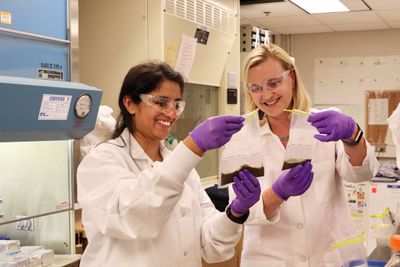
The University of Delaware’s Kalmia Kniel can discuss foodborne parasites and food safety risks, including the ongoing cyclosporiasis outbreak spreading across the United States. Kniel, a professor of microbial food safety, can explain how foodborne parasites spread, why outbreaks (particularly those involving the Cyclospora parasite) can be challenging to investigate and what consumers should know about reducing their risk of illness. She co-authored a study published in December 2025 that examined challenges researchers face in detecting, studying and controlling Cyclospora cayetanensis, including gaps in understanding the parasite and improving prevention strategies. Kniel can also discuss why fresh produce and water are often a focus during investigations and the steps consumers can take to improve food safety. Kniel’s expertise includes: • Foodborne parasites and illness outbreaks • Produce and microbial food safety • Food contamination and prevention • Food safety research Kniel discussed the biology of this specific pathogen in detail at a recent presentation on cyclospora. To arrange an interview with Kniel, visit her profile page and click the contact button. Interested journalists can else email MediaRelations@udel.edu.



University of Delaware structural engineering expert Michael Chajes is available to discuss the engineering challenges involved in assessing and stabilizing high-rise buildings following structural damage, structural failures and concerns about potential collapse. Chajes, a professor of civil and environmental engineering and a registered professional engineer, specializes in structural engineering, structural health monitoring and forensic engineering. He has provided expert commentary to national media outlets on major structural failures, including the Surfside condominium collapse and the Francis Scott Key Bridge collapse. His expertise is particularly relevant to the ongoing situation in New York involving a high-rise that is at-risk of partial collapse. He can discuss. • The conditions that can trigger structural instability during construction, renovation or changes in building use. • How engineers assess damaged structures and determine whether a building can be stabilized or safely repaired. • The engineering challenges involved in converting older office towers into residential buildings, including changes in structural loads, construction sequencing and temporary support systems. • How structural health monitoring and inspection technologies help engineers evaluate the safety of aging infrastructure and high-rise buildings. To arrange an interview with Chajes, visit his profile and click on the contact button. Interested reporters can also send an email to MediaRelations@udel.edu.
