
Experts Matter. Find Yours.
Connect for media, speaking, professional opportunities & more.

How serious is the sabre-rattling over Syria?
Last Saturday, though not ‘officially confirmed,’ a poisonous gas attack happened in the besieged Syrian town of Douma. The World Health Organization has confirmed that 500 people showed symptoms of being exposed to "toxic chemicals". This act of aggression supposedly by the Assad government has opened a Pandora’s Box. President Donald Trump is threatening missile strikes. Russian officials are threatening retaliation for any American aggression. Many world leaders are on edge and watching closely – Syria has become a powder keg and what happens next could have global implications. What are President Trump’s options? What could happen if the Russians counter? Is there a diplomatic option? There is an enormous amount at stake and a lot of scenarios to consider. That’s where experts from Missouri State University can help. Dr. David Romano, political science professor at Missouri State University, researches Middle Eastern politics and government. He's an expert in theories of peace and conflict, and foreign policy. He's available to speak about the escalating tensions, potential outcomes and consequences regarding any action in Syria. Click on his icon to arrange an interview. Source:


On Thursday, President Donald Trump announced that the U.S. would abandon the Paris climate accord. During his speech, Trump cited disputed numbers showing that the accord would result in a minimal change in temperature over time. Daniel Peppe, Ph.D., associate professor of geosciences in Baylor University's College of Arts & Sciences, studies ancient terrestrial ecosystems and how they have been influenced by environmental perturbations, such as long- and short-term climate change events. He works to recreate those ecosystems. Peppe argues that one goal of the Paris accord -- developing a strategy to keep the average increase in global temperatures to less than 2 degrees Celsius above pre-industrial levels -- is integral to warding off future disaster. He said: "The Paris Agreement represents a really significant moment in history in which the countries of the world agreed that reducing greenhouse gas emissions was fundamentally important to help reduce the most significant effects of climate change around the world. The agreement developed a strategy to keep the average increase in global temperatures to less than 2 degrees Celsius above pre-industrial levels. Crossing that threshold of temperature increase is likely the point where warming will push the Earth to a climate state that last existed millions of years ago -- one that is fundamentally different from today. Reconstructions of climate, the Earth, and its biota from the last time Earth was in a similar climate state indicate that sea level was dramatically higher, which would mean that many major cities around the world would be flooded; and many places on Earth were hotter and drier and the distributions of plants and animals on the landscape were very significantly different, which would have catastrophic effects on modern agriculture, water use and society." Source:


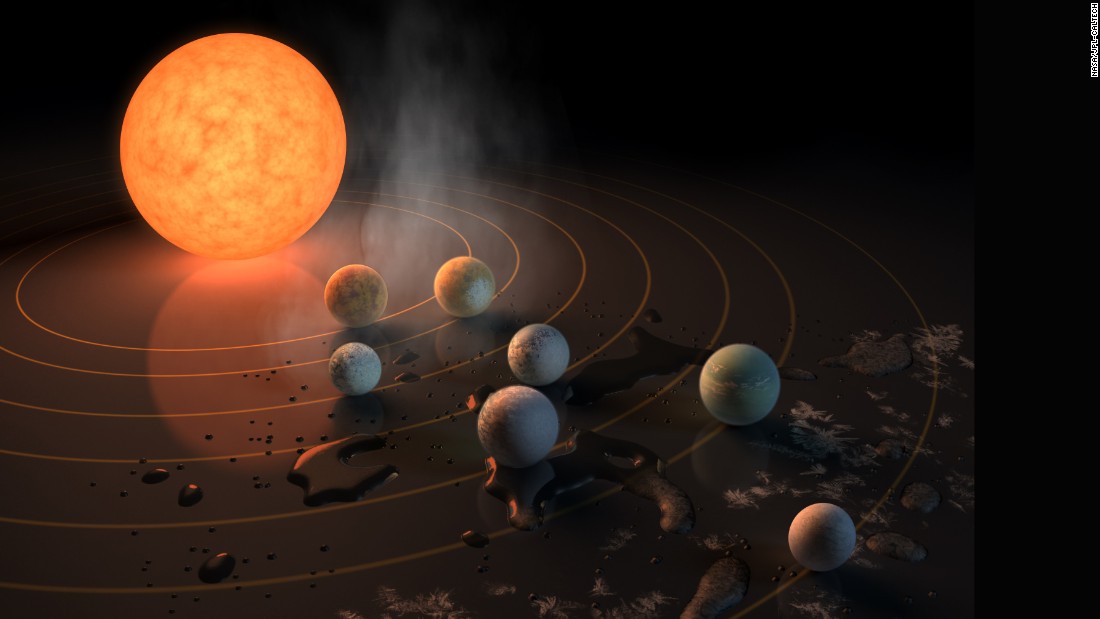
Is there life out there? Our experts can provide some insight
According to a study published Wednesday in Nature, and announced at a NASA news conference in Washington – a mere 40 light years away, astronomers have discovered seven planets similar in size and shape as Earth. As well, scientists believe these planets are made of rock and not gas – meaning if the conditions were right, they could support life. This is an amazing discovery and a great step for science but what does this mean? What’s next? And how will we ever find out if there’s life out there? How far away is 40 light years and how long would it take to make contact or for a satellite to get there? There are a lot of questions. And astronomy and physics are not simple fields to understand nor comprehend. That’s where Missouri State University can help. Dr. Peter Plavchan is an assistant professor of physics, astronomy and materials science at Missouri State. He researches the formation and frequency of exoplanets around solar-type and low-mass stars, and is an expert in astronomy and astrophysics. Dr. Michael Reed is a professor of physics, astronomy and materials science at Missouri State who specializes in asteroseismology, binary stars and extrasolar planets. Both experts are well-spoken, available to speak and can explain to the media what this all means for science, the study of space and if there might actually be life out there. Click on either of their icons to arrange an interview. Source: