
Experts Matter. Find Yours.
Connect for media, speaking, professional opportunities & more.

Keratoconus – ever heard of it? It’s an eye condition where genetics and environmental factors like ultraviolet light and vigorous eye rubbing conspire to make the usual curvature of the cornea more pointy, leaving us with double vision and nearsighted. National Basketball Association and Golden State Warriors star Stephen Curry helped make keratoconus, which affects an estimated 1 in 2,000, a more visible eye condition this April. A $2.1 million grant from the National Eye Institute is now helping Dr. Yutao Liu, vision scientist and human geneticist, learn more about keratoconus’ causes and identify points to better diagnose, treat and possibly prevent the progressive disease that typically starts in our teens. “We want to help patients better understand what is happening to their vision by better understanding how keratoconus happens, and give physicians better points to intervene,” says the scientist in the Department of Cellular Biology and Anatomy at the Medical College of Georgia and James and Jean Culver Vision Discovery Institute at Augusta University. For Curry, his solution was simple – treatment with corrective contact lenses. But keratoconus does progress and some who suffer may eventually require a corneal transplant surgery or corneal collagen cross-linking as treatment. Keratoconus is a fascinating disease and the research by experts at Augusta University will be groundbreaking. Do you need to know more? That’s where we can help. Dr. Yutao Liu is an associate professor of Cellular Biology and Anatomy with the Center for Biotechnology and Genomic Medicine at Augusta University. Dr. Liu and is available to speak with media regarding this rare disease - simply click on his icon to arrange an interview.


Why not make Don’t Fry Day…every day the sun is shining?
Looking to get the long weekend started right? Well then before you head out, lather up and apply that sunblock. The National Council on Skin Cancer Prevention has designated the Friday before Memorial Day as “Don’t Fry Day” to encourage sun safety awareness and to remind everyone to protect their skin while enjoying the outdoors. The American Cancer Society estimates there will be more than 73,870 new cases of malignant melanoma, the most serious form of skin cancer, and more than 2 million new cases of basal cell and squamous cell skin cancers in the U.S. Fortunately, skin cancer is highly curable if found early and can be prevented. Remember to “Slip! Slop! Slap!...and Wrap” when you’re outdoors. Slip on a shirt Slop on broad spectrum sunscreen of SPF 30 or higher Slap on a wide-brimmed hat And wrap on sunglasses. The best way to detect skin cancer early is to examine your skin regularly and recognize changes in moles and skin growths. There’s a lot to know and we have an obligation to ourselves and our loved ones to make them sun-safe and cancer free. If you are covering this topic or need to know more, let one of our experts help. Dr. Jigarkumar Parikh is a medical oncologist specializing in kidney cancer, prostate cancer, bladder cancer and melanoma at the Georgia Cancer Center at Augusta University. He is available to speak with media regarding skin cancer – simply click on his icon to arrange an interview.

Georgia Southern researchers find adverse childhood experiences associated with short sleep duration
Georgia Southern University professors from the Jiann-Ping Hsu College of Public Health (JPHCOPH) recently completed a study that shows adverse childhood experiences are associated with short sleep duration in adults. Recently, the study was published in SLEEP, the benchmark international journal for sleep and circadian science. The JPHCOPH team looked at nationally representative data from 22,403 adults. Participants in the study who had adverse childhood experiences were more likely to have short sleep duration (less than 6 hours per night) than those without such experiences. Each adverse experience increased the likelihood of insufficient sleep by over 20%, and the association remained throughout adulthood. The study participants were part of the 2011 Behavioral Risk Factor Surveillance System, conducted by the Centers for Disease Control, in which they completed questionnaires detailing childhood experiences of abuse, neglect and household challenges as well as how many hours they sleep nightly as adults. Short sleep duration was not accounted for by mental health challenges or poor physical health, which suggests there are different underlying causes. Over 60% of adults in the U.S. report having experienced at least one adverse childhood experience. The results emphasize the importance of childhood neurodevelopment on long-term health outcomes. Also, the data provides new information on how long adverse childhood experiences may affect sleep and calls for further investigation of the role of childhood experiences in people with sleep challenges. Do you need to know more? Are you looking at stories or to cover how adverse childhood experiences impact sleep and how the long-term effects can follow that individual into adulthood? Let our experts help. Kelly Sullivan, Ph.D., is an expert in epidemiology and neurological diseases and Haresh Rochani, DrPh, is the director of the Karl Peace Center for Biostatistics in the Jiann-Ping Hsu College of Public Health at Georgia Southern University. Both experts are available to speak to this topic – simply click on either icon to arrange an interview.


Watch your step…snake season is in full swing! Let our experts help with your questions!
In Georgia there are sure signs of spring - flowers are in bloom…and snakes are back in the grass. Now before you shriek or shirk away at the sound or sign of a snake, it is important to know that snakes play and important and vital role in the local ecosystem. They’re essentially nature’s pest control - keeping rats, mice, moles and other rodents at bay. In fact, seeing a snake is usually a sign of good environmental health for your garden, property or local environment. And now for the less than good news. Some snakes in Georgia are dangerous. In fact, there are six different venomous snakes slithering around the state. And it’s not just in the forests and countryside, copperheads are all part of the metropolitan urban landscape too. So, what precautions do people need to take? What are the simple do’s and don’ts if you encounter a snake? Are there easy ways to identify dangerous and non-dangerous snakes? And – this season seems to be producing a much more pronounced snake population– why is that? There are a lot of questions to be asked – and that’s where our experts can help. Lance McBrayer from Georgia Southern University is an expert in organismal ecology and snakes. He’s happy to talk with media - simply click on his icon to arrange an interview.

/arc-anglerfish-arc2-prod-mco.s3.amazonaws.com/public/L6SURNCQV5FBDM3EJRPWVSETNU.jpg)
Modern times call for modern solutions. In these days of digital transformation – the new trenches of warfare are dug in cyberspace. In fact, just recently NATO ran a four-day drill where the exercise simulated a cyber attack on a country’s infrastructure and election process. Cyber-warfare is the new reality across the globe. It’s with these advancements that the Georgia Southern University Center for Applied Cyber Education (CACE) signed an Education Partnership Agreement (EPA) with the 688th Cyberspace Wing (688 CW). “As of now, we are the only academic organization in the country that has a direct EPA with the 688 CW,” said CACE Executive Director Scott Scheidt. “The collaboration supports research and development activities for Georgia Southern faculty and students across multiple disciplines, allowing them access to defense laboratory projects that would not otherwise be available in an educational environment.” Are you interested in cyber-warfare or covering this topic? Do you need to know more? Just how vulnerable is America? What are the likely targets? And who are the actual likely perpetrators? There’s still a lot to learn about this topic and that’s where an #expert from Georgia Southern University can help with your coverage. Scott Scheidt is the executive director of the Center for Applied Cyber Education at Georgia Southern University. He is an expert in cyber security and cyber workforce development. Scott is available to speak with media regarding this topic – simply click on his icon to arrange an interview.
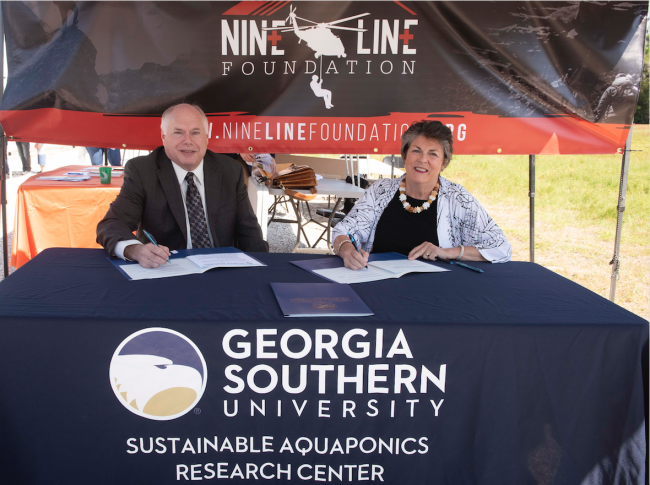
Working together to promote veteran education
Georgia Southern University recently signed an agreement (see attached) with Nine Line Foundation that will assist veterans as they transition back into civilian life. Veterans will be enrolled in an aquaponics training program with the University’s Armstrong Campus’ Sustainable Aquaponics Research Center (SARC) at a compound at Nine Line Apparel in Savannah, Georgia. Aquaponics, or soilless farming, mixes aquaculture, the farming of fish, and hydroponics, to fuel the growth of plants in water. The SARC, a 4,100 square-foot greenhouse, has four independent recirculating systems, each containing 900-gallon tanks capable of holding more than 100 mature tilapia. Working within the College of Science and Mathematics, the SARC is focused on providing students, faculty and volunteers with the opportunity to conduct fundamental, interdisciplinary research in the area of aquaponics. The partnership with Nine Line Foundation will extend education opportunities to area homeless veterans and provide faculty and students an opportunity to engage with the veterans. Are you interested in learning more about his project and how Nine Line Foundation and Georgia Southern University are working together to provide opportunities and training to veterans? SARC’s director, Brent Feske available to speak with media – simply click on his icon to arrange an interview.

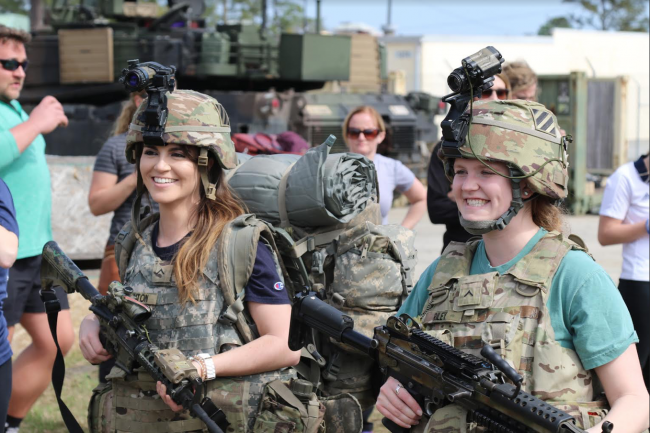
Musculoskeletal disorders are the number one reason for soldier evacuation and account for almost 25 percent of all military injuries compared to combat injuries, which account for 14 percent in the armed forces. It was with that knowledge that students from Georgia Southern University’s Department of Rehabilitation Sciences met up with soldiers from the Army’s 3rd Infantry Division at Fort Stewart-Hunter Army Airfield in Georgia to gear up and better understand soldiers’ unique physical challenges and how they can help better prepare them for combat. “The event provided our students with a much better insight as to the physical demands of soldiers at Fort Stewart,” said Nancy Henderson, DPT, assistant professor of rehabilitation sciences on Georgia Southern’s Armstrong Campus in Savannah . “This added knowledge will help them to better tailor their education while working with soldiers.” As technology and equipment change and adjust between each theatre of operation it is imperative that the America’s soldiers stay fit and have all the knowledge and resources, they require to achieve their assigned task. But why were so many soldiers suffering from musculoskeletal disorders? Is the issue easily solved? And how can every branch of the armed forces adopt and adapt how they’re operating on the ground to avoid these issues? There are a lot of questions to be answered and that’s where our experts can help. Dr. Nancy Henderson is an assistant professor in the Department of Rehabilitation Sciences at Georgia Southern University. She is an expert in injury prevention, running form and assessing meaningful change of interventions. Nancy is available to speak with media regarding this topic – simply click on her icon to arrange an interview.

The amazing story of General Casimir Pulaski and the secret the war hero took to the grave
He’s a person who has intrigued Americans for centuries and will be the subject of a documentary airing Monday. Scientists have confirmed that legendary Revolutionary War hero and famed General Casimir Pulaski took a secret to the grave. The General was intersex. News of this was enough to inspire an episode in Smithsonian Channel's "America's Hidden Stories" documentary series. Georgia Southern University’s Virginia Hutton Estabrook, Ph.D., assistant professor of anthropology, was recently contacted by media for expert perspective and comment. In the documentary — “The General Was Female?” — which premieres Monday, scientists use skeletal remains and DNA testing to make a case that the skeleton was Pulaski’s and that the Polish-born general was intersex, or what used to be known as a hermaphrodite.“That’s pretty much the only way to explain the combination of features that we see,” said Estabrook, who participated in the most recent effort to identify the bones, and appears in the documentary.“He was so important as a touchstone for the Polish community. And it’s kind of cool that in the 21st century, Pulaski can be a touchstone for a different group of people: That, hey, there were intersex people in history, too, and here’s this one who had this really amazing life: heroic, resourceful, all of the features in the American narrative that we value and treasure.” – Chicago Tribune This discovery unearths questions about what this might mean as we all look back at history and the real people who helped write it. Are you covering this story and need to expert perspective, insight and information? That’s where the experts from Georgia Southern University can help. Virginia Hutton Estabrook is an assistant professor of anthropology and played an integral role in this discovery. She is available to speak with media – simply click on her icon to arrange an interview.
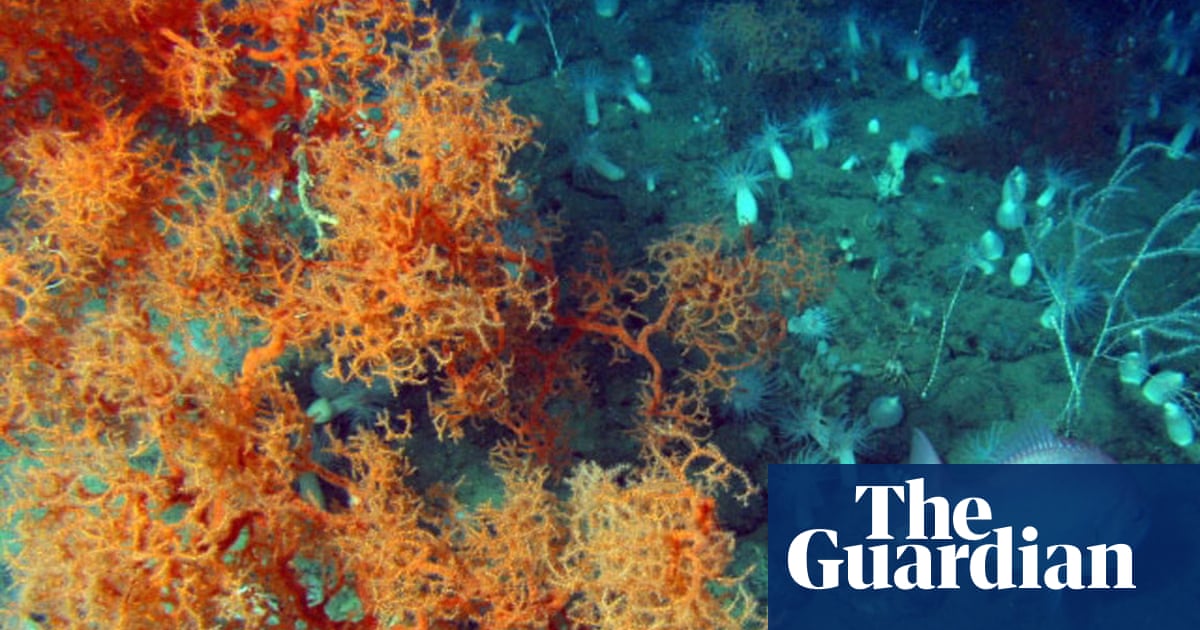
Record freezing temperatures and global warming – let our experts explain
This week has seen temperatures drop to record lows. Across the mid-west, a polar vortex coupled with biting winds saw temperatures plunge below minus 50 degrees Fahrenheit. As the word has been focusing on climate change, its causes and effects – this week stands as a stellar example of the impacts of global warming. Despite the tweets and trolls of prominent politicians somehow aligning a deep freeze as a counter argument for climate change the evidence is becoming more clear - with global warming, comes warnings far more worrisome. Dr. Pamela Grothe, an Assistant Professor in the Department of Earth and Environmental Sciences at the University of Mary Washington, was recently quoted in the Guardian about how global warming is forecasting a grim future at the rate we are going. “Warmer temperatures and associated lower oxygen levels in the ocean are sufficient to explain the observed extinctions we see in the fossil record”, she says. “We are already seeing warming ocean temperatures and lower oxygen in many regions, currently affecting marine ecosystems. If we continue in the trajectory, we are on with current emission rates, this study highlights the potential that we may see similar rates of extinction in marine species as in the end of the Permian.” And is this just the beginning? What other extremes can we expect to see in our weather? Can that trajectory Dr. Grothe reference be turned around or slowed down? And what species are the most vulnerable and what ripple effect will that have on our oceans? There are a lot of questions to be asked – and that’s where the experts from the University of Mary Washington can help. Dr. Pamela Grothe is an assistant professor in the Department of Earth and Environmental Sciences as the University of Mary Washington. She recently completed a Ph.D. in the Paleoclimatology Lab at the Earth and Atmospheric Sciences department at Georgia Institute of Technology. Her current research involves a study of the central Pacific climate and El Niño Southern Oscillation (ENSO) variability over the past 6000 years through the analysis of coral fossil records. She’s an #expert in climate change and is available to speak with media – simply click on her icon to arrange an interview.



In Georgia governor's race, women could cast deciding vote
With the 2018 midterm elections looming less than a month away, Georgia gubernatorial candidates Stacey Abrams and Brian Kemp are neck-and-neck according to the latest Atlanta Journal Constitution/Channel 2 poll. In an election year with record voter registration numbers in the Peach State—and amid allegations of voter suppression—women voters could cast the deciding vote. But for which side? To find the answer, says Dr. Mary-Kate Lizotte, associate professor of political science at Augusta University, look to the issues. “Women, in particular Republican and Independent women, differ from men of the same party on the issues of government spending on childcare, public schools, welfare, social security, and aiding the homeless,” Lizotte said. “Women typically favor increased spending on the issues.” Examining data from 1994 to 2008, Lizotte, an expert on gender differences relating to public opinion, found that women are also more liberal than men of the same party on the issues of gay rights, government-guaranteed standard of living, and on the provision of more government services. “For races where these issues have become salient, it might be the case that women would be more likely to be motivated to turn out to vote and to vote for candidates that have liberal positions on these issues,” she said. That could be excellent news for the Abrams campaign, which has emphasized public education funding. “Women in Georgia who believe in increasing public education funding should be more likely to vote for Abrams,” Lizotte said. “This may also be the case for several House races where the issue of tax reform and tax cuts has become salient.” The confirmation of Justice Brett Kavanaugh to the Supreme Court earlier this month could also sway election results, albeit in less clearly defined ways. Lizotte said the confirmation could either motivate conservative women voters to turn out or, alternatively, dissuade Republican women with Pro-Choice leanings from voting entirely. The expectation is a little more cut-and-dry for liberal women voters. “The Kavanaugh confirmation is just one more reason to expect an increase in voter turnout among liberal women,” she said. “The Women's March in 2017 and 2018 along with the increase in female interest in running for office all indicate that the Trump election and presidency had already galvanized liberal women voters.” Finally, Lizotte said, although white women are divided politically—with college-educated white women swaying Left and those without a college degree favoring the Right—there was no such division among African American women voters. “And as we've seen, African American women turnout at high rates and can influence elections like the Alabama Senate race,” she said. Dr. Lizotte is available to discuss: "Gender gaps" on various issues leading up to the 2018 midterm elections The role of women voters in State and National elections The perception of voters, in terms of public opinion, toward candidates in Georgia's gubernatorial election.
