
Experts Matter. Find Yours.
Connect for media, speaking, professional opportunities & more.
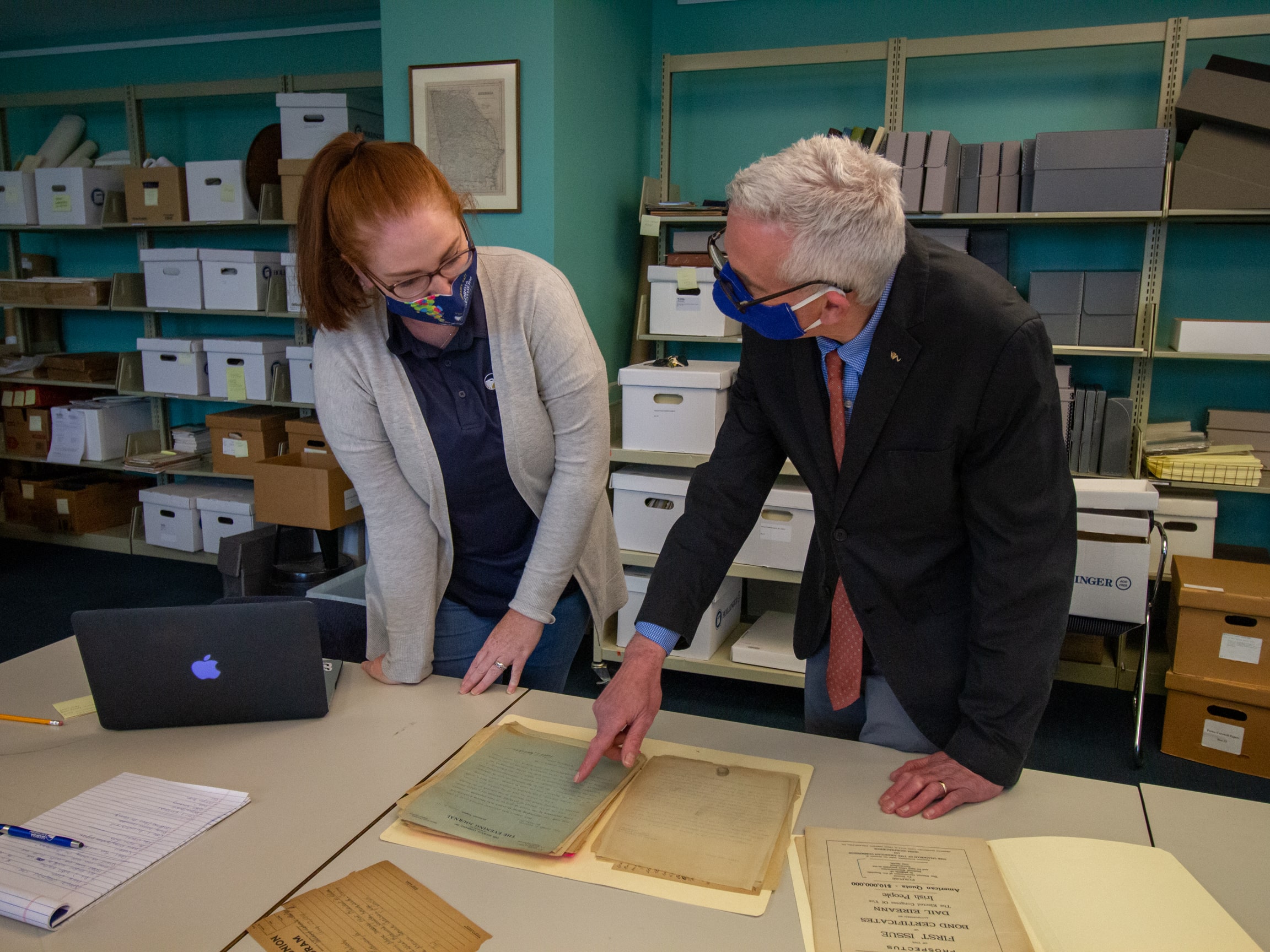
This year marks 100 years since the signing of the Anglo-Irish Treaty, which eventually would establish Ireland as a republic, and Georgia Southern University undergraduate student Caitlyn Hudson is getting a first-hand look at some historical documents that chronicle U.S. efforts to help establish Ireland’s freedom from British rule. Hudson is researching a collection of documents called the Lawless papers, which follow Virginia-native and Irish descendant Joseph Thomas Lawless’ involvement in the southern leg of an extensive U.S. tour by Éamon de Valera, a prominent political leader in Ireland’s history. “My favorite part of working on the project has to be the physical work with the documents,” Hudson said. “It is fascinating to see primary documents in hand rather than online. It provides a unique form of analysis.” The collection, which was gifted in Fall 2020 to the Center for Irish Research and Teaching (CIRT) at Georgia Southern, includes letters, advertisements and more that document an important narrative in modern Irish-American history, according to Howard Keeley, Ph.D., director of CIRT. “These documents shed significant new light on how Ireland perceived Savannah and our region at a critical time in Irish history: that nation’s War of Independence from 1919 to 1921,” Keeley said. “The collection helps us understand the network that Éamonn de Valera and other future leaders of an independent Ireland sought to build in the American South, using as one anchor the sizable and active Irish-American community in Savannah.” All of the Lawless papers were either written or received by Lawless, the son of immigrants from County Galway, Ireland. Lawless was involved in arranging southern stops on de Valera’s tour, which included a stop at the Chatham Artillery Armory in April 1920, in an effort to raise funds for the self-proclaimed Republic of Ireland. Lawless, who would go on to become a lawyer and prominent political figure in Virginia, was also very devoted to Ireland and involved in several prominent Irish-American organizations, including the Friends of Irish Freedom (FOIF), which advocated for political independence for Ireland. “De Valera’s fundraising tour of the U.S. is among the most important episodes in modern Irish-American history,” said Keeley. “The collection sheds significant light on how FOIF used the tour to advance a southern strategy. Clearly, Judge Lawless was key to those efforts.” Keeley also pointed out that in time, de Valera would become prime minister, and then president, of an independent Ireland, dominating the country’s politics for decades. The collection was gifted to CIRT by direct descendants of Lawless and is now housed in the special collections section of the Zach S. Henderson Library. “We are honored to be granted stewardship of these documents,” said Autumn Johnson, special collections librarian at Zach S. Henderson Library. “Having increased opportunities for Georgia Southern students to examine rare, one-of-a-kind collections, such as the Lawless papers, enriches the learning experience, particularly for our undergraduates.” Hudson said her work on the project has allowed her to fully understand the various aspects of potential careers she can pursue, as well as narrow down specific goals for her graduate school journey and beyond. “This type of work is generally done by graduate students, and it is amazing to know that I am able to gain experience in a field while an undergraduate,” said Hudson. “It has allowed me to learn career-relevant material earlier on and in turn has allowed me to better prepare for graduate school and my overall future goals.” Keeley added a collection like the Lawless papers allows students and faculty to conduct research on high-value primary source documents. The collection will also help further CIRT’s ongoing mission to increase research productivity, particularly with respect to the history of the Irish in Savannah and the state of Georgia. “The Irish experience in the south is open to much more study than has thus far been attempted,” Keeley said. “The generous gift of the Lawless papers to the Center for Irish Research and Teaching significantly enhances our drive to conduct meaningful research. For undergraduate students, such as Caitlyn, the opportunity to uncover knowledge by analyzing primary-source documents brings new levels of rigor and satisfaction to the college experience. And for our program, this collaboration with the Special Collections unit of University Libraries is a powerful way to honor our donors’ trust in us and, in addition, celebrate Irish heritage, especially around St. Patrick’s Day.” If you're a journalist looking to learn more about his project of the historical significance the Irish had on Georgia - then let us help. Dr. Howard Keeley is available for interviews — simply reach out to Georgia Southern Director of Communications Jennifer Wise at jwise@georgiasouthern.edu to set and time and date.


What We Can Learn From Celebrating Irish-American Heritage Month
About two weeks ago, President Joseph Biden declared March 2021 Irish-American Heritage Month. In an official statement, the president said, "We owe a debt of gratitude to the Irish-American inventors and entrepreneurs who helped define America as the land of opportunity... The fabric of modern America is woven through with the green of the Emerald Isle." As the director of the Center for Irish Studies at Villanova University, an institution founded by Irish Augustinians to educate the children of Irish immigrants, Joseph Lennon, PhD, agrees. He hopes to use this presidential declaration as an opportunity to expand the conversation around what it means to be of Irish descent beyond wearing green and watching the annual St. Patrick's Day parade. The way Dr. Lennon sees it, "there is much more to Irish America than a parade and parties." With such a rich history of Irish immigrants and their descendants living in and contributing to the development of the United States, Dr. Lennon sees March 2021 as an important time to reflect on the "contributions and travails of this ethnicity" in a way that reaches beyond "silly slogans and marketing schemes." He reminds us, "there are over 30 million Irish Americans. The Irish contributed massively to the infrastructure of industrial America and later to the civil, education and business worlds—not to mention the Catholic Church." Dr. Lennon also hopes this month will help redefine the larger notion of what it looks like to be Irish and American. He notes that "38% of African Americans have Irish ancestry," but acknowledges that "this is a complicated issue," since in some cases this may stem from abuses suffered during the American practice of slavery. It is important conversations like these that Dr. Lennon wants to bring to light during Irish-American Heritage Month, and he stresses that "more research is needed into understanding this history—as well as the unions between Irish immigrants and northern-bound African Americans during the late nineteenth century." Per Dr. Lennon, these historical events are tied to our present day. He sees a need for "the level of recent racist attachments to Irishness... to be confronted with historical knowledge and anti-racist understandings." With such important issues in mind, Dr. Lennon wants to impart that "the Irish diaspora is global and diverse and Irish culture runs much more deeply and broadly in America than we might guess by just attending the St. Patrick's Day celebrations." He adds, "I'm curious to see if the conversation continues past St. Patrick's Day this year." Despite most St. Patrick’s Day events and programs being virtual in 2021, there are many opportunities to celebrate Irish-American heritage this year. At Villanova, the Center for Irish Studies is hosting a virtual St. Patrick's Day Celebration called "Links Across the Atlantic" on Wednesday, March 17, from 10:00 a.m. to 9:00 p.m. This free celebration will include live entertainment segments, from an Irish breakfast tutorial with study abroad director Mary Madec to lunchtime laughs with actor Johnny Murphy, and will culminate with a streamed Irish music fèis (or festival) in partnership with Tune Supply, featuring We Banjo 3, the Friel Sisters and One for the Foxes! For more information or to register for this event, please click here.


Japan Society Presents When Practice Becomes Form: Carpentry Tools from Japan
Installation view at the Takenaka Carpentry Tools Museum, Kobe, Japan. On the occasion of the 50th anniversary of Japan Society’s landmark building, the institution is pleased to present the new exhibition, When Practice Becomes Form: Carpentry Tools from Japan. The exhibition celebrates the spirit of architecture and craftsmanship through Japanese woodworking tools as well as architectural patterns and various models. The site-specific installation, conceived by the esteemed contemporary architect Sou Fujimoto in collaboration with Brooklyn-based Popular Architecture, reinterprets major themes from the exhibition and is in dialogue with the gallery’s spaces, highlighting an enduring connection between traditional Japanese wooden construction and modern architecture. Featuring hand tools and joinery techniques that have been used for hundreds of years to build Japan’s wooden architectural masterpieces (from temples and shrines to teahouses and bridges), the exhibition unpacks how the intangible qualities of craftsmanship, such as consummate experience, knowledge, and the honed skills of master carpenters, have been transformed into significant forms of architecture. A diverse array of tools—planes, chisels, saws—have played an important role in the development of architecture in Japan’s history, and this philosophy extends to Japan’s cultural heritage today. Integral to the process of making by master carpenters (tōryo) is their extensive knowledge of the local environment and of wood as a material. Using natural resources and learning from their predecessors’ practices, they construct buildings using a refined methodology. Their philosophy of sustainability—for example, joinery can be restored or repaired as needed by future craftspeople—has been handed down over generations. Themes emerging from the exhibition have been interpreted by the internationally acclaimed architect Sou Fujimoto. His firm, Sou Fujimoto Architects, is based in Paris and Tokyo, and has been selected as site design producer for the 2025 World Exposition in Osaka, Japan. Fujimoto has designed the Serpentine Gallery pavilion in London (2013) among other internationally recognized projects. For this exhibition, Fujimoto has worked with Popular Architecture to explore the coexistence of nature and architecture. “Japan Society has been a home of cultural exchange, and a meeting place of past and present. In this exhibition, traditional Japanese craftsmanship is revealed in a new light by the design of contemporary architect Sou Fujimoto, and it becomes a precious educational opportunity to learn from this history,” says Yukie Kamiya, Japan Society Gallery Director. The building of Japan Society’s headquarters, designed by the architect Junzo Yoshimura (1908–1997), a major figure in 20th century Japanese architecture, opened to the public in 1971, becoming New York City’s first permanent structure designed by a Japanese citizen. It will commemorate its 50th anniversary in 2021. The building resides on land donated by John D. Rockefeller 3rd (1906–1978), former President and Chairman of Japan Society, who sought to revitalize the organization’s activities after World War II. Rockefeller 3rd and Yoshimura first met in Japan in 1951, and their friendship for over two decades resulted in Japan Society’s current building in Manhattan. Since its opening, the building has continued to serve as the central platform for the interexchange of ideas, knowledge, and innovation between the U.S. and Japan within a global context. In 2011, the building was designated landmark status by the New York City Landmarks Preservation Commission. When Practice Becomes Form: Carpentry Tools from Japan explores the connections between techniques, tools, and forms from traditional practices in Japanese carpentry and contemporary design perspectives. Paying homage to Japan Society’s building, where the arts and cultures of Japan and the United States intersect, this exhibition delves into the artistry and craftsmanship of architectural practice. Complementing the exhibition is a series of related public programs, including lectures, a hands-on workshop, and gallery tours. A digital publication illustrated and designed by Nathan Antolik further expands upon the exhibition. This exhibition is organized by Japan Society in collaboration with Takenaka Carpentry Tools Museum, Japan. The exhibition design is by Sou Fujimoto, in collaboration with Popular Architecture as local architect. About Sou Fujimoto Born in Hokkaido in 1971, Sou Fujimoto graduated from the Department of Architecture, Faculty of Engineering at Tokyo University and established Sou Fujimoto Architects in 2000. He has won several international competitions, including his recent 1st prize for the 2014 International Competition for the Second Folly of Montpellier, France ("L'Arbre Blanc"). In 2019, he was selected as the master architect for the Tsuda University Kodaira Campus Master Plan development. Among his notable projects are the annual summer pavilion for the Serpentine Gallery in London (2013)—the youngest architect to receive the commission; House NA in Tokyo (2012); Musashino Art University Museum & Library (2010); and House N (2008). In 2012, he was part of the Japanese team that won a Golden Lion award for Best National Participation at the Venice Architecture Biennale for their design of alternative housing concepts for homes destroyed by the 2011 tsunami. Most recently, he was selected as site producer for the 2025 World Exposition in Osaka, Japan. About Popular Architecture Brooklyn-based Popular Architecture combines simplicity with innovation across multiple scales ranging from master plans to buildings, interiors, and products. The firm is directed by Casey Mack, RA, LEED AP. After completing his M.Arch at Columbia, Mack worked with the Office for Metropolitan Architecture in Hong Kong and New York. He has taught urban design at the New York Institute of Technology and Passivhaus housing at Parsons School of Constructed Environments. Currently, with the support of the Graham Foundation for Advanced Studies in the Fine Arts, he is writing the book Digesting Metabolism: Artificial Land in Japan 1954-2202 (Hatje Cantz Verlag, 2021).


Inauguration day - Trump's legacy, Biden's priorities
Speaking this morning on BBC radio, Dr McCrisken said: "President Trump’s legacy is being written right now. He’s ending his presidency under such dark clouds - he’s been impeached, there’s going to be a trial in the Senate that could convict him and prevent him from becoming a candidate again for the Presidency, so he’s leaving with lots of controversy – which of course is something that he’s always cultivated to a large extent, he wants to make everything about him. "Even today, by not showing up at the inauguration, by having a separate departure address, by issuing pardons including to his close former adviser Steve Bannon, he’s still cultivating that attention. That’s going to be the biggest Trump legacy - the degree to which he has attempted to shake up American politics – but the normality of American politics continues, we’re going to have a handover of power today through this inauguration, in the way that it always happens, every 4 years and the pendulum will swing again politically back to the Democrats. "There’s lots of pomp and circumstance around the Inauguration but the main moment is at noon, when Joe Biden will take the oath of office to become President of the United States – place his hand on a bible and say the sacred words with the Supreme Court Chief Justice presiding, and then Kamala Harris, very significantly, will also be sworn in as Vice President. She’s the first woman to become VP and the first VP of Black and South Asian heritage. It’s a really significant moment for both of them. "After the swearing in the next significant moment is the Inaugural Address, the first time Joe Biden speaks to the country as President. He’ll try and set the tone for his presidency – we can expect him to seek unity and healing but also assert his policy positions and his approach and set himself apart from the last four years under Trump. "Biden wants to hit the ground running, as soon as all the ceremonies are over today he’s going to be heading up to the White House and he’ll start business as President. One of the first things he’ll do, which a lot of Presidents do when they take office, is issue a series of Executive Orders – these are orders that are given directly by the President to the rest of the Executive Branch to implement policy in particular ways, and he’s going to use these to very quickly overturn some of the things that Trump did, like re-joining the Paris Climate Agreement, changing policies around immigration, changing policies around COVID-19 as well. "But he’s also putting forward some really significant legislative proposals to Congress, he’s seeking a very quick economic stimulus, another 1.9 trillion dollars of COVID relief, and a new immigration policy is in the offing. COVID-19 particularly is the thing he really wants to challenge as quickly as possible and try to turn around the situation in the United States where the virus is still ripping though the country – from his position as President, he’s going to try and get 100 million vaccinations in his first 100 days, that’s what he’s promising. "There’s a lot of challenges here and it’s going to be very difficult for him - particularly being overshadowed perhaps by the impeachment trial – so it will be an interesting few weeks and months ahead at the start of his Presidency." 20 January 2021
