
Experts Matter. Find Yours.
Connect for media, speaking, professional opportunities & more.

Why it just makes ‘cents’ to know your financial ABCs early in life – let our expert explain.
Managing money, understanding interest and how to avoid debt – all these elements make up some of the very basics of financial literacy. However, despite a humming economy and record low unemployment, more and more Americans are falling deeper into debt. Just recently, CBS News reported that roughly 4 in 10 Americans can’t cover an unexpected bill of 400 dollars. Something desperately needs to be done about not just how we are handling our money – but when we are taught the how banking, money and personal finances work. It’s a topic of concern and one that is gaining traction. Showbiz moguls Will Smith and Nas invested in a financial literacy app for teens (see attached article). The issue is finally on the radar of leaders in Washington and throughout the country as well, with 19 states now requiring financial education to graduate, according to the Council for Economic Education, up from 13 in 2011. Can these efforts make a real impact and reverse the tide of financial illiteracy? How did America get to this point? Is this about our spending habits and access to credit or a lack of education? And if we don’t correct the curse – what could it mean for our economy? There are a lot of questions and that’s where our experts can help! Professor Jonathan Clarke is an award-winning teacher and researcher in the fields of investment banking, finance and analysis. Clarke created a personal finance course that is offered to all Georgia Tech students that provides the importance of budgeting, basics of credit, as well as more advanced financial topics such as investing and trading. He’s an expert in the field and is available to speak with media about economics and the importance of financial literacy – simply click on his icon to arrange an interview. He has also developed a one-week summer course for high school students – Wall Street on West Peachtree and annually assists the Boy Scouts with obtaining their finance badge.


Sawfish and hammerheads – we’ve got shark sightings and here’s what you need to know!
It was a rare occurrence, and for Florida Atlantic University’s resident shark expert Stephen Kajiura, Ph.D. – it happened twice. Kajiura has photographed millions of sharks – but this sighting was no regular day on the water. “The first sawfish was near Boca Raton and was seen swimming southbound in shallow water. He estimated it to be about 9 feet long. The second one was near MacArthur State Park on Singer Island and a little larger. Sawfish can grow as large as 17 feet in length. Kajiura's sawfish encounters are the latest in a regular string of encounters reported by anglers, divers and researchers. In recent years, sawfish have been caught and released by Florida anglers fishing from beaches for sharks, or in inlets for tarpon. Sawfish have become regular catches for anglers fishing the waters of the Indian River Lagoon, Everglades National Park or the waters of Charlotte Harbor. “ - TC Palm – USA Network That was last month, however, just recently, a large hammerhead shark was coming dangerously close to shore, raising some cause for concern about swimmer safety. Lifeguards closed the Nokomis Public Beach for close to an hour until the enormous fish had departed for deeper waters. The encounter left some scared and some curious – looking to catch a glimpse or picture of the gigantic shark. So, what do you do when a shark comes close to shore? How dangerous is it? How can experts or event he public tell when a shark is aggressive or just passing by? Sharks do call the ocean home – what do we all need to do to exist in harmony? Are you covering? Do you need to know more about sharks, the dangers they pose and what we really need to be concerned about and even break down some of the myths and legends about just how concerned humans need to be about these predators? Let our experts help. Stephen Kajiura, Ph.D., is a professor and researcher at Florida Atlantic University. He’s also an expert in sharks and shark behavior. Stephen is available to speak with media – simply click on his icon to arrange an interview.


Monitoring the migration of blackfin sharks – Florida Atlantic’s experts are in the news
Seeking the warmer waters of the south coast – it is that time again for the annual migration of the black fin shark. These majestic sharks can grow up to 8 feet and weigh in at more than 200 pounds when fully grown. They’re also listed by the International Union for Conservation of Nature (IUCN) as near threatened, mostly due to the fact it is a targeted for its meat and its fins, which are used to make shark fin soup. Recently, one of our experts was featured in the media for his efforts in ongoing research and his studies are benefiting those who live both on water and on land. “Dr. Stephen Kajiura, a researcher at Florida Atlantic University, has been tracking the migration patterns of these apex predators by air and sea. Now Kajiura's latest tool is providing thorough details about their every move. He is capturing their movements and gathering detailed information through a $5,000 reusable radio and satellite sensor attached to their dorsal fins for two to four days. Data from these "shark diaries" records information, including how often they swish their tails, at what depth they prefer to swim, and at what time of day they swim close to the beach — proving beneficial to lifeguards responsible for beach safety.” Tampa Bay Times Are you covering? Do you need to know more about sharks, the dangers they face and what researchers are learning about these amazing species of fish? Let our experts help. Stephen Kajiura, Ph.D., is a professor and researcher at Florida Atlantic University. He’s also an expert in sharks and shark behavior. Stephen is available to speak with media – simply click on his icon to arrange an interview.

United Nations Report Warns of Potential Extinction of One Million Plant and Animal Species
The United Nations has issued an assessment sounding the alarm that one million plant and animal species are at risk of extinction due to human-related changes to the Earth’s natural landscapes. This poses a dire threat to ecosystems upon which people all over the world are dependent for survival, according to a New York Times report. The human degradation of the environment has further been exacerbated by global warming, it added. “Biodiversity is caught between the stark, local effects of human action, like deforestation, and the diffuse but steadily worsening global effects like climate change. This report says the combination is more devastating than the sum of its parts,” stated Adam Langley, PhD, an associate professor in Villanova University’s Department of Biology. Consumerism is a driving factor in the rapidly deteriorating situation, Dr. Langley said. “It’s becoming clear that no amount of information can overwhelm the will of the consumer, whether it's the greed of the wealthy or desperation of the poor. Producers and consumers act out of personal interests, not out of their fondness for wildlife.” Government action must lead the way in alleviating the severity of the direction in which biodiversity loss is headed, according to Dr. Langley. “To make the drastic changes we need, the solutions must come from the top. Governments must recognize the enormous subsidy we receive from intact ecosystems in the form of food, fiber, clean water and air. In our world, valuing biodiversity means putting a price on it—and paying the price when we degrade it.” He added, “When I see reports like this, I’m struck that, in the history of Earth, we are the first species that is able for foresee an extinction event. We can predict it in painful detail. Avoiding that demise would be truly unique, but we’ve yet to see if human nature has that capacity.”


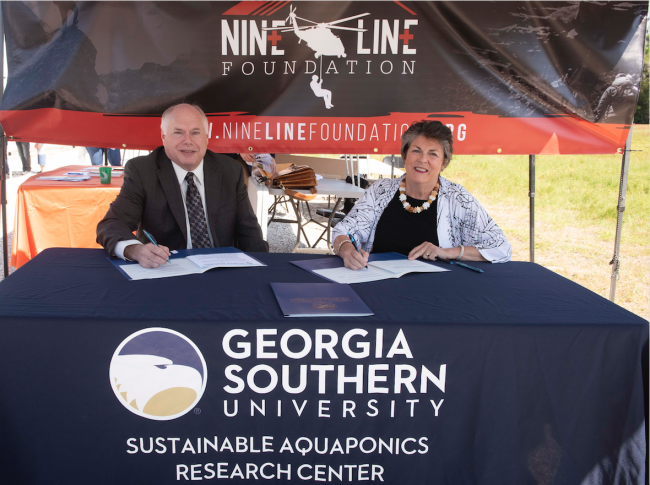
Working together to promote veteran education
Georgia Southern University recently signed an agreement (see attached) with Nine Line Foundation that will assist veterans as they transition back into civilian life. Veterans will be enrolled in an aquaponics training program with the University’s Armstrong Campus’ Sustainable Aquaponics Research Center (SARC) at a compound at Nine Line Apparel in Savannah, Georgia. Aquaponics, or soilless farming, mixes aquaculture, the farming of fish, and hydroponics, to fuel the growth of plants in water. The SARC, a 4,100 square-foot greenhouse, has four independent recirculating systems, each containing 900-gallon tanks capable of holding more than 100 mature tilapia. Working within the College of Science and Mathematics, the SARC is focused on providing students, faculty and volunteers with the opportunity to conduct fundamental, interdisciplinary research in the area of aquaponics. The partnership with Nine Line Foundation will extend education opportunities to area homeless veterans and provide faculty and students an opportunity to engage with the veterans. Are you interested in learning more about his project and how Nine Line Foundation and Georgia Southern University are working together to provide opportunities and training to veterans? SARC’s director, Brent Feske available to speak with media – simply click on his icon to arrange an interview.



Big trouble in Little Taiwan? Our experts weigh in.
It won’t be just America that faces a heated and high-stakes election in 2020, the small country of Taiwan is also at political cross-roads and its future could hang in the balance. To look back, just over two years ago, the pro-independence Democratic Progressive Party (DPP) won a major victory in both the presidential and the legislative elections over the Nationalist Party or Kuomintang (KMT) in Taiwan. KMT’s pro-China approach was thoroughly rejected by voters. However, recent elections saw a serious shift back in opinions toward the KMT’s favor, delivering a severe blow to Taiwanese President Tsai Ing-wen. In a recent Financial Times piece, added her perspective. “Elizabeth Freund Larus, a Taiwan expert at the University of Mary Washington in Virginia, said China would probably seek to capitalize on a series of DPP losses in local elections in November to sow discontent among Taiwanese and boost support for the China-friendly opposition party, the Kuomintang, ahead of the 2020 presidential election. “China’s leaders are like sharks in the water: they smell blood,” she said.” Taiwan seeks to bolster international support after China threats (Financial Times) So, what lies ahead for Taiwan? Will China meddle or push for KMT support? Can it be stopped? Will there be international support against Chinese interference? How will China react? And is this a political hot potato that could play into the upcoming US primaries and elections? There’s a lot out there that just not known, and that’s where our experts can help. Elizabeth Larus is a professor of political science at the University of Mary Washington and is an #expert on China and the field of Asian studies. She is available to speak to media regarding this topic – simply click on her icon to arrange an interview.



Baylor Professors Use Whale Earwax to Reconstruct Whale Stress Levels Spanning More Than a Century
In a follow-up to their groundbreaking study, Baylor researchers were able to reconstruct baleen whales’ lifetime stress response to whaling and other manmade and environmental factors spanning nearly 150 years. Using a technique they pioneered six years ago, Stephen J. Trumble, Ph.D., associate professor of biology, and Sascha Usenko, Ph.D., associate professor of environmental science, both in Baylor University’s College of Arts & Sciences, analyzed earplug laminae, a growth layer representing six months found in whale earwax, as part of their recent study published in Nature Communications this month. Using earplugs taken from fin, humpback and blue whales originating in the Pacific and Atlantic Oceans from 1870 to 2016, Trumble and Usenko were able to determine the whales’ cortisol levels, a stress-response hormone, to industrial whaling, World War II wartime activities and sea-surface temperature. “This is the first-ever study to quantify temporal stress patterns in baleen whales,” Trumble said. “While the generated stress profile spans nearly 150 years, we show that these whales experienced survivor stress, meaning the exposure to the indirect effects of whaling, including ship noise, ship proximity and constant harassment, results in elevated stress hormones in whales spanning vast distances.” Whaling had a significant impact on whales’ cortisol levels. During the 1960s when whaling was at its peak with 150,000 whales harvested, cortisol peaked to a maximum and was the highest average in whales in the 20th century, according to the study’s findings. Second in a three-part exclusive online look at content from the Natural History Museum's Whales: Beneath the surface exhibition featuring Dr. Stephen J. Trumble and Dr. Sascha Usenko. During World War II when whaling declined, whales still showed an increase in cortisol levels. Trumble and Usenko suggest the impact of the theater of war. “The stressors associated with activities specific to WWII may supplant the stressors associated with industrial whaling for baleen whales,” Usenko said. “We surmised that wartime activities such as under water detonation, naval battles including ships, planes and submarines, as well as increased vessel numbers, contributed to increase cortisol concentrations during this period of reduced whaling.” When whaling moratoriums were introduced in the mid-1970s, whaling decreased as well as cortisol levels—reaching their lowest concentrations. “From the 1970s through the 2010s whaling counts were reportedly zero in the Northern Hemisphere, but mean cortisol levels steadily increased, with recent peaks reaching near the maximum levels observed before whaling moratoriums,” Usenko said. The impact of stress on whales could have larger implications for baleen whales, which are “considered sentinels of their environment and indicators of anthropogenic or manmade stressors,” Usenko said. “This study shows that anthropogenic stressors results in a physiological response in large whales. These chronic stressors may impact life history events such as reproductive parameters,” Trumble said. “Lastly, human-based stressors such as warming sea surface temperatures may also result in elevated stress in these whales.” The research pair has expanded the number of museums they partner with and currently have more than 100 additional earplugs to process. Earplugs were provided through a collaboration between the investigators and the Smithsonian Museum of Natural History and the Museum of Natural History London. ABOUT BAYLOR UNIVERSITY Baylor University is a private Christian University and a nationally ranked research institution, characterized as having “high research activity” by the Carnegie Foundation for the Advancement of Teaching. The University provides a vibrant campus community for approximately 15,000 students by blending interdisciplinary research with an international reputation for educational excellence and a faculty commitment to teaching and scholarship. Chartered in 1845 by the Republic of Texas through the efforts of Baptist pioneers, Baylor is the oldest continually operating University in Texas. Located in Waco, Baylor welcomes students from all 50 states and more than 80 countries to study a broad range of degrees among its 11 nationally recognized academic divisions. Baylor sponsors 19 varsity athletic teams and is a founding member of the Big 12 Conference. ABOUT BAYLOR COLLEGE OF ARTS & SCIENCES The College of Arts & Sciences is Baylor University's oldest and largest academic division, consisting of 26 academic departments and 13 academic centers and institutes. The more than 5,000 courses taught in the College span topics from art and theatre to religion, philosophy, sociology and the natural sciences. Faculty conduct research around the world, and research on the undergraduate and graduate level is prevalent throughout all disciplines.


On average, you will spend about a third of your life sleeping or attempting to sleep. For many, this means more than 25 years of your life will be spent in bed. Given this startling proportion, wouldn’t you like to know more about what helps, hinders and happens while you are asleep? Michael K. Scullin, Ph.D., director of the Sleep Neuroscience and Cognition Laboratory at Baylor University, spends the majority of his time researching and teaching about such topics. “One reason I am passionate about studying sleep is because you can't really introspect too much about it, as with nearly everything else in psychology,” Scullin said. “With sleep, you're unconscious at the time you are doing it. Sure, you can wake up and say ‘Oh, how did I sleep last night?’ but when you're actually engaging in the sleeping process, you can't do that. As a result, sleeping becomes an enigma. When you have the right equipment, you can begin to design experiments to figure out what exactly the brain is doing when we sleep and why is it important.” Below, Scullin addresses several common beliefs about sleep and the science that proves or disproves them. MYTH: If you die in a dream, then you die in real life. For a time, a rumor circled around that one’s brain cannot handle the mental strain of dying in a dream, and if you die in a dream, you will die. “That's just not substantiated because people report dying in their dreams, and they report it while they're still alive,” Scullin said. “Your brain can actually handle a lot, and there’s one theory that says nightmares are a functional adaptation to help us survive. It is potentially really functional for your brain to have those stressors in its offline state to help prepare you for situations. A lot of people think that nightmares are bad, and yes, they can be a clinical problem. But when they aren’t to that level, they can help us prepare for stressful situations.” FACT: Snoring is a sign of disease. Sleep apnea and snoring are linked, although not with a 1:1 ratio; some people snore without sleep apnea, but snoring is the biggest risk-factor of sleep apnea, Scullin said. Snoring is caused by an obstruction to one’s breathing pathways. In many cases, individuals who snore wake up gasping for air. That’s an observed sleep apnea, said Scullin. If someone is observing those things, he recommends visiting a clinical sleep physician. “What if you stopped breathing every few minutes while you were awake during the day?” asked Scullin. “Would you be okay with that? Not only are you not getting enough oxygen to regions of your body, but it puts a lot of stress on your heart. Untreated sleep apnea traumatically increases your risk for heart problems and heart disease. The great thing is, however, if you get treatment, those risk factors all drop down to normal.” FACT: If you cannot fall asleep in 20 minutes, you should get out of bed. Seems contradictory, right? In fact, research shows that getting out of bed can improve your ability to fall asleep. Why? “If you’re lying in bed and can’t fall asleep, you are forming a negative association between your bed and sleep,” Scullin said. “The solution is getting out of bed and going to do something boring without the lights on. Then when you feel sleepy, go back to bed. This way, you only associate your bed with the feeling of sleepiness.” MYTH: After a night of great “recovery sleep,” you fully restore damage from pulling an all-nighter. “A really interesting neuroimaging study has been able to show that that sleep deprivation significantly impairs the frontal lobes ability to function,” Scullin said. “Your frontal lobe is responsible for memory, decision-making, paying attention and more. The study took individuals who had pulled an all-nighter and then allowed them to get a full night of recovery sleep. When they put them back into the scanner, scientists found that the frontal lobe only partly recovered.” Most people skip on sleep during weekday nights and then oversleep on the weekend, but this throws off your circadian rhythms, your body’s natural sleeping patterns, said Scullin. This means that when Sunday night comes around, you may have “Sunday night insomnia” – trouble falling asleep because you've trained your body to go to bed later. MYTH: During a full moon, people have twice as many sleep problems. A few years ago, there was a big media ‘boom’ claiming that there were more sleep disturbances during a full moon. According to Scullin, the scientific community was skeptical, and labs across the world pooled their data to discover the truth. They found no association between full moons and sleep quality. Why, then, did this myth surface? “Those who claim they don’t sleep well during full moons probably don't sleep very well on other nights as well, but they only realize it or think about it happening when it is a full moon,” Scullin said. “There is something called the confirmation bias where an individual holds a hypothesis about how the world works, and then he or she will look for instances that confirm the hypothesis. Oftentimes they forget every other instance that contradicts their claim. We think that is what caused the moon-sleep phenomenon.” FACT: You can fall asleep while driving without realizing it. People swerve on the road for many reasons – texting, drinking, eating – but not many realize that some individuals swerve because of ‘micro-sleeps.’ According to Scullin, people often operate under the impression that this would never happen to them, but what they don’t realize is that this a frequent occurrence that one has no control over. “We have a similar biological need for sleep as we do hunger and thirst,” Scullin said. “For thirst, we have to have access to water; for hunger we have to have access to food. But for sleep our body can shut down whenever it needs to. If this happens, our brain will occasionally do this for 3 to 5 seconds if you're really tired – and especially if you're involved in some long monotonous task such as driving down a long highway.” FACT: Some people’s bodies are paralyzed for minutes whenever they wake up. Imagine waking up, seeing your biggest fear and being unable to move. Unfortunately, this is a reality for some individuals. Sleep paralysis occurs when brain functions get mixed-up, said Scullin. In rapid eye movement (REM) sleep the brain paralyzes the rest of the body so one doesn't act out his or her dreams, and this is very important. “The problem is that in some cases, your brain isn't fully coordinating with the other parts of it,” Scullin said. The part that controls consciousness wakes up, but the other part that controls your body paralysis is hitting the snooze button. So, while you can be fully awake, your body is paralyzed.” Some people experience this for a few seconds, others for a couple of minutes. Some people also hallucinate when the part of your brain that is dreaming “crosses over” into your consciousness. These hallucinations are triggered when one is so sleep deprived that the brain is trying to get deep sleep, but it cannot fully wake up immediately afterwards. According to Scullin, there does not seem to be any big clinical issue with sleep paralysis or hallucinations, and they seem to go away over time and in development. MYTH: Smartphone apps can reliably measure your sleep. Despite their popularity, sleep apps cannot effectively track sleep quality or quantity, Scullin said. The only way to reliably measure your sleep is to have electrodes attached to your scalp, measuring your brain waves in a sleep clinic. But sleep evaluations are expensive and usually only worth the cost for individuals with sleep apnea or other ongoing sleep problems. The good news? Baylor’s sleep lab pays volunteers to get their sleep analyzed, and scientists like Scullin are always looking for participants. FACT: The latest you should consume caffeine is six hours before bed. In a placebo-controlled study, scientists manipulated whether participants had caffeine one, two, four or six hours before bed, and for each of those conditions they had a placebo control. When the subject’s sleep was measured, they found that in every group, it was harder to fall asleep and sleep quality wasn’t as good as those without caffeine. “Even if you have caffeine six hours before bed, you not only have more difficulty falling asleep, but your sleep was also less deep,” Scullin said. “We actually don’t know if the results would extend to seven or eight hours before bed, but we know that six hours before bed is a ‘no-go.’ What I recommend is having your caffeine in the morning.” For those who think caffeine has no effect on the body, Scullin points out a bigger problem. “If you can sleep right after drinking a cappuccino, it probably means that you are so terribly sleep-deprived that even with drugs in your system that are intended to keep you awake, your brain is saying ‘I don’t care; I’m putting you to sleep.’” For more about Scullin and his research, visit the Baylor Psychology and Neuroscience website. by Brooke Battersby , student newswriter, (254) 710-6805 ABOUT BAYLOR UNIVERSITY Baylor University is a private Christian University and a nationally ranked research institution. The University provides a vibrant campus community for more than 17,000 students by blending interdisciplinary research with an international reputation for educational excellence and a faculty commitment to teaching and scholarship. Chartered in 1845 by the Republic of Texas through the efforts of Baptist pioneers, Baylor is the oldest continually operating University in Texas. Located in Waco, Baylor welcomes students from all 50 states and more than 80 countries to study a broad range of degrees among its 12 nationally recognized academic divisions. ABOUT BAYLOR COLLEGE OF ARTS & SCIENCES The College of Arts & Sciences is Baylor University’s oldest and largest academic division, consisting of 25 academic departments and seven academic centers and institutes. The more than 5,000 courses taught in the College span topics from art and theatre to religion, philosophy, sociology and the natural sciences. Faculty conduct research around the world, and research on the undergraduate and graduate level is prevalent throughout all disciplines. Visit www.baylor.edu/artsandsciences.


Environmental scientists have identified 22 key research questions surrounding the risks associated with chemicals in the environment in Europe. Chemicals released into the environment by human activity are resulting in biodiversity loss; increased natural hazards; threats to food, water and energy security; negative impacts on human health and degradation of environmental quality. Now an international study, coordinated by scientists from the University of York, Wageningen University and Baylor University, has identified the most important research questions that need to be answered to fill the most pressing knowledge gaps over the next decade. They include questions about which chemicals we should be most concerned about and where the hotspots of key contaminants are around the globe, as well as how we can develop methods to protect biodiversity and ecosystems. The research, which resulted from a recent "big questions" exercise involving researchers from across Europe, aims to serve as a roadmap for policymakers, regulators, industry and funders and result in a more coordinated approach from the European environmental science community to chemicals in the environment. “Our research has highlighted international scientists' research priorities and our key knowledge gaps when it comes to the risks and impacts of chemicals,” said one of the lead authors of the study Alistair Boxall, Ph.D., with the University of York’s environment department. “The study aims to help focus scientific effort on the questions that really matter and inform decisions about the type of research needed to update policies and regulations.” Bryan W. Brooks, Ph.D., Distinguished Professor of Environmental Science and Biomedical Studies at Baylor University, who also coordinates a much larger global horizon scanning exercise, said the project is “intentionally transparent, inclusive of multiple sectors and multidisciplinary.” “Though this paper focuses on critical research needs for Europe, we partnered with the Society for Environmental Toxicology and Chemistry to perform similar studies in North America, Africa, Asia, Australia and Latin America,” Brooks said. “In fact, output from the Latin American study was recently published. This unprecedented exercise, which also includes a key partnership with the American Chemical Society in North America, is for the first time identifying global research priorities from academic, government and industry scientists and engineers to understand, avoid and manage adverse outcomes of chemicals in the environment.” A key suggestion in the report is that the basic and translational research is needed to advance robust assessments of chemical risks to the environment and human health. “These big research questions aim to reduce uncertainty during scientific evaluations of environmental contaminants and to advance innovation and sustainability through development of less hazardous chemicals to public health and the environment. Such research recommendations from our European colleagues are thus timely, necessary and internationally important if we are to achieve the United Nation’s Sustainable Development Goals,” Brooks said. Towards Sustainable Environmental Quality: Priority Research Questions for Europe is published in the journal Environmental Toxicology and Chemistry. It is one of six papers in a global horizon scanning study. ABOUT BAYLOR UNIVERSITY Baylor University is a private Christian University and a nationally ranked research institution. The University provides a vibrant campus community for more than 17,000 students by blending interdisciplinary research with an international reputation for educational excellence and a faculty commitment to teaching and scholarship. Chartered in 1845 by the Republic of Texas through the efforts of Baptist pioneers, Baylor is the oldest continually operating University in Texas. Located in Waco, Baylor welcomes students from all 50 states and more than 80 countries to study a broad range of degrees among its 12 nationally recognized academic divisions. ABOUT BAYLOR COLLEGE OF ARTS & SCIENCES The College of Arts & Sciences is Baylor University’s oldest and largest academic division, consisting of 25 academic departments and seven academic centers and institutes. The more than 5,000 courses taught in the College span topics from art and theatre to religion, philosophy, sociology and the natural sciences. Faculty conduct research around the world, and research on the undergraduate and graduate level is prevalent throughout all disciplines.


Baylor Black Gospel Music Expert Pens Dallas Morning News Column Remembering MLK
Robert Darden, professor of journalism, PR and new media at Baylor University, is a gospel music expert. He penned this column to commemorate the death of Martin Luther King, Jr. and to remember the music that carried people through the grief of the time. He writes: "In the days of rage and grief that followed the assassination of the Rev. Martin Luther King Jr. in Memphis on April 4, 1968, many Americans found, at least for a time, relief in music. Rosa Parks, whose brave stand on a Montgomery, Ala., bus just 13 years earlier was the inciting incident in the slow build of the civil rights movement after World War II, watched as Detroit erupted in violence. She sat in her room playing Sam Cooke's "A Change is Gonna Come" over and over. She said the song 'saved her sanity.'" Darden is the author of two dozen books, most recently: Nothing But Love in God’s Water, Volume II: Black Sacred Music from Sit-In to Resurrection City (Penn State University Press, 2016); Nothing But Love in God’s Water, Volume I: Black Sacred Music from the Civil War to the Civil Rights Movement (Penn State University Press, 2014); Jesus Laughed: The Redemptive Power of Humor (Abingdon Press, 2008); Reluctant Prophets and Clueless Disciples: Understanding the Bible by Telling Its Stories (Abingdon Press, 2006); and People Get Ready! A New History of Black Gospel Music (Continuum/Bloomsbury, 2004). He founded the Black Gospel Music Restoration Project, the world’s largest initiative to identify, acquire, digitize, categorize and make accessible gospel music from gospel’s Golden Age (1945-1970). The BGMRP provides the gospel music for the Smithsonian’s new National Museum of African American History & Culture. Source: